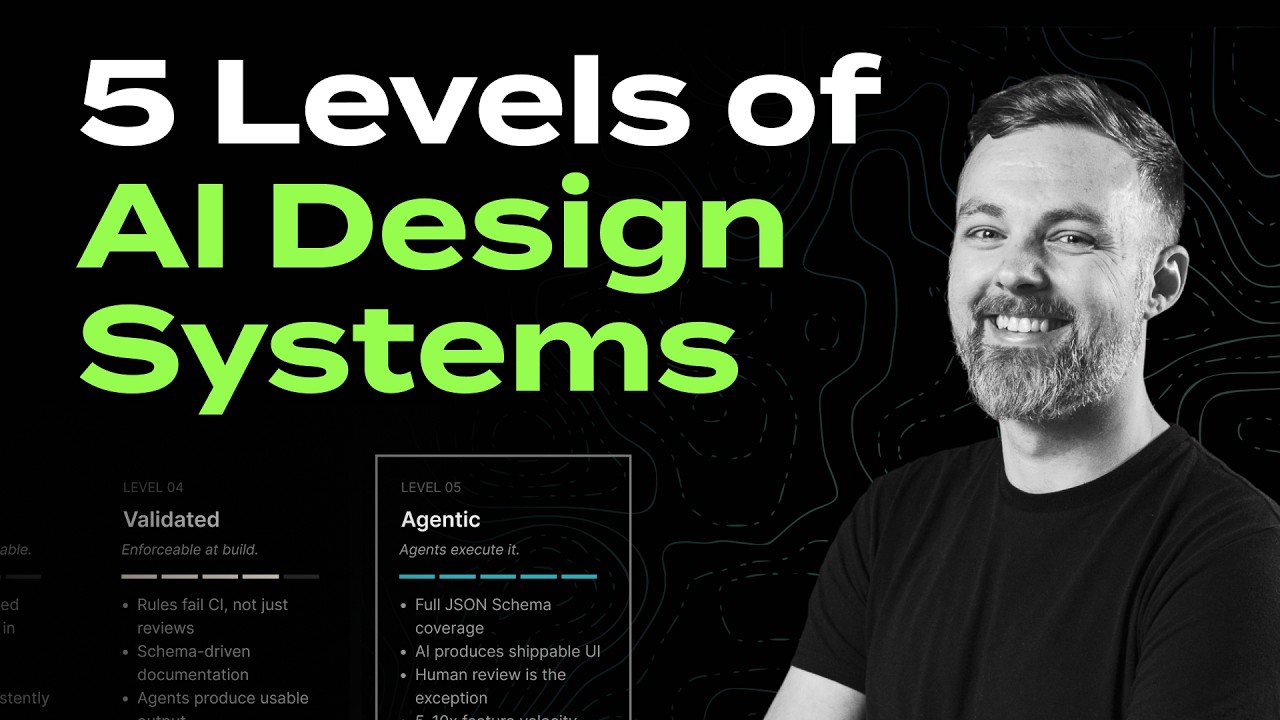
In this presentation, Nick Kugelman outlines a five‑stage maturity model for design systems, describing how teams evolve from early, ad‑hoc collections of copy‑and‑paste components to fully agentic systems powered by AI. The stages are: (1) Ad Hoc – fragmented components with little reuse; (2) Cataloged – a basic Figma library and token set, but limited composability and code‑design parity; (3) Structured – aligned Figma and code, a solid token architecture, basic governance and consistent human shipping; (4) Validated – CI integration, schema‑driven documentation, agents that can produce usable outputs and detect drift; (5) Fully Agentic – complete JSON schema coverage, AI‑generated UI shipped automatically with human review focused on high‑priority work. The speaker notes most teams sit at level 3, moving toward level 4, and explains how AI‑driven tooling (Design MD, agents.md routing, linters, etc.) augments each layer to create an end‑to‑end agentic workflow.
Chapters
we want to kind of take a look at where your system is. We have these early ad hoc systems where it might be a little copy and paste components. It doesn't sound like a whole bunch of folks are in this early phase, right? A lot of engineers might be building from scratch. And then we kind of have like the catalog system here. We have maybe a Figma library that exists. Components might not be super composable. We might have some variables and tokens established. Code might be a little disconnected, right? We might not be leveraging things like Code Connect or they might not be in parity, like property names might not be in parity, things like that. We might be on the structured side where Figma and code is aligned. The token architecture is in place. We've got some basic governance. Humans are shipping consistently. Then we have kind of level 4, which is the validated where roles, rules fail, CI. It's not just reviews. Schema-driven documentation, agents will be able to produce a usable output and we're able to catch that drift. And the final stage is really like that full, full agentic where we have full JSON schema coverage, AI's providing shippable UI, humans really reviewing, reviewing the work and really maybe even as reviewing just really high, you know, high priority work and not everything, you know, maybe there's lower priority work that's being shipped just automatically. Most teams kind of identify in this cataloged or structured, I'd say based on the poll that we had, everyone's probably like level 3, maybe starting to move into level 4. And, and so this is where we end up talking to a lot of teams and kind of where, where they are in the current, in the current process. Now with AI kind of touching everything, there's really this part of a new— the, the newer design system is this additional tooling that really helps us connect these automated dots, right? And it's happening at every layer across our, our design system, right? All the way down to the primitive level where we might have like a Design MD that's helping us generate or helping us maintain the context of tokens across various different tools. We're definitely gonna have updates to our agents.md file that's gonna help with routing and choosing the right things. We might have some linter tools that's gonna help design files become found— structured elements that catch any mistakes in the design file before we hand that over. So really there's a lot of things that are being touched in the design system that really builds up this agentic workflow.