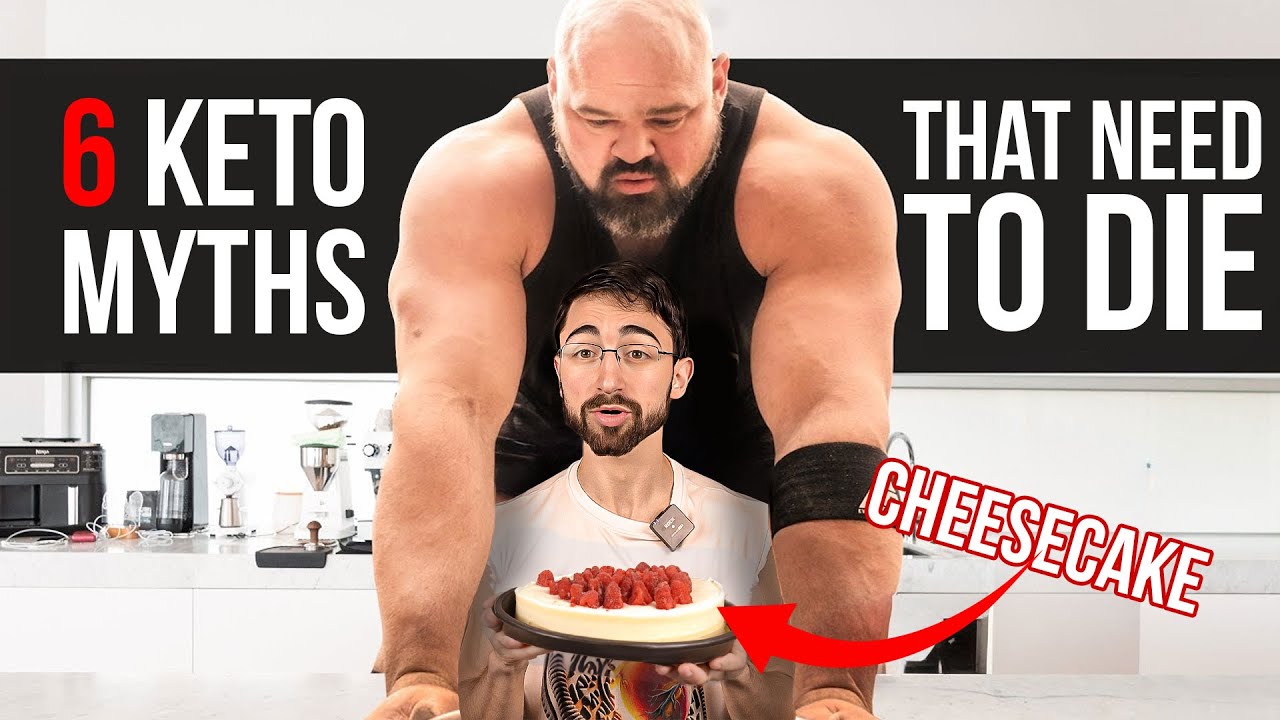
In this 27‑minute monologue, Nick Norwitz revisits six widely‑circulated misconceptions about ketogenic diets, offering nuanced, evidence‑based rebuttals. He begins by noting his prior “12 myths” video was well‑received for its moderate stance, and he aims to apply the same balanced approach here. 1. Athletes need carbs – Norwitz distinguishes between elite‑level performance (where carbs can aid record‑breaking) and the physiological needs of the average recreational athlete, arguing that once fat‑adapted the body does not require carbohydrates for reasonable athletic function. He uses strongman Brian Shaw as a counter‑example of a high‑carb, high‑calorie athlete. 2. Keto is unsustainable – He challenges the blanket claim, pointing out many people sustain keto for years. He reframes “unsustainable” as a self‑fulfilling prophecy, emphasizing community, messaging, and environment as key determinants of long‑term adherence. 3. Keto and longevity – Norwitz critiques the poor quality of human diet‑longevity data, noting the limitations of observational studies and animal models. He argues that no solid evidence links keto to longer or shorter lifespan; instead, overall metabolic health, social connection, purpose, and stress management are far more influential. 4. Lean‑mass hyper‑responders (LMHR) are “bad” – He explains the LMHR phenotype (lean, insulin‑sensitive individuals who on low‑carb diets exhibit very high LDL, high HDL, low triglycerides) as a distinct physiological response, not equivalent to familial hypercholesterolemia. LDL must be interpreted in the broader clinical context; a high LDL in LMHR does not automatically imply cardiovascular risk. 5. Keto screws up the thyroid – Norwitz clarifies that keto often lowers free T3 while leaving TSH normal, a pattern consistent with “sick‑euthyroid” rather than true hypothyroidism. He stresses that diagnosis requires symptoms and elevated TSH; low T3 alone on a low‑carb diet does not indicate thyroid disease, and basal metabolic rate often remains normal or elevated. 6. There is a single “ketogenic diet” – He argues that “ketogenic” refers to the metabolic state of ketosis, not a specific macronutrient recipe. Thresholds vary by individual size, activity, and composition; any diet (vegan, Mediterranean, etc.) that raises blood ketones qualifies. Throughout, Norwitz adopts a conversational, measured tone, repeatedly urging viewers to stay curious, consider individual variability, and focus on supportive environments rather than dogmatic rules.
Chapters
This video is going to be an unexpected sequel to a prior video I did on 12 myths, misperceptions, and false equivalencies. I'll just say when I put that video out, which is a 27-minute video of me rambling about things I call false equivalencies, X doesn't equal Y, I thought it would flop. I thought people would be like, you're fence-sitting, Nick, you're being too moderate, this is boring. To my surprise, people really liked it. They liked that I was being nuanced and somehow that was provocative, that I wasn't willing to just take a hard stance left or right. And so I thought I'd follow it up with something that I call 6 Keto Myths That Need to Die. You'll see actually when we start to unpack it, there's pretty moderate nuanced positions on these 6 myths. So let's start with myth number 1: athletes need carbs. This was inspired by a recent video I did that athletes don't need carbs. And obviously the response you're going to get is, oh well, show me the top athlete in sport X that doesn't eat carbs. When I say don't need carbs, I'm talking need as in, does your average recreational athlete need carbohydrates once they're fat adapted to perform reasonably well and live an active, full, healthy lifestyle? I'm not talking about, you know, benefits that can be accrued by including carbohydrates in your diet in particular sports in order to perform at the highest level. So if you redefine need as need in order to win an Olympic gold in sport X or world strongman competition, then yeah, I guess you do need, but we're talking about different needs. So the counterexample I often give is that of Brian Shaw, a world strongman winner who is 445 pounds, 6 foot 8, and he has a habit of eating cheesecake dipped in ice cream for his evening snack. He's eating over 10,000 calories a day. Actually, the videos of what he eats in a day are really entertaining to watch. I've gone down a rabbit hole on that. The point being, like, Yeah, if you're Brian Shaw trying to break world records in strongman, definitely get those carbs for growth. You're gonna have a really hard time as a homo sapien ballooning up to 445 pounds without including some carbs in your diet. So if that's your goal, then by all means eat carbs. But does the human body physiologically need carbohydrates in order to perform reasonably well athletically? No. Do you need carbohydrates to break world records in certain sports? Sure. But just take this in context, like what is the pro and con of you eating carbohydrates? I'm not saying don't eat carbohydrates if you're an athlete by any means. I'm just saying the human body doesn't physiologically need it. Seems pretty reasonable, right? Let's go on. Myth 2: Keto is unsustainable. Yeah, this is kind of one that's a little bit tired, so sorry for taking an extra whack at it, but I think it's one always worth bringing up because it's such an easily falsifiable statement. Unsustainable translates to, literally is defined as, a person can't sustain it. I know dozens, hundreds of people who have sustained ketogenic diets for years, some over a decade. So at what point does it become unsustainable? What people are really trying to say is most people don't sustain it. So unsustainable is not equal to or implies anything about the proportion of people who are able to sustain it over the longer term. And even if you make the argument most people don't sustain it, then yeah, but what are we really trying to discover here? Like, what is the useful bit to take out of this? Is there something special about those who sustain it? Are they just super willed? Or is there something else? I like to take the example of my friend Dave Danna, who went from over 400 pounds to now around 250, has turned his life upside down by sustaining a low-carb diet. It's been a huge positive impact on his life. Now, is he special because he is super willed? Or is there something else about his person, his personality, his environment, his community that allows him to sustain it? In my opinion, the hardest thing about dietary adherence, keto or otherwise, has to do with community and the messaging and the environment that we provide people. If you say something is unsustainable, you generate a self-fulfilling prophecy by which someone will fail. You need to give them a supportive community saying, you can do this, and here are resources in terms of education, social support, and otherwise that will enable you to maximize your chances of success. So, I really dislike the term unsustainable because it just sets the foundation to promote failure, rather than saying, "This is sustainable, it might be hard, and here are the variables that will allow you to maximize your chances of success." I think that's the conversation we need to be having. So, that's myth 2. Moving on. Myth 3: A ketogenic diet is good or bad for longevity. 50,000-foot view here: the data on diet and longevity in humans is more or less trash, in my opinion. You can look at large-scale population studies, but even there, the dietary records are quite poor, and you're never going to do an RCT for diet alone. So we have to move to understanding, you know, biomarkers for longevity and maybe even animal models. But those have really limited translatability to humans. So I can cite papers suggesting that ketogenic diets expand longevity in mice. I don't know how much that's translatable to humans. And the headlines about things like ketogenic diet— there was one headline recently, huge global studies find low-carb or keto diets could shorten lifespan. Obviously very sensational headline. You dig into the literature on it and it's a population study in which the lowest quintile of carbohydrate intake was 37% kcal from carbs. That is equivalent to a Burger King Whopper and fries. So they take that kind of literature and they skew it into these misleading headlines. Keto-like diet or keto diet, you know, promotes death. It's absurd. Bottom line is there aren't good data for diet and longevity. So I think you should just eat whatever diet optimizes your metabolic health and your quality of life in order to, you know, promote healthy lifespan and healthy living for as long as you're going to be around, which is determined by a lot more than just diet. In fact, I find it interesting. The one common feature I see among those people who are interviewed that live to say like 115, you ask them, you know, what's the secret to longevity? And they'll usually joke about something like, oh, it's cigarettes, or cake, this is— or bacon, you know. Obviously they're, they're making light of it, but something that I think that reveals, and something that I think is a common feature about people who live to a really, really old age, isn't diet, but it's social connection, purpose, and also not taking life too seriously. That's my opinion. I'll table that for now. But let's hit myth number 4 about my favorite topic, lean mass hyperresponders. For those of you who follow me, I apologize. I know I must sound like a broken record coming back and back to topic over and over again, but it's one about which there is a lot of confusion. Lean mass hyperresponders are those people who tend to be lean and insulin sensitive that when they go low carb see massive increases in LDL along with massive increases in HDL and low triglycerides. And I posit, we posit, those of us studying lean mass hyperresponders, that this is a distinct phenotype with a distinct etiology, distinct cause, pathology, or not pathology, let's say physiology, because I don't actually know that it's pathogenic. As compared to other cases of high LDL. And I think that needs to be a foundational starting point. And so one thing Simon asked point blank was, can we stick to one thing first? I had a bunch of topics I wanted to cover with him. Happy to get to all of it. Hopefully we're actually going to be having a conversation in person in May when he comes to Boston. I look forward to that. So he asks, you're of the viewpoint that people who meet lean mass hyper-responder classifications, presumably lean people, high LDL, high high HDL, low triglycerides on low-carb diets are different to people with high LDL, LDL-C, LDL cholesterol that don't have other traditional cardiovascular, CV, risk factors? And I'm going to say yes. I'll say it again, yes. This is so important, so foundational. The point that we try to make is that LDL cholesterol needs to be taken in the broader context of the individual person, in their entire clinical picture, not as an isolated variable. And I think this often gets confused. I see it get confused by Simon— forgive me, Simon— Peter Attia and others who think we're making some case about something like— I think the way Peter said it is that, you know, high HDL and low trigs are protective. It's not that they're protective, it's that they might give insight into what's going on physiologically And so I like to take a step back and compare lean mass hyperresponders to the only other group of people who have LDL at that level above 200, 300, 400, 500, which is hypercholesterolemia, familial hypercholesterolemia specifically, with a genetic etiology, something that you're born with. It's a congenital defect in lipid metabolism driving up your LDL cholesterol. And this is different. If you have a broken lipid receptor, it's different than having somebody who's having a metabolic response to carbohydrate restriction. And you can see some of the differences here demonstrated on this slide that I've made. But point being, it's not that the marker in and of itself is not important if everything else is quote clean. It's that the marker needs to be taken into context of the underlying physiology. And if that physiology— we have reason to believe that physiology is different in Population X, lean mass hyperresponders, versus Population Y, mixed diet populations., then it will be inappropriate to conclude something about Population X based on Population Y data. The analogy that I've come to a few times is that of, say, height. There are different reasons you can be tall. You can be 6'5", maybe playing in the NBA because you have tall parents. It's one reason to be tall. You can be 6'5" because you have a pituitary adenoma secreting growth hormone. And the consequences of the underlying physiology leading to that 6'5" is going to be different if you just have tall parents versus if you have a brain tumor. And that should be pretty obvious. We shouldn't conclude that there's going to be the same outcome when there's different underlying physiology that converge on a similar marker. So I hope that's cleared up. Finally. I feel like I've been beating this horse to death repeatedly. But anyway, that's myth number 4. I'm going to move on. Myth number 5 is that keto screws up the thyroid. Now, what keto does do is lower free T3 and T3 levels. T3 is active thyroid hormone, so a lot of people conclude from this, oh, keto is screwing up your thyroid. That is incorrect. So hypothyroidism is defined by generally, um, high TSH. So the feedback mechanism whereby T3 feeds back, it should suppress TSH. And if you have hypothyroidism, TSH should go up in order to try to stimulate more thyroid hormone. There's something else called sicku thyroid, which is where TSH can be normal and you can have low thyroid hormone because you're in a critically ill condition or you have, say, an eating disorder like anorexia and your body is trying to conserve energy. So there's decreased conversion to active thyroid hormone downstream. And you can have normal TSH with low T3. But even in that case, you have sequelae of low thyroid activity. So if you're hypothyroid, You might have hypothyroid symptoms, decreased basal metabolic rate, your hair falling out. There's a lot of signs of hypothyroidism. Mixed edema. Just having low T3, a normal TSH, and otherwise a completely normal non-symptomatic profile does not qualify as hypothyroidism. So then you have to ask the question, well, why is the thyroid low? Well, there can be better thyroid sensitivity and also decreased demand. Thyroid's involved in carbohydrate metabolism. So if you have fewer carbohydrates going into the system, you actually need less thyroid hormone combined with potential increases in thyroid hormone sensitivity. So it's completely inappropriate to say just because T3 is low in a low-carb context that you're hypothyroid. In fact, often if you looked at basal metabolic rate in people who are keto, even when their T3 is low, basal metabolic rate and energy expenditure, total energy expenditure will be normal or sometimes even elevated. So for me, my T3 runs really low. But if I feed way above my estimated caloric needs, say take my Harris-Benedict calculated basal metabolic rate plus my activity and eat way above that, as I've shown before, I don't gain weight. I expend a lot of energy. So symptomatically, clinically, I'm not at all hypothyroid despite having a low T3. So anyway, hopefully that's clear. I don't think in most cases keto screws up thyroid. In some cases, possibly. I never exclude those possibilities. But I think in most cases there's confusion about how you diagnose hypothyroidism, and that requires some symptomology of hypothyroidism. If you don't have that, you have a normal TSH and a low T3 and you're low carb, you probably don't have hypothyroidism. Okay, moving on. Myth number 6 is that there is the ketogenic diet. Ketogenic diets are defined by ketosis. Ketosis is a metabolic state defined usually by ketone levels above 0.5 millimoles in the blood, although you can generate different thresholds. Point being, it's a metabolic state not defined by any particular diet, not defined by a carbohydrate threshold or dietary composition. I recently got into it with one commenter who was saying, you know, in ultra runners, 80 grams of carbohydrates isn't a keto diet. And I'm saying, well, when your activity level is that high, yeah, 80 grams of carbs is keto because you're going into ketosis because you're burning those carbs. And then relying more on fat as fuel, generating ketone bodies. You're going into ketosis. That's not disputable. If your ketone levels go up, you're on a ketogenic diet, unless it's maybe diabetic ketoacidosis. Provided, let's say, you have a normal metabolism, then if your ketone levels are going up and you're eating low carb, generally low carb— there isn't a particular threshold that defines what a ketogenic diet is. We like to have these heuristics, something like 20 grams of carbs per day, to help inform the lifestyles for the average person that would result in the metabolic state But the metabolic state is what defines a ketogenic diet. So you have to take into account the individual, their activity levels, their size. 50 grams of carbs for me, even at the same activity level, is not the same as 50 grams of carbs for Sean Baker, who is twice my size. He just has more muscle mass to suck up the carbs. So we're going to have different results in terms of our carbohydrate threshold. And also dietary composition. People get this idea in their mind that a ketogenic diet needs to include things like meat and eggs, which it can. Personally, I think those are healthy foods, but a ketogenic diet isn't defined by them. You can do it with any dietary composition you want, provided it's low enough in carbohydrates to get you above, you know, a certain threshold in terms of ketone generation and ketone utility, usually measured by ketone levels in your bloodstream. So you can do it vegan, vegetarian, pescatarian, Mediterranean, whatever you want to do it, whatever works for you. Bottom line, there is no the ketogenic diet. Ketosis is a metabolic state. And a ketogenic diet is whatever diet gets you into that metabolic state. Okay, those are our 6 for the day. Let me know what other myths you'd like me to chat about. I kind of find this fun. Let me know your thoughts on this video. And as always, stay curious and have a lovely spring.