A Deep Dive into Sleep, Light and Mitochondria (with a Surprise)
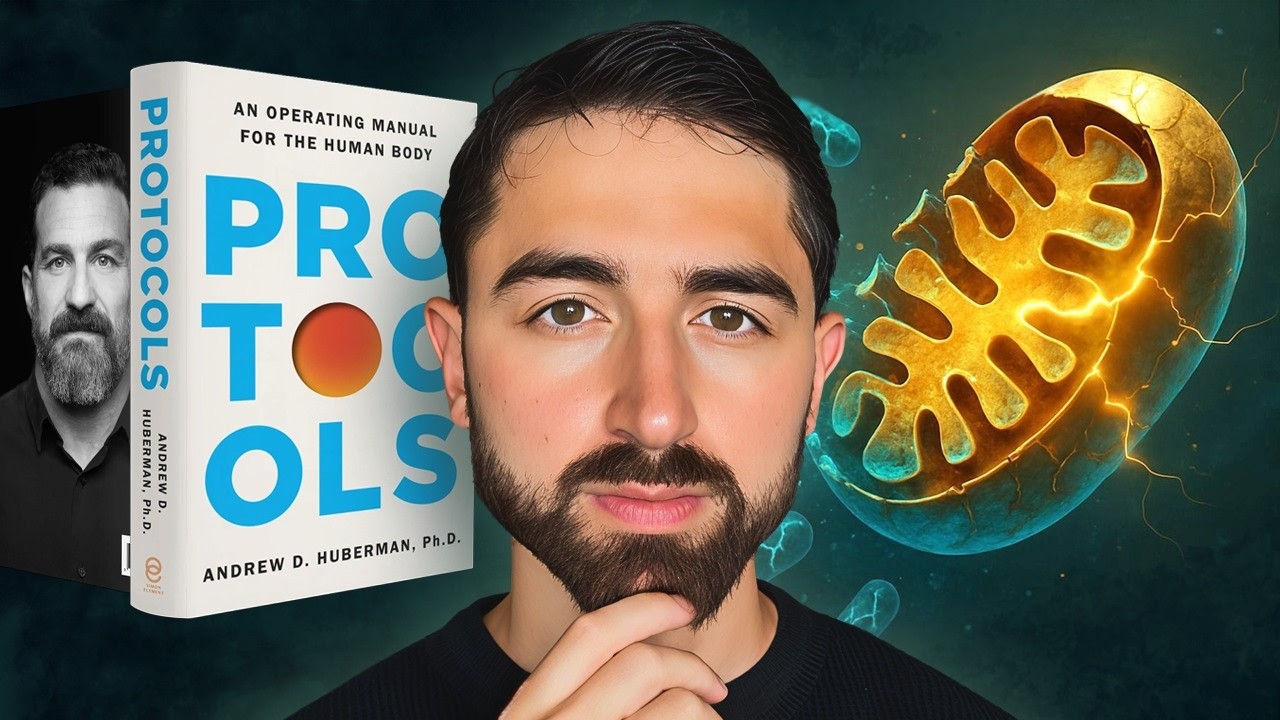
A 2025 Nature study shows wakefulness fragments mitochondria while sleep fuses them, and blue light exposure damages retinal mitochondria and disrupts sleep. Five practical fixes: 10-15 minutes of morning sunlight, red-shifted evening light, embrace sunset, blackout your bedroom, and keep a consistent sleep schedule.
Chapters
This video is going to be something special. Yes, we're going to cover new 2025 data in a top journal, Nature, about sleep, light, and mitochondrial health, and yes, I'll give you some practical tips on the topic matter that you can use in your real life, but it's also going to include a teaser and a giveaway, one that you'll want to stick around for. But let's now fuse into our lesson, starting with a high-level point. The sun is our oldest biological partner. It does more than warm our skin or grow our food. Its relationship to metabolism goes far deeper. Light interacts with the trillions of mitochondria scattered throughout our body and our brains. And when it does so, light sets in motion a metabolic dance, a rhythm of fusion and fragmentation of mitochondria that underlies everything from energy production to sleep regulation. If you get the dance right, the timing right, the choreography right, the dance flows. If you get it wrong, you step on your own metabolic toes. So today we're exploring how light influences mitochondrial behavior starting in the brain and then extending out of the skull, extruding out of the skull with your eyes. So let's get into it. A recent paper published in the journal Nature reframes how we understand sleep pressure, the biological drive to sleep that builds up the longer we're awake. And it's not just through the hormone melatonin, but through mitochondrial choreography. The researchers found that waking and sleeping— sleep drive— they engage opposite mitochondrial behaviors, an epic dance between fusion and fission, merging and fragmentation, subcellular events that ebb and flow with day-night cycles. And this isn't just passive biology or correlation.— it's active regulation of sleep itself. In fact, when researchers artificially manipulated these mitochondrial states, fusion and fission, in animals, they were able to alter sleep patterns, alter sleep drive. So why does this matter? Why does this mitochondrial dance matter? Well, fusion promotes the sharing of resources throughout mitochondrial networks and helps maintain metabolic energy efficiency. And fission, fragmentation, on the other hand, allows cells to isolate and remove damaged portions of mitochondria. These processes are both essential, but they must happen at the right times and in the right balance. This rhythmic dance of mitochondrial remodeling may be the very reason we evolved sleep in the first place. The authors of this paper write, "Power-hungry nervous systems appeared, and with them, apparently, the need for sleep. Sleep serves an ancient metabolic purpose. So yes, sleep restores your brain and consolidates memories, but at its core, sleep may exist to manage mitochondrial health. Pretty fascinating, isn't it? Now let's extrude from the brain to the eyes. In another study, researchers exposed mice to high-energy blue light over long periods of time, To study the effects on mitochondrial dynamics—fusion and fission—in the retina directly exposed to light. And quickly, before you criticize this for being a mouse study, ask yourself whether you want to let scientists harvest your eyeballs for their next publication. How about it? Didn't think so. Anyway, the results: blue light tipped the balance towards fragmentation, leading to ultimately increased oxidative stress, mitochondrial dysfunction, and severe retinal thinning. This wasn't subtle— mice exposed to chronic blue light showed measurable thinning and damage of their retinas. Mechanistically, again, this came down to protein regulation imbalance between fusion and fission. Blue light increased levels of fission-promoting proteins, Drp1 and Oma1, and decreased levels of fusion-related proteins, skewing dynamics towards fission and fragmentation. And this also led to an accumulation of reactive oxygen species. You can see that here in red. The red is showing oxidative stress and damage to the retina. And over time, in humans, this damage and blue wavelengths can contribute to ocular diseases like age-related macular degeneration, in addition to interfering with melatonin rhythms and throwing your sleep and metabolic health off balance. The punchline? Disrupt the mitochondrial dance in your eyes and the whole system may miss a beat. Now, to connect the dots, er, sort of, you might be asking now, how does blue light exposure in the eye, or light exposure in the eye, affect mitochondrial function, fusion and fission, in the brain? The answer is it doesn't directly connect. It's not a cause-effect relationship whereby mitochondrial fragmentation in the eye causes the same in the brain. Rather, it's about a shared, common metabolic underpinning. This isn't like a wildfire spreading from organ to organ, eye to brain. It's more like a serial arsonist setting separate metabolic fires in different places—eye and brain—but driven by the same mismatch: light exposure at the wrong time of day, the wrong intensity, and/or the wrong wavelength. Does that make sense? The takeaway here: this isn't about fear. I'm not trying to fearmonger. It's about awe and respect for biology. Mitochondria aren't just energy factories; they're sensitive, responsive, and tuned to the sun. They've been dancing with light for billions of years, and we're just beginning to understand that choreography. Seriously, I'm not here to scare you. But awe and the humility that inspires? Can be powerful levers for behavior change. So now let's discuss some tips that aren't revolutionary, but perhaps you'll now see them in a new light. Get it? All right. First, get natural light early in the day. Morning sunlight. Morning sunlight is a biological cue that you can think of as setting your circadian rhythm into motion, telling your mitochondria it's time to start the dance, to fuse, move, and produce energy. Even 10 to 15 minutes of sunlight in the morning within the first hour of waking can help align your system, get the dance off to the right start. Moving on, tip 2: reduce blue light exposure, especially at night, and reduce exposure to LED lights. These emit high levels of blue light as well, and this promotes mitochondrial fragmentation and suppresses melatonin. So you can use red-shifted night modes. Dim lighting, candlelight, or blue-blocking glasses after sundown, especially in the hours before you sleep. 3. Embrace sunset and dusk light. Evening light, as the sun's going down, has a different wavelength profile than, say, midday light. It has less blue and more red and orange. You can see this if you're looking at a sunrise or a sunset. Getting outside during sunset helps wind down your circadian and mitochondrial rhythms naturally. It's not just a vibe, It's a biological signal. And as a nuance note on this matter, because this is really interesting and important, again, light at different times of day produces different biological effects. It comes down to the sun's position in the sky. When the sun is directly overhead, say at noon, you're exposed to higher concentrations of blue light, short wavelength light that penetrates the atmosphere and enters your eyes more easily and The cells in your eyes that kind of detect time and are responsive to setting your circadian rhythm, they're very sensitive to this light. In contrast, during sunrise or sunset, when the sun sits low on the horizon, or what's called low solar angle, these blue wavelengths are relatively scattered by the atmosphere, leaving your eyes to absorb relatively more red and orange hues instead of blue hues. Again, this matters because your retinal ganglion cells, the ones responsible for setting your internal clock, are especially sensitive sensitive to blue light. All this means your body registers morning, noon, and evening lights differently and responds accordingly. Your eyes aren't just seeing, they're keeping time. Isn't that cool? All right, moving on. 4. Let darkness be dark. At night, avoid overhead lighting and keep your bedroom as dark as possible. Invest in blackout shades, probably the cheapest biohack you can get. And even low levels of light, they can alter mitochondrial behavior and sleep timing. So if you can't get blackout shades, at least get eye covers. Darkness isn't just for sleep, it's a mitochondrial signal. And 5, respect rhythm on the weekends. Try not to drastically shift your sleep-wake timing on the weekends. Social jet lag can confuse mitochondrial dynamics in the same way real jet lag does. So consistency is key. Even a 1 to 2 hour shift matters. So if you get up and sleep at 10 PM and 5:30 AM, I guess the other way around, you get up at 5:30 and go to sleep at 10 on the weekdays, try to do that within an hour on the weekends. Hopefully that makes sense. But the punchline to all of this, you're not just living with light, you are metabolically dancing with it. Now, wrapping up, I didn't mention a special giveaway. Well, I want to give some credit where it's due. Some of the insights in this video and in the more elaborate newsletter, which you can find at staycuriousmetabolism.com and linked below, are inspired by Dr. Andrew Huberman's upcoming book, Protocols: An Operating Manual to the Human Body. Chapter 1 is actually on light and sleep, and I was in the process of reviewing it and commenting on it when this new Nature paper came out. Talk about choreographed timing. Anyway, I know what a monster project this has been for Andrew. Sincerely, and I kid you not when I say this, Chapter 1 was 125 pages, 12-point Times New Roman font, not including the references. This is really a Herculean effort by Andrew, and I'm happy and privileged to support it. So to that end, I'm doing a pre-order giveaway of my own initiative. If you're subscribed, free or paid, to the Stay Curious Metabolism newsletter and here on this channel, you can see the link below for the newsletter, drop a comment there at the newsletter and here, and you'll be entered to win a free copy of Protocols on pre-order on my dime. Andrew did not plant this idea, it is all me. Because people lifting each other up, that's what we do here on this channel. Also at the newsletter, you'll find more information on light and mental health and an exclusive Q&A with the first author of the Nature paper who coincidentally, a lot of coincidences here, is at the same department at Oxford where I got my PhD. Small world, right? So check it out. Stay curious. Thank you. And thank you for your interest in science. Peace.










