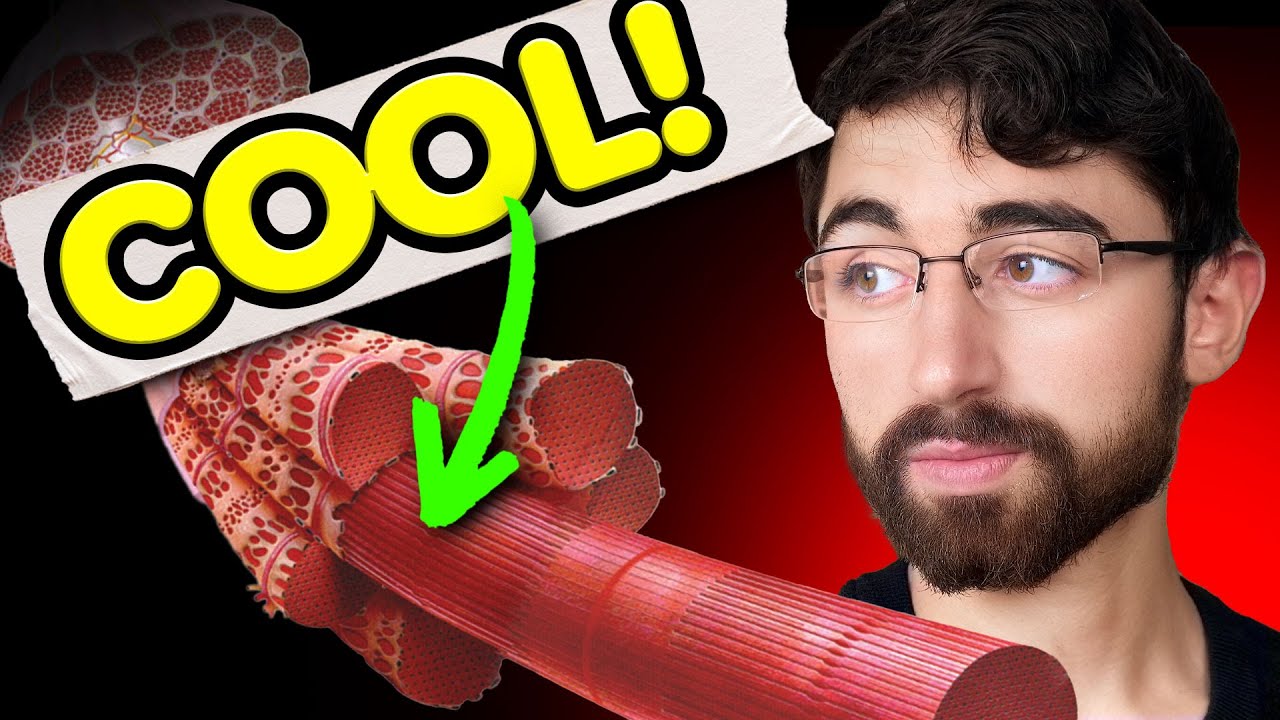
In this concise educational video, the presenter shares five key insights about muscle and exercise, building on inspiration from a Huberman Lab podcast episode with Dr. Gabrielle Lyon. The first point emphasizes that muscle quantity does not equal muscle quality; functional capacity, intramuscular triglyceride content, and endocrine roles matter more than sheer size. The second explains muscle’s role as the body’s largest glucose sink, detailing how exercise‑induced AMPK signaling moves GLUT4 transporters to the cell surface independently of insulin and also enhances insulin sensitivity, thereby stabilizing blood sugar and even supporting ketosis after targeted carbohydrate intake. The third discusses protein bioavailability, highlighting emerging pre‑clinical evidence that gut microbiome composition creates individual differences in amino‑acid absorption, which can affect serum amino‑acid profiles and downstream signaling molecules such as serotonin, influencing metabolism and glucose homeostasis. The fourth addresses exercise and longevity, noting a recent 2024 Nature Aging study showing that just one hour of vigorous activity for four days reduces BMP lipid levels, a newly identified lipid biomarker of aging. The fifth delves into the thermic effect of food, introducing the TUG protein anchor that, when cleaved during glucose transporter translocation, releases a C‑terminal fragment that enters the nucleus and activates PPAR/PGC‑1α signaling, boosting mitochondrial biogenesis and thermogenesis; this effect is further modulated by baseline insulin sensitivity. The video concludes with a call for viewers to rate the novelty of these facts, a gratitude note to the podcast guests, and an invitation for mutual learning.
Chapters
Here are 5 things you should really know about muscle and exercise. But before I get on to the meat of this video, I just want to give some acknowledgement to what inspired it, which was I listened to a brilliant episode of the Huberman Lab podcast with Dr. Gabrielle Lyon, who I've gotten to know over the past week, and she's really fantastic. I have her book here, which I'll admit I haven't read, but I'm excited to read. So I want to plug that episode. It's linked below because it was a fantastic listen. I learned a lot. But with With that, I wanted to add my own little amendment, really cool things that you really should know about muscle. So here we go. Welcome to my channel. Stay curious. The first of these facts is that lots of muscle does not equal lots of good muscle. And what this is meant to highlight is that muscle is about more than just the size, the amount, the mass of the muscle you have, but its functionality. Otherwise stated, it's more about functionality than it is about flex. So you can think of muscle at a superficial level as being kind of like maybe, you know, a lean filet mignon that is, you know, mostly just the muscle tissue versus something like an A5 Kobe steak, which is really delicious. Albeit delicious, it's quite fatty and not as functional. So you can think about muscle at that level, like how much intramuscular triglycerides are there. But there's another level to think about it as well, because muscle isn't just —there to help you lift heavy objects. It's an endocrine organ that secretes hormones. It's a glucose sink. So in thinking about your muscle functionality and how much good muscle you have, we have to think about all these components. How much intramuscular triglyceride is there? What are the endocrine functions of muscle and how is it working for you in your body? And we can start to suss these out by looking at proxies. But the high-level point I want to make here is that lots of muscle does not equal lots of good muscle. And when thinking about your musculature and what's optimal, we have to go beyond beyond just looking at size, looking in the mirror to evaluate how good your muscle is. All right, hitting number 2 has to do with muscle as a glucose sink. Muscle contractions can support increased glucose sinking, sinking that sugar out of your blood into your musculature. And it's important to recognize muscle is the biggest reservoir for glycogen in the body and the biggest, therefore, sink for glucose circulating through your bloodstream. So if you have more healthy muscle tissue, you can sink more glucose and you can have more stable blood sugar levels. But there's an added layer here, which is normally the way we think about it is your muscle cells have these transporters, these GLUT4 transporters, that are mostly hidden inside the muscle cell, and they need to be at the surface to transport glucose from the blood into the muscle cell, right? So what happens is insulin signals to the muscle cell, and that insulin signaling says, okay, we're going to put some GLUT4 transporters on the surface to sync the sugar that's now circulating around because you presumably ate something and now there's more sugar in your bloodstream. But there's also a mechanism by which muscle contractions via AMPK signaling go through an insulin-independent pathway to promote the translocation of these GLUT4 transporters to the surface. And separately from insulin-independent effects, the muscle contractions also enhance the sensitivity of the muscle to insulin. So it's a one-two punch, really, where exercise muscle contractions promote GLUT4 translocation to the muscle cell membrane in an insulin-independent manner and sensitize the muscles to insulin. Thus, when you do have carbohydrates and there's more sugar in your bloodstream, there's more GLUT4 transporters to sink the glucose, leaving you with more stable blood sugar. And if you're on a ketogenic or low-carb diet, can enhance or permit you to remain in ketosis despite having some carbs. I actually can do this myself, and I think a lot of people can do it. It's kind of an advanced dietary move, but once you learn about your personal carb thresholds, I, for example, I can have a banana and a half or a little bit of honey in a homemade halva and can stay in ketosis with BHB levels above 2 millimoles if I target my carbs specifically after a hard workout. Number 3 is on protein bioavailability. Now, you may have heard statements like animal protein is more bioavailable than plant protein, or maybe more specifically like egg protein is more bioavailable than peanut protein. And as a heuristic, this is true. But there's another layer here, which has to do with bio-individuality with respect to our microbiomes, based on new preclinical data in Cell Host and Microbe that are brilliant. And it makes sense on the surface of it that we as metaorganisms, human-microbe combined, metaorganisms, are very unique and the bugs in our guts get first-pass metabolism at anything we eat, including the amino acids that build up proteins, that compose proteins. And so if you have particular gut bugs that, say, process a particular amino acid, let's say tryptophan, more than someone else, then they get first pass at that tryptophan, and there's less tryptophan left over for your body. So it can affect serum levels of these amino acids, which is really interesting for a couple reasons. One, it means that any particular individual could have a different serum amino amino acid spectrum based on the microbes in their gut. And what's more, it's important to recognize amino acids, they're not just building blocks for proteins. It's not just about how much structural component there is for building your muscles, but they are also precursors to signaling molecules. The reason I chose tryptophan as a specific example is it's a precursor to serotonin, and serotonin is a hormone that has a whole host of impacts on your metabolism, including glucose homeostasis. So variations in your microbiome can affect things like glucose homeostasis via amino acid bioavailability, which I think is super cool and super trippy. Now, to be clear, this is mostly based on preclinical data right now, but you can see how our understanding about heterogeneity among humans is evolving in the protein space, which I think is really cool and exciting. Okay, with that, moving on. Number 4 has to do with exercise and longevity. Now, To be clear, I'm not gonna try to sell you some snake oil that exercise X is gonna make you live longer. We don't have those data. We may never have those data. But I think it's still very interesting to look at biomarkers of aging and see how different interventions, including exercises, can affect those biomarkers of aging. And one of these that was recently discovered is a class of lipid molecules called BMP lipids. And in a recent study in Nature Aging, this is a 2024 study, it was shown that just 1 hour a vigorous activity for even just 4 days can reduce BMP lipids, effectively reducing an aging biomarker, a lipid signature of aging, which I think is really cool. Now, for numbers 3 and number 4 in the list I'm going through today, I actually have separate videos that you should check out covering those data. So if you want a deeper dive into those, go check out those videos. But now I'm going to move on to number 5. Number 5 has to do with the thermic effect of food. This is something you may have heard about before, and it has to do with the idea that digesting protein takes more calories than digesting, say, fats or carbs. So it's led to the common knowledge that, say, for every 100 calories of protein you eat, you actually extract fewer calories for other uses because some is spent on digestion, leading people to say, oh, therefore calorie for calorie, protein is better for, say, body composition because you're burning calories from the calories that you would otherwise be gaining from the protein. Kind of makes sense, right? But the thermic effect of food is way more complex and I think way cooler. So let's go a level deeper, and I want to talk about something called TUG. TUG is the anchor. I mentioned earlier that glucose transporters are kind of held inside the muscle cell membrane. Well, TUG is the anchor that holds them there, and in order to move, the glucose transporter to the muscle cell membrane, you need to cut that anchor, cut the Tug. And the interesting thing about this Tug anchor is once it's cleaved, it doesn't just go into the ether. But you have the two components, the N-terminal and the C-terminal end, that's how proteins are labeled. And the C-terminal end of the Tug anchor, once it gets cleaved, goes into the cell's nucleus, into the muscle cell's nucleus, and signals via PPAR and PGC-1-alpha, which is the master regulator of mitochondrial biogenesis, it signals via that pathway to increase thermogenesis, the thermic effect of food, increasing heat expenditure and calorie burning. So there are really two major components of the thermic effect of food. That yes, protein digestion can cost more calories than say carb or fat digestion, but as an added layer to that, your baseline insulin sensitivity impacts the thermic effect of food such that if you're more insulin sensitive, which you consider a more chronic effect, you're gonna have a better thermic effect of food. So that's number 5, and I think that's super cool, and I'll link to some more information below. So I hope you thought these 5 facts were fun. Now what I want you to do is grade me in the comments. Tell me which of these 5 you actually knew, and you can express it as a novelty percentage. So 100% if all 5 were new to you, 80% if 4 were new to you, etc., etc. Let's see how many 100%s I can get, and tell me if you like the format of this video. And again, I just want to plug the Huberman and Gabrielle Lyon episode. I thought it was really great. I'm super excited to read her book. Nobody's paying me to promote this. I just genuinely want to promote other people in this space, and I really enjoyed listening to their conversation. So that's just an expression of gratitude for Andrew and Gabrielle and learning from other people in this space. And I hope you can learn from me and you can teach me, et cetera, et cetera. I love learning. I love teaching. I love talking, as you can tell, because I'm still talking. Anyway, now I'm gonna actually cut this video. Have a good day.