Episode 167: Nicholas Norwitz discusses a ketogenic diet as metabolic medicine
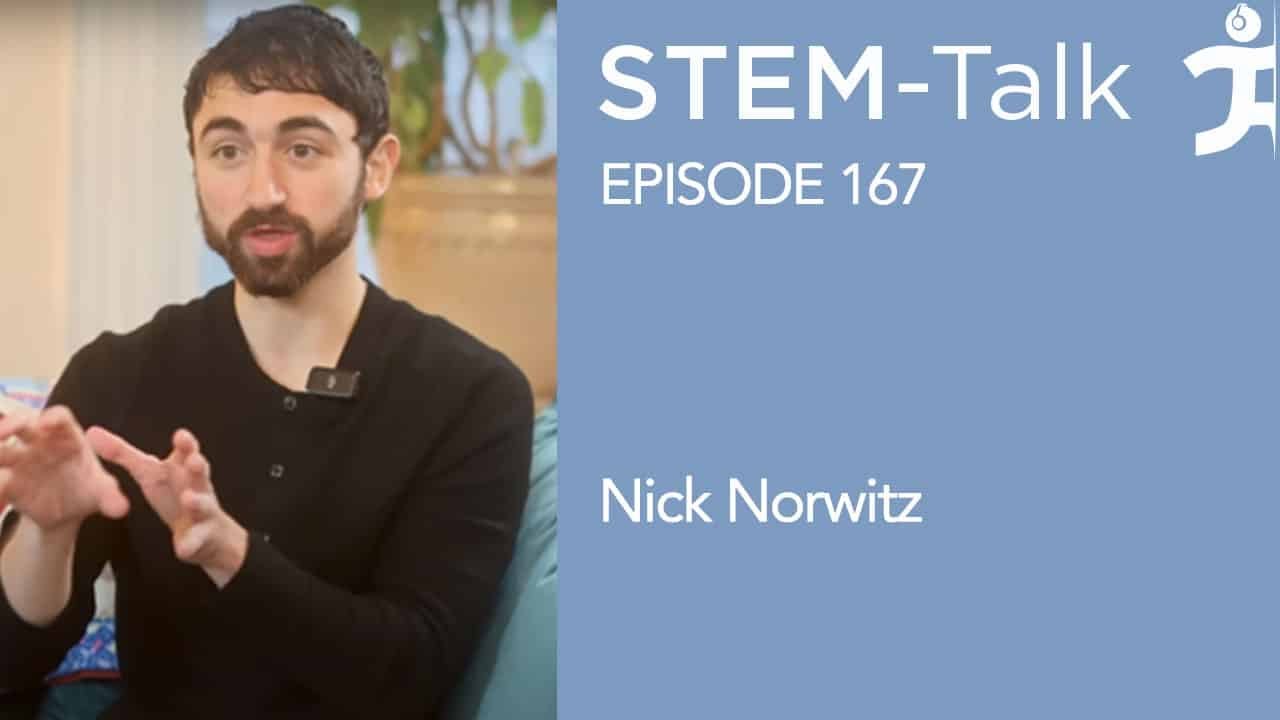
In this STEM Talk interview, 28‑year‑old Dr. Nicholas (Nick) Norwitz, a Harvard Medical School third‑year student and Oxford PhD, discusses his personal health journey and research on ketogenic diets as metabolic medicine. He recounts a childhood fascination with science, a high‑school marathon career, and a series of unexplained stress fractures that led to a diagnosis of severe osteoporosis linked to a rare LRP5 A745V mutation. While at Dartmouth he developed ulcerative colitis, which culminated in a life‑threatening flare during his early PhD at Oxford, landing him in a palliative‑care ward. Desperate for relief, he experimented with multiple diets before adopting a ketogenic diet in June 2019, which rapidly normalized his inflammatory markers and put his ulcerative colitis into remission. Nick then describes his discovery of the “lean‑mass hyper‑responder” (LMHR) lipid phenotype—very high LDL, very high HDL, and low triglycerides—that appears in metabolically healthy, insulin‑sensitive individuals on carbohydrate‑restricted diets. He outlines the lipid‑energy model that explains this triad as a consequence of massive free‑fatty‑acid flux to the liver, VLDL over‑production, rapid triglyceride removal (lower TG), VLDL shrinkage to LDL (higher LDL), and cholesterol transfer to HDL (higher HDL). He notes that BMI is a proxy for body‑fat composition in existing data, but argues that more precise measures (DEXA, visceral fat) would improve the model. To test a prediction of the model—that re‑introducing carbohydrates would sharply lower LDL—Nick designed an n=1 crossover study titled “Oreo cookie treatment lowers LDL cholesterol more than high‑intensity statin therapy in a lean‑mass hyper‑responder on a ketogenic diet.” After a ketogenic run‑in, his fasting LDL was 384 mg/dL; consuming 12 Oreo cookies per day for 16 days dropped LDL to 111 mg/dL (71% reduction). After a three‑month washout (LDL rebounded to ~421 mg/dL), a 6‑week course of 20 mg Crestor lowered LDL by only 32.5% (≈137 mg/dL). He emphasizes that the experiment was a provocative demonstration, not a dietary recommendation, and that the underlying mechanism aligns with the lipid‑energy model. The conversation also touches on broader issues: the dysfunction of current medical practice that treats symptoms rather than metabolic health, societal norms that normalize junk‑food incentives, the limited utility of BMI, the nuanced interpretation of LDL/HDL/ApoB in LMHRs versus familial hypercholesterolemia, and the challenges of advocating low‑carb approaches within conventional medicine. Nick reflects on his experience in medical school, noting that while his keto stance makes him a “quirky” figure, he feels supported by peers and uses his platform to promote metabolic health research. Overall, the episode blends personal narrative, mechanistic biochemistry, experimental methodology, and critique of nutrition science, illustrating how self‑experimentation and rigorous modeling can inform metabolic medicine.
Chapters
Welcome to STEM Talk.
STEM Talk.
STEM Talk. STEM Talk. STEM Talk. STEM Talk.
STEM Talk.
Welcome to STEM Talk, where we introduce you to fascinating people who passionately inhabit the scientific and technical frontiers of our society.
Hello, I'm your host, Marcus Bauman, and joining me to introduce today's podcast is the man behind the curtain, Dr. Ken Ford, IHMC's director and chairman of the double-secret selection committee that selects all of the guests who appear on STEM Talk.
Hello, Markus. Great to be here.
Today we have Dr. Nicholas Norwitz, who is one of our youngest guests to appear on STEM Talk. He's a 28-year-old third-year Harvard Medical School student whose research into the applications of a ketogenic diet as metabolic medicine has attracted significant attention lately.
In today's interview, we talked to Nick about how his research on nutrition and metabolic health led him to adopt a ketogenic diet, which has apparently reversed several of his chronic diseases.
After graduating from Dartmouth College in 2018 with a degree in cellular and molecular biology, Nick headed across the Atlantic to Oxford where he earned a PhD in metabolism and nutrition. He's the author of peer-reviewed scientific papers and textbook chapters on a wide range of topics.
We discuss Nick's research into lean mass hyperresponders, which is a group of people who exhibit elevated levels of LDL cholesterol in response to carbohydrate-restricted diets. This research led Nick to conduct a study and author a paper published in the journal Metabolites titled Oreo cookie treatment lowers LDL cholesterol more than high-intensity statin therapy in a lean mass hyper-responder on a ketogenic diet. But before we get to our interview with Nick, we have some housekeeping to take care of. First, we really appreciate all of you who have subscribed to STEM Talk, and we are especially appreciative of all the 5-star reviews.
As always, the double-secret selection committee has been continually and carefully reviewing iTunes, Google, Stitcher, and other podcast apps for the wittiest and most lavishly praise-filled reviews to read on STEM Talk. If you hear your review read on STEM Talk, just contact us at stemtalk@ihmc.us to claim your official STEM Talk t-shirt.
Today, our winning review comes to us from listener Keith G. Mills. The review reads, this podcast deserves more attention and a bigger spotlight, a locus of information and how we can use science to better our lives and better our understanding of the world.
Thank you, Keith, and thanks to all our other STEM Talk listeners who have helped make STEM Talk such a great success.
Okay, and now on to today's interview with Dr. Nicholas Norwitz. STEM Talk.
STEM Talk. STEM Talk. STEM Talk.
STEM Talk. Well, Nick, it's great to have you on the podcast here with Dr. Ken Ford and me. Uh, we'll jump right into it. I see you grew up in a suburb just outside of Boston and understand that as a child you were incredibly curious. Is that right?
Uh, I'd like to think so, and I've been told so. Yeah.
So what are some of the things you were interested in as a kid in terms of your curiosity?
I mean, basically everything science-related. I was the kind of kid that would go, you know, not just walking around in the woods, but walking around in the woods trying to find like dead animals to dissect. I actually got in a lot of trouble a few times for like taking dead snakes with little lumps in their belly and doing dissections with a butter knife because I couldn't reach the sharper knives on the kitchen table. Or we'd go on, you know, long car rides. My mom's family is from Buffalo, New York, so it'd be like 7-hour drives from Boston and a car game. We wouldn't play 20 Questions. We play like Stump Nick, where my siblings and my parents would have to ask questions science-related and see if they could stump me. And this was before the age of iPhones and stuff, so there was no looking things up. But I've always just been fascinated by the natural world, everything about it. And it's just what I get pleasure out of life, pleasure in pursuing. And I just feel really grateful right now to be able to make a kind of a career out of that. But I think that was always going to be my path.
So I understand as a young child, you always knew you wanted to be a physician and a scientist. Is that correct?
Pretty much. I mean, I was largely influenced by my parents who are both physicians. So it was in some ways the default path, I would say. You could even call it my null hypothesis in terms of a career choice. And then it was a matter of, as I was growing up, you know, testing that null, getting experience working with people in lots of different respects, be it being a camp counselor or shadowing people in clinics, and then exploring my scientific curiosities in ever more professional engagements. In college, obviously, I was in a lab and then went to do my PhD. And everything I've done with respect to science and medicine has just been an pleasure and helped me to evolve not only that interest and the skill sets, but, you know, start to differentiate and determine, you know, where in all of science and medicine do I really want to have my impact. And right now I'm kind of on the cusp of that. I'm in my late 20s, having finished up my PhD, and now in my third year of medical school. We actually just got, uh, my class emailed out about residency applications, so I got that code, and everybody's asking me. It's that period of time, you know, when you're in like high school, people's like, oh, where are you going to go to college? Now everybody's like, so where are you applying to residency? What are you going to do? And figuring that out and figuring out how I want to balance all the options in front of me in terms of research and clinical medicine and then public education, which is a new thing I never really thought about. It's really exciting. I'm at a high point in my life, I feel.
Well, you were a runner in high school, and I understand that you were doing marathons. And it sometimes happens with marathoners, you started developing fractures, but these didn't resolve. Can you talk about how this led to you coming to what might be thought of as a somewhat surprising discovery about yourself?
Yeah, so as I mentioned, I've always been, you know, loved to go down the rabbit hole and I've just been intrinsically motivated to try to dissect scientific curiosities. And I also loved to marathon run. And there was this curious thing that happened to me when I was in high school. It was 2014, so this was the year after the Boston bombings, which are in 2013, which I mean, the Boston Marathon was always my favorite sporting event of all time. I grew up watching it like as a little kid. I used to wait for the top runners to come around the bend and then try to sprint up next to them up Heartbreak Hill since I lived at the base of Heartbreak Hill, and it was always just like astonishing to me how their like human bodies after now hitting 16, 17 miles could go up that hill at like 15 miles per hour. They were gliding like ghosts, and it was just always fun for me as a kid every year to run and see how long I could stick with them, which was basically no time at all because they're superhuman. But that tangent aside, it was an event I always really wanted to do. So to run a major marathon, you need to be 18 years old. Boston's a major, and so if you want to run without having to raise a ton of money, you have to qualify, and the age category I wanted to qualify for was the 18-35, which is the one with the hardest qualifying time. Because I wanted to run it in 2014 when I'd be 18, I wanted to try to qualify at age 17. So I trained. I was a pretty decent runner at 17. I could run a 2:45 marathon and I qualified, which was great. And then I continued to train and up— the race was upcoming and I developed a fracture in my tibial plateau. And at the point in time It wasn't really surprising. I mean, I was a 17-year-old kid running 80, 100-mile weeks. Stress fractures happen, right? But the quirky thing was it didn't really heal quickly. Actually, it took a really long time to heal. And when I started to get back into running, I just started to get more and more fractures. And this is the curious thing, they happened at lower and lower mileage thresholds. So, my first year of running, I could run like 3,000 miles, right? No problem. Then I get a stress fracture. But then after that, I can't run even a 60-mile week without getting a stress fracture. Then I couldn't run a 40-mile week It got so bad that I ended up giving up really long-distance running because the injuries were getting so frustrating and went to triathlon. This was in college at Dartmouth and my friend, Brent, was the captain of the triathlon team. So, like, I'll do some sprint triathlons. It's your cross-training, there's not impact. My first race, I shattered a bone, a squarish bone in the middle of my foot. Literally, the bone just snapped in half. And that was during a 5K. So, that was something weird. I remember going to the doctor and he did the MRI on my foot. And he's like, wow, in 30 years of doing this, I've never seen someone break a bone like that. By that point in time, I've been asking for a bone density scan, but everybody had said no for years. They're like, no, no, you're a healthy young guy, normal testosterone, normal BMI. Like, your bone density is not going to be off. We're not going to get a DEXA scan. Just no indication. Lo and behold, finally got it. And my bone density was like cataclysmically low. My T-score and Z-score, which is the same thing because I was of that age, were -3.3 at the spine. And just, that's like, that's abysmally low. And on further imaging, I had fractures, like little ones all over my femur and my spine. And I was diagnosed, I clinically had osteoporosis. Osteoporosis as a young 20-year-old male who was an athlete, which to me was like, how did this happen? It was a big mystery that nobody really could figure out. I'm not sure it was completely ever figured out, but like I said, I love science and now I have more motivation than ever to figure out this particular curiosity. So in some of my free time, I started to dig and discovered I have a very, very, very rare mutation in a gene called LRP5. The explicit variant is LRP5A745V, alanine to valine point mutation. And I did digging. I looked at like, you know, comparative biology genome sequences across species, saw that it was conserved, looked at some of the mouse models because nobody at the time that I had been diagnosed with osteoporosis had ever had this mutation and ended up writing a paper. This is my first ever first author paper about my gene variant and using my case as the nucleus for a Chimera paper about a literature review on this particular topic, which had to do with Wnt signaling in bones. And it was, I think, a moment that built up my confidence that, yeah, I can solve problems if I put my mind to it. Now, because I'm the only person with this particular phenotype, I can't really verify it beyond the speculation I put forward in the paper. But it was fun. It was the kind of thing where it's like, look, I'm not yet a trained expert in any field, but I have the resources to kind of do some digging and put together something coherent, which, you know, it felt really good that my medical team, including some top endocrinologists in the country and at Harvard, since that's, you know, where I was getting my care, you know, even though I was in my late teens, maybe I just turned 20, they were like, wow, this is a compelling case. We're happy to sign our names to it and be your partner and your colleague and your peer. And that felt really fantastic. And that was then, you know, finishing college, going into grad school. And yeah, I guess that answers your question in terms of the whole bone thing. Overall, my Bones are better now, and I can do basically everything except for distance runs. So it's something I miss, but, uh, I try to stay active and do just about everything else other than the, the running.
You were the kind of guy in college, I'm told, that would devour anything put in front of him. I think this is a common trait of, uh, college males. You were a foodie as well, and that's not a common trait, and you love to cook. Toward the end of college, some particular event took place, uh, relevant to this discussion. Could you share that with us?
Absolutely, yeah. There was definitely like a male athlete ego kind of thing where we go to the food court and just like absolutely devour everything. I was also known for stealing giant tubs of ice cream and my best friend, Brent, I mentioned him, it's the captain of the triathlon team, was do these cookie challenges and eat as many cookies as you can in a sitting. So that was the culture that we developed and actually, if you want proof in the metaphorical pudding, during my college valedictory address, I called out Brent's cookie eating record. As a fun aside. But anyway, at the end of college, I developed really bad IBD, ulcerative colitis in particular. And it was a real shocker to me because food was always something that was really central to my life socially, as an activity. Even in high school, like, I started a baking club, Baking for Bears. We used to just bake all sorts of 7-layer bars, magic cookie bars, brownies, sell them, raise money for the WWF. Like, I loved baking. And cooking for my family. I'm the oldest of 3, and I was always the chef in the house because both my parents worked. So it was something that I loved. I love to travel and try cuisines from all over the world. It was a point of pride for me that I'd go anywhere. We go to China and they'd be like, "Try this weird thing. We don't know what it is." And I'd try it with a smile on my face. Food really is something special culturally, and it was something that I really loved to partake in. But I got to the point where I couldn't eat basically anything without severe GI distress. And sorry to get a little bit graphic, but, you know, like profuse bloody diarrhea. And it started to take over my life with respect to, well, everything. I mean, social anxiety for one. You know, in college there's a lot of elements to life and one of them is relationships. That became a complete no-go because if you don't mind me getting very direct here, like, you don't want a girl to come over at night and then have to stop to go have bloody diarrhea. Like, that's not a particularly romantic thing. And then With respect to academics, like, I was always, you know, killing it academically, and I was never stressed about going into exams, but I became incredibly anxious. Not because I was worried about what, you know, question to answer on a multiple choice, but I'm like, what if I have a flare? And that just developed and got worse as I was finishing up college. I actually, when I was giving my graduation address, it was probably one of the most anxiety-provoking times of my life because it was an opportunity I wanted to take. I couldn't say no. To get to speak in front of your whole class, be the student commencement speaker is awesome and I wanted to do that. But at the same time, I'm struggling with this thing that's new to me. Leading up to that, I actually fasted for like 36 hours, did a coffee enema because I had no idea what I was doing with like shitty coffee from the dining hall. And that's the life I was living, which isn't much of a life and you kind of put on a brave face. But anyway, I finished up college and had the opportunity to go to Oxford to do my PhD and then I moved And shortly after I moved, things just really hit their worst. And I ended up having severe flares, losing about 20% of my body weight in several weeks. And I was in ICU. I was in palliative care. I was literally in a palliative care ward, probably the lowest moment of my life, uh, for 3 days. Couldn't sleep because the alarms kept going off, people running around screaming, uh, yelling like bloody murder. And I remember my mom actually had, uh, she definitely came over. From the States to be with me in that ward. And I think it was probably the most sobering moment for me as a person and also as an adult son at that point, seeing how my mom was reacting to that. And then just feeling completely lost because there was this one element to me that had a lot of promise for the future at that point. I was getting my PhD at Oxford, I had secured a place at Harvard Med, and potentially had a lot of positive things in my future at the same time. I'm laying in a hospital bed with zero energy, completely emaciated and can't even really— Getting up to go to the bathroom was an effort. It took more effort to get up and go to the bathroom. This is not exaggeration, as it did what was then, I guess, 4 or 5 years before. I used to get up on Sunday mornings and go run 20 miles like nothing. So, to go over the period of years to being a pretty decent athlete to being that sick and realizing that I might have to give up on a lot of my dreams, which were otherwise just on a silver platter in front of me, that was difficult.
Let me just follow up that for a second. The palliative care unit experience for you, can you tell us, you know, what point in time was that during your PhD training at Oxford?
It was at the beginning. It was, um, it would have been 2018, October-November time. I remember because it was around the time of my 23rd birthday. I remember having a vanilla meal replacement shake as my birthday cake, so to speak. So, I was 22 because I was turning 23. So, it was at the very beginning of my time there. And yeah, I know it was pretty awful and lonely. Although, it was a great opportunity to make one of the best friends in my life. I'll give him a hat tip. You should have him on. His name is Adrian Sotomota. He was like my big brother at Oxford. He's an MD-PhD now. He practices over in Mexico. And when I moved to Oxford, I had like no connections. So, they're asking me like, "Who's your healthcare proxy?" Who's gonna come take care of you here while you're in England? At the time, I'd known Adrian for like a week, and I'm like, Adrian, can you come help me out? And he ended up just being so nurturing and loving and has become like a brother. So good things come out of these sort of scenarios. But to move on to the more uplifting part and where I think lemons get turned into lemonade is when you're at that level of desperation, you're willing to try anything. And I was pretty bad off and didn't have any confidence that I could help myself just because I was working with some of the best in the world. I've been treated at, you know, Oxford hospitals and Harvard hospitals and really worked with some brilliant, brilliant physicians and tried a bunch of medications and nothing was really working. So you, you know, it seems arrogant to think one could really change things for themselves, but when you become desperate enough, you'll try anything. So I started to try experimenting with different lifestyle interventions, different supplements, different diets, and I tried everything you can imagine. I tried the basics like low FODMAP, specific carbohydrate diet, and all the other ones that one perceives to be healthy by normal standards— Mediterranean, Whole30, paleo, vegan, vegetarian— really nothing helped. Some things even exacerbated the problem. Until— this was June 1st, 2019— I tried a ketogenic diet. Again, I tried it out of complete desperation, no expectation, and within a week my inflammatory markers, my calprotectin, dropped precipitously, and I was feeling so much better than I had in months. And that was my foray into what has now become 5 years on a ketogenic diet. I have actually had a colonoscopy since, and I'm in biopsy-proven remission, which is pretty cool. So, it's pretty cool to have that as I see it behind me. But at the time I had that response, you know, it wasn't like I transformed like some people imagine, "Oh, you know, somebody has a good experience with the diet and they become a zealot for that diet." It wasn't that at all. I was very skeptical about my reaction and thought even if this is a modified reaction in me, which I do think it is because I've only tried to reintroduce carbs a couple of times and those are the only times I've had flare-like symptoms. But you know, I'm a zebra. I've been an oddball and outlier in a lot of ways in my life. But it was enough to get me to start to inquire into the literature and into the communities around ketogenic diets because it is kind of its own, you know, community niche. And what I was finding, what I found, and I say this over and over again, is that the most remarkable thing about my story and my medical story is that it's not at all unique. I thought it was, but it's not. I came to realize there's this common pattern, this motif you see over and over again where people really struggle with their health, some sort of metabolic or inflammatory disease. They struggle for sometimes years, sometimes decades, and get to a place of desperation where they start to do something that I guess could be perceived as a little renegade or not quote proven by, you know, modern medical standards. And we can get to why that is in a minute, but absence of evidence isn't evidence of absence. I'll put that teaser in there. And a lot of these people had, like me, phenomenal success. And so I have to ask myself, as someone going into medicine, like, okay, what's going on here? And what can we learn from this to apply to, you know, pursuing science and promoting interventions that can change lives? Because it changed— not only changed my life, but I'm seeing it change lives all around me in people with, you know, kidney disease, lupus, obesity, diabetes, arthritis, depression, Parkinson's. My research was in neurodegenerative diseases, and I'm seeing this every day, and I'm like, okay, what's going on here? And that really drew me into the interest in metabolic health clinically and also research-wise. I used to think, and I think a lot of people think, that nutrition is kind of a fluffy science. I thought I knew what healthy eating was my entire life, and my life experiences and experiences, you know, since really delving into this area of metabolic health have made me realize that that was a profound misperception, that this isn't a fluffy science. It is the hardest science you can imagine. The only issue is the existing literature on it is some of it's real garbage. And so it dilutes the conversation, especially when you compound on that some of the awful and misleading media headlines that, you know, are just trying to score points by presenting engaging headlines. And we can talk through a bunch of examples if you want, because I have a lot of examples at my fingertips. But, um, yeah, it, it gives people a false perception about what metabolic health really is and what power it has to transform lives.
Yeah, I think there are other fields that sort of experience that same sort of media frenzy, uh, which we, you know, we could talk about too. Exercise certainly being one of those. So with this idea of, of integrating or incorporating metabolic health into mainstream medicine, I'm going to just talk about that a little bit, the challenges of doing that. As we all know, medicine or the healthcare system of today is primarily geared toward treating ailments and disease rather than keeping people healthy, particularly metabolically healthy. So it's more of a sick care system than a healthcare system, frankly. And we talk a lot about that here at IHMC. I understand you once said, we live in a society where our social norms and ecosystem with respect to health and food are extremely dysfunctional. Can you elaborate on that?
Absolutely. Before I do so, I just want to caveat that I'm not here to— obviously I'm not here to attack physicians and have the deepest respect for medical practitioners. But what I've found is it's not a controversial statement to say our system is dysfunctional. And I think, you know, patients are frustrated, but physicians are equally, if not more frustrated. And that manifests in, I think, poor care and often burnout. So this is a, you know, a discussion we need to have not to criticize, but to ally medicine with broader issues with respect to research funding infrastructure and societal norms. But to get to your actual question about that quote, I think that when you pause and take a step back and see some of the things that we do, a common example is— I might even get in trouble for saying this, but like, isn't it a little dysfunctional that when the pandemic hit, we decided it was okay and normalized bribing people with Krispy Kreme doughnuts for free to get vaccinations? What kind of messaging does that send? And I'm not saying don't get a vaccine. I'm saying, why is it that we feel it's okay to have mayors and governors shoving French fries down their face and say, you get this free if you get a shot? And not only is it normalized to eat junk all the time, like you go into the hospital, the first thing you see is a pastry shop, but it's stigmatized not to do so. To be the person— I've covered this recently— but like, to be the person who is focused on their metabolic health is— it puts a target on your back as kind of the weirdo, the person that's, you know, obsessing rather than just, quote, enjoying life. And I don't think people realize just how dramatically the food we eat and the lifestyles we live impact our overall health. And if we don't address that, if we don't normalize living healthy lifestyles and and more to that point empowering people and teaching them that this isn't something that is too hard. You get that all the time if you live low-carb, it's like, "Oh, wow." Either it's, "You're weird," or it's like, "Good for you, I never could, blah, blah, blah." And when that translates to people who could benefit and you get the messaging that like, "You know, this is going to be a little bit too hard for you, so let's just bite off baby steps and do small interventions." We actually, I remember reading an article that was assigned to us first year of medical school and we were talking about nutrition counseling. I'm not going to even say where it was published, but I remember reading a line in it which was saying, you know, it was talking about SMART goals and that they were achievable. It's like, you know, for a patient, you could tell them to switch out the potato chips for the tortilla chips or vice versa because they're lower in trans fat. I'm like, are we joking here? Like, is that all we think of people? That that's the, you know, reasonable step? I've seen people completely transform their life without the need for medication or surgery. Not to say that those don't have their place, But if you don't mind me giving an example, do you guys know Dave Danna? Have you seen him on social media at all?
No.
So Dave Danna was a guy I reached out to a while back in late 2022, I think. And at the time, he was just starting a weight loss journey. He was over 400 pounds and I think really struggling with some things. And long story short, he was someone who just had the right attitude, built a community around him, and went on this remarkable journey to the point that now, what, a year and a half later, he's dropped something like 150 pounds. I stopped counting at the point where he had lost more weight than I am as a human being. But not only that, with that, he went from a place of being, you know, let's just say not well mentally and financially to being, you know, finishing an MBA, getting married. Now he's literally, if you look up his social media, like he's in Arnold Schwarzenegger's house because he's been such an inspiration through his journey that he's attracted the attention of the Terminator who wants to, you know, in some ways partner with him to help bring that message of patient empowerment and I guess what Dave would call a different sort of body positivity to the masses. And being able to normalize that and highlight people like that, because I truly believe that all of us have that in us, I think that's incredibly empowering. And that doesn't disregard, you know, the NEJM data on GLP-1 receptor agonists and having that as options as well. But right now I think we're in a state of a little bit of learned helplessness with respect to our food environment and metabolic health where we just default to, you know, mother Western medicine is gonna fix things for us. And if we get ourselves in that mindset, I think it's going to be a losing battle. So I think we need to really have hard conversations about what are our social norms and how do we change them to make metabolic health mainstream.
Speaking of junk food, you recently published a paper titled Oreo cookie treatment lowers LDL cholesterol more than high-intensity statin therapy in a lean mass hyper-responder on ketogenic 'Ketogenic Diet: A Curious Crossover Experiment.' Now, that title may sound almost like a joke to some people, but this experiment of yours was published in Metabolites in January. To give our listeners some background, there's something about avoiding carbohydrates that can in some instances drastically increase some folks' LDL cholesterol. But there's an interesting question that occurred to you, and the question was, if it's the absence of carbohydrates that causes LDL cholesterol to rise, wouldn't it stand to reason adding carbohydrates back might lower cholesterol. So Nick, tell us how you went about this experiment and, uh, and, and how it all proceeded.
Yeah, so this is the, the point in time where you get to really sense the very impatient, you know, 20-something-year-old within me. But I, I really need to pad this with context. Sorry I'm long-winded today, but this really does require some context, which is, like I said, a ketogenic diet was really life-saving for me, and that's life-saving for a lot of other people. But a lot of the indications, or things that people use them for, let's just say, are in people without obesity or diabetes. And those people, when they're lean and insulin sensitive, can have this response where their LDL cholesterol goes through the roof. And I'm not talking you go to your doctor and your standard, oh, your cholesterol is high. I'm talking levels so high that people think either you're misreporting and making a joke about how high your cholesterol levels are, or you have a 1 in 1 million genetic disorder like homozygous FH. That's how high my cholesterol levels got. Mine have been in the mid-550s for LDL alone. Close to, you know, 700 at times for total cholesterol. And that will give your doctor a heart attack. Those levels are absurd. If you are listening and you go to your doctor and you say, oh, what do you think about somebody with a cholesterol of, you know, 600, 700, you can see what they say. And it definitely is scary. I don't think we should say it's not scary. But the question remains, well, one, why is this happening? I think that's the obvious question that we all need to be asking. What is causing this? And let's figure that out because understanding that, I think, is a hugely important thing for making this metabolic therapy accessible and less of— let's say it removes an obstacle into using this for various conditions. Because if a doctor thinks, "Oh, maybe my patient with bipolar disorder might actually really benefit from keto, but I'm scared of their cholesterol going up," and the patient feels the same way, or if that ends up happening and there isn't a clear solution, then they abandon the therapy that's benefiting them. For bipolar disorder, you have those symptoms. For epilepsy, you start getting seizures. Let's just say it's very important to understand why this happening— why this is happening, and also the risk that's involved. And sometimes it's easy in medicine to kind of wave your hands and say it's something genetic, or it's the saturated fat, because that's a nice scapegoat always. But here the picture never fit. There's no indication that saturated fat could have this kind of effect, plus my saturated fat intake is actually very low. When I have my peak LDL, my saturated fat was 1 gram per every 5.7 grams of unsaturated fat. Fat, which is low. And yet I had this response. And a friend of mine, even before I went low-carb, had started to notice this, the same phenomenon. And what he observed, Dave Feldman, was that, huh, you know, there's something about these people with a high LDL. They're never the ones with the obesity, or very rarely the ones with the obesity and type 2 diabetes. They're usually the young, athletic, healthy people. Not necessarily young, the, let's just say, the lean, insulin-sensitive folks. And that's kind of curious because you'd expect if you have two people and one has obesity and one is lean and looks healthy, you put them under an intervention, who's going to be the one with the "bad" response? Well, it turns out if we're saying "bad" is high LDL, it's the lean healthy people, metabolically healthy insulin-sensitive people. So, why is that? And we ended up validating that in first a cohort study, but then most recently in the American Journal of Clinical Nutrition, we published, and this was first authored by my friend Adrian Sotomayor, the guy I mentioned earlier in the podcast, my big brother from another mother, a meta-analysis of 41 randomized controlled trials, like really solid evidence. The human randomized controlled trials on low-carb diets show very convincingly that being leaner is what is a major driver of high LDL, which is bizarre, right? Like, like, if you do the meta-analysis for all people that are lean, BMI is under 25, LDL goes up. Obesity or overweight, LDL does not go up. Class 2 obesity, LDL goes down. So what's causing this? That's so bizarre. Uh, and we have a model around this which is called the lipid energy model. And the short of it is that when you're lean and insulin sensitive, if you cut out carbs and the liver stores of carbohydrate drop, then your body massively upregulates fat trafficking in a way that manifests in very, very high cholesterol because the VLDL particles that store some triglycerides and use them to— VLDL transports the triglycerides to your muscle and your fat cells, then they get turned over. Basically, it manifests in this lipid phenotype, this triad, that if you get a lipid panel, very, very high LDL, very high HDL, and low triglycerides. That jargon aside, and we can direct you to content to get into the precise elements of the mechanism, but the root of it is, okay, If our model is correct, then reintroducing carbs, just making my liver glycogen stores go up, should just remove the driving force for this result. And that's a bold statement because typically people think of cholesterol levels as rather static, or they move glacially. You know, your cholesterol level is what your cholesterol level is, you can't change it that quickly. But if we're right, then adding back carbohydrates in a lean mass hyper-responder like myself, should drop cholesterol quickly. And we actually had done this before. This is the important thing. Even in an interventional trial, we'd done this. We'd given people back carbs, their cholesterol went down, perfectly consistent with the model. But there wasn't much discussion around it. It's been really, really hard to get people to talk about this area of literature, even though I think it's so fascinating. It's been hard to get, let's say, it recognized by conventionalists and the public. We can get into examples of why that is, but I would say there's even suppression and manipulation of our area of research. So I got to the point where I'm like, all right, frankly, I'm a little bit pissed off that we can't have this conversation. We can't have an adult conversation about the heterogeneity of LDL response and what's driving it in lean mass hyperresponders on a ketogenic diet and how that relates to learning just more about human physiology and pursuing further research. So I decided I don't have several million dollars to do a large study and get everybody's attention. I don't have the 30 years of clinical experience that my co-author did in lipidology, William Cromwell, to really, you know, get the attention of the professor emeritus and the Nobel Prize winners. So based on our understanding of the model and our pre-existing literature, which again, now we have meta-analysis of RCTs, there's solid literature there, I'm like, our model predicts that if Oreo cookies, freaking Oreo cookies, just add them to my diet, my cholesterol should go down. So I went, I got my IRB exemption from Harvard, I had my PCP ordering labs, I announced what I was gonna do, I brought on an expert lipidologist, Professor William Cromwell, who if you don't know him, he trained Thomas Dayspring, who trained Peter Attia. He's just a really highly respected and open-minded and brilliant person. I didn't hire him, pay him. I brought him on as a consultant lipidologist and mentor and then executed on what became Oreo versus Statin, the study. And the methodology was, I'm gonna go on a standardized ketogenic diet as a run-in period, measure my cholesterol, then eat Oreo cookies, a whole sleeve of 12 cookies per day for what ended up being 16 days, and see what it does to my cholesterol. Then I'm gonna do a washout period for 3 months and then test a comparator, which is high-intensity statin therapy. I took 20mg of Crestor for 6 weeks, which is actually giving it longer time than the Oreos because I wanted to give the statin as steel man a position as I possibly could, and I couldn't keep up eating, you know, Oreos at that level for 6 weeks. So what ended up happening, consistent with our model, my LDL cholesterol dropped like crazy on the Oreos. It went from 384 as a starter down to 111 in 16 days, a 71% drop in 16 days by adding Oreo cookies to my diet. Like, that is a stronger response than you can expect from any LDL-lowering medication, stronger than a statin, stronger even, even than a PCSK9 inhibitor. It just tanked my LDL. And then as compared to the statin, actually the Oreos were twice as effective. The statin lowered my LDL 32.5%. So Oreos, 71% drop, statin, 32.5% drop. And I mean, that's the punchline. Oreo cookie did outperform statin in me, as predicted by our model and as consistent with other literature. Obviously, the caveats around this are that I'm not recommending Oreo cookies for health. I'm not saying this will generalize to your average Joe. This is clearly a metabolic demonstration, and I say that ad nauseam. But I mean, I'm sorry, but if you don't find this fascinating, you should hand in your scientist card because this is just— that's, that's phenomenal. Like, that is so interesting. And you— I mean, tell me, gents, if you think I'm wrong, but how can you not see that see that it was predicted by a model and go, whoa, that, that's cool. I want to learn more about that. Am I wrong?
Well, I think the, uh, I mean, it seems like it's an, uh, an effort to be a provocateur, and I think that's what you had in mind. The model predicts the addition of carbohydrates would have this effect. And, you know, if the title had been Carbohydrates Outperform Statins, it would've not had this kind of attention.
Absolutely. So, like I said, we've done this before. So, in a case series of 5 patients in Figure or Table 4 of our Current Developments in Nutrition paper, which was published with senior author Professor David Ludwig out of Harvard, that came out late 2021, early 2022, we showed that adding back carbs dramatically dropped LDL. Average drop was over 200, but those were healthy carbs. And then we did an interventional trial, Cooper et al., and, you know, we added back carbs in the diets of 10 lean women who were keto with high LDL, and LDL But like I said, the discussion was not happening. People weren't picking up on this or taking it seriously. And so I'm like, look, we need to talk about this. So I chose— I literally thought, what is the canonical, best branded, universally accepted unhealthy food? And I came up with Oreo cookies. Nobody's given me a better food than Oreo cookies for that purpose. And yeah, that was the point. The point was to be a provocateur, but in a productive manner.
Nick, you had mentioned you did, you know, the experiment with the Oreo cookie versus statin. You did in series with a washout. I think what you said was you started with fasted morning LDL of 384, dropped it nearly 200 points, and then had the washout and, and tried the 20 mg per day statin. What was your baseline after the washout when you started the statin? Do you remember?
It was 421.
Okay.
I did the washout to get back to a similar body comp, and there are a lot of variables that can control my cholesterol. And honestly, because it's so dynamic, it's a little bit noisy. So it was 421 baseline. I could have measured it 12 hours later, it could have been 390.
Gotcha.
But the point was to bring it back. And honestly, if I was erring on one side or the other, I'd want it to be a higher level, which it was, than the, the Oreo baseline, because then, you know, there's a bigger tree to fell.
Sure. No, that makes sense. I just wanted to, just for the listeners, make sure they understood that it climbed back up so that the two phases of the experiment were pretty similar as a start point.
Yeah. And I gave the relative reductions of 71% and 32.5%, but if people are wondering, the absolute reductions were, oh, 274, if I'm doing my mental math correctly, it's been a while, for Oreo, 274 drop, and I think a 137 drop for the statin.
Got it.
So in terms of relative or absolute values, the Oreo outperformed the statin in a much shorter time period.
Stem Talk is an educational service of the Florida Institute for Human and Machine Cognition, a not-for-profit research organization investigating a broad range of topics aimed at understanding and extending human cognition, locomotion, healthspan, resilience, and performance.
All right, so your deep dive into the ketogenic diet eventually led to a paper that appeared in the journal Metabolites, as we've been talking about. About. You were the lead author on this paper along with colleagues Dave Feldman, Dave Ludwig, and Bob Kaplan. The paper was titled The Lipid Energy Model: Reimagining Lipoprotein Function in the Context of Carbohydrate-Restricted Diets. The aim of the paper was to propose a mechanistic explanation for the lean mass hyper-responder phenotype within the context of the lipid energy model. And a key goal of this review was to help inform prospective research First of all, can you give listeners a brief overview of the lipid energy model? We've touched on it a bit, but dive into it a little bit more.
Absolutely. So first, to define lean mass hyper-responder, because that is the phenotype, specifically a lipid triad, a set of 3 markers that we want to explain and that we think has a lot of— a lot to teach us, let's just say. And so what that is, is very high LDL, very high HDL, and very low triglycerides. When you get a standard lipid panel, you get an LDL, an HDL, and a triglyceride. And when I say lean mass hyperresponders, I am purely referring to LDL greater than or equal to 200, HDL greater than or equal to 80, and triglycerides less than or equal to 70. Those are 3 pretty impressive individual markers. Together, they are very, very rare on a population level. They occur as a triad, a set of 3, in unity really, I mean, it's very hard to find them outside lean people who are low-carb. But among lean people who are low-carb, it's very common. In fact, we haven't done this study yet, but we call it the gym hypothesis, that we could go to a gym and like look around, just pick out people who we could turn into lean mass hyperresponders, put them on a particular diet, and make them this phenotype. So again, lean mass hyperresponder, it's actually not— doesn't have a BMI criteria or a leanness criteria. It's just high LDL, high HDL, low triglycerides, triglycerides. That's very important. Now the question: why does that occur? And the lipid energy model explains that. And briefly, what happens is if you go very low carb and you're insulin sensitive, your body will want to burn more fat. It'll need to lean on fat for fuel. So free fatty acids spill out of your fat cells at a very, very high rate. They can be used to feed your muscle tissue, but a lot of the free fatty acids end up getting taken back up by your liver. So the free fatty acids go to the liver, they get repackaged. So free fatty acids, they're kind of like individual chains, and you can stick them on this backbone called glycerol and make what's called a triglyceride molecule. It's a storage form of fat. Triglycerides are a storage form of fat, and they're what's found in your fat cells, and they're also how fat is trafficked around in the bloodstream when it's exported from the liver. So the free fatty acids that are kind of— you can think of them as spillover— get taken up by the liver and then packaged into triglycerides aboard what are called VLDL particles. And if you look at the paper and the main figure, this is easier to follow along, but basically Basically, you take the stored form of fat out of the liver, the triglycerides, and you put them aboard these big spheres, these VLDL, which are actually precursors to LDL. And the VLDL then go to your fat cells and go to your muscle cells, and they unload the cargo, which is the triglycerides, the fat. So the fat go back into your fat cells to replenish the fat cells as part of a trafficking system, and they go into your muscle cells to fuel the muscle because your muscle's obviously burning a lot of fat at that point in time. Time. And that turnover process, that process of exporting the VLDL at very high rates and then turning them over, sucking out the triglycerides to replenish fat cells and supply fuel to muscles, that turnover process results in the triad I described— the high LDL, the high HDL, the low triglycerides. Because what happens is, imagine you have this big VLDL, the sphere that's packaged with triglycerides in the core. You suck the triglycerides out of the suck them out really quickly. So your triglycerides, one element of the triad, go down. That's low triglycerides. But what happens when you take a large sphere and you suck out the center? It becomes a smaller sphere. So when a VLDL shrinks, it becomes an LDL. So you end up with lower VLDL and higher LDL, and the LDL sticks around in your blood longer than VLDL. So you have high LDL. So we've explained the low triglycerides, we've explained the high LDL. Now why is the HDL high? Well, if you go back and think about that sphere, that VLDL the large VLDL, it has the core with triglycerides, but then it has a surface as well. And the surface has all this cholesterol and other things. And when you shrink down the sphere, when the VLDL becomes the LDL, you know, you're decreasing surface area. So surface area components including cholesterol have to go somewhere. And HDL particles are acceptor particles for that turnover process. So you shed off surface area, you shed off the kind of shell that gets picked up by HDL particles, and then you end end up with an increase in HDL. Cholesterol is basically getting picked up by HDL. And so, you see how this manifests in low triglycerides, high LDL, and high HDL. That is the triad. And I'll enforce that it occurs because, at least we think because, you're low-carb and insulin sensitive, able to mobilize a lot of fat, be a really rapid fat burner, and the systemic trafficking system, which kind of really starts with depletion of liver glycogen stores because that means you have no more carb stores to defend your blood glucose and rely on that as the systemic fuel. If you then put back carbs into the liver, the whole driving force for this process, the need, goes away. So adding carbs back into your liver should just kind of take this flywheel that's going at a million miles per hour, the lipid energy circuit that we just described, and just tone it down, slow it down. And then what should happen is you're exporting less VLDL and everything just drops, and your LDL drops. So that's the model, and that's what predicts the result that we saw in the Oreo versus statin study. Because all I did— I didn't cut my fat. I increased my fat because some Oreo— I mean, Oreos have some fat, but the Oreos have carbs, and that sugar goes to the liver, fills up the liver, and then the whole driving force behind the lipid energy model, you know, is like, you could say, undermined. The driving force goes away, and the cholesterol dropped by, you know, 71%.
I understood that from your earlier comment that you currently don't, uh, require— you know, the BMI itself isn't part of of designating somebody a low mass hyper-responder. At least I thought you just said that. In your paper though, it talks about BMI and BMI levels. When I read the paper, I thought, well, according to this paper, in every way, I'm a lean mass hyper-responder. I have all the criteria, you know, keto, my LDL-P went to the moon, you know, but I'm borderline obese according to BMI. So I have actually, I think BMI does more harm than good. And I was wondering if you looked at DEXA because what you're talking about should be very interesting in a DEXA scan. You know, you mentioned the availability of fat in the paper and fat compartments, at least I think you did. And, you know, you have smaller subcutaneous compartment and this would lead to, you mentioned, the increased spillage into plasma. So how would body fat and fat compartments have been useful had you had the information in formulating your model, or it probably would strongly support the model, but I just want to throw that out there.
No, it's a question we get all the time, and it's for good reason. It's a great question. What I would say is, first, with respect to the BMI, it's not being a criteria. That's confusing for some people because it is called Lean Mass Hyperresponder, but it's more of a prediction of the model. The triad is, is named for just that triad, and the association, the very strong association— that is another curiosity— is is this, this doesn't manifest in people with a BMI of 45. I'm using 45 because it's a very high BMI where it'd be really hard to get there with just lean muscle mass alone. But if you have excess adiposity, which usually associates with being insulin resistant, then, you know, it's, it's unlikely that you're gonna manifest this phenotype. And we see that as well. So if I drop my BMI by losing body fat, my LDL goes up. And if I put on mass mass, my BMI goes down. If I put on fat, my— I'm sorry, my LDL goes down. Now, as to your question, yes, I would love DEXA scans in all these studies. It's a matter of the resolution we have in the available literature. So like when we do a meta of RCTs, they just don't have DEXA scans across 41 studies for all the time points. We do not have those data. And on population scale, BMI is a decent proxy. Most people aren't Dwayne 'The Rock' Johnson, but there are exceptions. And we do have people who are, let's say, more muscular with BMIs above 25 who are lean mass hyperresponders, but often they have very body fat. We did do a fat-free mass and fat mass analysis in our Cooper study, which are just 10 women, and it was consistent. But going forward, this is the one of the things we'd like to do more of is, yeah, I'd love DEXAs and be able to improve the resolution and specificity of our model because I think you're right. I think we could have a better marker than BMI as a predictor for LDL change. BMI is currently the strongest, the best explainer of the heterogeneity in terms of LDL response. But I think if we could get sub-q fat, visceral fat, lean body mass, and other features, we'd be able to be much more precise in our language. It's just a matter of the limitations of what data exists for us and the fact that we don't have the resources at this time to do a large-scale study to suss that out.
Yeah, I think it would be very interesting and probably strongly supportive of your model because when I read BMI in the paper and then I was, you know, set my alarms off pretty profoundly.
Yeah, it's the best we have. It's not our ideal is what I'd leave it at.
But yeah, so, uh, back to this topic of adipose tissue. Adipose tissue contains 25% of total body cholesterol, roughly, and we've known that LDL binding to adipocyte cell membranes are competitively inhibited by HDL. If lean mass hyperresponders were found to have low mass as a defining feature, how might this affect the lipid panel in terms of LDL That's very interesting.
It's not a question that's been put to me, which I love, so I don't have a very developed answer. What I would say is that like all models, lipid energy model is not attempting— well, all good models— to be complete but to be useful. So it's the core of our explanation of this phenotype, but of course it's not sufficient to explain all the heterogeneity. And so in terms of, you know, competition between HDL and LDL and, you know, how differences in fat mass and the cholesterol cholesterol pool, or also dynamic changes in fat mass could impact the lipid profile. Right now I really can only speculate. The point here is, and I'll have a video literally on this topic, acute does not equal chronic. And the really cool thing about the lipid energy model, if we were gonna take a step back and do the 50,000-foot view, is how it demonstrates again and again and again how dynamic this system is. So when I say my LDL might go down by smashing butter, or that my triglycerides went down when eating Oreos, that doesn't mean that that's a good thing. You know, people tend to think, oh, low triglycerides are better. It doesn't mean that it's a good thing. We have to take it in the context of what is happening in that person in a dynamic setting. And I think that's really interesting.
Right. That often gets lost in the discussions. They equate it with then it would be good to chronically consume Oreo cookies. Speaking of the model not being complete, that's true of all models. And, you know, there's a saying, the map is not the territory. And the map would have no utility if it were the territory, right? It'd be too big to fold up. So back to HDL. HDL, as you know, is in the sort of in a process these days of shifting and how people think about it and how people talk about it. Maybe the word to use is it's being refined or the thinking is being refined. And currently a lot of the current thinking on it, on HDL, is all-cause mortality is kind of a U or bathtub-shaped curve with respect to HDL. So you see HDL in lean mass hyperresponders being on the extreme end of the HDL curve, and I am too. What health risks do you think this might confer on folks like that, or like myself?
Yeah, um, I'm going to answer your question with another question, and that is, do you think that if I, you know, took an NBA player, uh, let's say, you know, 6'5", that's tall, right? Is that concerning? Not necessarily. Right? What if I took, you know, somebody that's the same height but they're a person with a pituitary adenoma that's pumping out growth hormone and they have gigantism, who's a child? Like, that's, you know, they're the same height but there's a different cause, a different etiology, and they're going to be different outcomes. The point being, the cause matters with respect to the outcome, or at least it might matter. And that's my whole point with respect to LDL and lean mass hyperresponders. This is— and I'll get to HDL in a minute— this is something that is new with respect to its mechanism and its etiology. So, with LDL, you don't lump lean mass hyperresponders in with familial hypercholesterolemia because yeah, they both have high LDL, but in one case, it's a congenital genetic disorder with a broken lipid metabolism and, you know, malfunctioning receptors. In the other case, it's clearly a metabolic response that's reversible. And those are two different things that we need to treat as separate in a nuanced fashion. So, just as an LDL level isn't an LDL level depending on context, an HDL level isn't an HDL level— in particular context. So yeah, I just don't really see much value in those data as relates to the lipid energy model and lean mass hyperresponders. If I see a lean mass hyperresponder with an LDL that's very elevated in the context of the triad, then I kind of have a sense of why it might be that high. And if they went higher carb for a while, what happens is the HDL goes down. So if they're kind of genetic set on a mixed diet, HDL is 60 and it goes to 130 130 when they go low carb, well, do you just then take them and plop the 130 onto whatever that U curve is when they're a very different person in a very different context than, you know, the population from which the data was drawn, which is generally a mixed diet population because these are large-scale studies?
Yes, but we really don't know the answer to the question yet, and it would take a long time and lots of money to know, but I'm comfortable. I'm not psychologically fretting about my elevated HDL for the reasons you mentioned, but in a truly scientific sense, or I don't know, I'm just suspecting that's the case based on mechanism.
So Nick, thinking about the dynamic nature of the model that you described, and I think, uh, you're exactly right. I think a lot of our biology and metabolism is a very dynamic system that oftentimes gets overlooked, particularly when we take snapshots in time, like a fasted morning blood sample every, you know, you know, once a year or every 6 months. So just to— I want to get your thoughts on this. This is another sort of paradox that's important and may have some relevance here. Highly trained endurance athletes who are also quite lean, as— and, and would sort of fit the phenotype that you're describing, actually have more lipid stored within their skeletal muscle fibers. We call it intramyocellular lipid. Then insulin-resistant obese people, and that is linked to demand for energy, but it's a very dynamic intracellular lipid storage, triglyceride storage, such that after an exercise bout, their intramyocellular lipid is deplete. Then when they refuel, it goes back up. It's a very dynamic system. Obviously those lipids are being supplied, you know, from the bloodstream. And in much, probably for those people who are ketogenic on a ketogenic diet, it may follow your model exactly. Exactly. So I, I guess the question is, when you think about the model as it applies to lean people, can you envision a study to actually look at amongst those lean people, those who are highly trained versus those who are not? And the second piece of that would be, when do you take the samples relative to exercise training? Because I think that can have some major effect.
Yeah, I mean, the, the intramuscular triglyceride pool and how that interacts with peripheral pool is a very interesting question. I mean, if I'm gonna go full send and do that kind of study, I'm gonna get biopsies before and after. Are you kidding me? Plus, that's generally, in my, my experience, a fantastic population to work with because they don't mind getting poked and prodded, particularly like ultra runners and athletes. So I have a long wish list. I will add that study to my wish list. And you make a great point. I'll actually, you know, point out also that the, the literature on highly trained athletes is consistent with our model. So like we said, you know, this lipid energy model system, you need to be low-carb for it to manifest, or at least in the high cholesterol phenotype. But because it's an energy demand thing, people who are burning a lot of fuel, if you increase energy expenditure, you expect them to manifest it too. So people who aren't necessarily super low-carb but are very active, would you expect them to have an increase in their LDL and be trending towards towards lean mass hyper-responder phenotype? And I would predict, you know, yes. And actually, we see that in the literature.
I—
don't quote me on these numbers because it's been a long time since I read the paper, but I think it was by Creighton et al. I think it was 2018 in BMJ Open Sports Exercise Medicine. And I think there was a— it was a low-carb versus high-carb ultra runner group, so ultra marathon runners, ultra endurance runners. And the low-carb group had, I think it was 82 grams of carbs in their diet, which isn't like typical keto level, but they're burning that, right? And they have high energy demand, so you'd expect them compared to the high-carb group to have higher LDL trending. And, uh, I think what the levels were, were like the high-carb group had an LDL of 91 and the low-carb, uh, ultra runners had an LDL of like in the 160s. I think it was 163 with a p-value that was basically negligible. And they found consistent with the lipid energy model that the LDL and the total cholesterol and importantly the HDL was significantly higher in the low-carb ultra runners. Again, consistent with the lipid-energy model. I believe that was even in Figure 1. I have a terrible memory for names and birthdates, but I tend to remember figures and journals pretty well. So I think that was, yeah, Creighton et al., 2018.
Yeah, thanks for that. Again, I think it speaks to the dynamic nature of the model for Sure. So the European Society of Cardiology and the European Society of Atherosclerosis came out with a consensus statement 5 years ago, 2019, on the superiority of apolipoprotein B, uh, measurement over serum cholesterol levels such as LDL as an indicator of risk. While ApoB was not measured in your study on Oreos, you mentioned that your high LDL was correlated to a high LDL particle count. So the endpoint for lean mass hyperresponders may be ostensibly a high ApoB and/or high particle count as a, as a key indicator. This could still potentially translate into increased risk of coronary artery disease, cardiovascular disease. What are your thoughts about how people on low-carb diets should navigate a high ApoB level?
Yeah, so first things first, obviously no medical device. The second thing is I get that question sometimes like, oh, the LDL-C is high, but what about the ApoB? Because that's a better marker now. And I'm glad people are becoming aware that it is probably a better marker. The fact of the matter is if your LDL is 500, your ApoB is through the roof. There can be discrepancies, yes. And actually, the LDL-to-ApoB ratio in lean mass hyperresponders, or even more specifically, the non-HDL-C-to-ApoB ratio is incredibly pretty high in most lean mass hyperresponders, at least that I've seen, because they're more pattern A phenotypes. So, they have the large fluffy LDL and sometimes very little of the small dense. In fact, sometimes the LDL triples or quadruples, but the small dense actually goes down. So, LDL profile probably does matter. And I think there are different schools of thought on how much one can glean from ratios and how much it's just the applebee is the applebee and that's what we need to focus on. And taking that mindset for a The conservative stance would be to say, all things being equal, in a lean mass hyper-responder, ApoB is going to be very high, and reducing— again, all things being equal— reducing the ApoB levels would reduce risk in this person. And I don't disagree with that statement, but what I'd add is all things are never equal in medicine. So, you know, if, if I were someone who was a lean mass hyper-responder and I was keto just for the sake of being keto because I 'You know, I enjoyed being low-carb. It made my abs look a little bit better,' that kind of thing. If that were me, I'd add back a sweet potato per day and lower my ApoB and just have a little bit more peace of mind. Why not? It doesn't cost me anything. I'm not worried about gaining weight. And people that go low-carb who have obesity and are using it to treat obesity or diabetes, they're not going to have the high ApoB response. At least it's very unlikely. But what about those people— and, you know, I brought this group up before— who had life-crippling bipolar disorder, epilepsy, inflammatory bowel disease, who are now living their best life as a lean mass hyper-responder. And to add back carbs to reduce their ApoB would require either— it would require them basically relapsing on whatever their disease state is. Those are the people I care the most about. Now, of course, pharmacology is always on the table, and that has its pros and cons separately, which we can discuss.
Yeah, absolutely. We're gonna, gonna go back, uh, I guess a couple, 3 years. You wrote a piece on a website called STAT, journalistic website, covers health, medicine, life sciences, about your ketogenic diet experience and your concern as you were sort of entering medical school, whether or not your adoption of a ketogenic diet would make you somewhat of a pariah in med school. From your perspective, conventional medicine sort of failed you and so-called alternative medicine in the form of a ketogenic diet really helped and, and sort of saved you metabolically. Metabolically. In med school, you wrote about how you most likely would be taught the conventional view of nutrition, which may, may create a dilemma for you. So here we are 3 years later. We're curious to hear your thoughts on this, uh, and how your experience in med school has been. Are you indeed a pariah?
Um, yes and no. I would say I've made the decision to make no secrets about the life I live, and sometimes it manifests awkward moments. I don't go around trying to sell the religion of keto. I don't care what people eat as individuals, but I found people really gravitating towards me to want to talk about metabolic health. We've had journal clubs and I have more and more people now doing cool things in metabolic health, in keto. My friend Kaylie, who is an absolute beast, just decided she's going to try to break a 3-hour marathon marathon going animal-based keto. So, she's keto and we have, you know, Independence Arc Farms is sending her some meat. We got like Keto Brains is sending her some fuel and now she's trying to break a 3-hour marathon while keto while, you know, in medical school. But, you know, I have more and more of my friends that are at least trying this, some sticking on it for now over a year and some just trying it to learn about it because they're interested and because I think my generation of medical trainees is very aware that what we're doing is not working. So no, I, I feel like a weirdo, and at some level you just kind of have to embrace that. So, uh, pariah, I would say, you know, um, quirky. But I, I feel confident, I feel, you know, accepted, and I feel that I'm very open to feedback and criticism and will take it as it and evaluate it based on, you know, what value I think it has. And sometimes it helps me grow. Bottom line, no, I don't feel like a pariah. I feel like my community has been incredibly interested and supportive of this, so I feel very encouraged and protected on the whole.
Well, Nick, thanks for joining us here today, and, uh, we're both glad that you're not a pariah, and we certainly hope that you'll keep up the good work of challenging the status quo. After all, uh, science does not proceed by consensus or by expert decree. In his speech in 1966, Richard Feynman famously said that science is a belief in the ignorance of experts, and, uh, I think that's a wonderful, uh, way to think about it. So thank you again, Nick.
Thank you Thank you so much for having me and tolerating my interruptions and energy. I feel like I was a little bit rude throughout. I was catching myself, but you were really fantastic hosts, and thank you for having me.
You're quite welcome, and energy is a good thing.
Absolutely. Thank you, Nick.
Thank you so much. STEM Talk. STEM Talk. STEM Talk.
STEM Talk. STEM Talk. One particularly interesting aspect of Nick's Nick's story is how he essentially conducted an n=1 experiment on himself to heal himself. We certainly do need to incorporate more metabolic medicine into the healthcare system as a whole.
Nick is certainly a man on a mission, and I wish him the best of luck in all of that. But there is no doubt that he, along with hundreds of other healthcare professionals who do advocate low-carb approaches to chronic disease, will face significant pushback from conventional medical practitioners. However, I do sense things are beginning to change as a result of emerging research as well as extensive clinical practice. At least I hope so.
If you enjoyed this interview as much as Ken and I did, we invite you to visit the STEM Talk webpage where you can find the show notes for this and other episodes at stemtalk.us. This is Marcus Bauman signing off for now.
And this is Ken Ford saying goodbye in Until we meet again on STEM Talk.
Thank you for listening to STEM Talk. We want this podcast to be discovered by others, so please take a minute to go to iTunes to rate the podcast and perhaps even write a review. More information about this and other episodes can be found at our website stemtalk.us. There you can also find more information about the guests we interview.










