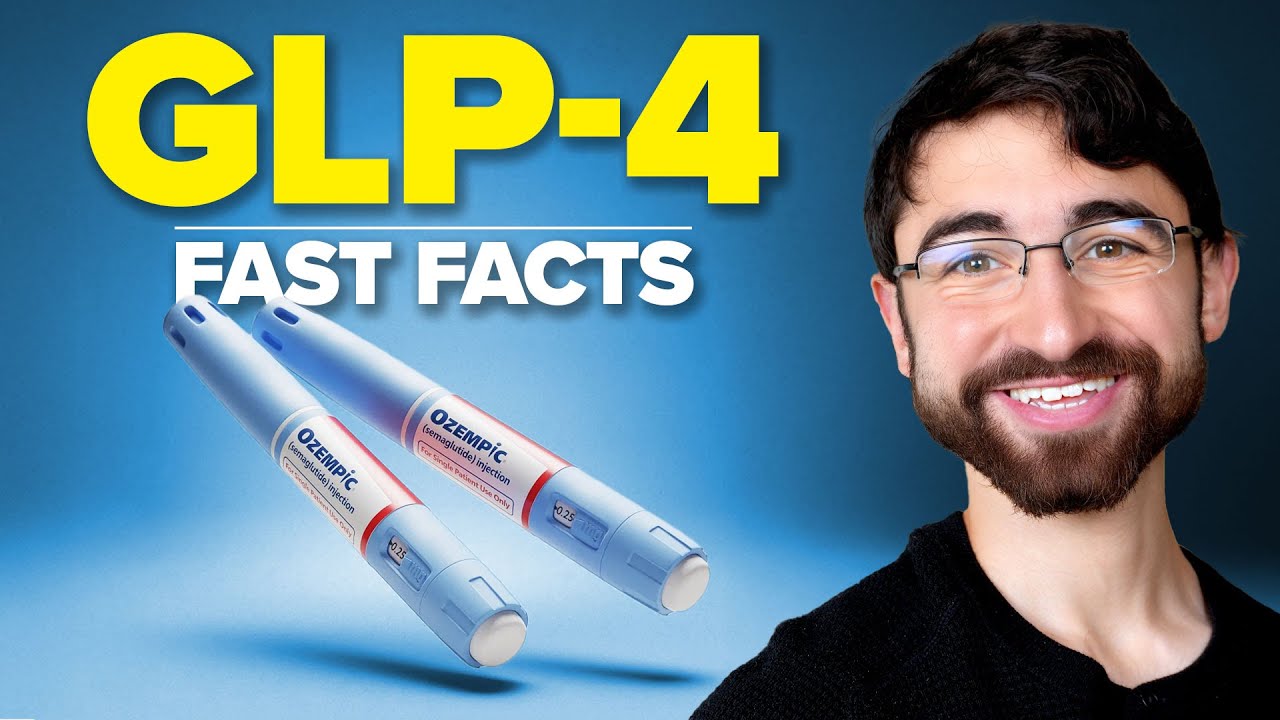
In this video, the presenter offers a high‑level, physiology‑focused review of four recent, high‑impact papers on glucagon‑like peptide‑1 (GLP‑1) receptor agonists such as Ozempic, Wegovy, and tirzepatide. The aim is to explore the basic‑science mechanisms that underlie the drugs’ efficacy, not to provide clinical recommendations. 1. Nausea‑free satiety circuit (Nature, July 2024) – The study identifies two distinct brain nuclei that mediate GLP‑1 effects: the nucleus of the solitary tract (NST) drives satiety and weight loss without nausea, while the area postrema (AP) triggers nausea and food aversion. Activating both does not produce additive weight loss, suggesting that targeting NST alone could yield a nausea‑free GLP‑1 therapy. The presenter raises the translational question of how such region‑specific targeting could be achieved in humans. 2. GLP‑1 reversal of polycystic ovarian syndrome (Nature Metabolism, May 2024) – In a mouse model of PCOS, administration of the GLP‑1 agonist liraglutide eliminates ovarian cysts and normalizes reproductive physiology. Since PCOS is linked to insulin resistance and reduced endogenous GLP‑1, the finding hints that GLP‑1 drugs might become a therapeutic option for PCOS in women. The speaker asks whether regulatory approval for this indication is forthcoming. 3. Reduction of “food noise” via pre‑ingestion satiety (Science, June 27 2024) – The paper distinguishes between ingestion‑related satiety and pre‑ingestion satiety (the mental chatter about food). GLP‑1 agonists most strongly improve pre‑ingestion satiety, objectively confirming patients’ reports that the drugs quiet food‑related thoughts. The presenter invites viewers to consider non‑pharmacologic ways to lower food noise. 4. Tirzepatide’s GIP‑driven metabolic flexibility (Cell Metabolism, June 14 2024) – Tirzepatide combines GLP‑1 and GIP receptor agonism. Unlike GLP‑1, GIP receptors are abundant on adipocytes. Direct GIP activation enhances metabolic flexibility: during fed periods it improves glucose disposal, and during fasting it promotes lipolysis, leading to more dynamic fuel partitioning. This mechanistic advantage may explain tirzepatide’s superior weight‑loss efficacy over pure GLP‑1 agents. The video concludes by emphasizing a curiosity‑driven, basic‑science perspective: understanding how these drugs work at the physiological level can inspire future innovations, just as the original GLP‑1 drugs emerged from studies of Gila‑monster venom.
Chapters
This video is going to be something different. I'll fully unpack what I mean by that in a moment, but broadly, this video is going to be about GLP-1 receptor agonists, that new class of blockbuster weight loss medications like Ozempic and Wegovy that are taking over the obesity medicine world and honestly social psyche as well. Anyway, I'm going to go over 4 papers published in top journals—Nature, Nature Metabolism, Cell Metabolism, and Science— published just within the past couple months. So this isn't information you're going to be getting really from other sources. And also, to be clear, I'm not going to be advocating for or against the clinical use of these drugs. This is going to be about basic science and physiology— what the mechanisms that are being discovered underlying the efficacy of these drugs can teach us about physiology. So this is a physiology lesson, not a clinical lecture. Anyway, with that, I did say this was going to be something a little bit different. What I meant by that is it's going to be a high-level overview of these 4 papers. I'm going to keep it as basic as I can, actually do a 1-1-1 approach where I present a finding, draw a conclusion, and then ask you a question. And it's going to be a nested intellectual environment. So for each paper, I've also done a separate deep dive, which I'll link below. So we'll keep this one high level, but if you want to go into the nitty-gritty see the other videos and resources. Anyway, with that, let's dig into it and hopefully learn some really cool things about physiology. Welcome to my channel. Stay curious. Ozempic without nausea. So the first paper I want to talk about was published in Nature, July 10th, 2024, which is 1 week ago at the time I record this.. And it talks about this common phenomenon of nausea with taking these GLP-1 receptor agonists. About 60% of patients will experience some degree of nausea. And they kind of ask the question, could you design an Ozempic 2.0 that doesn't carry the risks of nausea? Now, for that to be the case, you'd need separate biological circuits, one exerting a pure satiety effect and weight loss effect, and the other exerting a nausea effect. And what they find in this paper, high level again, is Indeed, this is the case. That there was an area of the brain, the nucleus of the solitary tract, that you could specifically target and get weight loss and satiety without any nausea, whereas the area postrema, a different region, exerted a nausea effect. And while targeting the area postrema could cause nausea, food aversion, and weight loss, these two areas, activating these two areas that express GLP-1 receptors in the brain, were not additive. So you didn't get any extra weight loss benefit, at least in the preclinical model, by targeting the area postrema, leaving open the possib— ability that you could basically target this one center, the nucleus of the solitary tract, and get all the satiety, all the weight loss, without any risk of nausea. So that's really interesting. That's kind of the conclusion, the extrapolation. I guess the question that I would then bring up is, to do this in mice, you can manipulate brain circuitry. You can use optogenetics, reviewed in other videos, to shut off, silence certain brain circuits. How would you do this in humans though? How would you design a drug to target one region of the brain and not the other? Or otherwise stated, how could you shield a region of the brain? Could you do this with human pharmacotherapy? Anyway, provocative question. I think it's really fascinating that there are these different neural circuits, and I'm going to leave you with that, and you can go check out the deeper dive if you want to. Now, moving on. GLP-1s and polycystic ovarian syndrome. So now I want to talk about a paper that was published in Nature Metabolism, May 20th, 2024. And it discusses polycystic ovarian syndrome, a very common reproductive disorder in women typified by irregular periods, elevated androgens, so male sex hormones like testosterone, and/or polycystic ovaries. You need at least two of those three to have polycystic ovarian syndrome. Now, an interesting thing is that polycystic ovarian syndrome is associated with insulin-resistant disorders like diabetes, also cardiovascular disease. And GLP-1 levels are known to be reduced in various insulin-resistant disorders. So GLP-1 levels are reduced in obesity, and GLP-1 levels are reduced in PCOS. What they found in this paper though, the main finding, is that giving back GLP-1 was sufficient to basically erase PCOS in a PCOS mouse model, which is really fascinating. You can see that here. Here's the PCOS mouse model. What happens when you give liraglutide? GLP-1 receptor agonists, boom, cysts be gone. Now that is the main finding. The conclusion therefore, or the extrapolation, is maybe GLP-1s could treat PCOS in human females. And the question I guess I'd leave you with is, do you think Ozempic or related drugs are gonna be approved for PCOS? And if so, give your best guess on the timeframe over which that'll occur. Anyway. Resisting your culinary kryptonite. I have to admit, I had fun with the title, uh, concept, packaging, and thumbnail on this one. You should definitely go check out that video because I'm particularly proud of it. I thought it was a lot of fun. Anyway, this paper published in Science, June 27th, 2024, talks about broadly food noise. Food noise is a subjective descriptor that patients and physicians might use to describe that chatter that goes on in your head. About food. So you're always thinking about food, always thinking about how to access food, and eventually it leads people to falling off the bandwagon. People say GLP-1 receptor agonists like Ozempic reduce food noise. Now that's obviously a subjective descriptor, but now there's science published in Science to explain why that's the case. And what they did in this study is they looked at the effects of GLP-1 receptor agonists on satiety, but they bucketed it into ingestion satiety. So when you're eating, you know, how full you get, how quickly, versus pre-ingestion satiety, which relates more to food noise. So when you get cued to food in the environment, do you have a lot of food noise, or are you able to say, "Nah, I don't need that"? That's pre-ingestion satiety. That's reducing food noise. And what they found actually in humans and in animal models is that indeed the biggest differentiator in the GLP-1 receptor agonist group versus the control group was the pre-ingestion satiation, basically the reduction of food noise. So I find that quite interesting. It basically is a finding that— this is the conclusion— confirms the subjective experience of patients with respect to this descriptor, reducing food noise. So another question, this is the question I'll pose to you if you're not taking this drug, or if you are: what are other ways to reduce food noise, maybe without pharmacotherapy? Are there lifestyle interventions? Are there environmental building exercises? Maybe just getting certain foods out of your access, out of your awareness, that can help reduce food noise and therefore help be lifestyle interventions that could lead to better success. Better than Ozempic. So in this paper published in Cell Metabolism, June 14th, 2024, they start to dig into the differentiating physiology between a newer generation of weight loss drugs The GLP-1 receptor agonist combined with GIP receptor agonist versus Ozempic. So you might have heard of this drug, tirzepatide. It's kind of like Ozempic, but it's Ozempic with a bonus. That is, it's a GLP-1 receptor agonist, but it also is an agonist of the GIP receptor, with GIP being another incretin hormone released from the gut. So you have GLP-1 released from L-cells, you have GIP released from K-cells in the intestine, and they act on different receptors around the body. Now, earlier in this video, we alluded to the fact that there are GLP-1 receptors in the brain, and they're elsewhere in the body as well. But interestingly, where there are not a lot of GLP-1 receptors is fat cells. So GLP-1 doesn't act that directly— it can act indirectly, but not that directly on fat cells. But GIP is highly expressed on fat cells. And what they find in this paper is GIP Receptor agonists, including tirzepatide, can act directly on fat cells and bind to fat cells, as you can see here in red. And what it does is basically enhance metabolic flexibility. That will be the high-level summary. Where tirzepatide, when provided, has a long half-life, about 117 hours or about 5 days. So it takes about 5 days for the drug's level to be halved. And over that time, it's chronically stimulating signaling in the fat cells. As you go through feeding periods, and you're in the postprandial period, and fasting periods. And in the postprandial period, after eating, it helps with glucose disposal, keeping your blood sugar more stable. And in the fasting period, it enhances lipolysis, it enhances fat burning. So basically what it's doing is it's making your fuel partitioning, your metabolic flexibility, more dynamic and adaptive. And so basically the benefit, the margin between the benefit of tirzepatide, which is more powerful than Ozempic, has to do with enhanced metabolic flexibility and fuel partitioning via action on fat cells. And if you want more on that, my conclusions and questions, I'm actually going to tease you to go watch a whole separate video on fuel partitioning. So I have a video on tirzepatide and why it's better than Ozempic physiologically, and then a separate video on fuel partitioning. You should go watch both of those. With that, I'm gonna wrap up this video, but again, reinforce what I was trying to do here. Not talk about the pros and the cons clinically of these medications. You can get that elsewhere. You can get fearmongering about the side effects or praying to the altar of GLP-1s elsewhere. What I want to talk about here is, look, we have these medications out in the world. We have interesting physiology via these medications, and we should just study it and I think be interested in the underlying physiology of how they work because for From that, we can gain knowledge that can lead to future innovations. And it's not always clear the benefits we'll get out of just studying basic science. It actually is a nice, you know, full circle coming around because where did these medications come from? They came from studying the basic science of Gila monster venom. And then when scientists in the '90s were studying Gila monster venom, they didn't know that now in 2024, we'd have multiple drugs and multiple evolutions of drugs that are changing the weight loss game. They just were studying the humble Gila monster. They were staying curious, and look where we are now. Whether that's a better or worse place in your opinion, I think it's a pretty fun and exciting ride. I hope you agree.