I Tried Retatrutide – Here's What Happened
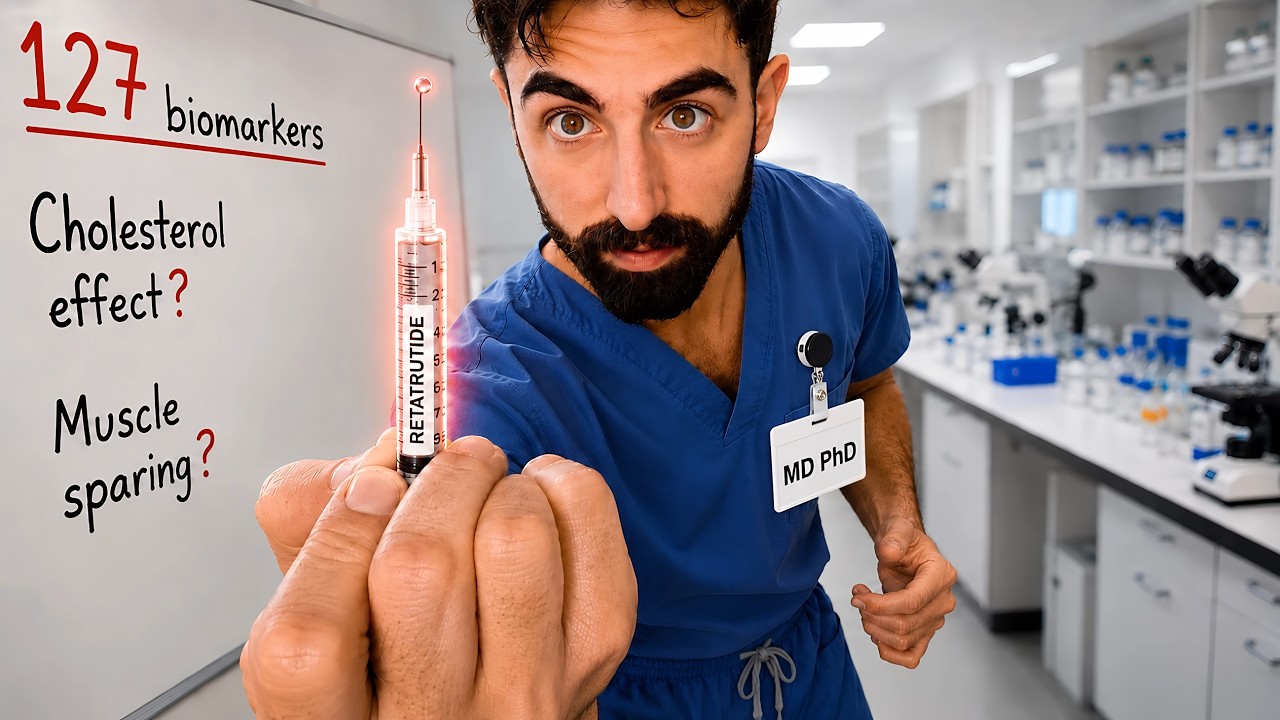
This content was created by Nick Norwitz. This content was uploaded by Nick Norwitz. This is a YouTube video titled "I Tried Retatrutide – Here's What Happened" (uploaded June 10, 2026). A single presenter (creator of the video) gives a first-person deep dive into trying retatrutide (aka REDA/RETA-TRUTIDE): mechanism overview (GLP-1 appetite suppression, GIP for fuel partitioning, glucagon-driven increased energy expenditure), two observed paradoxes (some people become hungrier yet lose weight; claims of muscle preservation versus published trial data), and a detailed personal report. The presenter describes dosing (started 1 mg/wk → 2 mg/wk), acute reactions (feverish episode, large rise in resting heart rate, lower HRV, ~1.2°F core temp increase), rapid weight/body-composition changes (≈4 lb first week, ~12 lb in a month; bioimpedance suggesting a drop in body fat), and tracking of 127 biomarkers (notable increases in hs-CRP and decreases in LDL/ApoB). The video contrasts anecdotal reports with clinical trial findings (published trials show ~38% of weight loss as lean mass at higher doses), offers mechanistic hypotheses (FGF21 and individual FGF21 sensitivity explaining muscle effects), and discusses broader implications for long-term use and future bioregulatory therapeutics. The presenter also promotes a "Stay Curious Metabolism" newsletter and an upcoming GLP-1 guide.
Chapters
This is set to be the biggest weight loss drug in history! Retatrutide? Reta-tru-tide? Rit-a-true-tide? Red-atrue-tiede? Ratatru-tiede? Reta-two-tiede? And in published trials people taking retatrutide lost 1/4 of their bodyweight in under a year— like a snake shedding off its skin except the skin is body fat. The power of this compound is insane outperforming all other weight loss drugs by a league it's 60% stronger than Ozempic so I... Tried it. Pause. I know exactly what you're thinking. Nick, you're skinny as heck. Why would you take a weight loss drug? Well, in addition to being a highly credentialed professional guinea pig, I was hearing rumors about this specific drug that didn't add up in my brain. Strange reports of people taking it and actually getting hungrier, or claims that people were shedding body fat without losing any muscle. And it seems like there's some degree of muscle sparing. Or even building muscle. And frankly, that piqued my curiosity enough to try it myself, not for my health, but even at the risk of my health, just to see what the hype was about and start to untangle some of the mysteries in my brain. I logged my experience, the good, the bad, and especially the unexpected. And there was unexpected. I collected 127 biomarkers before and after taking Reda to see what other people couldn't see. And to see what was changing under the metabolic hood of my body. And I can tell you upfront, this isn't just a weight loss drug. I was eating over 4,000 calories per day and still lost 4 pounds in just the first week. You're not just eating less, you're also burning more. My resting heart rate increased over 50% and I ended up pretty sick on the bathroom floor. This is powerful. Trillion dollar question: Should you use these drugs? And if you do, should you stay on them? Okay, real quick before we begin, I want to mention a lot of my deep dive content is now migrating over to the Stay Curious Metabolism newsletter, which is now a top 2 overall bestseller in science globally. So if you want even more nuance, to go really deep down the rabbit hole with me, I encourage you to subscribe there. It's also a great way to support what I do. But for now, let me lay out our intellectual treasure map, our roadmap to this video. In part 1, we're going to go over why renatrutide is different than other weight loss drugs.. In part 2, we're going to unpack not one, but two paradoxes about Reda Truthide. In part 3, we're going to talk about my personal experience with Reda, especially what caught me off guard with respect to my personal experience and blood markers. Then in part 4, we're going to untangle those Reda paradoxes we introduced earlier before part 5, answering the trillion-dollar question: should you? So let's begin. What makes Reda Truthide different? Retratide, sometimes called RETA or informally GLP-3, is the next evolution in a class of weight loss drugs known as the GLP-1 receptor agonists. The first generation, think like the original iPhone, were drugs like Ozempic and Wegovy. These targeted the GLP-1 receptor, which in simple terms makes you less hungry. There are other effects, and we're going to get into these, but at a high level, think GLP-1, less hunger. Then came the second generation. Think the next iPhone upgrade. And today we're introducing the iPhone 3G. This was drugs like tirzepatide, or perhaps you've heard the trade names Mounjaro or Zepbound. These hit two pathways: GLP-1, like the first generation, plus another hormonal axis called GIP, which plays a role in how your body partitions fuel. So now you have less hunger via GLP-1, plus improvements in how your body uses and fluxes energy via GIP, like supporting your fat cells' ability to spit out fatty acids to support you during a fast. Then came Reda Trutide, yet the next iPhone upgrade. This adds a third mechanism: activation of what's known as the glucagon receptor, which at a high level increases your energy expenditure. So now, you're not just eating less, you're also burning more. And that's in part why people report things like elevated heart rate, elevated metabolic rate on REDA. In my case, I definitely experienced this. My resting heart rate increased over 50% from around the low 40s to 65 or 70 beats per minute, which is a really dramatic shift, definitely something I felt, and I'm going to talk about or speculate about the biological relevance of this later. But zooming out, REDA-TRUTIDE is hitting 3 different hormonal pathways. Reducing appetite via GLP-1, altering how your body partitions fuel via GIP, and increasing energy expenditure via glucagon. And as a quick aside, I used that iPhone analogy because I find it a bit funny how these compounds are being marketed. Rennet is often called GLP even though there's no such thing, it's just a marketing ploy, but it's clearly a play on the original GLP-1s which have great brand recognition, which honestly makes me think What will GLP-17 Pro look like? But that's a story for another time. So let's get to the next part of our investigation: the two big reticrutide paradoxes. Now, you'd think because this is a weight loss drug, it would make you less hungry. That's what people generally report, right? And for many people, it does. Like Ozempic, reticrutide can make you less hungry. But that's not the whole story. I kept on hearing these anecdotes from friends, from scientists, from doctors who are toying with these things behind the scenes, people I trust. And they were reporting the opposite. They were reporting taking runatrutide and getting hungrier, which on the surface doesn't make sense, but they were also still losing weight. And that alone was enough to make me curious, because as counterintuitive as it sounds, getting more hungry, eating more, and losing weight— 2 double cheese, 3 orders of fried chicken, 1 BLT, 2 ham and Swiss on rye, chicken fried steak, turkey club, and 2 bowls chili extra onion. There's a mechanistic explanation for it, and we're going to get to that. But let me first introduce the other retatrutide paradox. Paradox 2. There was this rumor floating around that retatrutide could cut fat, but without the typical loss of muscle or lean mass that's seen on these GLP-1 drugs. This rumor was powerful enough that even famous scientists like Andrew Huberman were suggesting that retatrutide might be muscle sparing on TV. So loss of 1/3 of body weight in about 6 months' time. And it seems like there's some degree of muscle sparing. And let's be clear, if true, this would be very different than earlier drugs like Ozempic in this class where roughly 25% to 40% of weight loss comes from lean mass. But here's the thing. The actual human data on retatrutide don't support this claim. In the main body composition studies, especially at higher doses like 8 and 12 milligrams, about 38% of weight lost on retatrutide appears to be lean mass. So now you have two paradoxes: people getting hungrier but losing weight on REDA, and people supposedly preserving and even building muscle despite what the published data say. What's actually going on here? The answer is more bizarre than you'd think. But before we get to resolving those paradoxes, let me tell you what happened when I tried it myself. That's part 3: my personal experience with retatrutide. I started retatrutide conservatively at a very low dose, 1mg per week, eventually increasing to 2mg per week. For context, the trials go up to 12mg per week, so this was a pretty modest dose. And importantly, I just want to put this out there, I did get this from an FDA-approved 503 compounding pharmacy, not a gray or black market source. Anyway, what I felt was incredible. The first morning after my injection, I actually woke up famished. I was starving. I ate a 6-egg omelet with about 4 ounces of feta cheese cooked in butter, then drizzled on olive oil, or more drained it in olive oil, "So I'm actually hungrier than usual at 10 AM. I'm just gonna eat what I want and see what happens." And then I ate another. Which is not what you'd expect from a weight loss drug. But here's the deal. Remember, retinotrutide doesn't just suppress appetite via GLP-1. It also increases metabolic rate via the glucagon mechanism. So, at a high level, it's very plausible those effects—decreasing hunger and increasing metabolic rate— don't hit at the same time or with the same intensity in every person. In my case, I think what happened is that the energy expenditure metabolic boost side hit first and hit hard, so for several days my appetite was actually increased because I was burning off more energy. I was eating over 4,000 calories per day and still lost 4 pounds in just the first week. Now, next question: was it fat or muscle? Well, I don't have a ton of fat to lose, so realistically some of it was probably lean mass. But I actually didn't notice any drop in performance over that month. My strength, power, energy all felt the same. If anything, I felt more energized. So this is day 1 after Reda, and I had this weird feeling of being really warm and actually having a great workout. And this isn't just speculation. There's nuance in the data that helps explain this, and we're going to get to that later, I promise. Then things got weirder. When I increased to 2mg, doubling the dose, I had a pretty intense reaction, one that definitely caught me off guard. At around 3 AM, 8 hours after the injection, I woke up feverish in a sweat. My heart was racing, palpating, and I ended up pretty sick on the bathroom floor. Oh, it's 3 AM. Yesterday evening, I doubled the dose from 1 to 2 milligrams, and I'm having a really strong reaction. Like, I feel really warm. My heart is pounding, probably 80 or 90 beats per minute, which for my resting heart rate, it's like twice normal, which, geez, this is powerful. Now, to be clear, I can't say with certainty that this was the drug, but I hadn't eaten anything weird. I don't think I had food poisoning. I personally think it was the drug, although that is a little bit of speculation. And if so, it at least gave me a sense of how powerful these compounds are. I don't think it was super dangerous, it went away after a little while, but boy did I felt that metabolic boost. My body was on fire, my heart was racing. And beyond that, I did have consistent signs of an increased metabolic rate. My resting heart rate measured in the morning jumped from the low 40s where it normally sits into the 60s and even the 70s. And along with that, something called my heart rate variability dropped and my core body temperature increased by about 1.2°F. And as a quick aside, I do know how to properly measure core body temperature. "Oh, wait till I put the thermometer in." Now, I'd mentioned I'd talk about the biological relevance of the increase in resting heart rate and also the decrease in heart rate variability. The honest answer is we don't know. Typically, higher resting heart rates and lower heart rate variability are associated with worse health outcomes and lower life expectancy. So on the surface, this sounds bad. And if you want a comparative biology analogy, think Greenland sharks. These have a resting heart rate of about 12 beats per minute and can live over 400 years. Contrast that to a hummingbird with a resting heart rate of about 500 beats per minute, which lives more like 3 to 5 years. And if you want to learn more about heart rate variability as an independent metric, definitely check out this video here where I also share the craziest Starbucks story you will ever hear. But back on track with this video. The fact that renatrutide can increase resting heart rate and decrease heart rate variability I think is concerning and deserves further study. However, it doesn't necessarily mean that renatrutide causes poor health outcomes via this mechanism because high resting heart rate is typically just a signature of underlying cardiovascular dysfunction. So it doesn't follow that if you give yourself an exogenous compound, a pill or a poke, and resting heart rate increases, it actually causes poor health outcomes. This is just an area that needs deeper understanding, but I did want to log it and it was definitely something I experienced. So all I can genuinely say at this point is we don't know, but we should figure out more. Anyway, taken together, all of these data points point in the same direction. Reddit truthide boosted my metabolism. But then, after about a week and doubling the dose from 1 to 2mg, something ended up shifting. My appetite started to come down. Not dramatically, but noticeably. I was still eating between 2,800 and 3,000 calories per day, but the weight kept coming off. I even tried to stop it by making little butter fat bombs for an extra 1,000 calories per day. Didn't matter. Over the course of a month, I lost 12 pounds while eating on average around 3,000 or more calories per day with no change in activity. And again, I'm not a big guy to begin with, so 12 pounds was a lot. So we're finishing up. Moment of truth. I'm stepping on a bioimpedance scale. It's going to give me my body fat percent. It's not quite as accurate as a DEXA, but it's precise enough to measure changes. Starting level was around 5%. So let's see what the moment of truth is. Let me know your guess right now. 3.2% body fat. Now, take that with a grain of salt. Bioimpedance scales aren't as accurate as DEXA scans, so I don't think this was an absolute measure of my actual body fat. And I'll explain why I didn't do a DEXA scan later because they have their own problems, but consider this directional. That is a very, very powerful effect in just 4 weeks. But that brings us to the next part of our journey, which I think is even more exciting: the labs. I tracked 127 biomarkers using my 100 Health app. And if you want to use what I use, check out the link below. I have a discount code for you. It's not a paid promotion, just a discount code for you. Stay curious, 50. Anyway, let me start with what didn't change. My full thyroid panel was stable, my cortisol was stable, my blood sugar was stable, and all my blood cell counts were stable. Actually, across 127 biomarkers, my labs were incredibly stable, but with some notable exceptions. The first was my high sensitivity C-reactive protein, a marker of inflammation. It increased. Not dramatically, but enough to move from the optimal area to suboptimal, from 0.3 to 1.8 mg/L. Now, this is really important. GLP-1-based drugs, including retatrutide, are generally thought to reduce inflammation, not increase it. So why did I experience an increase? Well, here's my hypothesis. I don't think it was the retatrutide itself. My working hypothesis is indirect. Retatrutide increased my metabolic rate, and at times made me kind of restless. I'd occasionally wake up with a racing heart. I didn't feel dramatically worse, but my sleep was more disrupted than normal. And as a little aside, I have recovered my sleep dramatically with another peptide called pinealon, which you can read about in this letter if you're interested. Anyway, even short-term sleep disruption can increase inflammatory markers like hs-CRP. And the night before the second lab draw, I slept about 5 hours. So my interpretation is that this spike in inflammation wasn't directly caused by retatrutide, but was a downstream effect of how it was impacting my sleep. There are of course other explanations, but the takeaway for me is this: these medications don't replace the fundamentals. Sleep, nutrition, exercise are all still important. I hope that's obvious, but I think it's worth remarking on. But let's get to the next weird change in my lab markers. Here's something that totally caught me off guard: my LDL cholesterol and ApoB dropped. Now, I won't go into the weeds here, but this genuinely surprised me because my expectation was the opposite. Historically in me, given my physiology, weight loss tends to drive my LDL up, not down. But this time, the retatrutide, despite causing weight loss, caused my LDL cholesterol and ApoB to go down. Why? Well, something I hadn't fully appreciated is that the glucagon component—remember, this is one of the pathways that makes retatrutide unique, different from Ozempic—it appears to influence a protein called PCSK9. That's really interesting because PCSK9 is also the target of a potent class of cholesterol-lowering medications known as the PCSK9 inhibitors. PCSK9 inhibitors. Maybe you've heard of drugs like Repatha. So in hindsight, it actually makes mechanistic sense. Retrutaride is basically acting like a PCSK9 inhibitor lite, lowering LDL cholesterol and ApoB in the process. I genuinely didn't see that coming. But now I know one more thing about physiology, and maybe you do too, something I didn't before. And honestly, that's my favorite. My favorite is when results diverge from your expectations because that's when you truly learn. So there's something I learned. But that brings us to part 4, maybe the best part of this whole video: resolving the retatrutide paradoxes. First, let's answer that question: why do some people get hungrier while others lose their appetite on reta? We've actually already answered that. Retatrutide is doing multiple things at once. It suppresses appetite via GLP-1, but it can also increase metabolic rate via glucagon. So, you get a kind of tug of war—more energy burn, but also less hunger—suppression of appetite via GLP-1. Where you land as an individual, where I land, where you land, and how things change over time depend on the dose, the timing, and our bioindividuality. Anecdotally, I will note that leaner individuals like me seem to be the ones more likely to experience that increase in hunger, and in my case it was transient and faded after about a week, but my hunger was never that suppressed. Anyway, that's just an observation. The second paradox I think is even more interesting. The muscle paradox. Again, some people were reporting losing fat without losing any muscle, including on DEXA scans, which does not align with the clinical literature. Remember, in the clinical published trials, retatrutide causes about 38% weight loss as lean mass, so what the heck is going on? Here's what I think, and try to hold on because I realize this is going to get a little bit technical. One downstream effect of the glucagon component of retatrutide, the one that increases metabolic rate, is to cause the release of another hormone called FGF21 from the liver. FGF21 is a fascinating hormone because it increases metabolic rate as well, but also protects against muscle loss. So in theory, you could have a scenario where you burn more energy while preserving muscle, which people say they see on retatrutide. But here is the key point: not everybody responds to FGF21 in the same way. Obesity is an FGF21-resistant state, meaning the FGF21 signal doesn't land as effectively in people with obesity. So now you have an explanation. Do you see it? Clinical trials are done in people with obesity, who may be more resistant to FGF21 and therefore see less muscle preservation on retatrutide. Meanwhile, leaner individuals like bodybuilders, athletes, or biohackers who are toying around with red atratide might be more sensitive to the FGF21 pathway, so they experience stronger muscle-preserving effects. This is still a hypothesis, but it helps clear up a discrepancy between what people are anecdotally reporting and what's published in the literature. This is also a great opportunity for another Stay Curious Side Quest to clear up a broader misconception. About GLP-1 drugs, from Ozempic to retatrutide, tirzepatide, all of them, and muscle mass loss. You've probably heard that these drugs cause more muscle mass loss than if you just lost weight by diet and exercise alone. In fact, in the published trials, 25-40% of weight loss comes from lean mass. That sounds concerning, but here's the deal. The DEXA scans used in those trials, when they're measuring lean mass, they aren't just measuring muscle, It actually clusters together organs and non-contractile components in muscle. So basically, when lean mass decreases in these trials on DEXA scans, it doesn't necessarily mean functional muscle mass is being lost. In fact, in new trials, strength is actually fully preserved. So, it's entirely possible, and I find this kind of funny, that in the trials where we've been saying, "Oh, we're seeing muscle mass and lean mass loss," it's actually just the case of a sneaky shrinking liver. If you stop to think about it, that's a pretty embarrassing oversight with respect to how we interpret these data. And I'd be embarrassed myself if it wasn't a mistake that was being made by basically the entire biomedical community. But now let's bring this all home with the trillion-dollar question, and it might not be what you expect. Should you use these drugs? And if you do, should you stay on them? Let me answer this question by starting with a personal story about a friend of mine. He was on one of these drugs, Mounjaro. He lost 40 pounds. He was feeling great. He had no side effects. And he asked me how he should come off of it. Not because he wanted to, but he assumed he had to. Like this was just a temporary fix and he couldn't stay on it for life. And he was genuinely surprised when I told him candidly, "You know, man, you don't necessarily need to come off this drug if it works for you." And I don't mean that pessimistically, like you have to be on it for life. I mean it as a liberating idea. Because these aren't just weight loss drugs. That's how we frame them because society focuses on weight. And yes, reversing obesity matters. But the deeper you go into this space, the more you realize that's only one very narrow piece of the story. We are now seeing signals across the literature of these drugs benefiting heart health, joint health, liver health, and even having potential neuroprotective effects that appear to be completely independent of weight loss. The key point here: independent of weight loss. Weight loss is just the tip of the iceberg. And because I know I'll get asked it, no, absolutely not, this video is in no way, shape, or form sponsored by or in any way in financial conflict of interest with any pharmaceutical company. So we can avoid that troll comment. Anyway, back to my point. This means even people who aren't trying to lose weight at all, people like me, might eventually be using these drugs or something similar in different ways, not as weight loss tools, but for more meaningful biological tinkering. Frankly, I don't care much at all about what the scale tells us about how the Earth's gravity is acting on a human body. To me, that's kind of boring. But I do care about the ability of our human species to tinker with the inner workings of our bodies as if we're jailbreaking that iPhone. What we're really witnessing here is the early stage of something much, much bigger: a shift towards using targeted bioregulators, well beyond retatrutide, to shape human biology in ways we couldn't before. This is exciting, if yes, a little unsettling. But every major leap in human history has carried tension. So this isn't just about retatrutide. It's really about what comes next. And the real question is whether it's going to happen— it is— It's what you're gonna do when these new tools arrive. Last thing for real, I'm working on the definitive guide for GLP-1s. I intend for this to be a one-stop shop for all your GLP-1-related questions. I've already read over 100 papers on the topic. It's a 7,000+ word manuscript that I'm expanding, so drop your questions below and I will get them answered.










