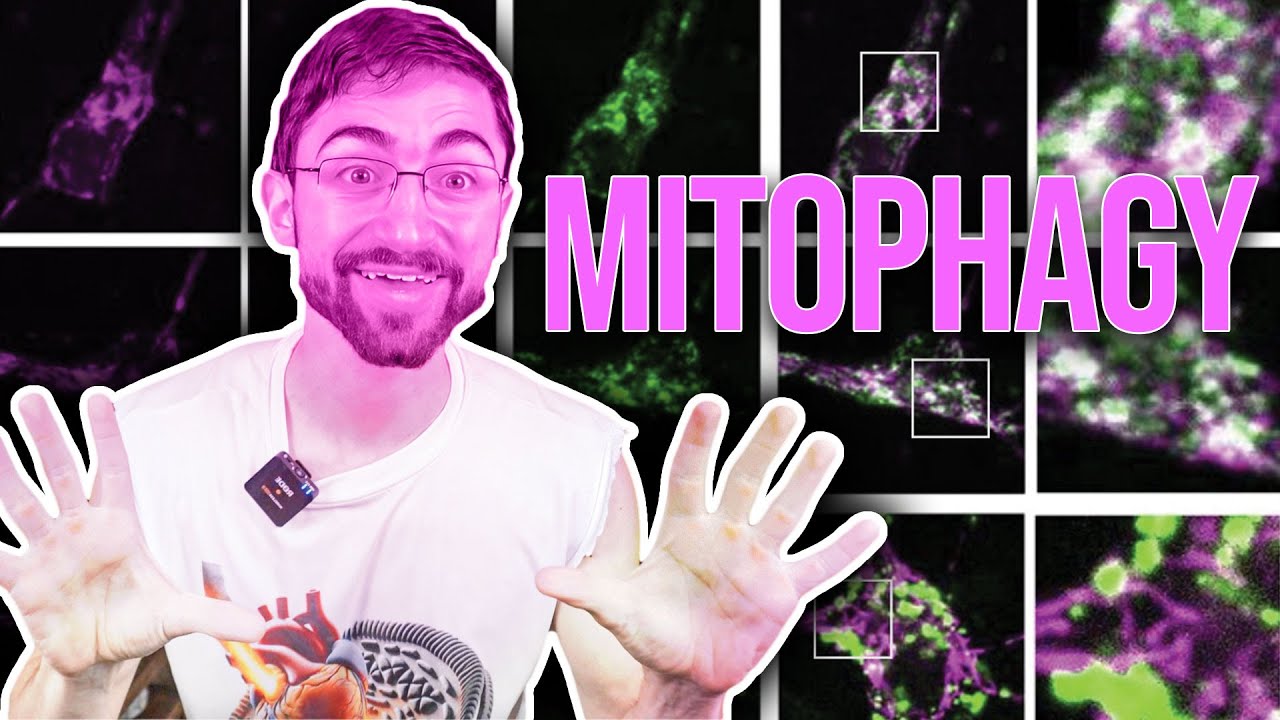
In this video, the presenter explains a recent paper titled “Insulin Signaling Regulates PINK1 mRNA Localization via Modulation of AMPK Activity to Support PINK1 Function in Neurons.” He begins by framing the brain’s high energy demand and the need for precise mitochondrial quality control in neuronal extensions. The core mechanism described involves insulin inhibiting AMPK, which normally phosphorylates the mitochondrial anchor protein SYNJ2BP to keep PINK1 mRNA tethered to mitochondria, suppressing mitophagy. When insulin signaling is active, AMPK is turned off, the tether releases PINK1 mRNA, allowing local translation of PINK1 protein and activation of mitophagy, thereby rejuvenating mitochondria. The video walks through imaging data showing insulin‑induced untethering of PINK1 mRNA (decreased colocalization signal) and contrasts this with neurons expressing the Alzheimer’s‑risk allele APOE4, which exhibit insulin resistance, persistent tethering, reduced mitophagy, and mitochondrial dysfunction. The presenter connects these findings to broader disease relevance, suggesting that APOE4‑mediated insulin resistance may contribute to Alzheimer’s pathology via impaired mitochondrial turnover. He then speculates on behavioral relevance, noting that intermittent fasting cycles may promote healthy insulin signaling and mitophagy, though the paper does not directly test this. Finally, he reflects on his channel’s content strategy, aiming to balance dense scientific deep‑dives with more “baity” videos to build an intellectual ecosystem that engages a wide audience. The video ends with a call for viewer feedback on this balance.
Chapters
Insulin makes your mitochondria young and pink. Okay, what is this gibberish? What am I talking about? Well, let's step back and take a 50,000-foot view. Acknowledge something you probably know. The brain is an energy-expensive organ. And by extension, brain cells, neurons, are incredibly energy expensive. They gobble up energy like Kirby or Scooby and Shaggy with a plate of hamburgers in front of them. Insert whatever pop culture reference you want here. Bottom line, the brain and neurons are energy hungry, and this creates a problem, actually a spatial problem, because if you think about what a neuron kind of looks like, it's kind of like an octopus. It has a cell body, a soma, where the nucleus is, and then these long arms. And those long arms need to be maintained, their energy status needs to be maintained. And within these long arms are mitochondria, the powerhouse of the cell. And the neuron needs a way to assess the energy status at the end of these arms. And control the mitochondrial turnover, the mitophagy, so you can generate energy, but you can also turn over mitochondria at the opportune moment so that old damaged mitochondria don't accumulate, which can lead to mitochondrial dysfunction and eventually neurodegenerative diseases like Alzheimer's disease. So there's a problem here. How does the neuron monitor mitochondrial status in the arms and turn over mitochondria, keep them young and healthy at the right time. Enter PINK. Welcome to my channel, stay curious. The paper this video is really going to be about is entitled— wait for it, this is a mouthful— Insulin Signaling Regulates PINK1 mRNA Localization via Modulation of AMPK Activity to Support PINK1 Function in Neurons. I know, a mouthful, but we're going to unpack it. You're going to understand what all this means And you're gonna have fun along the way, kind of like Margot Robbie in the Barbie movie. You got this, even if you don't have girl power like me with my Y chromosome. Anyway, in this paper, they dissect a very cool mechanism by which insulin, the hormone insulin, regulates a cascade of events to control mitochondrial quality control. I'm gonna delve into the mechanism right now, then show you some data, and then take a step back and tell you maybe what this means and how it's relevant to you. So, the mechanism. Here's how it works, and I'll try to talk slowly because I know I have a tendency to talk fast. Mitochondria are turned over in a process called mitophagy, mitochondrial autophagy. Ideally, old and damaged mitochondria are broken down for parts to keep the mitochondria pool young and healthy. Mitophagy is turned on by a protein called PINK. So that's where PINK, or specifically PINK1, enters the picture. When PINK1 protein is present, mitophagy is on. That's a simple way to think about it. But because you don't want to just keep mitochondria turning over consistently, You want to generate the pink protein at the right time locally at the end of the mitochondrial arms. In other words, you wouldn't want to just generate a bunch of pink protein in the, uh, soma, the cell body, and then send it down the arms because then you're just going to have the mitochondria turning over consistently. It'll be like taking the batteries in your remote and exchanging them every single day. It'll be incredibly inefficient. So you don't want that. Instead, what you want is a mechanism whereby pink protein can be generated at the mitochondrial arms when it's needed. How do you do that? Well, what the cell does, the neuron does, which is very clever for a dumb cell, is it makes the precursor to the pink protein, the pink messenger RNA, mRNA, and takes that precursor and it tethers it to mitochondria. Though when the mitochondria are sent down the arms, they have the precursor to the pink protein present, and it can sit there until the opportune moment, at which point the tether can be broken. And the pink mRNA is released, and then the pink mRNA is turned into the pink protein, which signals mitophagy. So to review, the cell does what the neuron does, is it takes the pink mRNA, the precursor to the protein, puts it on the mitochondria, literally tethers it using an anchor called SYNJ2BP. I know, a lot of annoying letters, but that's the anchor's name. And it sends the mitochondria with the precursor to pink tethered by this anchor down to the end of the neuron's arms, the neurites, and wait for the opportune moment where the tether can be released and the pink mRNA can be turned into pink protein promoting mitophagy. Now, how is that controlled? Well, enter protein AMPK, the regulatory protein, this kinase, and its regulator insulin. AMPK. What does AMPK do? AMPK is a kinase. It puts a functional group on the anchor called the phosphate group. And when AMPK is active, when it phosphorylates the anchor, it keeps the PINK1 mRNA tethered. So AMPK active, tether on, mRNA attached to the mitochondria, mitophagy off. Insulin is present though. Insulin is a well-known inhibitor of AMPK. So insulin will inhibit AMPK, turn AMPK off, and this will mean the anchor can untether and release the PINK1 mRNA. And the PINK1 mRNA can be turned into PINK protein, and PINK protein can promote mitophagy. So simply, AMPK on, PINK1 mRNA is tethered, less PINK1 protein, less mitophagy. When insulin signaling is present, it turns AMPK off, releasing the tether, releasing the PINK1 mRNA. Then you get PINK protein, and then you get mitophagy. So that's the mechanism in a nutshell. Sorry if you have to go back and rewatch this. Hopefully the little graphic and animation will help, but that's the mechanism, and I really want you to understand it. And you can give me feedback on my explanatory style and if I still talk too fast. Now, to give you a dose of the data yourself, actually a little pretty picture from the paper because I wanted to show you some of the figures. So what you're looking at here is a stain of mitochondria, and the mitochondria themselves are stained in purple-pink, and the PINK1 mRNA, the precursor to the protein, is green. I know that's irritating, the PINK1 mRNA is green and the mitochondria are pink, just bear with me. But bottom line, what you're looking at here, what you're looking for is the merge. The merge is where the PINK1 mRNA, the green, and the mitochondria are overlaid. And what this is saying is that PINK1 mRNA is tethered to the mitochondria. The tether is on, so mitophagy is off. And what you're looking at in the bottom row is what happens when you give insulin. What happens when you give insulin? What do you see? You see more or less white in the merge? You see less white, right? And what this is saying is when you give insulin, the PINK1 mRNA is becoming untethered, which correlates with the generation of PINK1 protein and the activation of mitophagy. So that's how you kind of look at these data. Hopefully that's clear. Now I want to introduce another player to the picture: APOE4. So APOE4 is the gene coding for the APOE4 protein that's a major risk factor for Alzheimer's disease. It's not causative per se, it's a risk factor. So how does it work? Well, one thing APOE4 does is it increases insulin resistance in the brain. And Based on what we just explained, insulin resistance inhibiting insulin signaling should inhibit mitophagy. You're not going to get the same response to insulin. So based on the prior figure I just showed, I want you to look at this figure where you're comparing what happens when you treat insulin or you treat neurons with insulin. You're comparing what happens when you treat neurons with insulin if they're ApoE3, which can be thought of as the control, versus ApoE4. Now again, I just want you to focus on the high level. When you treat ApoE3 with insulin, as you saw before, you see in the merge a decrease in the white, right? The decrease in the white meaning the PINK1 mRNA is being untethered so you can get PINK1 protein in mitophagy. How does that compare when you treat ApoE4 neurons with insulin? What happens? Do you have a decrease in the white or not? You don't, right? Whereas the ApoE3 neurons treated with insulin, there was a decrease in the white correlating with indicating increased release of the PINK1 mRNA and the mitophagy. When you have the apple before treated with insulin, the white remains, meaning the PINK1 mRNA is staying tethered to mitochondria. So, you're not getting release and you're not getting mitophagy. And what then happens is the mitochondria become old and damaged. You get mitochondrial dysfunction and that can lay the groundwork for cognitive decline. And things like Alzheimer's disease. So I'm not saying this is the whole picture with ApoE4, but these data add to the picture about how ApoE4 can be a risk factor for Alzheimer's disease by contributing to insulin resistance and impaired mitophagy and accumulation of old damaged mitochondria, which I think is pretty cool and very scary. In closing, how is this relevant to you? Well, first and foremost, I wish or hope that we can all just sit here and appreciate the cool science that this represents and just sit in awe of the science. But if you want relevance, the way I would relate it to your behavior, and this is a little bit of a stretch, has to do with fasting and feeding cycles. In general, biology works best, you know, in cycles. And this is all about the ebb and flow in energy and waiting for the opportune time to engage mitophagy. Now, all this paper isn't about fasting. There are a lot of other literature to suggest that fasting, intermittent fasting, feeding and fasting cycles is good for the brain. If you want to delve into that, look up the work of Mark Mattson at Johns Hopkins. But bottom line, intermittent fasting tends to be good for the brain. It's not shown in this paper. That's not what this paper is about. But relating it to behavior that I engage in for my brain health, that is something that I definitely do. Intermittent fast at some level. I mostly do 16:8, but people do, you know, alternate day fasting, 24. There are a lot of patterns. Bottom line, you know, our biology does work best in ebbs and flows, energy cycles. And this paper is consistent with, let's say, that approach, even if it doesn't look at it directly. You can see I'm kind of stretching to generate human relevance because this is a basic science paper. But nevertheless, I think I stand by that claim. That's something that I definitely do. Take from that what you will. Again, I hope we can just sit in awe of the cool science and the fact that we are using methodology and tools that are arising to unpack the black box that is the organ that makes us who we are. I think that's really cool. Before I end this video, I actually wanna add a little amendment, which has to do with the intellectual ecosystem I'm trying to cultivate on my channel. You'll notice this video was pretty dense. I think a lot of my videos are quite dense, but at the other end of the spectrum, I have ones that I think could come off as pretty gimmicky, like the butter drop or the video entitled Celery Has More Calories Than Butter. And I'm doing this very intentionally. Because, you know, there are different ways to engage people. I think you can break down the data and you can present people with provocative thought puzzles. And what I'm trying to do here again is create an intellectual ecosystem. So I'd like your feedback on what you enjoy and if you think that I'm finding the right balance of things that are a little bit more baity, things like celery has more calories than butter, and using that as an opening to present a thought puzzle to then get you to think and lay the groundwork for intellectual engagement for when we come to these denser papers or these denser video reviews of papers. Again, it's not one or the other. I want to be able to do both and create an intellectual ecosystem to reach a broader set of people and also provide orthogonal approaches to get you thinking about and excited about science. That's my goal here on this channel. Let me know what you think.