Lowering Cholesterol Killed: A Study Buried for 40 Years
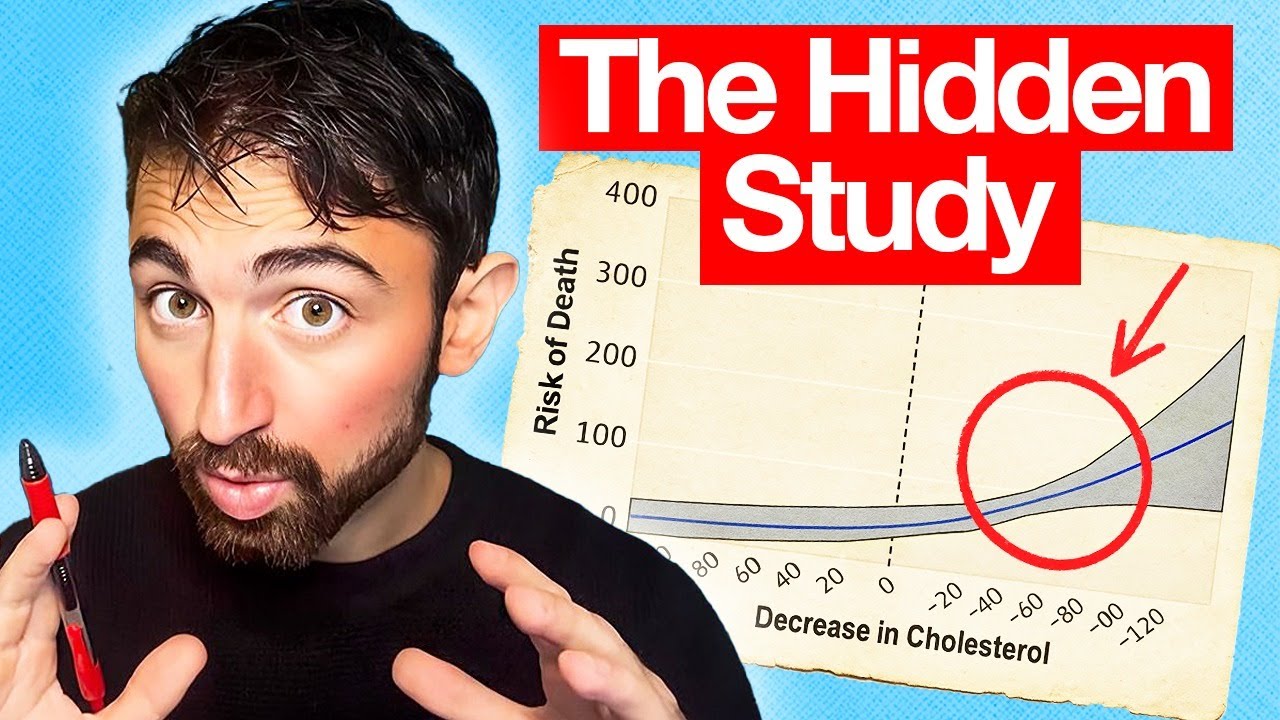
Nick Norwitz examines the Minnesota Coronary Experiment, a 1968-1973 study where replacing saturated fat with vegetable oil lowered cholesterol but increased mortality and coronary events. The data were buried for 40 years until a 2016 BMJ paper resurfaced them, raising questions about the safety of blanket dietary recommendations.
Chapters
What if lowering your cholesterol increased your risk of death?
Cholesterol.
Cholesterol. Cholesterol. Cholesterol. Well, that's what a forgotten trial from the 1970s appeared to show. Now, this was a gold standard study, a blinded randomized controlled trial testing whether swapping saturated fat, like in butter and beef, for unsaturated fat would improve heart health and save lives. But to the astonishment of the researchers, it did the opposite. The cholesterol-lowering diet didn't save lives, it took them. And what's more, the lower the cholesterol dropped, the more death occurred. But then the study wasn't published. It was hidden on 9-track tapes in some guy's basement, only unearthed decades later. Why?
He says, "Dr. Franz, I've heard the possibility that there might be some very interesting data in your father's basement." And there was a moldering old cardboard box there that I opened up and I just immediately thought to myself, "Eureka! I have found it." Was it a conspiracy?
Was it an inconvenient truth that didn't fit a narrative? Or was it something else? Stick around because in this video we're going to delve into the details and find out together. Science is messy, and nutrition science especially so. Excellent fodder for conspiracy theories. An intervention designed to heal ended up doing harm. If I were the personified lipid-heart hypothesis right now, I'd be sweating bullets. Unexpected consequence was catastrophe. The real lesson is one that can be summed up in one word: "Fuck." Now, to truly understand the meaning of these results, we first need to understand the methods. What did the researchers actually do? What were they aiming to find? Well, this experiment, the Minnesota Coronary Experiment, was a randomized controlled trial conducted between 1968 and 1973. It included 9,423 men and women from across 6 mental hospitals and 1 nursing home. Now to emphasize the power of this approach, though ethically questionable by today's standards, was that the researchers could truly blind and rigorously control the patients' diets with remarkable accuracy. But what were the researchers trying to find? Well, according to the grant proposal put forth to the NIH, the project's objective was to "provide evidence concerning whether the incidence of atherosclerosis and its clinical consequences could be reduced by dietary modification." So, in effect, the researchers were testing whether swapping saturated fat, like in butter, for unsaturated fat in the form of vegetable oil would reduce heart disease and death. That was the hypothesis. Now, another unique strength of this study, which is unparalleled by any other study, was that participants could be autopsied after death, allowing the researchers to examine their arteries, like literally go into the body, look in the arteries after death to assess for changes in cardiovascular plaque progression, presumably as a result of the intervention. This is a stunning level of control and rigor. I want to emphasize that. Now, what about the diets themselves? Well, the intervention diet was designed specifically as a cholesterol-lowering diet—that was the objective. Butter was replaced by margarine, rich in polyunsaturated fats, leading to a diet that was overall much lower in saturated fats and higher in unsaturated fats, particularly the omega-6 linoleic acid. In fact, compared to the baseline hospital diet, the linoleic acid intake in the intervention group was increased by 288%, while saturated fat intake was decreased by half, cut by 51%. Now, these dietary shifts, as I mentioned, were aimed to reduce cholesterol. Predicted to cause a large reduction, specifically using the Keys equation, named after the famous researcher Ancel Keys, the intervention group, the vegetable oil rich diet, was expected to lower cholesterol by about 18%. Now, speaking of Ancel Keys, maybe that's a name you've heard of. He's one of the best known nutrition researchers of the era. He's best known, in fact, for his controversial Seven Countries Study, a very influential observational epidemiological investigation that linked saturated fat intake with cardiovascular disease. And he was also one of the lead investigators on this study, the Minnesota Coronary Experiment. That's an important detail worth noting, and we'll turn to the history later. But in summary of the design, the Minnesota Coronary Experiment was a rigorous, blinded randomized controlled trial. Researchers fed patients either a low saturated fat diet or a control diet and then tracked them over the course of years for meaningful clinical outcomes, including heart disease and death. So now comes the moment of truth. Are you ready? The low saturated fat vegetable oil diet group did in fact show a significant reduction in cholesterol, a 13.8% reduction, but this didn't translate into improved outcomes. On the contrary, the vegetable oil, low saturated fat group actually fared far worse. Specifically, there was a 22% higher risk of death for each 30 mg/dL reduction in cholesterol. So, in plain language, the lower the participants' cholesterol fell, the more likely they were to die. I know. Now, if I were less charitable toward the researchers and the broader scientific community, the way the results were then handled could be read as excellent fodder for conspiracy theories.
"He remembers everyone just being baffled." "And they were hoping that with some new statistical techniques that had just come out that they might be able to either understand why the results came out the way they did, or perhaps after some adjustments for various explanatory factors that maybe the results would would change. The results didn't change.
When Brosti talked to Ivan France, France just shook his head. The data were not rushed to publication or integrated into the medical knowledge base for the betterment of medical care and patient well-being, which is kind of the objective of clinical research. Instead, they were effectively buried, stored away on 9-track tapes. I actually didn't know what these were. I had to Google them. I guess I'm aging myself here. And left in a basement for more than 40 years until researchers finally uncovered them and published findings in the BMJ in 2016.
And there was a moldering old cardboard box there that I opened up and I just immediately thought to myself, "Eureka!
I have found it." Now let's take a moment to pause. I suppose you may be wondering why you never heard of these data before and why they haven't shifted common wisdom that lowering your cholesterol is good for heart health. That's still common knowledge. Well, we'll get to that, but first I need to reveal the actual cardiovascular findings, because you might be thinking at least, "OK, maybe lowering cholesterol with this vegetable oil-rich diet was associated with more deaths overall, or caused more deaths overall, but surely it must have offered some benefits for the heart specifically, right?" Well, actually no. As mentioned earlier, one of the unique strengths of the Minnesota Coronary Experiment was that the researchers could perform autopsies on a subset of patients. This allowed them to confirm the presence, relative presence of plaque, and confirm whether participants actually had heart attacks. However, again the vegetable oil intervention showed no benefit for heart disease, coronary atherosclerosis. In fact, the vegetable oil, low saturated fat intervention group exhibited about twice as many heart attacks as confirmed on autopsy compared to the control group with a higher saturated fat diet. 41% versus 22%. You can't handle the truth. So taking a step back, the high-level point: not only did the cholesterol-lowering vegetable oil intervention increase mortality, leading to more death, but even cardiovascular outcomes looked worse. Okay, if I were the personified lipid-heart hypothesis right now, I'd be sweating bullets. But of course, the last resort is to argue, "Well, this was just one study. Even if it was unusually rigorous, surely the weight of the other studies, the preponderance of evidence, would tip the balance, right?" Well, the researchers thought of that too, so they conducted a meta-analysis, a conglomerate of studies, a conglomerate of randomized controlled trials in which the intervention was swapping out saturated fat with unsaturated fat, vegetable oils. And importantly, as a nuanced note, The researchers excluded trials where participants also had a large increase in omega-3 fatty acids, since omega-3s might confer benefits that could mask the potential harms of vegetable oils. So in the end, there were 5 qualifying trials in the meta-analysis. This encompassed another 10,808 participants. And the results? Once again, no evidence of benefit for coronary heart disease or all-cause mortality. In fact, when viewed in the aggregate, the outcomes continued to trend worse for the saturated fat reduction vegetable oil groups. So I return to my earlier question: if these findings are so robust, if the trial was so rigorously conducted, and if the data, albeit published 4 decades late, were made public 9 years ago, why haven't they meaningfully changed the conversation or dietary guidelines? Let's think about that. Well, first I want to give you my high-level opinion. And then we'll talk about some facts. My high-level opinion is, sadly, that conventional medicine has inertia. If it's stuck in one place, it's like a boulder, it's very hard to move. And sometimes it takes more than rigorous data to move that boulder of established thought patterns. But to be fair, playing devil's advocate, there have also been criticisms of the Minnesota Coronary Experiment and these data. And it's worth reviewing them and responding to them to add another layer of nuance. So critique number one, too much unsaturated fat. In a commentary following the publication of the Minnesota Coronary Experiment data in 2016, researchers at the Harvard School of Public Health argued, and now I'm quoting, "The diet used in the Minnesota Coronary Experiment was never consumed by any appreciable number of Americans," and that the level of linoleic acid was well above the range recommended by the American Heart Association. So, in effect, these researchers at the Harvard School of Public Health suggested that the vegetable oil intake was too high and therefore carried a risk of toxicity? Now, I find this argument and phrasing fascinating. It's really curious, isn't it? Curious. Very curious. Well above the range recommended because As far as I'm aware, and you can fact-check me on this, the American Heart Association has never actually set an upper tolerable limit, or toxicity threshold, on vegetable oil intake. I'll let you draw your own conclusions about that, really think about it and its implications, and let me know your thoughts in the comments. But let's move on to critique number 2: blaming it on a toxic hidden trans fat. Another criticism of the Minnesota Coronary Experiment was that the intervention diet, The vegetable oil diet, though lower in saturated fat overall, and lower in total trans fat as well, accidentally introduced the most dangerous type of trans fat, called 18:2 trans isomers. That's not really important, but this is thought to be a particularly dangerous form of trans fat. So in other words, the claim is that the researchers accidentally put a specific poison in the intervention group, which might explain the results. I think it's reasonable to acknowledge the possibility of a confounder here. But as an explanation for the results overall, this excuse doesn't hold up. First, setting aside the fact that this claim that the intervention group had higher levels of these toxic trans fats is actually just speculation. Those toxic trans fats would be expected to raise LDL and total cholesterol, not lower them. Yet the cholesterol in the intervention group dropped. About on par with what was predicted a priori by Ancel Keys in his equation. So if the dose of this supposedly hypertoxic fat were really high enough to completely invert the expected outcome, it seems unlikely that cholesterol reduction would have lined up with the projection so neatly. But that's actually not the stronger counterargument. I think the stronger counterpoint is the dose-response relationship existed not just in the intervention group, but also in the control. Basically, the lower cholesterol dropped, the more death increased, not just in the intervention group, but in the control. If a poison specific to the intervention group were the culprit for the increased death, this pattern wouldn't make any sense. So again, this critique doesn't hold up to rigorous scrutiny. And finally, 3. Critique number 3 was that too many people dropped out. I've seen this stated again and again, that the study suffered from what's called massive attrition, basically dropout, because in the final analysis, there were only 2,355 participants, compared to the original 9,423. So the logic goes, if 75% of the participants dropped out, how can we trust the results? Pause the video here. Are you convinced by this argument? I hope not. That's a convenient bit of hand waving, but it falls short of being a genuinely strong criticism, and here's why. Remember, the study was conducted on patients in 6 state mental hospitals and 1 nursing home. This design allowed for tight control over the diet, but it also meant that some patients would inevitably leave the institutions for various reasons over time. You can get discharged from a hospital. And the analysis was restricted to those who remained in the study for at least 1 year, which is an entirely logical decision since outcomes, like death, from the intervention would take time to manifest. So yeah, patients left the hospitals and weren't included in the final analysis. But, and this is really important, there is no clear reason to suggest this attrition, this dropout, biased the results one direction or another. The randomization should wash out this noise. So in the end, this third criticism also falls flat. So where does this leave us? The Minnesota Coronary Experiment is a reminder that science is messy. And nutrition science especially so. It can be really messy. Looking for good nutrition science is like looking for a needle in 12 haystacks. But in this study, what we see is that lowering cholesterol with a vegetable oil-rich intervention, it didn't save lives. In fact, it cost lives. And whether that was due to cholesterol lowering itself or some coincidental variable isn't actually the central point. The real point is this: Even when the dietary intervention successfully targeted the intended marker, it successfully lowered cholesterol, the ultimate unexpected consequence was catastrophe—death. The assumption was simple: lowering cholesterol would improve outcomes, heart disease and death. But by clinging too tightly to that assumption, narrowing in on it, an intervention designed to heal ended up doing harm. And that is not speculation, that is a hard truth, that is a fact. And that's a lesson we shouldn't ignore. And further, the fact that these data were buried, or at least not published, for decades only sharpens the cautionary tale. The lesson here is not that cholesterol lowering is inherently harmful—I never said that—nor that we should flip conventional wisdom completely on its head. The real lesson is one that can be summed up in one word: humility. We must resist the urge to turn limited evidence into sweeping prescriptions that may harm more than help. In fact, I love how these authors finished up this paper. To quote the authors of the 2016 BMJ paper that resurfaced the Minnesota Coronary Experiment, they said, "Given the limitations of current evidence, the best approach might be one of humility, highlighting the limitations of current evidence and setting a high bar for advising intakes beyond what can be provided by natural diets." So, in other words, this is the picture that's coming into my mind: while these researchers had the blade of their foot on the throat of the personified lipid-heart hypothesis, they didn't press down. They could've, but they didn't. Instead, they extended a hand and said, "Look, this is a complicated topic. Maybe rather than being prescriptive in such blunt black and white ways like saturated fat is bad, cut back on red meat, and butter is evil," Maybe we should pause before making sweeping recommendations to the population through dietary guidelines that could ultimately be more harmful than helpful. So let's return to the question we began our investigation with: What if lowering your cholesterol increases your risk of death? The truth is, it might, or it might not. It depends on the how. But what the Minnesota Coronary Experiment really teaches us is that the answer isn't nearly as simple as we'd like to believe. And until we know more, the wisest stance is one of humility. I hope you found this thought-provoking, nuanced, and reasonable. Stay curious and let me know your thoughts in the comments, what further questions you have, because this discussion is far from done. And I think that's a great thing. 18:2 trans isomer. 18:2 trans isomers. Isomers. Isomers. Blah blah blah blah blah blah.










