Microplastics may be Poisoning You! 11 Solutions
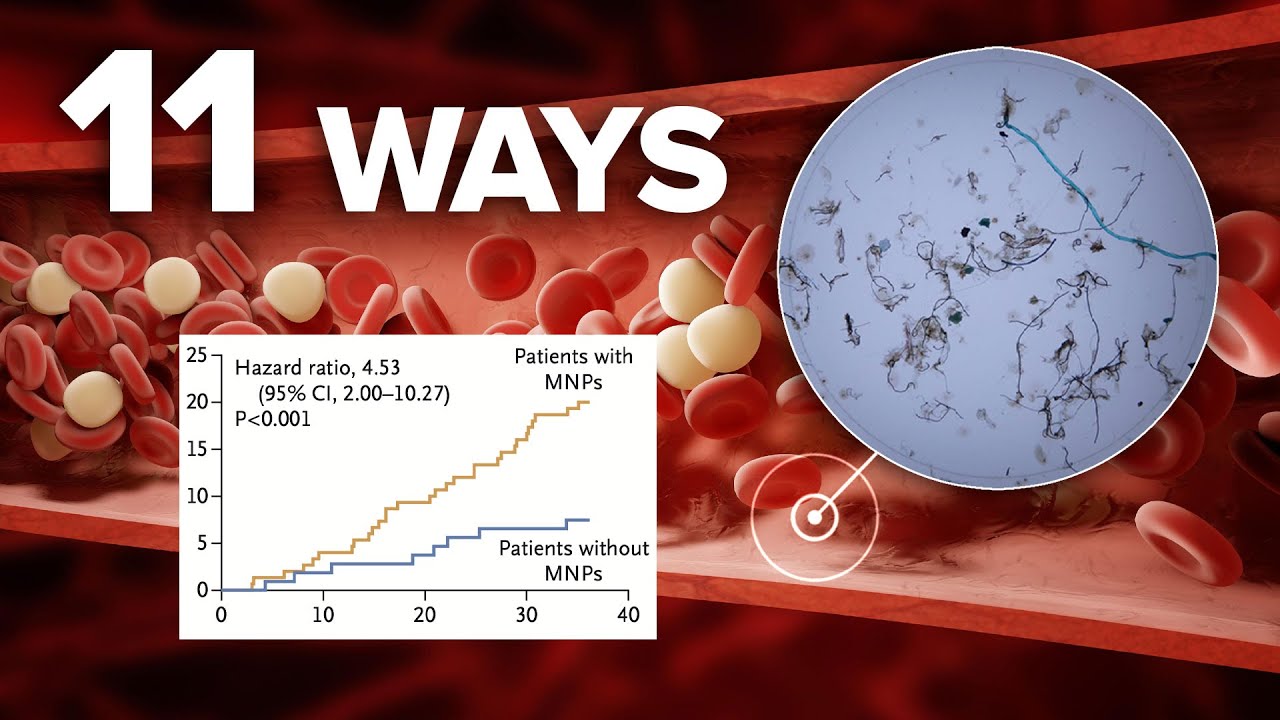
A new study found micro- and nanoplastics in arterial plaques of heart surgery patients, linked to a 350% increased risk of heart attack, stroke, and death over 33 months. The host walks through eleven ways to reduce your exposure: dietary choices, packaging, clothing, seafood, water sources, and personal care products.
Chapters
A new study just came out that everybody is freaking out about, saying microplastics are killing me, or asking the question, are microplastics the new smoking? Honestly, these data published in the New England Journal of Medicine a few days ago at the time I'm recording this are terrifying. But if you stick around in this video, I promise to show you the data, and I'm going to provide you with 11 tips to reduce your exposure and hopefully save yourself. Welcome to my channel. Stay curious. Getting into the paper. The paper represents an observational trial of 257 people followed for an average of 33.7 months. These patients, while asymptomatic, meaning they didn't have any symptoms, had undergone a procedure called a carotid endarterectomy. This is a surgery in which plaques are removed from narrowed carotid arteries. These are major blood vessels. They carry oxygen to the brain, and, um, samples of these carotid arteries were sent for analysis for presence of microplastics and nanoplastics, or in the paper abbreviated MNPs. Of the 257 people, 150 had microplastics and/or nanoplastics, including polyvinylchlorine and polyethylene in their plaques, and 107 didn't. So the majority did, and the MNP positive and MNP negative, so the people with microplastics and the people without, were similar along other risk variables. So similar age, smoking status, LDL, HDL, triglycerides, BMI. They were pretty similar groups except some had microplastics and some didn't. So here's the big question. Over the following about 33.7 months, was there higher incidence of heart attack? Stroke, and death in those with microplastics and nanoplastics in their plaques as compared to those without? And spoiler alert, the answer is yes. This is why people are freaking out. A huge, um, increased risk ratio. The hazards ratio for these primary outcomes, heart attack, stroke, and death, was 4.53. Simplified, this is kind of like saying there is a 350% increased risk associated with having plastics in your body, and in particular in your plaques. Dang, 350%! Additionally, the presence of microplastics, nanoplastics in the plaques was associated with a large increase in inflammatory markers, things like TNF-alpha, a cytokine. So you can see why people are freaking out. The paper also does not say what the sources of the plastics were, where they come from, nor what to do to limit exposure, because really microplastics are everywhere. In fact, it's rumored that the average American may be ingesting a credit card's worth of microplastics every week, although I'll admit I don't have a great reference for this, so take it with a grain of salt, hopefully from a salt shaker that's not seeded with microplastics. So anyway, since the release of this paper, I've been getting a lot of questions, people asking me, Nick, how do I reduce my exposure to microplastics and nanoplastics? And I did a little sleuthing. Keep in mind, I'm not an expert on this topic, but I did come up with a list of 11 solutions to minimize your exposure, things I'll be doing myself to minimize my exposure to microplastics and nanoplastics. So here they are. Number 1, avoid processed and packaged food and drink. This includes chip bags or just takeout containers. Those are lined with plastics. You can see they're plastic that get into your food and drink. That's 1. 2, If you do heat food, this kind of folds after one, but if you do heat food, use ceramic or glass. One of the worst things you can do is heat plastics. The heating of plastics increases the shedding of the plastics into your food and really massively spikes your exposure. So if you have a takeout container that has, you know, that is plastic and has food in it, definitely do not put that in a microwave. At least transfer it to something ceramic. Or glass before microwaving it up. All right, number 3, avoid fruits and vegetables in packaged plastic. This includes when you go to the grocery store and put them in those little baggies and tie them up. Find another way to do that because those are plastic and the plastics are above onto your fruit. In addition to avoiding plastic bags and containers, you wanna avoid canned foods because the canned foods often are lined with BPA, or you can look for BPA-free free cans. That's number 4. Number 5 is to use natural fibers. So sometimes people wear polyester, and that has plastics on it that can literally rub off onto you. By contrast, you can use wool or cotton, which don't have the plastic. So choosing wool or cotton, uh, clothing can be a smart choice. Now, for polyester clothes, as a bonus tip, you can get microplastic filters that help for washing, and that reduces plastic exposure because sometimes It's only reasonable to wear polyester clothes. If you have a suit, for example, that's polyester. And this goes for clothes and carpeting. Carpeting can have microplastics in it. So choosing, you know, a wool carpet might be a smart choice. Now, number 6 is for your carpets, it's really important to regularly vacuum. This is really effective at reducing the load. And if you don't vacuum, what happens is the dust remobilizes into the air. Deposits on water vessels, on your fruit, on people's hands, on kitchen utensils. So you really want to vacuum. And if you want to go above and beyond, you can get a little robot vacuum to go around and vacuum continuously, sopping up the microplastics. Another thing you might not think about, and this is number 7, I can count, is sponges, or our sponges and brushes. They are often synthetic and have a lot of microplastics. So you're scrubbing your dish with a sponge, and shedding microplastics onto it. What you can do instead is use sponges made from natural materials. So, so for example, they have sponges made from wood cellulose or coconut fibers, and you can get these sponges and they don't have microplastics. Uh, number 8 is avoiding heavy traffic roads. Sometimes this is impossible, but plastic comes off the road markings and wears off, uh, brakes. Also, if you're in traffic on a heavy traffic road, maybe don't have your windows down. Because some plastics can potentially get in your windows. That's me speculating a little bit, but I'm gonna keep my windows up if I'm on the freeway and, uh, there's traffic. Number 9, and this is my least favorite, seafood. I love seafood and I'm not gonna be eliminating my consumption of seafood, but there's a lot of plastics in the ocean. Our fault, bad humans. But marine animals consume some of these small plastics, which means they end up in the seafood we eat. So that's something that I bring to the fore because there are data on it. Again, I'm not gonna be giving up salmon anytime soon. I love it too much. But bear in mind, that's a possible source of plastic exposure. Number 10 is toothpaste and, uh, self-care products. This is something I wasn't aware of, but often there are little microplastic beads in certain self-care products, things like deodorants and, uh, toothpaste, shampoos. So don't not brush your teeth. That's not what I'm saying. But you can actually use databases to search for microplastic-free options. And I've linked one of the databases below in the show notes so you can check 'em out there and find out if there are any varieties of toothpaste that might not have microplastics that are appealing to you. I'm gonna check 'em out certainly. And the number 1 tip is avoid bottled water. 1 liter of bottled water can include about 10 particles of microplastic. So you accumulate that over a day, over a week, over a month, you're getting a lot of microplastic exposure from bottled water. So bring your own stainless steel canteen, fill it up. It's better for the planet and it's a lot better for you. So that's number 11, but it is the number 1 tip, avoid bottled water. So those are 11 tips. I hope you found them helpful. I certainly will be implementing these in my life because I don't want Jagged microplastic particles in my arteries. That does not sound fun or healthy. Have a good day.










