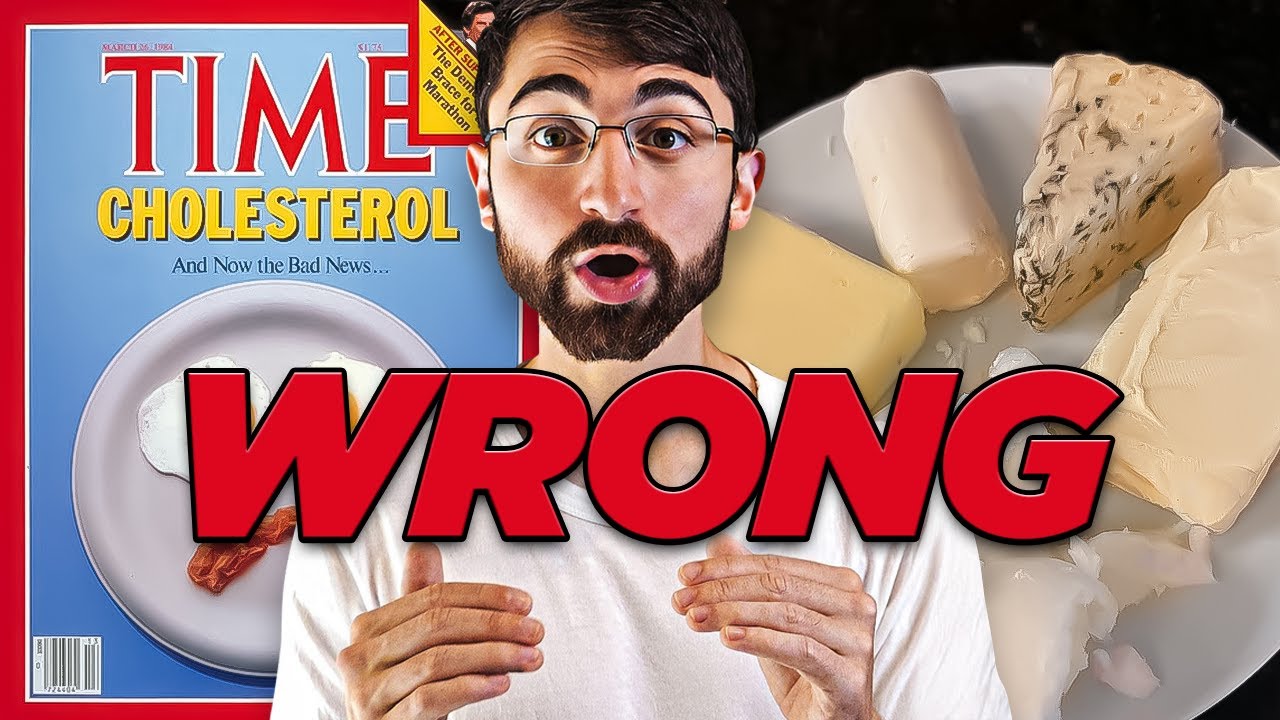
In this video, the presenter examines a newly published 2025 meta-analysis of nine randomized controlled trials (13,352 participants) that investigated whether reducing saturated fat intake lowers cardiovascular disease risk. The analysis found no significant effect on cardiovascular mortality, all‑cause mortality, heart attacks, or coronary events, and no dose‑response relationship between the degree of saturated fat reduction and risk reduction. The speaker discusses methodological strengths (RCT focus, exclusion of observational studies) and limitations (mostly secondary‑prevention trials, male‑dominant sample, lumping all saturated fats together). He then explores why the saturated‑fat controversy persists, citing scientific inertia, financial interests, oversimplification of saturated fats, and individual variability. Detailed examples illustrate how different saturated fatty acids—short‑chain fatty acids, medium‑chain triglycerides, odd‑chain C15, and stearic acid (C18)—have distinct metabolic effects. The presenter advocates for personalized, n=1 experimentation, mentioning his use of a portable cholesterol analyzer (CardioCheck) to monitor individual responses. He concludes that blanket dietary restrictions on saturated fat are unsupported by current RCT evidence, urging guidelines to incorporate nuance, individual context, and rigorous methodology.
Chapters
We've been told for decades that saturated fat is bad for the heart. But is it finally time to stop blaming butter for heart disease? Well, today we're diving into a brand new 2025 meta-analysis, possibly the most rigorous of its kind, that asks the bold question: should we finally stop blaming saturated fat for heart disease? Now, this new meta-analysis of randomized controlled trials reports, and now I'm just quoting, "The evidence available from randomized controlled trials does not support saturated fat restriction for the prevention of cardiovascular disease. Now, this directly contradicts dietary guidelines that place a limit on saturated fat at 10% of energy intake, a recommendation that has been consistent since the first edition of the dietary guidelines published in 1980. Now, the questions I'm sure you're asking yourself are, why is this the still a matter of confusion and debate? And why haven't nutrition scientists and health authorities come to a clear consensus on what seems to be a pretty simple question? I want to name these questions up front because I know they're front of mind for you. I know they are for me. And I promise I'm going to answer them. I'm actually going to give you 4 answers. But first, I want to review the findings of this new 2025 meta-analysis. Quickly, for those who don't know, a meta-analysis is a statistical method that combines data from multiple independent studies to arrive at what is hopefully a more robust conclusion. Now, while meta-analyses are not infallible, they can help provide clarity on topics that lack consensus, like this one. And in this meta-analysis, the authors chose to include only human randomized controlled trials in which the intervention was saturated fat restriction and the primary outcome with cardiovascular disease. In so doing, they necessarily filtered out observational studies, which are at higher risk for bias. And in the end, they included 9 randomized controlled trials with a total of 13,352 participants and found— drumroll— no benefits for saturated fat reduction on cardiovascular mortality, all-cause mortality, heart attacks, or all coronary events. If you'd like more on how to interpret the graphs I just showed, I provide a detailed breakdown in the newsletter of how to interpret these graphs—they're called forest plots. You can go to staycuriousmetabolism.com for more of those nuances. But anyway, moving on. Just because a study finds no effect doesn't actually mean no effect exists. It might just be too small to detect—the study might be underpowered. That's what's called a false negative. And while we can't rule out this possibility, there are complementary ways to approach the data to strengthen our conclusions, or lack thereof. One way to do this is to look for any sort of dose-response relationship, either one that's statistically significant or even just trending. So, simply put, setting aside the jargon, if we rank the studies by degree of saturated fat restriction, do we start to see a pattern emerge? Because it could be that the difference in saturated fat intake between groups in any given study is too small to see an effect. But were this to be the case, we might expect a pattern to emerge where there was more benefit in studies that had a greater relative degree of saturated fat restriction. So was this the case? Did more saturated fat restriction lead to better outcomes? Short answer: nope. Quoting from the paper, "No association was observed between the difference in saturated fat intake and the relative risk reduction or absolute risk risk reduction for any outcomes. So stepping back to summarize high level, the existing human randomized controlled trial data do not support the recommendation to reduce saturated fat intake to improve cardiovascular disease outcomes. That's basically the conclusion of this meta-analysis. So case closed, right? Well, not quite. It would be fair for someone to raise the counterpoint that there are other meta-analyses that come to different conclusions. How could this be? Aren't meta-analyses supposed to synthesize the existing literature to clear up contradictions? How can meta-analyses on a similar topic contradict with each other? Well, to answer that question, different meta-analyses of studies have different inclusion criteria for the studies they cover. And in this particular case, talking about saturated fat and cardiovascular disease, prior meta-analyses have included observational trials, not randomized controlled trials, that are at higher risk for bias. They've also excluded certain RCTs that were included in this study, and they've included crossover trials that carry a high risk for a carryover effect phenomenon that can likewise bias the results. If you want more nuance on that particular topic, see this video covering a new British Medical Journal paper. Now, for these reasons, I think this meta-analysis has advantages, and that's actually better than those that preceded it. So I largely agree with its conclusions. That said, it's not without limitations. It mostly looked at secondary prevention trials, mostly looked at men, not women, and it did lump all saturated fats as one conglomerate. That's foreshadowing something I'm gonna talk about. These aren't criticisms of the author's choices, they're just limitations based on the available data. But now returning to the core question: why is this still a matter of confusion and debate? Well, like I said, I have 4 answers. The last 2 are my favorites, but the first 2 still deserve a hat tip. So, number 1: momentum of the status quo. Science is conservative. Now, that's both a feature and a bug. If the scientific consensus were too flexible, we'd be more likely to introduce errors into our collective majority working model of the natural world, and that's not good. However, by contrast, flip side of the coin, science Science, as an institution, can be overly resistant to shifting ideas, even when the data don't support the consensus. We see that here with the dogma around saturated fat. At least that's my opinion. Or more colorfully stated, because sometimes that sticks, trying to change an entrenched scientific consensus, scientific dogma, is like trying to turn the Titanic with a spoon. And as an academic, Let me tell you, like the Titanic, or the glacier that it hit, the debate and drama around science is usually mostly beneath the surface. 2. Financial interests. Yes, it's true, there are lobbyists and financial interests that have, and could still—still do—bias the scientific literature and dietary guidelines. Indeed, it's true there are members of the Dietary Guidelines Committee with financial ties. To food companies like the vegan meat substitute brand Beyond Burger. Now, I'm not overtly claiming that said scientists allow their financial relationships to influence their interpretation of the literature. Still, I do think it's fair to name financial incentives as a possible factor in perpetuating the existing guidelines to minimize saturated fat intake. But those are the boring ones. Here are the interesting reasons. Number 3: Saturated fat oversimplified. As I mentioned above, in the existing studies, saturated fats are lumped together as a single entity. Now, plagiarizing my own analogy from a prior video, lumping saturated fats as a single article and labeling them as dangerous is the same as lumping all felines into a group and calling them dangerous, even though a tiger could rip your head off with a swipe of its paw, and a kitty is only dangerous insofar as its cuteness factor could be off the scale. Aww, kitty. Different saturated fats have different effects on metabolic health. Here are some examples. First up, short-chain fatty acids. The short-chain fatty acids acetate, propionate, and butyrate are saturated fats. These can reshape the microbiome, act as signaling molecules, and are generally regarded to be overall beneficial for gut and metabolic health. Next up, medium-chain triglycerides, or MCTs for short. You've probably seen them in keto circles as bulletproof coffee. MCTs are processed in a way that is distinct from their longer-chain cousins. Rather than being taken up into the lymphatic system and circulated in chylomicrons, MCTs go directly via the portal vein to the liver, more like a protein or a carbohydrate in digestion than long-chain fats. Additionally, MCTs can circumvent the normal carnitine shuttle system that longer-chain fatty acids need to get into mitochondrial mitochondria to be burned for fuel. The specifics here aren't critical. The point is MCTs have a distinct metabolism. Different saturated fats are different, right? But moving on, here's a wild card: odd-chain fats like C15. Yes, odd-numbered fats are kind of like the black sheep of the fat family, like pentadecanoic acid or C15. In fact, C15 has been proposed to be an essential fatty acid that may improve insulin resistance, improve fatty liver, and improve various metabolic diseases. Indeed, C15 is not readily made by the body, or in appreciable amounts by the microbiome. Lower C15 intake from the diet and lower blood concentrations are each associated with poor health outcomes. And C15 supplementation in preclinical and some clinical studies has been shown to be a bioactive signaling lipid with effects that parallel the associative benefits seen in larger-scale population trials. Bottom line, C15 may be really good for health, including heart health, and if you want more on that, see this video for a deep dive. But moving on, stearic acid, this is C18. The examples of the biological differences of saturated fats just don't stop. Even among long-chain saturated fats, there are diverse metabolic impacts. For example, stearic acid, C18, has been shown to promote mitochondrial fusion, enhancing metabolism, does not increase LDL cholesterol like C16, and may even fight various forms of cancer, including colon cancer. And yes, I have more content on this too if you want to go down the rabbit hole on stearic acid, including these two videos. They're all linked in the video notes. Also, if you want a table of the dietary sources of the fatty acids I just mentioned, you can find that at staycuriousmetabolism.com in the newsletter linked below as well. Finally, 4. Individual variation in response. Let me just name— there are many other factors— genetics, the microbiome, medications, obesity status, macronutrient intake— that can impact how an individual, you or me, responds to saturated fat intake. For example, when I feed myself even an insane amount of saturated fat, 2,000 calories just from saturated fat, 222 grams per day, my LDL cholesterol doesn't change at all. Certainly, that's an outlier response, and I'd caution you against concluding anything about your physiology based on my n=1 experience. However, the point remains, or actually is emphasized, we are all metabolic outliers from the broader population in some way, shape, or form, and failure to accept that reality will prevent you from discovering what makes you different and handicap your ability to discover what works best for you. That's why I always advocate for the n=1 approach, not because I want to promote keto or carnivore or vegan. It's about getting your data in your own hands and safely and responsibly tweaking variables to find what optimizes your health and well-being, and only you can figure that out. Now on that, a quick tip from my own n=1 journey. I've used a portable cholesterol analyzer called CardioCheck, which I got from BloodCheck Medical. It gives you real-time readings for total cholesterol, LDL, HDL, and triglycerides whenever you want, wherever you want. I think it's the best one on the market, and I've included a link with a discount code and more information below if you're interested in advancing your n=1 journey around cholesterol. But in conclusion on this topic and about this meta-analysis on saturated fat, The prevailing dietary dogma surrounding saturated fat restriction has long rested on shaky ground, and this new 2025 meta-analysis of human randomized controlled trials provides a compelling argument to reevaluate this stance. With no statistically significant associations between saturated fat restriction and reductions in cardiovascular disease, cardiovascular mortality, or all-cause mortality, The call for blanket restrictions on saturated fat appears to be scientifically flimsy at best. Importantly, not all saturated fats are metabolically equivalent, and individual variability further complicates sweeping public health mandates. As the scientific community continues to refine its understanding, it's critical that guidelines evolve in step with the best available evidence. Prioritizing nuance, individual contexts, and rigorous methodology over outdated assumptions and dogma. Now, if you found this eye-opening, give it a like and subscribe for more deep dives on nutrition and metabolism. Also, got more questions or just want to share your own n=1 story? Drop those in the comments. I try to read and reply to as many as possible. I really appreciate your contributions. Stay curious. Thanks.