New Science on How Gut Bacteria Control Your Appetite
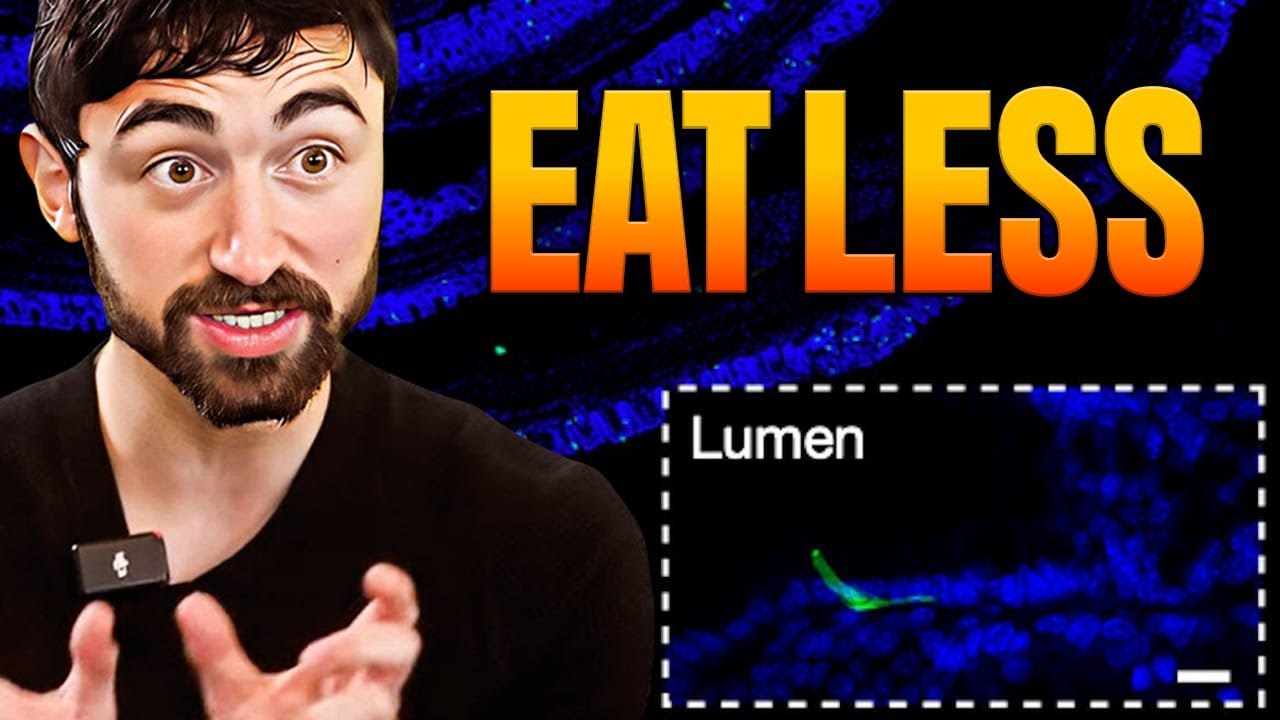
Nick Norwitz breaks down a Nature study showing how bacterial flagellin activates intestinal cells that signal fullness to the brain via the vagus nerve. Mice given flagellin ate less; mice without the receptor for it overate. The pathway exists in humans too, and high-protein meals boost the satiety signal.
Chapters
Your appetite might not belong to you. According to a new study published in the journal Nature, your gut bacteria can send literal signals to your brain that change how much you want to eat. It's being called a sixth sense, a neurobiotic sense. That's right, tiny microbes living in you may be pulling the strings of your hunger. You can think of them as microscopic puppeteers, except instead of making you dance, they're telling you to put the fork down. And then pick it back up again. And this isn't just a fun metaphor. Scientists have discovered the exact biological pathway, the how your gut senses certain bacteria, not the metabolites the bacteria produce, but the bacteria themselves, and then relays that message to the brain. Again, it's being called the neurobiotic sense, the sixth sense. The senior author of this new research actually told me these findings and the discovery of the neurobiotic sense, they mark the beginning of a new era in understanding how our senses shape our bodily reality. It's a bold claim, but I actually agree. By the way, the senior author's name is Professor Borquez, and if you want the full Q&A, you can find it in the newsletter linked in the video notes. But with that, let's get a little bit deeper into our scientific story. Specifically, the researchers discovered that a key component of bacterial tails, a protein called flagellin, again, a structural feature of these wavy whip-like tails, it can actually trigger a signal by acting on your intestines, kind of tickling your intestines, a signal that travels all the way up to your brain to alter your desire to eat. Again, I keep on coming back to the puppeteer analogy. Your microbiome is like pulling on your appetite strings, except your name isn't Pinocchio, it's Pinocchio— oh no, I just ate a sleeve of Oreos. But jokes aside, this is real and fascinating science. And before diving into the new data, which we're about to get to, let's back up. And I just want to give you the tools you're going to need to understand what's going on. First and foremost, you didn't evolve alone, or more correctly, we humans didn't evolve alone. We co-evolved with the billions of microorganisms that live inside us. In many ways, they are a part of us. They make me me and you you. So it makes perfect sense that our bodies would have evolved ways to listen to these microbes and adjust our behaviors in response. And one of the ways our bodies listen is through a remarkable sensor system made up of what are called neuropod cells. These neuropod cells are specialized epithelial cells. They live along the lining of your gut. They stretch inside your gut into the intestinal cavity known as the lumen, kind of the inside of the tube, and they connect directly with the nervous system. So they have kind of these sensors that reach out into the lumen of the intestines, and then they're anchored in the intestinal wall where they connect with the nervous system. In this way, you can think of neuropod cells as tiny biological bridges. They translate signals from the microbial world inside your gut into chemical messages that your body and brain can understand. And at a high level, this new study shows that these neuropod cells can detect this bacterial flagellin, the component of the bacterial tail, via a receptor called Toll-like receptor 5. We're going to get into more details later. And when the flagellin activates this receptor, the neuropod cells release they release a hormone. It's called PYY. Again, we're going to talk more about this hormone later. And this sends a signal, a satiety signal, via the 10th cranial nerve, the vagus nerve, to the brain. That signal is, "You're full, stop eating." So with all of that, I realize that was a long preamble, you're probably hungry now since you've been fasting. Anyway, let's look at the primary data. First, here's an image of an actual neuropod cell. In this experiment to kind of demonstrate where the neuropod cells were, researchers genetically modified mice so that neuropod cells producing this PYY satiety hormone would glow green under the microscope. So that's what you're seeing, green neuropod cells. And notice the green projection reaching into the lumen of the intestines like cellular antennae. Meanwhile, the body of each is anchored into the gut wall, physically connected to extensions of the vagus nerve going to the brain. So that's where neuropod cells are. They're the bridge between the intestinal lumen and the vagus nerve to the brain. Now let's prove what they do. Now, before we move on, a quick tangent. I want to thank the sponsor of this video, Chapter. I know sponsor messages can feel like a pill, but bear with me. This one's important and could save your life or your parents' lives. First, here's a transparency statement from me. After two doctorates and over a decade of higher education, The US healthcare system and insurance markets are still the most complex thing in the universe to me. It's more complex than if the Krebs cycle swallowed the chronic cascade and chased it down with a glass of quantum biology. But here's why this really matters. The right health insurance can literally improve all-cause mortality. And that's not just a correlation, there's causal evidence for this. The methods are kind of complicated, and you can see this Nuance Note letter for more. I've linked it in the caption. Anyway, that is why Chapter exists. It was founded by people whose parents were scammed by sleazy Medicare brokers, and they vowed to fix the system, and actually built a model that does just that. They search every Medicare plan to match you with the right fit for you. And Chapter is fully independent. It searches every Medicare plan available to find the one that truly fits your needs and priorities, and you'll always talk with a real human, too. And their advisors aren't compensated based on steering you to a particular plan. That means the results are savings for you in 3 currencies. Money— the average user saves $1,100 per year. Savings in stress— it's always nice to talk to a real human and have them handle it for you. And even maybe savings in life years. Now, if this could help you or a loved one, we've set up a phone line, 815-STAY-CURE, as in stay curious. That's 815-782-9287. Metabolic health is life insurance of a form. But you also need the right real health insurance. Thanks for listening, back to your main program. Now let's prove what they do. To test the system, researchers delivered flagellin, the key protein that makes up this bacterial tail, directly into the colon of fasted mice via an enema. They then measured how much the mice ate once food was supplied. So yeah, a flagellin enema. Science! Pushing the boundaries of knowledge. And colon walls. And surprisingly, even though flagellin has no meaningful nutritional content, the mice treated with the flagellin enema ate significantly less than controls, and that suggests that flagellin alone is sufficient to promote satiety. So a component of bacteria living in us can send a satiety signal, even independent of food. Now, next question, going down the chain a little bit, is that receptor TLR5 actually necessary as part of the pathway? Well, Yes, when researchers genetically deleted the flagellin receptor from neuropod cells, mice overate, gained weight, and stopped responding to flagellin. And then using a series of further experiments where they activated or blocked elements of this pathway, the researchers untangled the biological domino chain which we already discussed. Flagellin, as part of bacterial tails, activates Toll-like receptor 5, TLR5, causing the release of the satiety hormone PYY, which signals the vagus nerve to tell the brain stop eating. And this is fascinating because it reveals that your gut bacteria aren't just passive passengers; they're active participants shaping your behavior, including your hunger. So this study offers direct evidence that specific bacterial components can interface with neural circuits and influence how much you eat. That's fascinating, isn't it? Now, to be precise, and I've already said this, but the key research was done in mice. You need to do these sort of experiments in mice, but that's not a disqualifier. Neuropod cells are known to have similar functions in humans, and a growing body of literature, even beyond this paper, makes it clear that the microbes living on and within us, they do alter our behavior. So if you want another example, in this case how a bacteriophage may contribute to food addiction in humans, you can see this video. The examples are actually boundless, and the concept that our bacteria can influence our minds and behavior, I know it seems wild, But it's remarkably logical and consistent with what we know about biology. So yes, your body listens to your microbes and acts on what they're saying. The science is complex, but the takeaway is simple: they, microbes, influence our behavior. And internalizing that simple, humbling message, it's a paradigm shift in how we think about appetite, obesity, and even mental health, all of which are deeply linked. By gut-brain communication. But this isn't a fatalistic message. I know I made the puppet jokes, but really the way I see it is this opens up new possibilities for how we might better understand and intervene on our own biology. If microbes can shape appetite via gut-brain signaling, then maybe we can harness that communication channel too, to our advantage. So this isn't about surrendering control. It's not about saying, "Oh, Dang it, I'm a puppet. It's about gaining insight into a deeply interconnected system and learning how to work with that system, not against it. With that, I want to give you an example, talk about working with the system, in this case, satiety hormones. That PYY hormone we talking about, it's a satiety hormone. It's known to be reduced also in individuals with obesity. So for example, a study published in the famous New England Journal of Medicine found that fasting PYY levels, levels of the satiety hormone, were 40% lower in people with obesity as compared to lean healthy individuals. And they found that PYY levels correlated negatively with body mass index . So this is consistent with the idea that people with obesity have a PYY satiety hormone deficiency of sorts. However, when either lean or obese people were infused with PYY in a double-blinded placebo-controlled crossover study, both groups reduced food intake later at a buffet lunch. So, the keep it simple stupid version is: PYY decreases food intake and it's reduced in obesity. So the next obvious question I know you want the answer to is how? How do you boost PYY levels? Well, I don't recommend a flagellin enema just yet, there's an easier way to do it. Protein. Protein is a potent stimulator of PYY, providing another mechanism by which protein promotes satiety. For example, in one study, when participants were given calorie-controlled meals that were either high protein, high carb, or high fat, the results were that PYY levels rose much more and hunger declined much more after the high protein meal. So again, stepping back and giving you the keep it simple stupid version, it turns out the real secret to eating less isn't willpower, it's eggs. Probably eggs. But jokes aside, I realize the idea of eating more protein to promote satiety is not revolutionary most of you, but maybe now you have more insight into how protein promotes satiety. And I think insight counts for something. And granted, while this insight into protein satiation power intersects somewhere along the flagellin pathway, it's not at the point of flagellin itself, and I'm not recommending, again, a bacterial tail enema, but I did want to share these new data with you because I feel this study highlights how we're only beginning to understand how deeply interconnected we are with the microbial world inside us. These new data give us a glimpse into the hidden architecture of appetite, a reminder that behavior is not just a matter of choice, but of biology, context, and communication. And building awareness of this fact isn't just intellectually satisfying, and I think it is, but it's a first step towards living more consciously with your own body. And I think that's really powerful. Tell me if you agree. Tell me what feelings this video left you with and what you want to learn more. Stay curious. Thank you for your attention.










