Nick Norwitz PhD - Can keto treat ANOREXIA?
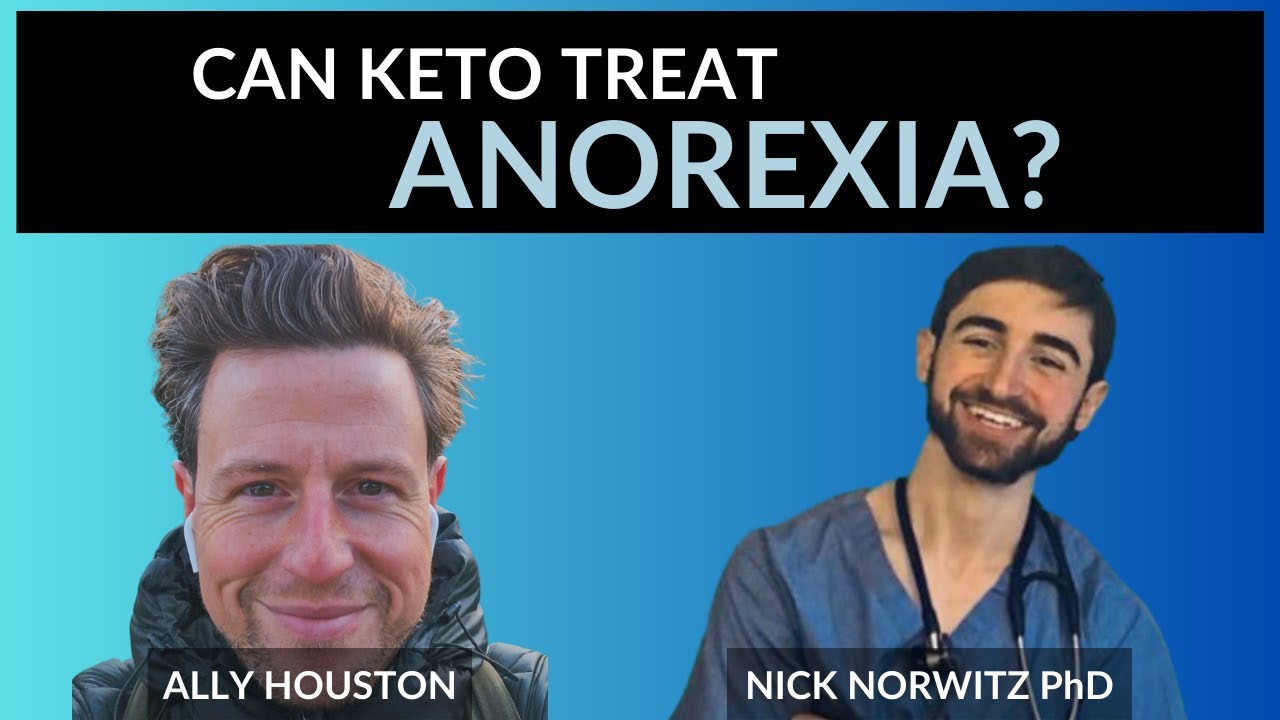
In this interview, Dr. Nick Norwitz discusses a recent case series of three patients with severe, treatment‑resistant anorexia nervosa who adopted an animal‑based ketogenic diet and experienced dramatic clinical improvements. The patients, all with BMIs below 13, had previously endured life‑threatening complications (blindness, liver failure, cardiac arrest) and failed standard therapies. After switching to a high‑fat, low‑carbohydrate diet, they reported rapid reductions in anxiety around food, restored appetite, weight gain, and sustained remission, with one patient describing a profound “seeing herself for the first time” moment. Norwitz frames anorexia as a neurometabolic disorder, arguing that ketosis provides potent neuromodulatory effects similar to those used in epilepsy and other psychiatric conditions. He contrasts the conventional “all‑foods‑fit” refeeding approach with a more targeted ketogenic strategy, noting potential advantages of an animal‑based regimen for gut comfort and microbiome reset. Safety, ethical, and practical concerns are explored: the need for careful patient selection, biomonitoring (ketones, glucose, lactate), professional support, and the distinction between efficacy (ideal conditions) and effectiveness (real‑world implementation). The conversation also touches on adjunctive treatments such as ketamine and psychedelics, the emerging Metabolic Mind trial, and broader questions about diet composition, plant‑based versus animal‑based keto, and the role of the microbiome. Throughout, Norwitz emphasizes the anecdotal yet compelling nature of the data, the necessity for further research, and the importance of offering low‑risk, potentially life‑saving options to patients who have exhausted other treatments.
Chapters
Thanks for joining us, Nick. Um, so last week, um, or in the last week, you put up your, um, recent case series paper on anorexia and a ketogenic diet.
Mm-hmm.
So nobody better than you to introduce it. Why don't you maybe outline what it's about and, um, say how it's been since you, since you released it?
Sure. So broadly speaking, this is a case series of 3 patients who had very severe treatment-resistant anorexia nervosa. All of the patients had had it for years, had tried lots of different forms of standard of care therapy, had pretty complicated disease courses. This isn't just a matter of having a little bit of a low weight. Their BMIs were There are 3 patients, 10.7 and 11.2 for the 2 females and then 13.0 for the male. So these are extremely low weights. And what comes with that is not only increased chance of death, but generally other mental health comorbidities and complexities of just having low body reserves. So one patient even went blind because she lost so much nerve— fat in her optic nerve. One patient had some liver failure. Another patient— cardiac arrest. So these are very severe cases. And what happened with all 3 is they ended up trying an animal-based ketogenic diet and it was life-saving for them. All of them report diminution in their anxiety, particularly around food and other mental health issues. And because they had less anxiety around eating food, they were able to start to renourish. They felt their brains were working properly and then they went into remission that's been lasting to date. Now, just for a little background and context, this is really interesting and quite incredible in the context of the fact that one, anorexia nervosa is a very severe and condition with few treatment options that are effective for long-term care. So the relative mortality rate is like fivefold over the general population, at least. In the first year of treatment, generally, the relapse rate is as high as 50%, although based on definitions, that number varies. But the idea is standard of care doesn't really effectively treat these patients for long-term success. And that's not a controversial statement. I think anybody in the fields of eating disorder or psychiatry would agree that treating eating disorders and particularly anorexia can be very challenging and frustrating for the patients and, and clinical teams alike. And then another interesting thing is obviously the elephant in the room, a ketogenic diet would seem to conflict with the concepts generally pointed to, to treat anorexia. So anorexia, it's a disease of food restriction and low body weight. Ketogenic diet is whether or not you like the term, by definition is a restrictive diet and generally used for weight loss. So they would seem to like basically point in the same direction and therefore a ketogenic diet would appear to be contraindicated in the case of anorexia nervosa. And you know, that's what basic logic would say if you just think about it superficially. But there's another way to think about it. And that is that ketogenic diets aren't actually weight loss diets. They're diets that have a whole host of effect on metabolism through ketogenesis and restricting dietary carbohydrates. And that includes very potent neuromodulatory activity. As you and probably a lot of your listeners know, ketogenic diets have been used for epilepsy for over 100 years. And more recently, their use cases have been expanded, particularly with neurological and mental health conditions, including neurodegenerative conditions, And lots of, or, or, you know, there are case series level data in eating disorders like binge eating, sugar addiction, bulimia nervosa, and then other mental health disorders, depression, schizophrenia. So one could argue, okay, maybe through neuromodulatory effects, if we're framing anorexia as not just a social mental health disorder, but as a neurometabolic one, that it might actually have some therapeutic efficacy. So, you kind of have these, these two different parallel lines of logic that I've laid out. One saying anorexia, you know, no, don't go near a ketogenic diet if you have anorexia. And the other one's saying, you know what, there might be something here. And what we have in these three case series is, you know, cases of patients who really struggled with standard of care, adopted this way of eating, and it saved their lives beyond anything any of them could have imagined. Really powerful testimonials from these patients and pretty comprehensive case histories. So, it's definitely not, you know, a randomized controlled trial. I don't think we'll have one of those if ever or for a long time. But based on the resources available to study this kind of thing, I think it's definitely intriguing and the feedback has been overwhelmingly positive. Definitely there are some emotional reactions, we can get into that, but overall people have been very excited about this. So I've been very happy with the reception.
Well, that's brilliant. Yeah, thanks for elucidating. The, the kind of, the really kind of controversial thing, I guess, is that eating disorders do have a psychological component.
Mm-hmm.
And there's a social component, which includes the notion of triggering an episode. And I'm obviously delighted for the people who are in the K series who have got better. It's wonderful. Like you say in the paper, it's a de— to use the word devastating condition. And you say there's a 5x chance of death over risk of death over the general population, and it's like a 10% mortality rate or something. Really, really nasty. And when I had Agnes Aiton and Ali Ibrahim on the podcast a few years ago talking about their their paper, which is called The Western Diet: A Blind Spot of Eating Disorder Research.
Read it yesterday. Yeah.
I mean, they, they, they talk about the fact that, you know, nobody's binging on lamb chops kind of thing. And bringing up all these points that there's metabolic and neurological pathways which exist that if we understand them and we research them,, then, uh, dietary patterns which act on them can be applied, suggested judiciously. Now, when I interviewed them, we got quite a lot of backlash from people, including, you know, a prominent journalist who had a past eating disorder and said the phrase, you know, surely the main goal for eating disorder is for patients to eat all foods. I wonder if you could talk around that statement, maybe.
Yeah. Well, first of all, I want to be sensitive to anybody who might be listening. We have a lot of people, or I've known a lot of people with eating disorders with different backgrounds and roads towards recovery. So I realize this is a charged issue. So if I, you know, offend anybody, I apologize. I think at some level that might be difficult to avoid. But what I can speak to is the experiences of our patients, all of whom had tried the All Foods Fit approach. That was the term they were using in some way, shape, or form. Their, you know, team was asking them to have, quote, normal foods, including pizza and ice cream. And this was being pushed upon them because, again, it's easy to put anorexia into a sociological framework, which at some level we should, but that shouldn't be the only framework. And to think about, all right, what are the, you know, what's, what's the unhealthy relationship with food and how can we combat that? And, you know, the simplest way on the surface of it would be resist the urge to restrict, period, end of story, because that's the problem. The issue with that is I think for a lot of patients, it, it doesn't really work. And the reasons might be a fewfold. As Agnes and her colleague lead out in their paper, I think there is something about just, you know, having a fully nourished brain that's important. And then there's something about the anxiety and loss of control that might come with eating a standard Western diet. So not only is your brain maybe not nourished so you can't think properly, but for a lot of patients, including ours, Restriction is a way to exert control when you might not have other, you know, ways to control your life. Maybe there has been a sexual trauma and you feel things are spiraling outta control, but you can control what you eat. So control becomes very important. And when you adopt a, a westernized diet that's kind of high in sugar and refined carbs and you go on this insulin rollercoaster, Uh, I can only imagine there's a sense of loss of control that is very anxiety-provoking. Um, it's said that the mindset of a lot of people with anorexia is that they're fearful things will get out of control and they'll gain a lot of weight and get fat, even if they don't consciously believe that. Like, they internalize that message emotionally. So if you try to refeed with things that are high in sugar and you get these cravings, I'm sure that can be very scary and make you feel like you're losing control. We had a patient that even spoke to this where he's like, he really wanted to get better. This was patient 2, the pseudonym is Trevor O. And he got to this place where he was like, he was working with a nutritionist and trainer and they were like, okay, all foods fit protocol. And he really went for it. Like he was really trying. He'd eat like 10 pancakes and pints of Ben and Jerry's ice cream and really just binge on a standard American diet, 3,500+ calories per day. And I'm sure his team gave him a lot of positive reinforcement for that, understandably so, because he's underweight and they wanted to gain weight. But what would inevitably happen is, although his weight kind of trended upwards, still remained like a BMI of 17 or below, but although it trended upward over time, his anxiety worsened and he'd go through these binge-restrict cycles. So he'd eat a ton one day, feel horrible, feel horrible about himself, and then restrict again. So psychologically, um, neurologically, he didn't really seem to be healing. His mental health was getting worse, even if the BMI trickled upward a little bit. So there are different philosophies on that. My understanding now is the field is trending towards more of a, a whole foods diet refeeding approach, maybe with the same mentality of really you do wanna nourish the body and you wanna have people adopt healthy eating practices while refeeding. So we kind of have this spectrum of the all foods fit, okay, let's just directly combat the restrictive eating psychology by saying, okay, good, eat pizzas, eat ice cream. I still think that's probably predominant. And, and then we have kind of a trend towards let's refeed people with healthy natural whole foods. At the extreme end of that will be let's feed people with a diet that has potent neuromodulatory properties and is restricted in carbohydrates, but actually might help heal some neurometabolic disorder that we don't really understand. Um, but nevertheless, there probably is some neurometabolic signature of anorexia nervosa. And I think with the tools that are arising in the next 10, 20 years, we'll kind of get a better understanding of the neuropathology of anorexia because right now the brain with respect to that disorder is basically a black box. And so I think people kind of like tend to ignore the fact that at its heart it's a neurological disorder like any other.
Yeah, there's something that's, um, that comes up again and again, which is quite difficult around, you know, neurological or psychiatric illnesses, is that, you know, it's particularly with psychiatric illnesses, you're, you're looking to a list of symptoms in the DSM rather than, rather than being able to rely on certain metabolites, you know, like part of the thing that makes kind of Virta Health such a a clean experiment, if you will, is they're looking at HbA1c over 5 years and then there you go. So, I know that lactate and continuous glucose monitors and ketone measurements are becoming really important for people trying to control psychiatric illnesses. But, and, and even to some extent measure progress and recovery from things like you know, ME, chronic fatigue. It'd be very interesting to see where it goes with something like anorexia and, and similar, you know, do you see any early signs that there's a, a, a, a metabolic understanding or does it fall into the same category of it's great that a ketogenic diet works for some people, but we don't quite understand why yet, even if we have some really compelling theories.
Yeah, I, I mean, I think overall the field of psychiatry is turning in that direction with, um, multi-omic approaches more at the research and then maybe clinical level. So maybe doctors collecting the data, um, to really understand the, the genetic microbiome metabolic, uh, fingerprints of anorexia. Right now that picture's starting to resolve, but it's not really clear, is it a cause or an effect? A lot of people propose if you just take a snapshot, oh, this is an epiphenomenon of the restrictive disorder. But it's not necessarily clear that that's the case, including in the brain, and actually might be the cause. We're still sussing that out, um, and developing tools will, will help us do that. As for providing direct tools for anorexia in the same way you might like diabetes, like a continuous glucose monitor, because I've actually heard that proposed, um, as a form of biofeedback. I do think that becomes a little bit tricky because of course anorexia has a sociological component. And one would need to be pretty cautious about kind of promoting orthorexia in the context of anorexia. And so having patients kind of focus on their mental health feels as our, our patients where they actually just felt less anxious, they felt better, I think will be a good first step. It doesn't mean that biofeedback couldn't be integrated in the long term. And I think that, you know, that comes down to like the science versus the art of medicine. If you're a clinician dealing with your patient and you know they love data and might actually respond really well to tracking their lactate and ketones and blood glucose, and you think that might be therapeutic for them, I think that'd be a call that you could make as an individual clinician treating an individual patient. But a population scale, that's something that I don't even, that I'm a little bit uncomfortable even, even going towards. But I think it's definitely something that we should consider. And I think, More broadly with respect to anorexia or any conditions like it where it's like, it's a, a chronic condition for which we have very little good long-term care. I don't think anything should be off limits with respect to asking, could this potentially work? And I wanna highlight that because I feel like a ketogenic diet goes in that bucket where it's like, it's assumed to be contraindicated, but it's a question that really hasn't been explored. A case series isn't gonna change standard of care by any means. But it's something that really has the potential to change and save lives. And I'm convinced of that after talking to the patients that I talked to. Remember, I interviewed each of them for a few hours, and during each conversation, my jaw was dropping to the floor, like, repeatedly, to hear them talk about their story and how powerful this intervention was for them. You know, and it's, it's not something that I know there's going to be a subset of people that say, oh, it's just anecdotes. Well, no, it's, it's human lives and it's clinical experience. I can highlight a few quotes. One that really stood out to me, maybe more than any other, was our third case. The pseudonym was Amelia F, and she had a 30-year history of anorexia and tried all sorts of things and suffered for 30 years. And after she went on a high-fat animal-based ketogenic diet, she said, like immediately she looked in the mirror and for the first time ever really saw herself, like truly saw where she was in life and had that calm resolve to just get better. And all 3 of the patients have said, you know, I am now confident that I'll never go back, which is nothing they could have said before. So, you know, you're not convinced by me. These people are actually coming out with their identities of their own volition. They really want to so that they can be a resource for other people. I think hearing from them and just hearing the attestations of not only them, but actually since the release several days ago, I've heard from at least 9 individuals who have treated anorexia with a similar approach, which is astonishing, including here at my own institution within Harvard. I've gotten a couple of emails from other Harvard, either faculty or students, so leave it vague. But if saying, look, actually this is in a sense me. And it's really hard for people to come out and talk about these kind of things because there's a huge stigma around it. Nevertheless, I think, you know, the, the 3 patients we highlighted were definitely on the extreme end of the spectrum, but there's biological plausibility here. There's actually a basis in other, one other case series and another small pilot trial with a ketogenic diet ketamine co-therapy. But it's something that I think has, incredible potential with very little downside. And I wanna highlight that because I think that's just generally the fact with nutrition interventions, there's typically very little downside. I mean, okay, maybe most people think an animal-based ketogenic diet isn't the healthiest eating steak all the time. Setting that aside, that's a whole nother debate. If a patient is interested and goes to their doctor and they've struggled with anorexia for years and they tell their doctor, look, I wanna try eating more calories, but specifically I wanna eat it in butter, bacon, and steak. You think the clinician's probably gonna be pretty excited and willing to support them on that. So it's something that I think is, is worth exploring, if for no other reason than the downside is pretty low and the upside is life-saving.
Yeah. You know, I hope the downside is low too, and I've had clients who've, you know, I'm a huge advocate of using ketogenic diets to improve your mental health. That's what happened to me, uh, 7 years ago. It was like a quantum leap change. I switched careers to a career that didn't really even exist. I just thought, I have to make this happen for other people. Um, but for some people it's very difficult and actually can make things a little bit worse in a sense, because they, they maybe have some support from the prescriber if they're on an existing, you know, prescribed therapy. But it's a bumpy road. You know, there is a risk that things get worse before they get better. And in the situation with something like anorexia, where someone's physical and mental state is on a knife edge, you know, it could make things worse. In a really, uh, life-threatening way before it makes it better, if it will consistently make it better. And we can talk about the, the sort of stats side of things, um, as a baseline afterwards. But, you know, what, what do you think about the risk?
I, I think that's a very legitimate argument. I'm going to highlight a nuance that I think is very important, and that is that, you know, the patients in our, our series were all in a sense, well, completely self-selected. They like adopted to try this. And the scenario I just laid out a minute ago is, you know, if someone were intrigued and went to their doctor and asked for like, I want to try this and, and do this, and this is the support. I think, you know, somebody being interested in trying something new and seeking help from their healthcare provider is one thing. And it's very different to be pushing a method that is really unproven, which is where we are right now. So by no means way, shape, or form would I be advocating, saying, or spreading the broad message people with anorexia should try this, or having, um, healthcare experts or healthcare providers in general push this on people who, you know, aren't seeking it in and of themselves. I'd be pretty cautious about, you know, prescribing this. Wouldn't be something that I would do in, you know, an RCT right now. So there's the people that are interested and wanna try it with medical help versus like, you know, broadly messaging, this is a good thing. I think the former's fine, latter not great. And formulation with ketogenic diets for any disease state is really important. It, like you said, can be a bumpy road because of the food environment we live in, which can make it very difficult because of lack of education among the general public, but also among clinicians and other healthcare providers. In terms of how to formulate a ketogenic diet. But this is no different than any other medical intervention. You wouldn't just like say, okay, a patient has type 1 diabetes, here's a bunch of insulin, go do stuff. Like you give 'em instructions and you give 'em education. And so I think we should deal with, you know, dietary interventions that have the same or greater potential than pharmaceutical interventions in the same way where we provide people with support in the form of, you know, ideally daily support and support group and health coaches. I think Dr. Tro's model's fantastic. If people don't know about that, he is working with some groups and they're having amazing success with that like daily check-in model. But if not that, just, you know, an interest in an expertise in this on the side of doctors and hospitals. Because right now the fact of the matter is a lot of institutions don't have support around a ketogenic diet. They don't have a dietitian specializing in this or one that necessarily is, is proficient in providing support. So it's a little bit of a straw man since like reality, I guess I would say with respect to ketogenic diets because it's like if you knew what you were doing and could do it right, maybe it has a lot of potential versus what you might actually be able to execute based on the resources available. And that's the distinction between efficacy, the ideal scenario and effectiveness, which is real life. Which is something that is very important to highlight. But I think the onus there is more on the medical establishment to say, okay, if there's potential here, we really need to study this more and become, become proficient in providing support. Because to have people do this on their own would be potentially dangerous just because, you know, they might do it incorrectly. So like for example, might use it as an excuse just to eat lean chicken breast and tuna fish, which would obviously not be ideal. So as with any diet or any pharmaceutical intervention, I think, you know, we need to support people properly. Yeah, absolutely.
And again, it comes down to this distinction between the art and science of, of medicine, of understanding human behavior. You know, the average study participant is not a human being and the, you know, the application of knowledge is, is different from the knowledge of knowledge. And it, it, it's going to be an exciting area, I think, because these are very powerful anecdotes. It's circling back to talking about gaining some control, you know, and keto is being best described as not a weight loss diet. I would agree. It's, it's an appetite control diet in my opinion. And, you know, very often with clients, they, I, I want to find out from them what measures they would like to put in place to track progress, if that's what they want to do. You know, sometimes it's enough just to talk about how they feel, what their emotions are like, without even thinking about how they look. And sometimes they just want to talk about how they look in the mirror.
Mm-hmm.
Like, um, Amelia F, who felt like she was seeing herself for the first time. Yeah. Um, certainly it can be as specific as some people don't want to talk about their weight in kilograms because it's triggering. So they stick to pounds because that's not what they've been dealing with their whole lives and obsessing over. Yeah. You know, often you can individualize these sort of interventions so that you, you don't trigger people and that whilst the body composition is improving all the while, you're, you're, you're doing it in a way that's safe for that person, but that seems quite difficult when we're still at the stage of debating whether this is even safe or not.
Yeah, I mean, you do need some sort of biomonitoring for safety in any health condition, whether or not the patient's blinded to it. They, you know, kind of need to be tracked. You can change units if that helps for people. And, you know, I think that there is framing that can be done for any individual, but I'm not exactly sure how this translates into each practical scenario. I don't know if there's a question you want to clarify that I can respond to, because I could, you know, imagine scenarios for any person and like talk through that person with it. But I'm not going to say don't weigh yourself. Kind of thing.
Yeah, no, absolutely. I have a habit of doing this, um, sometimes presenting a thought salad and seeing what comes back, um, from the chef at the other end. But I mean, maybe going in a different direction, you know, thinking about trying to get a baseline of numbers, um, about half of people who, you know, fit the, the symptom list of anorexia make a full recovery. So, um, you know, maybe 30— about a third of them improve over time, and maybe 1 in 5 just remain chronically ill throughout their life. So what, what would you— what would you see as a, as a win, um, in folding in a ketogenic diet approach over the long term? Do you think there's a way of predicting what's a likely good outcome from that?
I mean, in terms of long-term outcomes, I think differentiating a patient's mental health response to prior things they've tried would be pretty telling. You know, hindsight's definitely 20/20, But the way our patients spoke about their experience, it was like a light bulb went off in a way that it never ever had. And like with anything in mental health, there is a huge subjective component. But the subjective component reflects the human experience. So I think it's something to be taken very seriously. Talking about remission is not just changes on the scale, but as changes in mental health state. And we, we can try to quantify that, but also recognize that these aren't like, okay, two pillars, physical health and mental health. They're directly intertwined. And so when patients are reporting they're better and they're not having anxiety around food or body image, it predicts that they're gonna be successful in the long term because it's something that, you know, they're, they're happy to sustain. Whereas if somebody's weight goes up, but they're still reporting a lot of anxiety and focus on calories and, and body image, I would think that there's a higher probability they're going to relapse at some point. Could be 1 year, could be 2 years, could be 5 years, could be 10 years. But something needs to go on to kind of treat the underlying neurometabolic psychiatric condition. And that I think will be a combination of, you know, talk therapy, you know, and sociological interventions, but also, you know, healing whatever's going on neurometabolically. And again, that's not something we really have pinned down right now, but we can kind of take best guesses at what might be good for, let's say, healing the brain to put it in very hand-wavy fluffy terms. Ketosis makes sense.
Yeah, I'm, I'm I'm fine with hand-waving fluffy terms for when it comes to things like wisdom, intuition, emotion. I think we reach for, um, we reach for units to describe it if we're trained in science, but very often with these things you need metaphors to even get close, and even then it doesn't quite describe it.
Yeah, I mean, I'm not satisfied with hand-wavy fluffy terms, but what I would say is using them as a placeholder for an area where we can confidently say, I don't know, but we need to explore, is appropriate. Doing it to brush it under the rug is inappropriate. But all I'm saying right now is I think we're going to come to a point where we can discover something works empirically before we really know how it works, just because of how difficult it is to study. And we shouldn't shy away from, you know, testing things, testing things empirically, including ketogenic diets for anorexia before we can say, all right, here are all the pathways and we know exactly what's going on because that is probably understanding that's decades away.
So anyway, yeah, I'm, I'm, I'm kind of intrigued by the, the numbers again because when, when I talked to Chris Palmer on the podcast, And when I talk to Georgia Eade, the numbers that tend to fall out, and it's not exact, is maybe a third of people almost feel like it's a kind of Damascene moment where their life changes forever and they think, you know, I'm never going back. And that was certainly true for me with my mental health. And then there's maybe two-thirds of people where it either doesn't do as much as they would like. Straight away, or it doesn't help. And I guess, um, it's gonna be really interesting to see how much a ketogenic diet intervention affects anorexia in that way and other eating disorders for that matter.
Yeah, for sure. I think the question of generalizability is, is the big one at this point in time. I guess what I'd say to that is, let's say it's a third. If, if, if, if by trying it, a third of lives can be saved, then that's an incredible intervention. So it's, it's not, no one's making the argument that we know it's gonna be a silver bullet, but there's one element of, you know, if it can be done safely as an intervention as part of, you know, serial treatment options, everybody, you know, is always trying something different for different conditions. And this goes the same with drugs. Maybe you won't respond great to one, so you're gonna try another. Again, just the art of medicine. Not necessarily with any, like, real rationale. But on the other hand, you know, maybe by seeing who responds and who doesn't, we can start to understand what are the factors that predict somebody's going to respond and then target therapy a little bit better and understand what people that are responding are doing that might be different. Again, drawing a highlight upon the difference between efficacy and effectiveness. Just because something— somebody's trying something doesn't mean— and this is gonna come off as kind of blamey, but doesn't mean they're trying it, quote, right. Not because they're not actually trying, just because there are a lot of variables that might be optimizable in order to increase the, the, you know, effectiveness towards the efficacy of the intervention, you know, giving it the best possible shot. So, yeah, I, I Of course, I'm going to be very fascinated to see, and based on upcoming and future trials, what the generalizability of this is. I would predict it's probably going to be pretty high, but then again, I, I have certainly a selection bias, but it has been pretty high in other mental health conditions. So I don't know why it wouldn't, uh, wouldn't be decent here. There was the prospective trial by, by Georgia Ede and, uh, Dr. Dana out of France, and that was 100%. Um, for bipolar depression and schizophrenia. So if it can pull 100% for those 3 conditions, I don't know why it wouldn't pull high for other mental health conditions. Yeah.
And bringing back in the qualitative aspect of it, you can put a number to some, uh, measurement of full recovery or, um, uh, partial remission or remission to the point where you can live your life again. But certainly when I asked Georgia Eid, you know, what's the difference between a, a win in your old style, you know, blended drug and psychological kind of psychotherapy psychiatry practice versus with nutritional? And she said, well, I mean, sometimes when you give people psychiatric medication and psychotherapy, they can go back to work, they can finish their university degree. These, these are not small wins. But she said when it's a real win with nutritional psychiatry, they feel better than they ever have. And I get the sense that that's what you were hearing from the people in your case series. And I just wonder whether you've— in sort of reviewing the literature and so on, do you ever get the sense that that happens to people with anorexia in other treatment modalities or just spontaneously?
Yeah, I think that's a very good question. And, and to kind of cut to the heart of it, I, I'm, I'm not aware that it happens to that extent. And our patients are even saying they were told this is going to be something they deal with their whole life in some way, shape, or form. There's always going to be that voice nagging. That they're always gonna have a pathological relationship with food. And the reporting that has all but, you know, disappeared for them and that they're not only able to, you know, engage in life, but to use a colloquialism, like win at life. So our first patient, you know, she was at a point in her life where she almost died a few times. She had a son and she couldn't really engage with him. He would come up to her when he was like 4 and she was in a wheelchair because she didn't have enough muscle mass to like move around, BMI 10.7. And he would take his little fire hose from his toy fire truck and stick it up his nose to mimic his mother because that's like what he knew was normal and how he kind of engaged with her. And now she's at a point where, you know, she's taking him to trampoline parks for his birthday. She's working full-time as a civil engineer. Full custody of her son. They got some new puppies, and she— and this is quoting from the paper— reports pleasure in life and optimism for the future. Um, so yeah, juxtaposing the idea that you're always going to struggle with this, this is going to be something that you kind of— you battle your demons your lifelong— to let's go jump on a trampoline, and I have a full-time job, and let's get some puppies too, just for the heck of it. I mean, that contrast couldn't be stronger. Even if it is an anecdote, I mean, it's, it's, it's pretty remarkable. So yeah, our, that was something, I mean, that was basically the reason that I thought these cases were so important to write up is because they go so far beyond what is expected for recovery, not just in terms of BMI, but in terms of what they're reporting with respect to their mental health state and how enthusiastic they are for, for for sharing their stories because they really feel like they have a full human life back as they've ever had. And I don't think that they, you know, they were at a point where they probably didn't have hope that was possible. And so yeah, it's pretty cool.
Yeah, it's very cool. I never get tired of hearing stories like that. It's great thinking about Amelia F looking in the mirror and seeing herself for the first time or feeling like she knew herself for the first time or however she puts it. Something to that effect. I'm thinking about the, the other trial that you mentioned, which is using ketamine in combination with the ketogenic diet. Yeah. And other trials and psychiatric practices that are using ketamine and how, and, and, and psychedelics for that matter. Although I don't want to lump them together, I just think that, you know, my question is kind of opposite to the two of them and to serotonin because SSRIs, I feel and, you know, you'll be well placed to agree or disagree, I'm sure. They are in some respects about the distance we have, if we're talking about our mind's eye, from ourselves, you know. So if we have some kind of stimulus like pain, which is meant to tell us to get away from something or stop doing something, then if we are too close to that sense of pain all the time, and it just feels interminable and unbearable. So maybe, or maybe we're too detached from life, and we somehow need to be closer to that, those senses. I feel like SSRIs can sometimes modulate that, and sometimes to quite a negative effect. And I think ketamine can create distance. It's a dissociative, similarly with psychadelics, they can create a distance between our mind's eye and the reality around us. Some people who go through these therapies talk about almost going through like a full factory reset. And what do you think ketamine is doing? And why is it— why is it an interesting one to use here, given maybe the psychological component of of anorexia.
Yeah. The analogy I've heard for psilocybin and ketamine is, is kind of with respect to what you were describing, resetting things, like actually changing the default mode network in the brain. The analogy I quite like is, you know, like EtcH-A-Sketches, those little things where you can kind of like write in the sand using those two little knobs. It's like taking the brain where you've over time built these pathways that define your relationship to the world, which is, you know, just your schema at some degree arbitrary, but it's really hard to, you know, not track down those pathways once they're ingrained. My understanding is psychedelic therapy, when done properly, can be like shaking up the actor sketch so that you can form new relationships, new mental schemas, new narratives about yourself and the world. And in that way is really powerful because you can effectively reset. It's not something I'm by any means an expert in, but it's something that I know is really coming quickly towards the mainstream with lots of trials at Stanford, Hopkins, Harvard, and you know, for a wide range of conditions. So I'm not surprised that people are going after anorexia with respect to ketamine. And I think it's, you know, worth a try. My understanding is it's all, you know, and when properly applied, pretty safe. As for specifically the keto ketamine dual therapy, my understanding is that's evolved based on the original case study. There was a one patient who happened to do this, and I think after that there was a pilot trial because then there was precedent and now they're doing a larger trial. From a purely scientific perspective, it's not ideal because you have two interventions. Ideally you'd want one and the other. But when it comes down to what might be most highly efficacious and, and, you know, what is ethically passable at this point in time for the purposes of studies, I think this is a pragmatic approach to combining them. But I think that's the strength of our, our case series is that it highlights that the unimodal intervention with the ketogenic diet could be beneficial. I don't know about the literature on ketamine only for anorexia. But over time, it'll be interesting to see, you know, is there an additive or synergistic benefit? Or is one intervention kind of doing the heavy lifting, so to speak? Or, you know, different ones for different patients, which is certainly very possible. But I do definitely find psychedelics interesting. What got me into it is, I don't know if you ever read that book, How to Change Your Mind by Michael Pollan, but I thought it was fantastic.
I've seen him talk about it. I've not read it myself.
Yeah, it was, it was, it was a good book. My dad recommended it to me and we're both very like straight-laced, don't do drugs, blah, blah, blah. And I'm like, dad, you're recommending a book about doing shrooms? This is not like you. And he's like, just read it. And I read it. I'm like, wow, he did change my mind. True to the title. So it was a, it was a well-written book. And yeah, it's become very, very mainstream. The senior author of this paper, Dr. Fernando Espie Forsson, who is my attending on psychiatry at my psychiatry clerkship at Harvard and who helped out with this report. He's super, uh, pro-ketamine. So, um, might have to circle him into some of the, the upcoming, uh, ketamine for keto trials, ketamine and, uh, keto for anorexia. I think they just announced Metabolic Mind, a 20-person study in that area, um, to follow up on, on prior work. So it's definitely very exciting. Um, and I know patients are very excited about potentially having new and alternative options because right now the buffet is pretty skimpy, to use an ironic analogy.
Absolutely. You know, the, that sense of hope that people, I think, want to feel again and sometimes lose, and I think can be the source of some of the backlash and anger where people have feel like they've tried everything and see someone coming along and saying, you know, this might actually help and say, oh, here we go, we've heard it all before. Um, I do like the Etch-a-Sketch analogy. Uh, from what I've read with psilocybin anyway, it seems that maybe just giving someone psilocybin, even in a safe setting without, um, some kind of guidance to it, like, um, a, a therapy while they are tripping is, uh, not much more effective than placebo. And so it's interesting, maybe like, um, giving them, uh, the psilocybin is like handing them the Etch-a-Sketch and then, um, talking them through the trip with a, you know, with a therapist is like allowing them to shake it.
Yeah.
Or something.
Or maybe the Etch-a-Sketch is, and the psilocybin is the shaking it, and you need the, the guide to help you, you know, carve in new, more adaptive pathways. Uh, but I do definitely agree it needs to be done on the right setting with the right guidance. It's something I actually, I have done like zero drugs in my life. I don't even drink, no marijuana, no nothing, no tobacco. I did try psilocybin once at a very high dose under medical guidance and it was very, very interesting. Didn't change me. I came out and like, yeah, I expected all that. It was very trippy, but it's certainly a cool experience. I think that there are even some, I could be wrong on this, so don't quote me, some programs now, either medical school or at the kind of residency level where people that are getting trained in psychedelics have to undergo psychedelic treatment themselves. I know this is the same for some ketamine training programs, but I don't know about other ones. But I think that's great. I think that like, as much as possible and as much as safe that healthcare providers should undergo the treatments that they're potentially prescribing. It seems almost a little weird to like prescribe ketamine or psilocybin without having like experience experienced it at some level.
So yeah, that's very interesting. Thanks for sharing. You know, there is a subtlety around, um, the sense that of whether it changed you or not. Uh, I mean, how would one know? There might be far-reaching effects which, um, which we can't tell on the individual level. I mean, I, I, yeah, I tried, I tried psilocybin myself in Amsterdam where it's legal.
Yeah.
And there was no guided therapy. But it was a very interesting experience nonetheless. And I did still get a sense of some kind of reset. And I don't know if you find this, but— and I really didn't expect this episode to involve us trading psilocybin experiences, but the way I felt it was like was I had the sense of wonder again from childhood, but with the sort of emotional and actual vocabulary of an adult.
Yeah, that's actually funny because I had a similar, similar experience. So the way I've heard some people talk about their trips is that they like, you know, reveal something about themselves that in retrospect they could acknowledge, but it wasn't something that like they knew about themselves. Like there was this hidden element and allowed them to be their true self, or they felt more connected with the the universe. I had one friend who did ayahuasca. He's a very reserved person, and he called me and left the sweetest, most loving message, but like a very touchy-feely. I, I loved it, but it was very off-brand at the moment in time. This is one of the things like, wow, he, yeah, he definitely went on a trip. For me, it was like I went in with a cognitive set of, I really want to know what I'm hiding from myself. I'm curious about like, what am I not being 100% truthful with myself about, but every experience, the good ones and the bad, just reinforced my own self-narrative. So I came out of it, I guess, with a degree of reassurance that like, I know who I am, which in and of itself was valuable, but there wasn't actually any change there. And so yeah, there were, we were talking about your trip. I had this one, one component where basically I was just like, like a brain floating around in the ether, like almost like I was in a a womb, but it was like an empty universal space. And I was just like kind of chasing this undulating, changing, amorphous structure, but it was just like the pure sense of curiosity that in a meta way, you kind of appreciate that happiness and that feeling, but just kind of, you know, chasing it. And yeah, that was one element of it kind of reinforcing like, I'm a curious person. That's something that really like I enjoy. And then the other things were like, you know, motifs of families, et cetera, et cetera. And then various traumas and struggles, but it all spoke to like, oh yeah, this is me. So it's something I got value out of for sure, but I just didn't come out of it like, oh, I didn't know that about myself. Or, oh, I feel like I'm one with the universe, or I'm not afraid of dying because I just become the universe. I still don't want to die. I'm still scared of dying for now. So we'll have to see, maybe, maybe in a future trip, or maybe ketamine, or or ayahuasca or something, but at another, another time in my life.
Yes. When I'm looking forward to the, the Nick Norwitz keto ayahuasca retreat.
Well, you're supposed to like fast beforehand, right? To make it more potent.
So you fast before.
Weird. When I came outta my psilocybin trip, my ketones were at 7. And I, I wasn't, I was like 20 hours fasted, but I did have this like episode of it where I was hypermetabolic, let's say. It was very intense. I got trapped in like a time loop cuz like sense of time can disappear. So I like literally felt like I was like trapped in forever and then I was like, yeah, just my body was active and then I got up and my ketones were like, yeah, my, my glucose was like 42. And my ketones were like 7. It was crazy. Of course, the first thing I did after I came outta the trip was measure my, my blood markers on my Keto Mojo. That would be me.
Yeah. It didn't change you that much then, obviously.
I know.
Brilliant. I wanted to pick up on the fact that your case series used an animal-based ketogenic diet because, you know, I've had Peter Dobronilsky from Hyperlipidon and we've been talking about why a third of people get markedly better and two-thirds don't. And, you know, his hypothesis is that, and again, don't want to make people feel like I'm patronizing them or judging them by suggesting that they haven't done some diet right, but that if you were to do an animal-based ketogenic diet, excluding potential toxins or problem, problematic foods, which for some people can be plants. You know, I mean, I've spoken to some people who've, who've been carnivore for a time and then eaten something with herbs on it and, and felt very, very deep depression. And you know, I just want to pick up on what do you think the significance of the animal-based part is, if any?
Yeah, I, I, I really don't know. I would say the heavy lifter here is probably ketosis, but a thought problem I laid out in another chat about this was like, imagine if we did have an RCT, we could randomize people to like a standard diet or an animal-based ketogenic diet, a plant-based ketogenic diet, or just exogenous ketones, what will be most effective? My gut feeling is to go with animal-based ketogenic diet. And my rationale will be kind of what you alluded to, that in particular for people with the restrictive eating disorder, which can contribute to IBS and dysbiosis, I think it, it might just be a little bit discomforting and anxiety-provoking to have some, you know, material that might be a little bit more difficult to digest in the system. So I think from that angle it could be challenging. I don't, definitely wouldn't discourage people from trying it, but that's also what our patients reported. Like, it's not that they're scared of vegetables, it's like whenever they have them, it just hurts their stomach. So they, they avoid them. Now, you know, that doesn't necessarily forebode or is a marker of good health. I mean, I think a healthy microbiome should be able to, tolerate plants, but as a medical therapy to manage a condition, if plants or certain plants or plant groups are challenging for an individual, you know, then they're probably gonna wanna avoid them. And from like kind of a efficacy optimization point of view, if that is a variable, then maybe it makes sense to try an animal-based ketogenic diet first just because it might potentially have that advantage. And then the question is whether or not, you know, as a microbiome reset, the animal-based ketogenic diet could give way to being more tolerant of plants in a ketogenic context, which I think is perfectly possible. You could reset the microbiome with an animal-based ketogenic diet, then do some like probiotics, fermented foods, and then titrate in plants. I think that's an option. And one honestly could make the argument just to play devil's advocate that, you know, certain formulations of a plant-based ketogenic diet could hold benefit over an animal-based ketogenic diet because PUFAs tend to be, and MUFAs to a lesser extent, more ketogenic. So, you know, if you're having sesame oil and you're bumping your ketones to 4 or 5 as opposed to eating mostly butter and tallow and your ketones are staying lower, is there a benefit there for some patients possible? So I don't have a direct answer. I think I could logic it out multiple ways. But if there is an elimination aspect that is beneficial just by kind of quieting the gut, making digestion easier, it's a potential, at least short-term benefit that I could envisage. But for this case series, it's just what people were exposed to in terms of options and what they tried. So it was not like we prescribed the banana-based ketogenic diet, it's just what they tried. Mm-hmm.
Yeah, that makes sense. It's, it's really hard to know. And I think getting to the, the gut microbiome is where a lot of my discussions end up because, you know, you look around in Weston Price's work that I'm always banging on about, or, you know, the, the, one of my favorite books, Primitive Man and His Foods by Arnold DeVries, talks about, you know, the experience of explorers over a few hundred years and looking at what people ate, it's such a variety. Yes, there's, you know, carnivorous tribes around the world, but there's also people eating 95% carbs and everything in between. Tropical fruit just being picked liberally off the trees, et cetera. And pretty much everyone in a pic being in a picture of health. And these kinds of illnesses that we're talking about not really being observed. Now, of course, sometimes the populations observed were in the sort of tens of people, so it's not necessarily feasible to do epidemiology on these people. But, you know, the, the, the presence of plants in the human diet, at least in recent anthropological record, is you know, obvious and we're hybrid machines. But it'll be interesting to see if metabolism is broken, to what extent an animal-based will be better.
Yeah, I, I think your last line was really important. It's the distinction between what can be used and the diversity of approaches that can be used to maintain metabolic health. An otherwise healthy lifestyle in a person who is at this moment metabolically healthy versus basically a medical grade intervention for a metabolic or neurometabolic condition. Those are two very different things. But yeah, so I'm not arguing animal-based ketogenic diet is the optimal human primal diet. I know some people will argue that, but I think that for the sake of this discussion, it's just saying, look, this is something that has potential for a severe condition that has not many great treatment options, which is I think a, a statement that generalizes across a lot of conditions for which a ketogenic diet might be uniquely beneficial. Mm-hmm.
I mean, I would, I would probably, if the man came with guns and made me choose, I would probably be on more on the Mickey Bendour side of things where I'm quite happy that the going back, the paleo lithic record is reasonably well populated with bits of evidence that man the fat hunter is a decent hypothesis, but it's hard to be more sure than that, isn't it? You can only sort of look with sort of binoculars into that, that kind of, yeah, then in distant past.
Well, it was a good book by, what was it? Rancam, Catching Fire. I think it's Richard Wrangham. I could be wrong on that. Oh yeah. But basically the, the hypothesis that it was cooking that made us human, that it allowed us the potential to unlock nutrients and make us more, you know, efficient at absorbing nutrients and calories so we could allocate energy to building the brain. And I think that there's a subset of argument therein that meat being very nutrient dense was pretty important and the development of, of our brains. I, I think that, that the core to that, and I, this is something that I think is pretty well supported, you can't really thrive on a raw food diet and animal-based foods are integral to our evolution and basically every human civilization. Now that could be a sociological comment, doesn't necessarily need to be a nutritional one, but I, I do think that there probably is something to at least some degree of animal-based nutritional intake. Doesn't mean you can't do a good plant-based diet or that you need to eat tons of steak, but yeah, I think that there probably is something beneficial. Historically, anthropologically, and probably in a modern context as well. But that's a touchy subject, I'm sure.
Yeah, I mean, it's very interesting. There's a lot of speculation has to take place because you're looking through the mists of time. I guess like there are people doing some interesting kind of raw carnivore diet where you, you don't need heat to release the energy in fat, for example, you can, you can eat that without, without heating it at all.
Who's doing this and what diseases are they getting?
Yeah, it's interesting. So some people seem to be quite, quite happy eating a kind of tartare across the board style meat diet, especially high fat carnivore.
Why?
Because they feel better doing it. They just, they, they, they've realized that once they tried it, they felt better. And it's interesting, you know, if, if humans partially evolved, not through fire so much, which would obviously make food safer, but through, and, and maybe taste better, but maybe we evolved to, like that taste because we were doing it for other reasons. Hard to tell. That instead we, you know, spent as much or more time evolving scavenging, for example, cuz before we sort of were hunting these things, maybe we were scavenging these things. And might partially explain why we like the flavor of rotting things. You know, we love the flavor of fermented foods and vinegar and all the rest of it. These are rotting things that we like the flavor of. Are we, are we scavengers over more of our evolutionary history and with our stomach pH that like that of vultures to deal with raw, rotting food, you know?
Yeah.
And I'm not saying that this should be your next case series, obviously.
No, I, I, I'm admittedly skeptical. My understanding from what I've been exposed to is that cooking was pretty integral to brain expansion. Whether or not we like, we generally like, I mean, we like from certain fermented things or that can be part of somebody's taste palette. I don't know if we preference rotted food. I, I haven't really heard that argument be fleshed out. I mean, People can do whatever they want. I just, I, I think there's nothing wrong with at least searing your steak, but it is, it is something that I've seen like a culture's like, oh, like having like blue rare steak. I, I'd like my steak cooked. Let's just leave it at that anyway. But I'm, I'm happy to be proven wrong in, in some way, shape, or form at future time that there is a benefit to eating raw steak tartare, but Hard sell right now. Hard sell.
I think that might be a good place to, to wrap it up. Going from a case series about people getting better from anorexia to Nick Norwitz's steak preference.
Do you wanna talk about my bug preference? Just get me in trouble. Let's talk about entomophagy for now. That's where I hold a minority opinion.
But, well, you know, my first job was in a restaurant where we would take stuff from the plates of diners who hadn't finished and put it in a bucket and sold it to the pig farmer. Now, I'm very open to the idea of having, you know, by far and away, it's like 5x or something of the food waste in the world is vegetables and fruits compared to meat. Yeah. People just don't waste meat on the same level as they, because yeah, I think on a physiological level, you know, that's, that's what food is and where the nutrients are and everything. And obviously it's more expensive, so there's that. But I don't see any reason why you can't have these bug farms where you give them the waste and then you just—
The black soldier fly would be amazing for that. Like the way you could upcycle protein, get a complete protein to then even feed to chickens.
Exactly. As long as you're not just putting elements of junk food back into the, the monogastric food chain in, in, in the same way it got there.
Yeah. Yeah. No, no, I think it's a very interesting area. And then for people who wanna toy around with it, some of 'em taste pretty good. But yeah, and that is a whole narrative around it. Nutrition is so political. It's pretty, pretty astonishing. But yeah, no, no, this is a, a great conversation. We touched upon some fun stuff even beyond the K-Series.
Yeah, well, I really appreciate it, and more power to you. I think you're doing great work.
Thank you so much. Thanks for your time.
Thanks everyone for listening or watching. Um, please do hit subscribe wherever you're watching or listening so you don't miss out on future episodes. And please leave a review. It just takes 10 seconds and it really helps get these messages out there. And if you or anyone you know could benefit from a mental health tune-up, head over to metsai.com where me and psychiatrist Dr. Rachel Brown coach you to better mental health.










