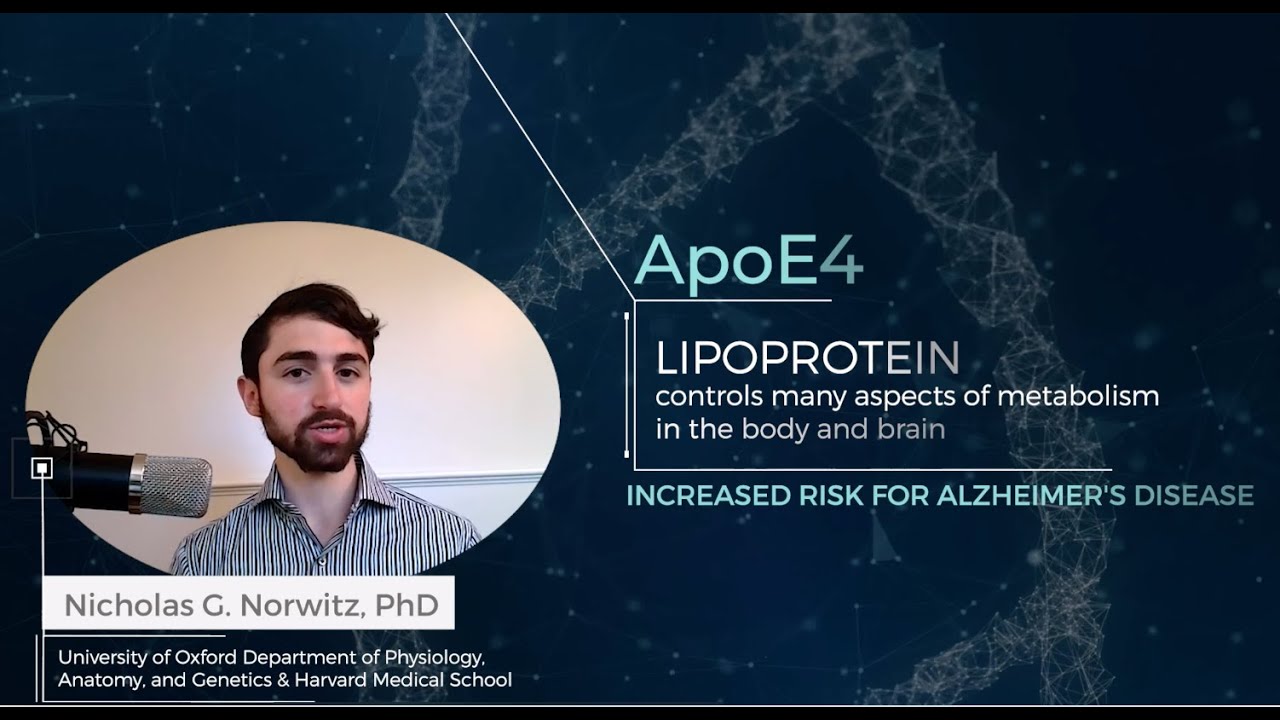
In this video abstract, the speaker outlines the growing public health crisis posed by Alzheimer’s disease (AD) in the United States, emphasizing its rising mortality rank, projected tripling of cases, and unsustainable economic costs. He argues that current clinical trials, which mainly address symptoms after disease onset, are insufficient; true impact requires primary prevention. The speaker identifies carriers of the APOE4 allele as the most critical target population because APOE4 markedly raises AD risk (2‑3‑fold for one copy, 12‑15‑fold for two copies) through gene‑environment interactions, especially nutrition. Recent mechanistic studies reveal how APOE4 disrupts metabolism via four pathways: (1) blood‑brain barrier integrity, (2) microglial activation and neuroinflammation, (3) astrocytic lipid handling, and (4) insulin resistance/glucose metabolism. Leveraging these insights, the speaker proposes a precision‑nutrition protocol for APOE4 carriers that emphasizes a low‑carbohydrate or ketogenic diet, Mediterranean‑style food selections, and a curated supplement regimen. He acknowledges the approach is speculative and based on mechanistic inference rather than long‑term clinical trials, but presents it as a pragmatic, mechanism‑informed starting point for at‑risk individuals and their providers.
Chapters
Alzheimer's disease is ascending the list of the top 10 causes of death in the United States. It currently ranks number 6 out of 10 on that list, however, is the only member of that list without any effective treatment or cure. Furthermore, current estimates project that by mid-century, the burden of Alzheimer's disease could as much as triple to 13.8 million cases in the United States alone. Coupled with that incalculable human burden is an unsustainable economic cost. By mid-century, the United States medical system and economy could be paying out as much as $3 billion per day to address Alzheimer's disease. So when you couple this incalculable human burden With the unsustainable economic cost, it's clear that we need to do something about the rising tide of Alzheimer's disease. But what? Current clinical trials really just focus on managing symptoms or at best slowing cognitive decline once it's set in. These are important strategies, but they're probably not ideal for addressing a disease that sets in in the brain, or at least starts in the brain decades before symptoms manifest. Really, the goal should be preventing the disease in the first place. So the problem is, if you like, akin to trying to slow a large boulder from rolling down a hill. Once the boulder gets rolling, there's really very little you can do to stop it, and the goal should be not to push the boulder down the hill in the first place. And that is the role of preventative medicine. So the next question is, what is the most important population to focus on when it comes to preventing Alzheimer's disease? And the answer is individuals who carry the gene variant APOE4. The APOE gene codes for a lipoprotein that controls many aspects of metabolism in the body and in the brain. And individuals who carry the variant APOE4 are at a massively increased risk for developing Alzheimer's disease. Alzheimer's disease. About 20 to 25% of people carry at least one copy of this gene, and having a single copy of ApoE in your genome increases your risk of developing Alzheimer's disease by about 2 to 3-fold, whereas carrying two copies of ApoE4 in your genome increases your risk as much as 12 to 15-fold by some estimates. That said, it's important to clarify that ApoE4 does not cause Alzheimer's disease. Just because you have ApoE4 in your genome does not mean you will develop Alzheimer's disease. It's only a risk gene. ApoE4 integrates with aspects of environment, environmental factors, to precipitate Alzheimer's disease. It's a gene-environment interaction. And a critical part of the environmental contribution is nutrition. Excitingly, new mechanistic work published in top journals around the world is beginning to shed light on how ApoE4 confers risk by altering metabolism. And by understanding this metabolic how of ApoE4, we can develop biologically plausible preventative strategies, including precision nutrition. So that's what this manuscript is about. In this manuscript, we review the recent literature on how ApoE4 alters metabolism, with particular emphasis on the blood-brain barrier, microglial activity and neuroinflammation, astrocyte activity and lipid metabolism, and insulin resistance and glucose metabolism. And based on these new data, which we review, we develop a precision nutrition approach for the prevention or at least risk reduction of Alzheimer's disease in those who carry APOE4. An approach that highlights eating a low carbohydrate diet with a ketogenic option, specific Mediterranean food choices, and a panel of specific supplement options. Admittedly, this bottom-up approach to developing a precision nutrition protocol is speculative from a clinical standpoint. However, given the practical limitations on conducting decades-long nutritional clinical trials and the urgency to address the rising tide of Alzheimer's disease, it's important to take this mechanism-informed best guess. This is a starting point and stands currently as the best available option for patients and providers who know they are at risk and who don't want to wait to take action.