Sardines & Seed Oils: The Controversy is Heating Up
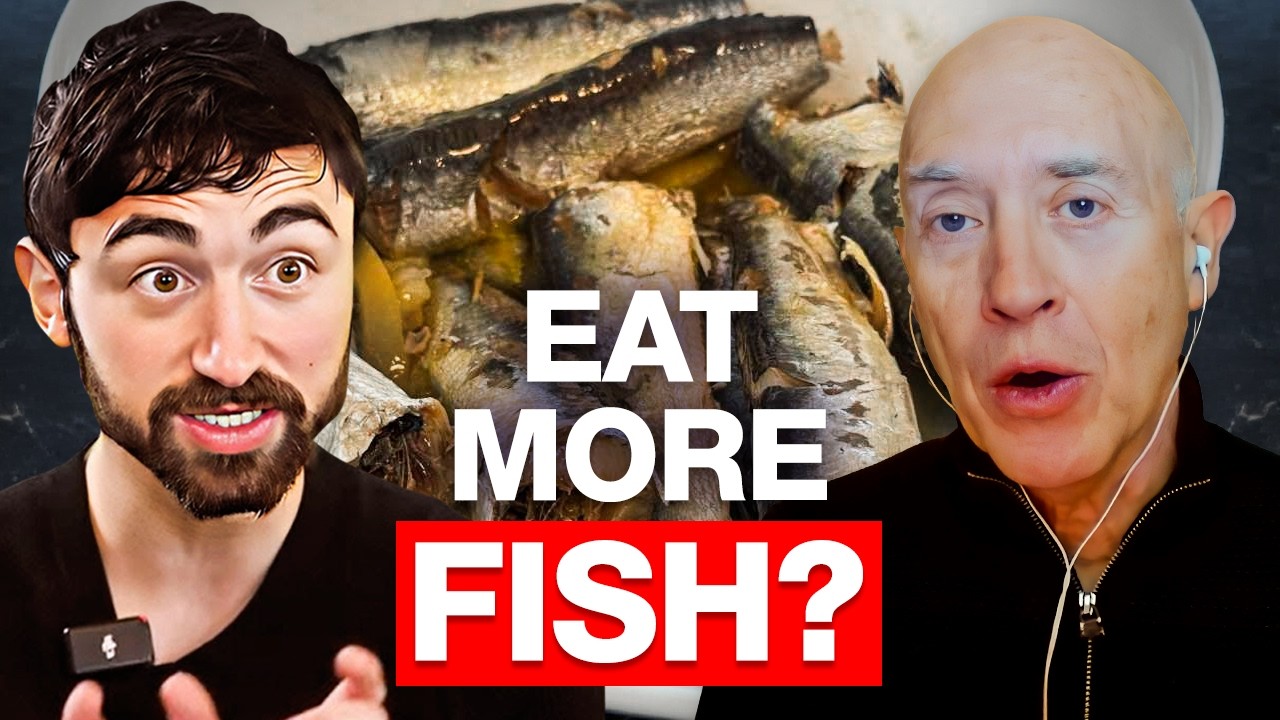
In this YouTube interview, host Nick Norwitz talks with omega‑3/omega‑6 expert Professor William (Bill) Harris about the ongoing controversy surrounding seed oils, the biochemistry of omega‑6 fatty acids, and the health implications of highly processed industrial oils versus whole‑food sources. They discuss the chemistry of oxidation, citing a Norwegian study that found no adverse effects from heavily oxidized fish‑oil capsules, and they reference the Minnesota Coronary Experiment, a randomized trial that swapped saturated fats for vegetable oils and reported higher mortality and atherosclerosis. Harris introduces the "omega‑6 vulnerability" hypothesis, suggesting that metabolic states such as obesity may shift oxylipin production toward harmful metabolites. The conversation moves to the broader family of fatty‑acid‑derived hormones, including prostaglandins, thromboxanes, and specialized pro‑resolving mediators, and they note Michael Snyder’s exercise study showing a rapid spike in omega‑3s during acute exercise that may aid inflammation resolution. Norwitz then shares his personal "sardine diet" experiment—eating 1,000 sardines in a month—which raised his Omega‑3 Index to 16 (near dolphin levels), led to unexpected cold‑resistance, and caused a persistent fish odor on his skin. Harris speculates on mechanisms such as the brown‑fat‑derived oxylipin 12‑HEPE and central perception changes. They also address FDA mercury warnings for pregnant women, with Harris arguing that the advice is overblown and that higher maternal fish intake correlates with higher child IQ. Looking forward, Harris is excited about making the Omega‑3 Index a routine clinical test and about sustainable omega‑3 production via algae and genetically engineered plants. He directs listeners to omegacuant.com and the Fatty Acid Research Institute for more information.
Chapters
Eat as much fish as you can.
You're never just having an isolated fatty acid.
It's just that those oils are used in the processing of a lot of different kinds of foods.
The host interacts with the inputs in ways to generate outputs that can be so dramatic to be opposite.
A higher level of processed foods apparently now is linked with better health outcomes.
It's hard for me not to believe it doesn't have profound physiologic consequences.
I think it probably does.
Smell your hands. You have sardines in your skin.
That's the weirdest thing I've ever heard.
All right, everybody, I'm back with part 2 in my discussion all about omega-3s, sardine diets, seed oils with world expert in omega-3s and omega-6s, Professor William Bill Harris. Bill being what his friends and family call him. And he asked me to call him Bill.
And you're my new friend now, so we'll go with that.
I appreciate it. I didn't scare him off with part 1 of this discussion. So he's kindly joined us for part 2. A little bit about Bill. He has an extensive resume, including chairing the American Heart Association Scientific Advisory Board on omega-6 fatty acids, publishing hundreds of peer-reviewed papers, innovating the widely used omega-3 index, which we talked about in part 1. Part 2, we're going to get into some trendy, interesting things: seed oils, sardine diet, mercury, etc., etc. Me stinking like fish is going to explain how that worked. Anyway, welcome back, Professor Harris.
Bill, good to be back with you, Nick.
We talked about this a little bit in part one, but I want to start off on the controversial topic of seed oils. A fair way to go about having this conversation is to give you my two cents on the confusion, because I don't want to put you in a situation where you're inadvertently pissing people off because people are talking past each other. So I, as an academic, have found the whole controversy around seed oils very fascinating because I feel like everybody's talking about something different. There is the highly processed industrialized oils that get all like the Instagram reels. And then there's like just the concept of omega-6 fats and they often get conflated, which leads to enormous confusion. So I have two kind of big ideas I want to run by you. I'm going to start with the first and then I'm going to go on to the second. The second is more interesting. But the first big idea is we talked about this a little in part one. In general, omega-6 6 from whole unprocessed foods— think walnuts or other nuts or seeds— tend to be healthy and anti-inflammatory. However, when you extract them, hyper-concentrate them, remove all the natural antioxidants, and process them in like these heating cycles that generate the highly industrialized oils that then get packaged into plastic bottles, etc., etc., those I think might have a physiologic basis for being quite harmful. What do you think about that overarching concept?
If we're talking about omega-6 fatty acids, when you get it from a natural seed or you get it from a highly processed oil, it's still linoleic acid. Chemically, it's exactly the same thing. So the question is, is it the company they keep that's the issue? Because I— there's nothing different between the linoleic acid in a walnut or the linoleic acid in soybean oil?
I would say you're never just having an isolated fatty acid. So the fatty acid in, let's say, the company it keeps after processing, a lot of things have happened. Some of the fatty acid might have gotten oxidized. It might have been converted into different things. Even just heating, like walnuts are very high in omega-6. And if you heat an equal amount, and I could say this paper of walnuts and macadamia nuts, I think it's at 150 Celsius for 20 minutes. You end up with 30 times the oxidized fat in the walnut. Not because the walnut's bad, but because it's heat sensitive. And also, like, when you're extracting the oil from its natural form, you're removing the natural antioxidants that could provide protection against oxidation. So in sesame, for example, this is done in vitro, but if you have the, like, lignan antioxidants that are naturally in sesame, omega-6 oxidation is very low. If you remove them, oxidation becomes much, much higher. So, you're right, you know, a cholesterol molecule is a cholesterol molecule, linoleic acid is linoleic acid. But practically speaking, if a person's having this highly processed oil where the fats have been oxidized, where they've been converted into other things, maybe other things have been introduced into the oil, do you think it's potentially a concern to human health?
Potentially. I guess I'd like to really see the data that it's harmful. I mean, I can tell you if we, take a little bit of a rabbit trail back to fish oils, but oxidation is the question.
Yeah, yeah.
Interesting study came out of Norway several years ago 'cause people were concerned about the oxidation of fish oil because they're even more easily oxidized than omega-6 fatty acids because they, the more double bonds you have in a molecule, the more places oxygen can attack the molecule. And so omega-6 fatty acids have 2 double bonds and EPA has 5 and DHA has 6. So there's, you know, the opportunity for oxidation in fish oils is much higher. This group in Norway did this study. I can't believe they got it by an IRB, but they did, an ethics board. They took a good quality fish oil and put it in capsules, okay? Put it aside, take that same oil, And before they put it in capsules, they put it on the lab desktop. They took a tube of a glass tube hooked to an oxygen tank, and they bubbled oxygen through it for like a day, a long time. I mean, they oxidized the hell out of this stuff because this is way, way beyond physiologic oxidation. Okay. Right. And then they took that oil and they put it in capsules. And then they randomized two groups of volunteers, you know, one to the unoxidized oil and one to the oxidized oil. And then they did, I think they fed them for 6 or 8 weeks, gave them the same amount of capsules. And then they looked for effects on changes in serum lipids or changes in oxidation, oxidative indicators or inflammatory markers. They couldn't find anything. The oxidized oil didn't do anything. Now, it doesn't mean in the long run it wouldn't do anything. It doesn't mean they failed to measure the right stuff, you know, but the classic stuff you look at, they didn't find any adverse effect. Now, the stuff didn't taste good, that's for sure, but that's my point. I mean, let's not talk about theoretical. Let's talk about evidence. And I think that's where we're missing a lot in the seed oil story. Where is the evidence other than theoretical stuff that the stuff is harmful? I mean, the stuff meaning the classic stuff you pick up on the grocery store that's been processed. Now they do leave quite a bit of vitamin E remains in corn oil, soybean oil, safflower oil. That's there, that's not stripped away. Now admittedly there are other other potentially protective molecules that are removed, as you said. I won't dispute that. But at the end of the day, I want to see the human data that it makes a difference.
I mean, there are some, for example, and this is a controversial study. I don't know how well you know the Minnesota Coronary Experiment.
Oh, that—
well, okay.
Yeah.
So I will just bring it up. It is— actually, that is an intervention that's a randomized controlled trial where they did swap out saturated fats for vegetable oil.
Mm-hmm.
Now you can talk about what was in that vegetable oil potentially, but there were outcomes in terms of more deaths and on autopsy, more atherosclerosis. My point here is not to vilify linoleic acid. I think that's very clear.
Yeah, right.
Absence of evidence isn't evidence of absence. And I see a lot of clear physiology, preclinical data, And then some clinical suggesting this could be harmful. So again, in making a lifestyle choice myself, these are things I choose to avoid while also being humble about the limitations of knowledge, which you correctly and I think fairly push back on.
I think that's a fair position to take too. Again, trying to balance risk and reward. And we really don't— we don't know really the value either one of those for a diet that's rich in seed oils. We don't know if it's beneficial or not. We certainly need more data on this. And I'm not going out of my way to avoid seed oils. I mean, I don't pour them on anything and just eat it. I don't take tablespoons of the stuff by any means, but I'm not focused on avoiding them. What's a conundrum to me is we know that in the US that the primary source of linoleic acid, omega-6 in our diet is from seed oils and it's not necessarily from salad dressings, although that's part of it. It's just that those oils are used in the processing of a lot of different kinds of foods. Processed foods, right? I'm not sure the— I don't know where the line between processed and ultra-processed happens, but this is kind of lingo. In any event, if we see that blood levels of linoleic acid are higher levels are associated with better outcomes. Health outcomes. If higher levels of linoleic acid mean higher levels of intake of processed foods, which is where most, again, Americans get it, then we have this problem where a higher level of processed foods, which brings in the omega-6s, apparently now is linked with better health outcomes.
The best health user bias, you're right. And that really cuts across a lot of macronutrients. It's the same thing with saturated fats. If you go to the USDA's like pamphlets, there are graphs on where does saturated fat mostly come from. It's not beef or steak, it's like ice cream and, you know, candy. So it just broadly, I think some of these questions are really difficult to answer. I think you see us both struggling here with them because the nature of the data is messy, confounded. And so it makes it difficult to draw conclusions off of what you definitely should do. And I love that we have a little bit of a divergence of opinion on where we err.
Yeah, yeah, yeah.
It's highly for people like, look, these things aren't clear-cut.
No, they're not. It's just unfortunate they get so polarized and vilified in, in social media.
All right. I agree. I think it's overblown.
Appreciate what you're doing here. This is a reasoned discussion that we're having, that we're, we're sharing perspectives. And I think we're both trying to be scientific, which I appreciate.
I want to get on to Big Idea 2, which actually I think is more interesting and also more speculative. I have this concept when I talk, you know, people are talking about the dangers, quote unquote, of omega-6, which I don't buy into completely, but bear with me here. I have this idea of an omega-6 vulnerability. And what I mean by that is, you know, we talk about linoleic acid or other omega-6s. They're substrate for the body. And then the body, the host, can convert them into a host of different hormones.. And when I'm looking at the literature, there are some that, like 12, 13, di-HOME, which can be great. They, they have like anti-fibrotic effects on the heart. You could call them like longevity hormones for the heart that's derived from omega-6. And then there are others like 4-HNE, et cetera, that are damaging. Or if it gets oxidized by enzymes in the body, like myeloperoxidase, could be damaging. And when I'm looking at the literature, I, I noticed this interesting thing where in somebody who has a disadvantaged metabolic state, let's say obesity, it appears that they would have a milieu to turn the omega-6 more into something that is harmful relative to someone who's healthy. So an example I'll give you is I was reading a paper, I think I sent it to you, on myeloperoxidase, which is a biomarker of oxidative stress, but also an enzyme that's made, circulates in your blood, and And it's also in the fat around your blood vessels and negatively impact your blood vessels from the outside and from the inside. And one of the things it does is it oxidizes fats like omega-6.
So oxidizes, meaning, meaning peroxidizes or burns them up for energy?
Peroxidizes. So yes, right. It's not turning them into ATP energizing energy. It's like starting a reactive oxygen cascade.
Yeah.
So in this concept, if you have more adiposity and you're generating more oxidative environment peroxidizing the, you know, fatty acids, could it be your body handles omega-6 fats broadly in a more disadvantageous way? Hopefully that makes sense.
That was a long—
Yeah, I mean that, that is a very reasonable hypothesis, I think. And testable. Which is nice, sometimes they're not. You could certainly look at blood levels of some of these hormones that you're talking about or these molecules that are made from the essential fatty acids and see how they vary as a function of body weight. And that would be a step in the right direction. And that probably may even have been done already. I don't know, but I think the hypothesis is realistic. What you're talking about. Depending on the, the body milieu, some, some fatty acids could be helpful or not depending on your body weight. Yeah, I mean, that's interesting.
Let's talk about more of the specific fat-derived hormones. What are some that pop out to you as important to physiology, derivatives of either omega-3 or omega-6?
Well, we go back to the '80s and the original discovery of prostaglandins. Is from— made from arachidonic acid. That was what really kind of kicked off the interest between omega-6 and omega-3 because the whole family of prostaglandins, of which there are many, have a variety of outcomes. Take one, thromboxane, for example, which is one of those hormones. Very potent, platelet aggregator, blood clotter. Theoretically, you don't want a lot of that in your blood because your platelets will stick together and you get blood clots. That comes from arachidonic acid. Another one that comes from arachidonic acid is called prostaglandin I2, which is prostacyclin. That is a hormone that's made not in the blood but made in the blood vessel wall that blocks platelet aggregation. I mean, they compete with each other. They're both omega-6 derived, but one is pro-aggregation of blood, the other one is anti-aggregation of blood. And so there's that yin-yang, the body, and plus that's just 2 out of maybe hundreds of fatty acids. Hormones made from essential fatty acids, that's one example. The ones I think you're referring to are what we call oxylipins, O-X-Y-L-I-P-I-N-S. And oxylipins is an umbrella term for any fatty acid that has had an oxygen molecule attached to it anywhere anyhow. And so given that there are maybe 15 polyunsaturated fatty acids in our blood, some omega-6, some omega-3, and there are, golly, how many different places can you put oxygen molecules? You end up with this huge panoply of of these hormones. Slight step away, there are companies that are selling omate supplements. So some of these molecules are called SPMs or specialized pro-resolving mediators, which is talking about actually the fact that inflammation, when it happens in our body, goes away in an active process. You remove your inflammation if you have omega-3s because they're turned into these certain molecules. That actually turn on a shutdown pathway, shut down the inflammation pathway, so they resolve.
And do you know Michael Snyder's work? Uh, he's at Stanford. He's, uh, a leader in, in multiomics and metabolic health. But he did one of my favorite exercise studies of all time. If you haven't read it, I'll send it to you. Is in Cell 2020, Molecular Choreography of Acute Exercise. But one of the things they did is they did high-frequency sampling of people after exercise, and they noticed this fitness inflammatory signature, a sharp spike. One of the characteristics was that when people exercised, saturated fats dropped, they were getting burned up, but omega-3 fats spiked. And the idea is that the class was acting as, I guess you could say, these resolvins, because you're having an adaptive inflammatory spike. But in a healthy person, the omega-3s were being released prophylactically to shut down the inflammation. I'll send you the paper.
Yeah, send me the paper. What'd you call it? Choreography. I like that.
Molecular Choreography of Acute Exercise Cell 2020. One of my favorite papers. There's this one table, one figure I'll— oh, I think it's 6B, one of the coolest exercise figures because one of the things they do is look at gene transcription as a result of exercise, but also break it by insulin resistance status. And they actually show there's a subset of genes that have completely opposite, not just like attenuated, but opposite expression patterns depending on someone's insulin resistance state.
Oh, back, back to your, whatever you called it.
Free susceptibility. I mean, it's just a big idea. Yeah. Not big as in like I created something like novel. It's kind of obvious. The host interacts with the inputs in ways to generate outputs that can be so dramatic to be opposite. And I like that it cuts across the board.
Yeah, that's really interesting. I'd love to see that paper. Yeah, 100%. I'm surprised it's in Cell.
Yeah.
Usually it's pretty basic science in Cell, not human studies as a rule, but that's pretty cool.
He's a pretty, I think his H-index is like 220. He's a pretty decent publication record.
Oh, okay.
Papers are readable though. Yeah, he's a good guy. If you can only dream. I do want to, actually want to pivot. I know your time is limited and I want to pick your brain about this sardine diet thing, which everybody is all, all jumped up about, including me. To give credit where it's due, I did now a pretty semi-viral stunt around eating 1,000 sardines in a month. I ate 1,000 sardines in a month. Why would I do this and what did it do to me? But I was not the one to come up with it. I heard about it from Professor Dom D'Agostino, who some people might know. And then other people have been talking about it. He talked about it on Tim Ferriss. Somebody was on Diary of a CEO talking about it. So it's now this thing that people are doing. And the concept at a high level is to have a minimal intake of a very nutrient-dense food. So sardines are like packed with nutrients, but also omega-3. So the idea is benefits of fasting while still preserving muscle, fueling the body, and getting omega-3s.
Yeah.
There's a lot of places I could start, but I'm most interested in your reaction to my actual omega-3 level. So, when I did this, my omega-3 level went up to 16 on OmegaQuant and the scale went up to 12. Based on our email correspondence, it seemed like that was an unusual number.
Yeah, that would be definitely an unusual number for a human being. I believe in your— Well, but what other mammal might have an omega-3 index something like that?
I think it's like a dolphin.
A dolphin. Exactly. Exactly.
Well, it's funny because I think dolphins are like 17, 18. And we were talking, I think at the last, in part 1 where you're like, humans in America have an average of 5. And it's really weird. I mean, it's weirder to me 3 times the normal human versus being closer to dolphin because when you think about nutrient balance in the body or how things are regulated, they're usually very tight. Like a glucose level, like 80 to 100. You don't have people that are healthy with 300s. You can go through the gambit so that we can have a diversity among humans, not just like, like 5% to mine, 16, but just that we can have this massive range. It's hard for me not to believe it doesn't have profound physiologic consequences, but I, yeah, no, I, I, I think it probably does.
I would love to have enough people to know to study that. I guess you'd do some n-of-1 studies, which you've kind of done on yourself.
Yeah, it's hard to draw definitive conclusions, but—
No, no. But I was very interested in your story about being cold resistant.
That was so weird. This is one of the more unexpected effects of this sardine fast. I'm cold resistant. I just haven't been getting cold, especially outside. Now, there's some literature on omega-3s increasing thermogenesis under cold stress. So I'm not sure if that's what's up. I don't know if this is a placebo, but it's really weird. So weird. So, so it, it was like, it wasn't something that I think I was placeboing because I didn't expect it. It wasn't like I had SI, eat omega-3s and become cold resistant, but I was just, I didn't feel cold. I don't have a perfect explanation. The hypothesis I generated and I released independent content on this is One of these oxylipins, we kind of mentioned the class earlier, is called 12-HPE.
Mm-hmm.
It's derived from omega-3 in brown fat, and then it acts as, um, both an autocrine and a hormonal signal. So an autocrine means it's released by tissue, then absorbed by that tissue and acts on that tissue. Hormonal means it goes through the blood. And basically omega-3s can be turned by brown fat into this 12-HPE, which then signals to brown fat to boost heat production. And activates muscle glucose uptake. So, maybe I bulk-produced 12-HEPE by just shoving omega-3s into my body. Usually, things aren't bottlenecked by this like this, but it's just one working model.
I don't know. I mean, how much brown fat do you have? How much fat do you have? You haven't got any fat, never mind brown fat.
I would think brown and beige. I mean, like, adult humans still have some active brown fat, And because, I mean, I'm not talking, I think people think about brown fat as it's a calorie burning machine. So if you have a little bit, it's not going to burn a lot of calories, but I think it's better to think about it as an endocrine organ. So you don't need a lot. I don't need to go thyroid to generate a lot of active thyroid. I just need a little to generate hormones. So I'm not saying my calorie burn went up 2,000 calories a day. I'm just saying, could it be that I'm forcing a hormone that's distributed throughout my body, my brown fat, to at a higher level than normal produce this 12-HEPE. I don't have an example. Usually these things are enzymatically gated. It's just like, it was such a weird phenomenon.
Well, yeah, I mean, it's possible that this is a central effect, a brain effect. I mean, a thing that it's, it's a matter of your perception of cold. Yeah, true. And it could be that somehow your brain is been modified by a very high omega-3 level to not perceive. You're still getting the same signals from the outside, but what's registering upstairs is not cold. I mean— That's true. Who knows? But, that's the weirdest thing I've ever heard. And, I'll keep my eyes open for future chapters of that.
Well, if you want to study me, you can biopsy my brown fat. Please don't biopsy my brain. Thank you. The other weird thing I noticed was, or I didn't notice it, my girlfriend noticed it. The fish smell. You smell like fish. Like you smell like you're sweating the smell of it. So I couldn't stop but smelling like a fish market. And I don't mean like my breath. Even when I was fasted, I had like this aura. It was coming off my skin of sardine scent. It became a relationship problem. And I kid you not. Yeah. I, I don't know if you have any further thoughts on why I smelled like sardines based on what you know about omega-3 chemistry.
Oh, so do you, you smelled it too or not?
I couldn't, but I think I was habituated to it.
Yeah.
As a, as a sidebar, I used to have these iguanas when I was growing up, these huge like 6-foot iguanas and I kept 'em in my room. My mom would knock them in my room because apparently they, their poop just made the place stink. Stink. I couldn't smell it because I lived in there, I slept in there. So I habituated. Maybe something similar was going on to my sardine smell. My girlfriend was very convinced that I just smelled like fish.
And it wasn't breath?
No, it wasn't breath. Like, she would like pick up my hands and I'm like, I haven't eaten sardines. Like, I smell your hands, you have sardines in your skin.
And it's not from lack of washing?
No, I'd be showered, I'd be fasted. Anyway, I, I, I, I—
well, we, you know, I put back back when I, in the late '70s, when we did our big experiment, we gave them that much omega-3. The other idea my boss had was, I wonder if there's omega-3 coming out of their skin. And so he said, do an experiment, Bill. He said, get some long underwear, go to the store, buy top and bottom long underwear, put it on, these people that we're doing this study with, have them wear it for 24 hours, just the long— I mean, clothes over it, but long underwear. Then bring the long underwear into the lab, and then you're going to put it in a big vat with acetone or some organic solvent, and you're going to put all the clothes in there, and you're going to boil it down and extract any lipids that might have come off on the long underwear, and you're gonna concentrate and you're gonna inject it into your machine and see how much omega-3 is coming out. And there was zero. But omega-3 is not what smells. The chemicals that give fish their odor is not omega-3. It's a variety of other protein breakdown products and, and some fatty acid breakdown products, but it's not omega-3s. Pure omega-3s don't smell at all. Uh, so what she's smelling, I bet there's no omega-3s on your skin.
All right, good news, bad news, everyone. We had some technical difficulties, but we only lost my video and audio, so we're editing it so that I'm just going to read the questions that I asked. There were two of them, um, and then we lost none of Professor Harris's wisdom. So the first question I asked is— we went on a little tangent— I was wondering what he thought about FDA warnings that maternal fish intake, particularly high mercury fish, is harmful to infant neurodevelopment. Here's what he had to say on that.
Back in probably 25 years ago, the FDA got wind of some studies where high mercury intake in pregnant women was having adverse effects on babies. And it came from, it came from studies in a remote area of the world called the Faroe Islands. Which are part of Norway, but they're north of Iceland basically, between Norse and Iceland. And people there like to eat pilot whale blubber and fish, but pilot whale. And pilot whale is quite rich in mercury. So women were getting high levels of mercury from eating pilot whale, and people published studies about this, and there were some cognitive problems with the kids. And so the FDA went bananas on this and said, okay, we're going to put out this warning about mercury in fish and pregnant women shouldn't touch, you know, 4 or 5 fish that were really high in mercury. Fish that almost nobody eats anyway. But anyway, they, you know, shark, okay, swordfish, not common things. That had a huge effect on shutting down the consumption of any fish by pregnant women. I mean, there was a drop. Of course, the best source of omega-3 for the baby is going to be fish while you're pregnant. We think was a very counterproductive advisory from the FDA. And then they made up all kinds of, you know, well, if we think the The toxic level is this. Let's multiply it times 10 and we'll call that the toxic level or actually drop it by tenfold. So it's, you know, safety. Anyway, this was— this has been reexamined recently. We, we were part of a big meta-analysis of studies around the world where they looked at the reported fish intake of moms while they're pregnant. And the mental health outcomes of the kids. And there were some, we had 35-some studies, 200,000 women, something like that. And we found that the, there was no, it was a linear relationship. The more fish mom ate, regardless of the mercury, and most fish don't have very much mercury at all, very little. The more fish they ate, the higher the IQ. Like for a delta of like 7 points on for the high fish eaters versus the low fish eaters. So we've been, you know, basically trying to get papers published and trying to advocate with the FDA to get them to change their fish advice for women and say instead of don't eat more than X amount of fish, say eat as much fish as you can. Basically, because this is where you're going to get the DHA. There is a harm in avoiding fish because they're not getting the omega-3s.
Now, this was the second of the two questions we missed out on, at least me asking it. We got his response, was, what are you most excited about for the future of omega-3 research? And here's what he had to say.
The fearmongering that went on about mercury and fish and pregnancy, and it spilled over into other health outcomes as well, I'm sure. But that's really where the sweet spot was. The concern is young children and pregnant women. And I think it's just been way, way overblown. And people have thrown out the baby with the bathwater and have avoided a really healthy food for fear of a whisper of a potential toxin in that food. And they're not doing what you were talking about earlier is balancing risk and benefit. Research-wise, I think we're finding lots of great health benefits, and I'm excited about the possibility that the Omega-3 Index or any, any test of omega-3, it doesn't have to be my test, okay, would become part of standard medical care, be part of every annual physical exam that you could measure. When you measure your cholesterol, you measure your glucose, you measure your omega-3, because if you don't measure it, nobody's going to manage it. And I think it's really critical. We've seen in other studies that the omega-3 level is a more predictive risk factor for death than cholesterol is. I mean, it's certainly a better risk predictor and it's more modifiable and it's safely modified than, for example, like cholesterol. So I'm excited about seeing more and more and more doctors start to use this test in practice. Another thing I'm excited about is the supply side of omega-3 'cause we've been, you know, 95% of the omega-3 we get is from fish. We get sardines and anchovies off the coast of Peru is primarily where we get it. Most of the fish oil comes there and then it gets processed into drugs or into omega-3 supplements or pet foods or, yada yada. There's a lot of good genetic research being done on how to make plants, land plants with roots in dirt, make EPA and DHA so we could have essentially an infinite resource. I mean, there's also the algae, algal microalgae that can be grown in, in a vat in Arkansas, you know, who doesn't make a difference and feed it. And these are specific species of algae that will make EPA and DHA and you get the algal DHA products, EPA products, just to get to the point where we're making omega-3 in a smart way that we don't have to depend on fish, catching fish to get the omega-3s. I think that's going to be better for the planet and it's going to be in the long run cheaper, I think, for people to get omega-3. And we, you know, if you're going to get 1 gram a day in every person on the planet, you're going to need another solution besides fish. And so I'm excited about the upside of the, those technologies.
Is there anything or anywhere you want to direct people to learn more about you, the work you do, anything like that?
Well, we can do it. Look at omegacuant.com. That's the laboratory that we have here in Sioux Falls, South Dakota. We also have a sister lab in Sterling, in Scotland that's doing work for our— doing some of our work for the EU. So omegacuant.com will tell you about me and the Omega-3 Index blood test. Also, I can go to the Fatty Acid Research Institute, just Google that, and you find a story about me and all the scientists that we have at the institute and the research that we're doing.
We'll drop in the links below. With that, thank you so much, Professor Harris.
My pleasure. Enjoy talking with you.










