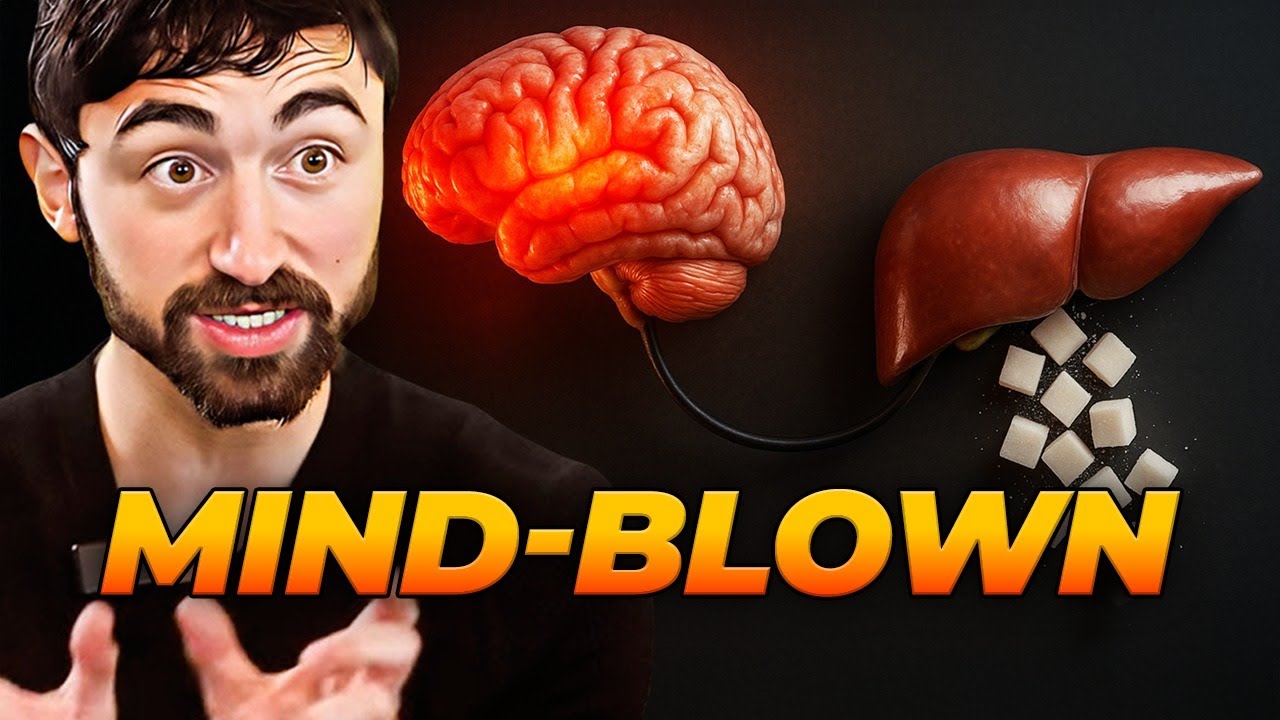
In this YouTube explainer, a 29‑year‑old MD‑PhD presents recent Nature research showing that acute psychological stress can raise blood glucose without involving classic stress hormones. Using mouse models, the investigators identified a neural circuit that starts in the medial amygdala (MEA), projects to the hypothalamus, and then sends a direct signal to the liver. Activation of this pathway—either by physical stressors or by chemogenetically stimulating MEA neurons with DREADDs—produces a rapid spike in blood glucose. Retrograde tracing with GFP‑labeled pseudorabies virus injected into the liver revealed the anatomical link to the hypothalamic region receiving MEA input, confirming a brain‑liver axis. Within the liver, the stress signal up‑regulates gluconeogenic genes, especially glucose‑6‑phosphatase, turning the organ into a “sugar factory” that generates new glucose and releases it into the bloodstream. The presenter discusses the evolutionary logic of this rapid energy mobilization, acknowledges the limitation of mouse studies, and argues that the pathway likely exists in humans. He then frames stress management (meditation, sleep, exercise) as metabolic medicine, offering three practical take‑aways: (1) acute stress literally makes sugar; (2) managing stress protects metabolic health; (3) the brain can reprogram liver metabolism, so chronic stress may contribute to metabolic disease. The video ends with a call to action to subscribe, read a newsletter, and comment on personal take‑aways.
Chapters
This is a bag of sugar. Now what if I told you I could think this sugar into my bloodstream, literally teleport it through my skin into my blood to flow to my brain, my heart, and my muscles? Well, I can't. I can't do that. I'm not magic. But I can do something almost as impressive. I can think my body into making its own sugar. I can create psychological stress that sends a direct neural line to my liver to cause it to make sugar and spill it into my bloodstream. This isn't sci-fi, this is brand new science identified in Nature that blew my mind. It left me giddy with scientific enthusiasm, also terrified about what I'm doing to my body every day unknowingly, and excited and satisfied that I now have the knowledge to change and improve my health through my mind. And I promise by the end of this video, you'll know exactly what I'm talking about. Stress doesn't just push around stress hormones, it can literally— stress management, it's just not a wellness buzzword, it's central to metabolic health. And I'm also really hoping my girlfriend and family aren't watching this, the brain flips a genetic switch that makes the liver into a sugar factory. Blood sugar spiked. Stress literally makes sugar. This is not just a metaphor. Stress doesn't just live in your head, it rewires your body, including your liver. The researchers first confirmed what we already know: different stressors, be they physical restraint, or social stress, etc., increased blood sugar. That wasn't shocking, it's already a well-documented phenomenon in humans and animals. We'll get to the evolutionary logic behind it a little bit later. These stressors also elevated the usual hormonal suspects like cortisol and adrenaline. Now, if the story stopped here, we might be tempted to conclude that stress raises stress hormones that increase blood sugar. The end, goodbye. But that's not the full picture. Not even close. And just to go on a little tangent, this is why we need animal models. They let us uncover the hidden causal mechanisms that we otherwise couldn't dissect, at least not in humans, because we simply don't have the tools to do so ethically. You'll see what I mean in a minute. But you can do this using animal models to explore the frontiers of metabolism by carefully manipulating systems with chemical and genetic tools. Basically, the approach is we toggle on System X to see if it causes Effect Y, or turn off System A to see if it prevents Outcome B, stuff like that. But I don't just want to wave my hands. Well, actually, I'm Italian. I wave my hands a lot. Some of you have noticed. Anyway, I want to give you a specific example of a tool they used called DREADD. Now, DREADD might sound like a dreadfully intimidating term or like a monster from The Princess Bride, but it actually stands for Designer Receptors Exclusively Activated by Designer Drugs. Here's how the DREADD system works. I'm hoping I can explain it to you. Normally, neurons have receptors that respond to natural neurotransmitters like dopamine or acetylcholine or glutamate or GABA. Maybe you've heard of some of these. But scientists can engineer designer receptors that ignore these natural neurotransmitters, but instead are exclusively activated by designer drugs. I know, hallelujah, terminology that actually makes sense for what DREADD stands for. But that means only neurons engineered genetically to carry these DREADD receptors respond when the drug is given, while the rest of the brain remains largely unaffected. Now the most common designer drug used, and the one used in this study, is called clozapine N-oxide, or CNO for short. By itself, CNO doesn't doesn't do much in the brain, but in animals engineered with DREADD receptors in particular neural circuits, CNO switches on or off these neurons containing the DREADD receptors. If that went entirely over your head, or if you got distracted by the idea of ROUSes from one of the greatest films of all time— Rodents of unusual size? I don't think they exist. And glazed over this section while thinking it's inconceivable anyone could find this interesting, Don't fret, here is the simple version. Simply put, this DREADD system lets scientists remote control specific brain circuits. Hopefully that makes sense, and tell me if this methodological aside was useful or just distracting. But back to stress, sugar, and the brain. I mentioned earlier that stress increases blood sugar and already gave you the punchline that it's through a direct brain-to-liver access. So let's discover the nature of this pathway together. When the researchers stressed out mice, neurons in a brain region that also exists in humans called the medial amygdala, or MEA for short, lit up. Now, these neurons connect to the brain's hypothalamus, which acts as kind of like the Houston control room for the whole brain-body balance. Blood pressure, blood sugar, temperature, you name it, the hypothalamus is the master regulator of whole body homeostasis. But then, to prove causality, a causal connection, the researchers used the DREADD system we just explained—see, I had a purpose in explaining it to you—to skip the external stressors and directly activate those MEA, those medial amygdala neurons. What was the result? Blood sugar spiked, but it occurred without changes in the usual suspects, cortisol and adrenaline. We know now that stress activates MEA neurons, that these project to the hypothalamus, and that this direct activation of MEA neurons can somehow increase blood sugar. But how can we demonstrate a direct connection to the liver? To probe deeper— brace yourself for this one, this is pretty cool— researchers use special viruses, pseudorabies viruses, that they inject into the liver. These viruses can travel backward along neurons. It's called retrograde transport. And they also contain a green fluorescent protein as a marker. And what that means is if there's a direct neural pathway from the liver to the brain, when you inject these GFP-labeled pseudorabies viruses into the liver, you can see a green signal appear in the brain. And sure enough, the green signals trace back to the same hypothalamic region in the brain that receives input from those stress activated medial amygdala neurons. So putting it all together, if this isn't clicking yet, stress activates the medial amygdala, which activates the hypothalamus, which sends a neural signal to the liver directly to spike blood sugar. So in short, stress doesn't just push around stress hormones, it can literally wire the brain to tell the liver, "Dump sugar now." That's pretty amazing. But with that foundation in place, next question: What is actually happening inside the liver to cause blood sugar to spike? Now, sorry to cut to a sponsor message on that cliffhanger, but I kind of need to. As you know, I'm a 29-year-old fresh out of my MD-PhD and these YouTube edits are expensive. But that doesn't mean what I'm about to share isn't also helpful. So bear with me on this one. I'll blaze through it as fast as I can like I'm on a sugar high. But I did want to thank the sponsor of this video, Chapter. Chapter is an amazing organization. It exists to help older adults find the right Medicare health insurance for them. The right health insurance can not only save you money— the average user saves $1,100 per year— but it can literally improve all-cause mortality. When I saw these data, I was pretty impressed. You can see this letter for more on that. But Chapter exists. It was founded by people whose parents themselves were scammed by sleazy Medicare brokers. And so the Chapter founders vowed to to fix the system. They search every Medicare plan to match you with the right fit. Chapter is fully independent and searches every Medicare plan available to find the one that truly fits your needs or your parents' needs and priorities. You'll always also talk with a real human, and their advisors are not compensated based on steering you to particular plans. The ultimate result is saving in 3 currencies: money—again, average $1,100 per year—stress—you'll always talk to a real person who can help you out—and even in life years. Remember, check out that letter for more information. If you want to call our dedicated phone line, it's 815-STAY-CURE. Metabolic health is life insurance, but you also need real health insurance. Okay, with that, back to our main story and back to our question. After stress causes the medial amygdala to signal to the hypothalamus to signal to the liver, what is actually happening inside the liver to cause the blood sugar spike? It turns out the stress signal from the brain to the liver ramps up gene expression. One of the star enzymatic players is one called glucose-6-phosphatase. This enzyme catalyzes the final step in what's called gluconeogenesis, or the generation of new glucose, new sugar, that is then dumped into the blood. In other words, the brain flips a genetic switch that makes the liver into a sugar factory, making new sugar. Furthermore, activating these medial amygdala neurons that respond to stress doesn't deplete liver glycogen, it can increase liver glycogen stores while increasing blood sugar. So taken altogether, this suggests that stress signaling boosts the production of brand new sugar and then dumps it into the blood. How astonishing is that? Stress can literally reprogram your liver to make sugar on command. And sure, this study was conducted in mice, that's a limitation, But I bet you a year's worth of eggs that this pathway translates to humans as well, at least to some extent. Why? Why am I so confident? Because from an evolutionary standpoint, be you a mouse or a human, short bursts of stress are useful. They mobilize energy when you need it most. So it makes sense that the brain might have a hotline to the liver to say, "Danger, danger, we need quick burning fuel now." now. With that said, in some ways our bodies are really intelligent, but in other ways they're pretty dumb, like the fact that our stress response can't tell the difference between a hungry tiger chasing us and an intimidatingly full email box. So that brings me to what can you do with all this? Well, first and foremost, if this has made you curious, and I hope it has, the story doesn't need to end here. I actually have more thoughts, including on the critical difference between acute versus chronic stress when it when it comes to this newly discovered system. You can find these insights and more at the Stay Curious Metabolism newsletter linked below. Also, you can check out this other video on stress and how it alters the brain to neurobiologically zap away willpower. I think it's pretty cool data. I said it's very cool data. Data are plural. This is a pet peeve. I get people on it all the time. Ugh. But I'd also be remiss if I didn't leave you with a few practical wisdoms and takeaways from this video. So let's go through 3. First, stress literally makes sugar. This is not just a metaphor. Acute stress can directly drive sugar production, gluconeogenesis, in the liver that then gets dumped into the bloodstream. For people already struggling with blood sugar regulation, whether due to prediabetes, type 2 diabetes, or metabolic syndrome, or some other condition, stress management isn't just a soft add-on. It's just not a wellness buzzword. It's central to metabolic health. Two, in building on that, this research makes a case that stress management is metabolic medicine. So practices like meditation, breathing exercises, regular and sufficient sleep, and physical activity, they're not only about mental health. They may directly protect your metabolic circuitry. So take a breath, Chill out. And I'm also really hoping my girlfriend and family aren't watching this or I can fully expect to get a hypocrite t-shirt for Christmas. And third, translation to humans is likely. Yes, these experiments were conducted in mice. I said up front why they needed to be conducted in mice. But this logic is too compelling to dismiss. The evolutionary impetus for this brain-liver axis is generalizable stressors, pressures, immediate stressors that require immediate access to fast-burning fuel. Glucose. Therefore, I bet this circuitry exists in humans as well. The practical implication is your brain doesn't just perceive stress, it programs your metabolism to respond to stress. In the end, this research drives home a simple but profound truth: stress doesn't just live in your head, it rewires your body, including your liver. It can flip genetic switches in your liver and other tissues, presumably to push sugar into your bloodstream and disrupt metabolism. And if left unchecked, this can set the stage for chronic disease. Now, finally, tell me, did you find this interesting? What was your main takeaway? Are you gonna change anything in your life about stress management? Please summarize your main takeaway in your own words and drop that in the comment. I wanna see your insights. And don't forget to check out the newsletter where you can always find more information references and all of that. Stay curious. Now tell me, is your mind blown?