Sunlight LooksMaxxing (Backed by Science)
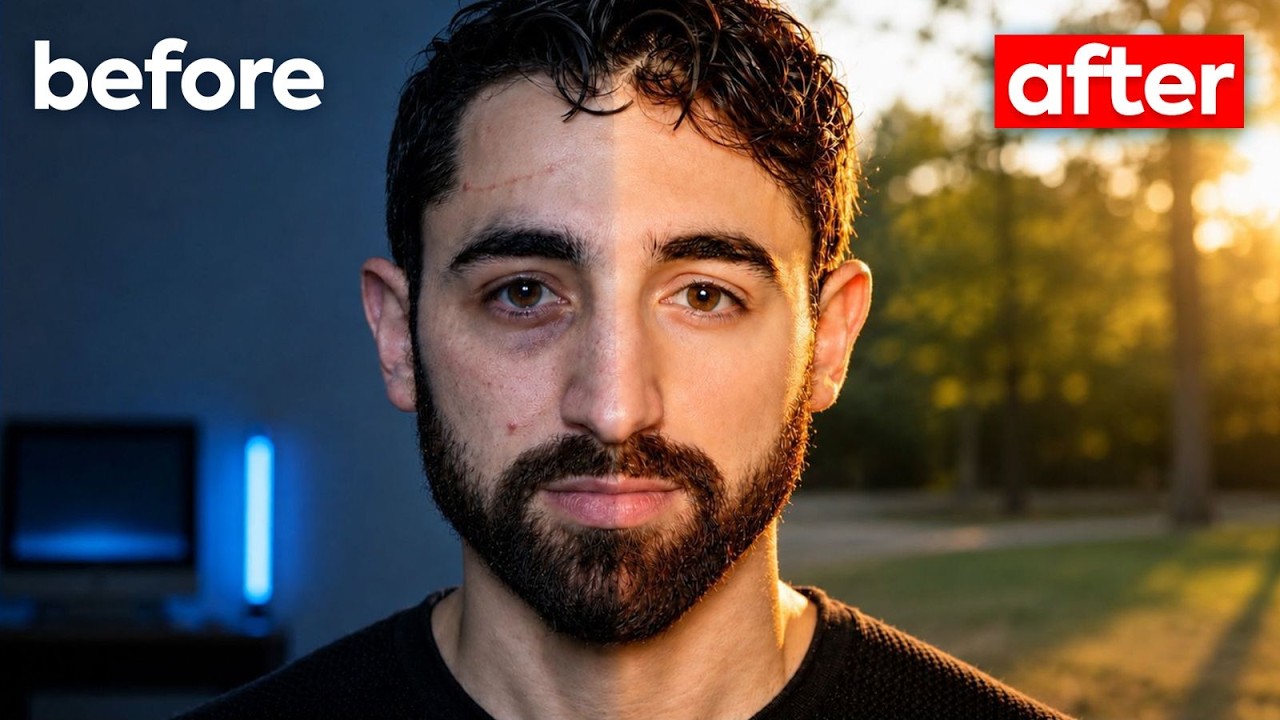
In this pop‑science video, Nick Norwitz (joined by a co‑host) argues that exposure to specific wavelengths of light, especially UVB, can act like a hidden nutrient that modulates the endocrine system, raising testosterone in men and altering female reproductive physiology. He weaves together evolutionary reasoning (conception peaks in summer when UVB is highest), animal experiments (UVB‑exposed mice show higher testosterone, increased grooming, larger ovaries, and a clear preference for UVB‑treated females), and human data (phototherapy trials and short‑term sunlight exposure that raise testosterone, estrogen, progesterone, and scores on the Passionate Love Scale). Throughout, he frames the findings as a “glow‑up” hack for personal attractiveness and relationship satisfaction, while also noting modern light‑pollution and the importance of solar angle. The video mixes literature review, personal anecdotes, and practical suggestions (e.g., 25‑minute midday sun exposure, avoiding light for two days, or using UVB lamps) and ends with a light‑hearted call to experiment on one’s own partner.
Chapters
You can increase your attractiveness to the opposite sex by just going outside. I know that sounds insane and too good to be true, and I thought so too until I read this paper. And then something interesting happened. Once the scientist in me got over his intellectual enthusiasm, my boy brain turned to a slightly more mischievous thought. I'm gonna use this science to hack my girlfriend's brain.
"Hey, what are you doing?" Now pause.
If you're worried this is going to be some sort of misogynistic manosphere video, don't worry. I'm going to give my doctor surgeon girlfriend the chance to hack my brain as well, but not with a scalpel. This isn't about taking advantage of anyone, but rather how everyone can benefit neurologically, physically, emotionally, and maybe even sexually from the science of light. Today I'm going to walk you through something that is deeply surprising and surprisingly well supported: how exposure to specific wavelengths of light can increase testosterone in men. Bro. Bro. Bro. Increase attractiveness of women to their partners. I'm gonna take a shower. Do you care to join me? And alter reproductive biology in ways that sound almost too strange to be real until you see the data for yourself. This is one of those stories where my goal is to take you from where you are now, which is There's no way this is true. Nick is exaggerating to a place of, oh my God, this actually makes a lot of sense. So put your skepticism in a dark little box for the next few minutes and let's turn to the science of light. Light has been shaping our biology since the very beginning. Matter of evolutionary survival. Light influences hormones, becomes more attractive, more desirable, more compelling, more chosen. Light, skin, hormones, brain, more hormones. Can you directly confirm preference for mates? UVB treatment induces female sexual attractiveness to males. Now, before we begin, just a quick note: if you want extra nuances, early access to this sort of content, you should check out our best-selling science newsletter, Stay Curious Metabolism. Find out why it's the fastest-growing premium letter on the Substack platform. But plug over, let's dive into this video. I wanna start with a mental image to hold on as we begin our journey. Imagine two identical people, same genetics, they're identical twins, same personality, even same appearance exactly. They're dressed the same. Only one difference. One is exposed to a different light environment and as a result becomes more attractive, more desirable, more compelling, more chosen. At a high level, part of the reason this sounds so implausible is because we don't tend to think of light in the way we think of nutrients, like vitamins and minerals. Those feel tangible, ingestible, real. Light feels ephemeral. We don't really swallow it. But that distinction is, in many ways, itself an optical illusion. Kind of meta there. Light has been shaping our biology since the very beginning. It is our oldest biological partner. And modern research is beginning to show that it interacts with our metabolism at the deepest possible level. For example, mitochondria, the powerhouse of the cell, undergo cycles of fusion and fission that influence our metabolisms, our metabolic efficiency. And these cycles are directly governed by light. But we can shift from looking at the subcellular mitochondrial level to looking through an evolutionary lens. If you were designing a species, our species, through natural selection, you'd want reproduction to be timed for maximal survival of the offspring, right? Conception wouldn't be random. It would align with environmental conditions that optimize for chances of survival of your babies so they thrive. And in fact, we see exactly those patterns. If you look across much of Europe in the Northern Hemisphere, birth's peak, or around April and May. Let's do some math. Subtract 9 months. That places us, conception, in July and August when sunlight exposure is actually at the highest and exposure to a particularly relevant wavelength of light, UVB light. And we'll get to that in a minute. And this is also when men's testosterone peaks too. Isn't that fascinating? And we'll get to women in a minute.
And as I was reading these data, I actually got really excited. So I did an experiment to use light to increase my testosterone. I'm gonna show you how to do it later. Hang on, there's a little curiosity loop there for you.
But start connecting the dots, it makes a lot of sense. Light influences hormones, hormones influence behavior, and the timing of both shapes outcomes as a matter of evolutionary survival. Now, of course, modern light has dramatically altered our environments. A lot of light pollution. If you live in a city, you know what I'm talking about. But the underlying biological programs haven't disappeared. They're the exact same as they've been for hundreds of thousands of years. They're still running. And if you understand you can begin to leverage them. You can, in a very real sense, leverage light to create what my generation calls a glow up, enhancing not just how you feel, but how you're actually perceived by others. Now, here's another fact, key groundwork as we move on. Skin is an active endocrine organ capable of producing and releasing hormones into your bloodstream, including vitamin D and various peptides. Now let me really hammer home this point because it's important. Think about your pancreas, for example. When you eat carbs, your pancreas spits out insulin into your blood as a hormonal response. Your skin isn't that different. When you hit it with sunlight, a particular wavelengths of light, it releases hormones too. And then many of these skin-secreted hormones can go from the blood to the brain, reach the brain's hypothalamus, and influence a downstream hormonal cascade. So it's a domino chain. Light, skin, hormones, brain, more hormones. So the question becomes, what is the ultimate consequence of light hitting your skin and then skin spitting out hormones into your bloodstream? Truly, what is the consequence? And this is where the story gets really interesting. And while we'll get to the human data in a bit, we do want to start with animal models because that's where the mechanism starts to gain some clarity. I'm gonna call this next section of this video, "Oh my lord, osis." That will make sense in a moment, so sticky note that in your brain. In one set of experiments, researchers exposed mice to full-body UVB radiation. They did shave the mice for this purpose. The results, they were not subtle. Female mice exposed to UVB triggered noticeable behavioral changes in the males. For example, when females were exposed to UVB, their male partners exhibited more grooming behavior. Maybe because they were secreting pheromones or something? The human equivalent, this would be like if my girlfriend shone a special light on herself without my awareness, and then somehow as a result, again, perhaps certain pheromones she's giving off that alter my subconscious perception, I decided to put more effort into getting dressed up to go out.
Whew! Nick Norwitz with his hair brushed in a button-down and a jacket.
I think that's irrefutable proof that this stuff is powerful.
Someone needs to call the New England Journal.
But it gets better. UVB exposure in females increased successful mating behavior, including intromission, intercourse, in what's known as lordosis. Remember Oh My Lordosis? Oh my lord.
Osis.
It's a reflexive posture that facilitates mating. I can explain it visually. It's, um, well, it's this. You can tell I'm having a lot of fun with this. But on the male side, UVB exposure drove a measurable increase in testosterone, with levels rising substantially. Look at this! There were also changes in mating calls and broader signals suggesting increased attractiveness to the opposite sex, like in mice, more anogenital sniffing. I'll let you use your vivid imagination to think about the human equivalent of that. But the researchers went a step further and asked an even more interesting question: Can you directly confirm preference for mates who have been exposed to UVB light? Remember our original scenario? In fact, you can. So using a 3-chambered cage in which a male mouse was sandwiched between 2 female mice in separate chambers, you can just expose one female to UVB, all else being equal, and see who he prefers. And invariably, he likes the female who has been exposed to the UVB light. And importantly, in this experiment, females were carefully matched. The only difference was one female had been exposed to the UVB light and the other had not. The male couldn't see the difference, but he could somehow sense it like some hormonal pheromone gravity. And again and again, the male showed the greater preference to the female who had been exposed to the UVB light. Think about what that means. In a very literal sense, UVB exposure, without changing any obvious visual or physical characteristics in the female, made her more attractive to a male, all else being equal. It is a literal glow-up. And if you don't believe me, quoting directly from the authors of this paper: UVB treatment induces female sexual attractiveness to males. That's pretty straightforward. But now let's move to the human data. The researchers recruited a group of participants undergoing phototherapy with controlled doses of UVB exposure. Participants completed a Passionate Love Scale, PLS, questionnaire before and after phototherapy treatment. Basically, they just asked men and women questions about their attraction and desire for their partners and did so before and after the light therapy. The protocol involved UVB treatments administered 2 to 3 times per week for a total of 10 to 12 treatments. If you want more specifics on the doses and devices and protocols, you can check out the newsletter linked below. The results? Well, take notes. In men, scores increased significantly in domains like obsessive thoughts about her, their partner, yearning to know everything about her, and an endless appetite for affection from her. And in women, the effects were equally interesting: a strong sense that their male partner was the perfect romantic match and a heightened bodily response to his physical touch. When you think about it, phototherapy is starting to look a lot like actual couples therapy.
Funny story.
Well, after I recorded the raw footage for the video you are now watching, um, but before I came back from final edit, I was having interaction with my girlfriend and she texted me a joke about a necklace she wanted, a diamond necklace, something to the effect of, "Well, if you're looking to buy me diamonds now." And I, being the committed jokester I am, thought it'd be really funny to reply with an order tracking number. So yes, I bought the diamond necklace and sent her the order tracking number. Needless to say, she was pleased. And then the edit from this video came back and I just realized, oh, I think I spent too much time in Light.
They're pretty.
Now, if you're one of my naughty listeners, you might also be wondering if this means you can use Light to improve your chances of picking someone up at a bar. I don't know, I'm not gonna comment on that, but you can do that experiment and tell me. Or better yet, invite your date on a walk in the sun. And we're gonna get to sunlight in a moment, so put a pin in that too. But first, let's ping pong back to the animal data, because this is where things get even more mechanistically grounded and biologically real. UVB exposure increased levels of hormones along the brain-to-gonadal axis like GnRH, FSH, and LH, And then, brace yourself, this is real, it made the female mice's ovaries bigger. I am not joking, look at the data, the ovaries literally increased in size, likely reflecting a developing pool of follicles and enhanced fertility potential. What is the human equivalent? Well, consider that male testosterone is highest when UVB light from the sun is greatest, And while nobody has done the definitive experiment to look in females at human ovary size as relates to sunlight and UVB exposure, it's perfectly possible, if not likely, that sunlight and UVB enhances females' fertility as well. In fact, evolutionarily, it's downright logical. That is incredible. UVB light is literally altering reproductive anatomy. But now, back to humans one more time. To further test whether these animal findings translate to humans, the researchers recruited 19 men and women between the ages of 18 and 55. They instructed them to avoid sun exposure, go full Gollum for 2 days, and then on a bright day spend 25 minutes in direct sunlight, resulting in a total UVB dose of about 2,000 millijoules per centimeter squared. More details in the letter below.
As a sidebar, you might be curious as to why the summer months are more effective for boosting sex steroids and potentially fertility. Maybe it's just the number of hours of sunlight we have, but actually no, that's not the whole story. It has to do with what's called solar angle. So in the summer months, the sun ends up being more directly overhead, which gives waves of light a more direct path from the sun through space to your skin. It has to go through less atmosphere, and this is particularly pertinent to UVB light, which is most important here because it's short wavelength and easily scattered by ozone in the atmosphere. So having that more direct path to your skin really enhances the potency of the light, not just the number of hours in the day. Hopefully that makes sense. It's solar angle and total duration of light.
Anyway, blood samples were collected the day before and the day after sun exposure. And the results? There was a positive correlation between sun exposure and sex hormone levels, including testosterone in men and estrogen and progesterone in women.
I found this relationship between testosterone and sunlight really interesting, so I decided to do a little experiment. For one full week prior to a blood test, I tried to avoid sunlight, and when I went outside, I put on this black hoodie just to minimize my sunlight exposure. And this is what happened to my testosterone. Testosterone.
Next phase of the experiment was easy.
I just tried to get more sunlight. I went outside shirtless as much as possible, or with a sleeveless shirt, and then this is what happened to my testosterone.
So now we have a convergence of evidence all pointing in the same direction. Sunlight, and specifically UVB light, is not just something that affects your skin, maybe gives you a little tan. It's something that reaches deep into our biologies. Mine, yours modulates our hormones in ways that can directly shape our attraction to one another, behavior and reproduction. We are not separate from our environment. We are tuned to it. And in this case, turned on by it. Now I'm off to go hack my girlfriend's brain. And I hope you found this science valuable on your quest to get l— learning. To get learning.










