The Cholesterol Code with Special Guest Nick Norwitz
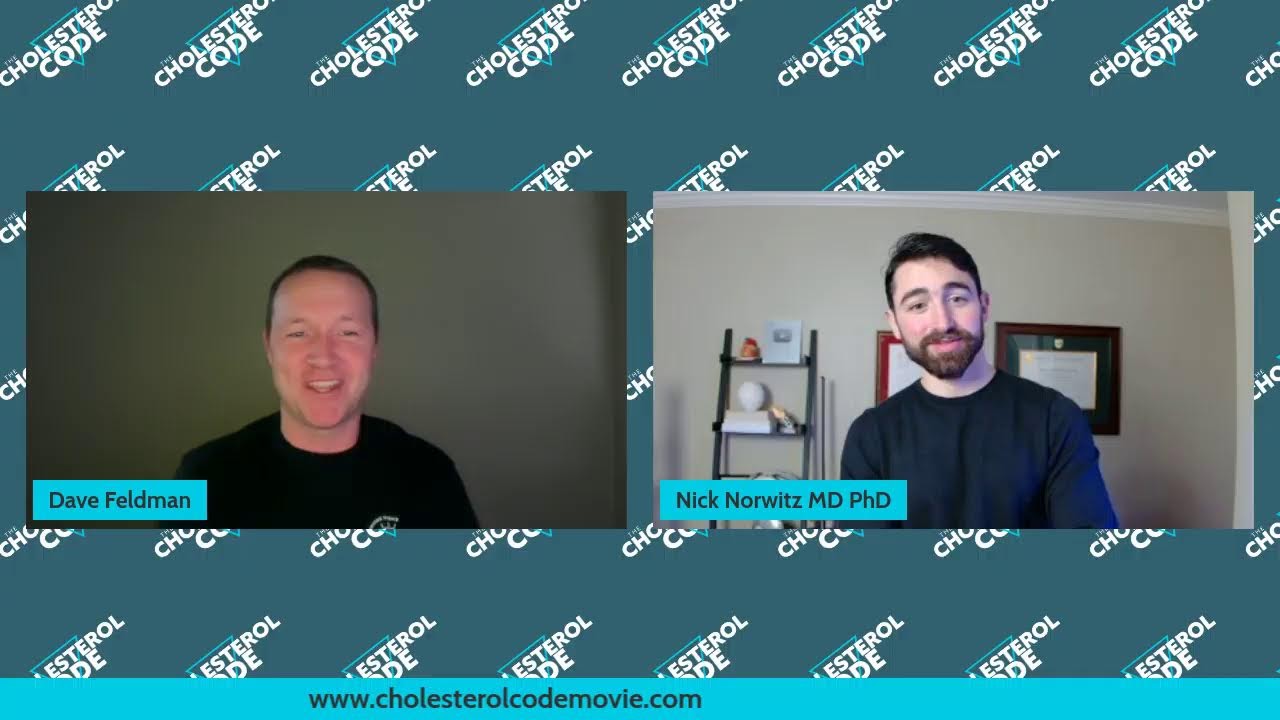
Dave Feldman and Nick Norwitz discuss the release of The Cholesterol Code documentary and Nick's self-experiments, including one comparing Oreos to statins. They explain how LDL cholesterol responds to carbs on keto and how communities can organize screenings through the Gather platform.
Chapters
Boo-yah!
Hey, man.
Hello, Nick Norwitz. How are you doing today?
Excellent. Always a pleasure when you're around.
Yes, yes. We don't do this as often as we used to, right? Like, we used to do this constantly. We used to do Spaces constantly, but we have something awesome that's bringing us together now, and that's the release, the official release of The Cholesterol Code documentary, which you play a prominent role in. Are you excited?
I could not be more excited. It's been a long time in the making and, you know, the conversation has just been so stimulating. I can't see it. I can't wait until it gets to the next level after this comes out, because it's truly remarkable storytelling.
So it's not quite a spoiler alert, but yes, as it happened, we did have a fully edited version that we showed at COSI last year. I want to say 10 months ago. And then lo and behold, an additional chapter got added with ongoing events. But we don't want to spoil that part. That's just something you're going to have to tune in for. But you yourself, Nick, you've not had a chance to see the new edit.
No. I think people assume that I have all the insider information. The fact of the matter is I don't. They're expecting me off doing my thing and then to come back. But it's kind of nice being in the dark. Like, I know you— for people who don't know, Dave hates spoilers. Like, I can't even send him Marvel trailers. It's true. So there is something nice about, like, being in the dark and having things revealed to me. It's a nice surprise.
But we do have one tiny little spoiler. We have an exclusive clip from the film that features you. Uh, it's a lead-in that also includes some graphics. So for everybody who's watching this, enjoy the exclusive and try not to spoil it for other people. Uh, Nick does this experiment with a certain sweet. I hope you guys haven't, uh, haven't heard through the grapevine because I think only this movie has mention of this experiment that happened. That's what I think. But we'll see. Hopefully the, the PR team has all ready to go.
I called it the White Bread Experiment. In it, I lowered my cholesterol more than 200 points in a week by adding white bread to my otherwise keto diet. The experiment reveals just how tightly linked cholesterol is to metabolism. Many people who eat keto have replicated variations of this experiment. It can dramatically and swiftly affect cholesterol levels. And any simple carbohydrate will work. It can be white bread, sweet potato, or—
5 months ago, I started an experiment to see which would lower my cholesterol more: statin therapy or Oreo cookies.
Nick made the provocative choice of adding 12 Oreo cookies per day. About 100 grams of carbs to his otherwise low-carb keto diet. He compared that to 6 weeks of high-intensity statin therapy. The results are stunning. The addition of Oreo cookies was twice as effective at lowering Nick's LDL in less than half the amount of time. But why? Well, remember, according to the lipid energy model, the main driver of LDL cholesterol in people on keto diets is a drop in glucose stores in the liver. This shifts energy demand toward using mostly fat-based fuel. But even a small reintroduction of carbohydrates can refill those glucose stores. And when glucose is easily available, it dramatically drops the need to ship fat fuel in the blood, resulting in a sudden and significant drop in LDL cholesterol.
Ta-da! So fun, fun little aside, that video clip where he's talking to the camera, that's from the really one of the very first videos that you made for your channel once you started to decide to become a content creator.
I'm going to— by the way, I think, correct me if I'm wrong, I didn't have any editors at this time. This was like very early on. I think you did the animation. I did, I did. Which I think is my— it's still like a top 3 viewed video. I think it's like something like 500,000, 600,000 views. So credit to you for the edit on that. But yeah, it's been a while.
It's so much fun revisiting that time for us because I just, you know, it's— I know you feel the same way. I feel like I've known you forever at this point. But at that time, it was still early on. The film had— the filming for the documentary had just gotten started. And that Oreo versus cookie experiment was, you know, a massive success. A lot of people got their attention placed on the lipid energy model, got more interested in the science. And, and I'm so happy we got to feature that in the film.
Yeah. Um, it's so funny to look back at that time. Um, there are elements of it that kind of make me cringe a little bit, even just like watching myself shove Oreos into my mouth. Um, for, for context, I do not remember doing that at all. So when this came up on the big screen when we were doing the original screener last year, I'm sitting in the middle of a theater with everybody around me, and I come up like a 40-foot me head And I'm shoving Oreos in my mouth. Everybody's like, is he gonna put another one in? Another one in? And I'm sitting there with everybody else being like, is he gonna put another one in?
Because I don't remember.
But it was really a catalytic moment for me, not in terms of like scientific understanding. Because the funny thing about the Oreo versus statin experiment is it was so predictable based on what everybody else, including you, had done before. You just done it with another carb. We had case studies done with other carbs. And I was frustrated on the behalf of the scientific community, you, me, our colleagues being like, from a mechanistic perspective, this is so mind-blowing. Why does no one care? And I took that frustration and angst and put it into like, I'm going to design something that people cannot ignore using all I have at my disposal being an extreme lean mass hyper-responder. LDLs, 300, 400, 500s, and then the most provocative cookie I could. And then the branding behind me, Harvard Med, whatever. I just knew that would be the package that would lift the discussion through provocation. And to your point, it was immensely successful by every metric of, I'm gonna say this very consciously, attention. I know that's a taboo word because it makes it like we're just gunning for clicks. But when I say attention, I mean attention for research funding, collaborators, clinicians who need to know about the lean mass hyper-responder phenotype and don't. It gets it on their radar and it starts a conversation. That was the purpose. And my experience with it as a social experiment proved sometimes you need to kind of like, well, pardon the pun, crack some eggs to make an omelet. But yeah, that was a—
but then that's the only time you've done that for a video, right?
So that's the thing is it's, it's unreasonably effective. I, you know, I have very conventional training. You know, undergrad, cell bio, biochem, PhD, Oxford, then I went to medical school. You know, where— and throughout all that, I had this idea, this like hope that science could be pure and we just come around by like, oh, these are cool graphs and cool data. You realize that is not the case. Science, even at the highest level, is all about engaging people's curiosity. And once I appreciated that and kind of like what makes people tick, I started playing with scientific storytelling. And I've done multiple experiments where I cover data and I cover data again, but wrap it around a personal narrative. Sometimes it's self-experiment and every single time it goes off better. In fact, I won't spoil it, but I do have another statin, in this case, a blinded placebo-controlled trial I'm doing on myself. You know about it. People will see it coming, but you're going to see, I'll tease at the end of that video, I'm going to say I released another video covering these data, actually a 300,000 participant trial.. And I will tell you predicting in the video that I'm releasing, this one's gonna do better even though it's an n 1, because people just like the human element. They do. We're human. That's how we learn and interact. So it's a feature of how we communicate around science in this day and age that just needs to be acknowledged because people are going to leverage it to get your attention. So it's a tool anyway.
So yes, part of why we're here is it's not just to talk about the film. It's to mention that exactly what you're doing on your channel is what we're doing with the movie, is we've actually documented not just your experiment, my experiment, we also document a whole bunch of these people's personal stories and how they experiment with their diet to actually get greater efficacy. Uh, not just a lot of folks who were losing weight, but, um, there's been a lot of people who benefited from keto with regard to mental health, with regard to type 1 diabetes. But they all had this issue that both you and I, Nick, ran into, which is everything looks great, ah, except for this one thing, which is the cholesterol. And that's what led us to ultimately not only look into it from the mechanistic standpoint, but also the risk standpoint, which is what the film has as its through line. Is the study itself on lean mass hyperresponders, and particularly with regard to risk. And I'll just kind of softball this up for you for a second, just briefly. Would you say that our tagline, "The science is never settled," proved to be prescient for this final chapter that got added?
For sure.
For sure. So, okay, so I have some news to share with you. You've been hearing probably that we have actually been getting a number of folks who've been interested in showcasing this film in their community through this platform called Gather, G-A-T-H-R. And I got to be the first one to sign up to have a showing myself. The way it works is you basically just, you go to the pla— you go to cholesterolcodemovie.com. It's actually a banner down there at the bottom. Sign up to be a host. When you sign up to be a host, it lets you go to a map where you can actually choose a nearby theater that's participating, choose the time slot for, um, just both the date and the time where you want to have the showing, and then you host it. You can help to then gather people to come and watch the screening. And what's cool is I've got a map that actually shows how many people have signed up.
Wow.
Yeah, this has just been— we only just like did kind of a soft launch of the, the very first stream we did was like not even wide, and we had— we're now up to, I want to say it's like 26, 27 different, uh, people who signed up. And yeah, it's all across the— I'm sorry, I just got corrected, it's 30. 30 people who've signed up across the United States who are going to be showing our movie, The Cholesterol Code. And, uh, it's, it's so exciting because I— in this day and age, you're usually going straight to streaming, right? And make no mistake, we will be up and streaming, uh, ultimately. But everyone who's setting up their own showing and then getting their own friends, family, everybody else that they can to come and watch it they're hoping to see it on the big screen. And hate to say I'm pretty old school, Nick, but I love watching it on the big screen. I love the theater experience. It's, it's a lot more camaraderie in that respect.
If you don't mind me going on a little bit of a tangent, you know, in science, the projects are fun. If the data are cool, the data are cool. But what really makes it an experience is who you go through the journey with. The peers you have around you who like can get equally excited about questions, data. It's all about community. I mean, that's just how life is. It's not about the destination. It's not even about the journey. It's who you take the journey with. Now, where I'm going with this is really from the earliest inception of all of this has been about community. You got a trial up and funded based on community interest. The trial that you then run, it took immense effort from participants. And I've never ever heard of this, zero dropouts, like a longitudinal study with zero dropouts, people traveling across the country to get scans. Not one person drops out. That does not happen. And it speaks to the immense power of community interest in this science. And now I feel like we're just seeing it again. With this. I didn't even know this Gather thing existed. The people signing up to show it, I just want to like take a moment to applaud because even if it seems trivial, like getting excited about new data on social media or hosting the screening, like this is the heart of what makes pursuing science so rewarding. It's not even necessarily the data, it's that you get to share it with other people. And the enthusiasm I've seen for this science and just the concept of challenging dogma and the science not being settled is what makes this— I feel like a movement's almost a cheapening word, but it is a movement— so compelling to me.
It's definitely a movement, and it's definitely towards the discovery. You know, one of the most exciting things is to feel like we're actively participating in unlocking this information that Well, you know this part of the story. This, this was something I tried to go through just the straight vanilla formal channels for 2 years, uh, from 2017 to 2019, before finally in 2019 is— it was almost like I said, well, there's only one way to do this, and that's if we form our own scientific charity, raise the money ourselves, and then just get a research center to do it for us. So to, to the credit of those 100 souls, those 100 hearts that came to get scanned, yes, it's a testament to just how, how much we all care about trying to get to the truth, about trying to get to the real data that can take us to the next step. It is something certainly I care about, not just for myself if I'm on a low-carb diet and I have high LDL, but to you and to Adrienne and to everybody else who I know who is trying to be as responsible as they can every step of the way, but also is, you know, struggling with how much do they benefit from being on a ketogenic diet, being metabolically healthy, being fat adapted, and then how much is what is thought to be the highest risk going to prove to be true or not true. That's what we're finding out in real time.
Yeah, I think there's this, this picture that people get in their minds— probably not people listening, people taking the time to listen, they're probably past this picture— but just generally of like, there's the conventionalists and then there's the rebels, and we're the rebels trying to like fight the dogma and like overturn decades of knowledge.
And I—
there's a part of me, the troublemaker, which There is within me who even likes that image, but I think truthfully it's just about the frustration of, hey, here's the bubble of what we know and here's what we don't know. And you would think the biomedical community, especially when there are patient lives at risk, would just be like, let's poke the bubble of what we don't know, like truly authentically to learn. And there's such little interest in doing that. The tagline of the science is never settled. Is just speaking to what the process of science is, which I think gets like voice time, but so shallowly that nobody actually wants to engage with anything that challenges the status quo. And you and I have both had experiences, some together, some independently, on just how bad that gets in the conventional realm, where even if you have done everything by the book, you have all the data there, You know, if the conventional pipeline just don't want to put it out, there are always ways for them to just brick wall you. And at some point you have to find a way around that, which is this trial, this movie. It's very authentic.
Yeah, I'm, I'm so proud of the work. I have to once again just give extra shout out to Jen Eisenhardt, our director. Our fearless leader, and her team, and helping to put this thing together. And I'm so, just so thankful that so many people I care about who are part of this research journey, including you, Nick, were a part of this film. So we can't let the video go too long. I just want to once again shout out, appreciate everybody who's interested in joining. Go to the cholesterol code— sorry, specifically cholesterolcodemovie.com. Click, uh, join as a host, sign up as a host. I want to say something like host, just host a showing. And, um, my understanding is we're also going to, uh, have an easy way for people to find the existing showings that are out there. And maybe it's through the Gather platform itself. But I'm also excited to share that I'm going to now start plotting flights because, uh, I'm going to be actually traveling around the country to different locations to join some of these screenings. We're finding that out here shortly, which ones get selected, which ones don't. I want to share one other secret, which is literally this morning, I'll just say somebody with a sizable following who's in the carnivore space wants to host The Cholesterol Code for a fundraiser.
Themselves.
And I'll hopefully have some news about that here pretty soon.
But needless to say, guess in this live stream who the person is and you can confirm or deny, or no?
I, I can't confirm or deny, but you can feel free to just throw a guess and then I'll not respond.
Go ahead. Michaela Peterson.
No, like I said, I was not going to respond to whatever, whoever you said, but anyway, right? Yes, well, I'll chat about it later.
Literally no information on this, is the first time hearing of it, so I could be dead wrong.
Real quick, we do have a last-minute question that's come in, which is, uh, oh, actually a couple. Question 1: Can you do it in Canada? And the answer to that is yes. Um, and what you want to be able to do is you want to, you want to email cholesterolcode@ @gather.com. Yeah, there it is. That's the email. If you're outside the US, email cholesterolcode@gather.com. Originally, when I was just announcing this, I thought we could only do just inside the US, which is how I announced it from before. And turns out people were like setting up, you know, they were able to set up outside. And now the PR team said just go ahead and email them directly and they'll concierge, they'll make it easy for you. To accomplish.
Cool.
Uh, second, where do we find the showing so I can attend? Um, and the answer to that is we are going to share all the cities that have a screening via our newsletter, but there isn't one— there isn't one we recommend. If there isn't one, we recommend you host one. So that's the other piece. Sorry, I should have mentioned the newsletter earlier. Sign up to the Cholesterol Code newsletter if you want to follow on this film. There's also additional great information that's shared in the newsletter as well. In fact, Nick, we have a nice little, we have a nice little primer on the lipid energy model that's going to be in the coming newsletter.
Cool.
We have another question on international availability. People in the US, Canada, New Zealand, Australia, Ireland, and UK can all screen in theaters. Other countries can all still request screening. So yes, this gets back to the international as well. Just email cholesterolcode@gathr.com. And yeah, yeah, I think that— I think we can wrap it here. Nick, I can't wait to see you at COSI. It's going to be great. We need to do another ultra marathon.
And this one without audio hiccups. For context, we recorded over a 6-hour podcast, but I have a voice that just carries, and something happened with the mic where there's like a reverb.
Yes.
Anyway, yes, now that the Feldman Protocol is up and running and you're absolutely crushing it, we will do a repeat.
We have a, we have a better, uh, studio setup. And, uh, what I'm gonna do is I'm just gonna like hire some people to, you know, as we're talking, they're gonna like run up and hand us water bottles like, you know, like we're in a marathon. We're just like drinking down the walls.
Gels the goos, but that would just stick to butter or something.
Yes, exactly.
Yeah.
All right, um, I hope you all have a wonderful weekend, and, uh, I hope to see you in the theater. Cheers!










