The Gut Health Trick I Wish I Knew 10 Year Ago
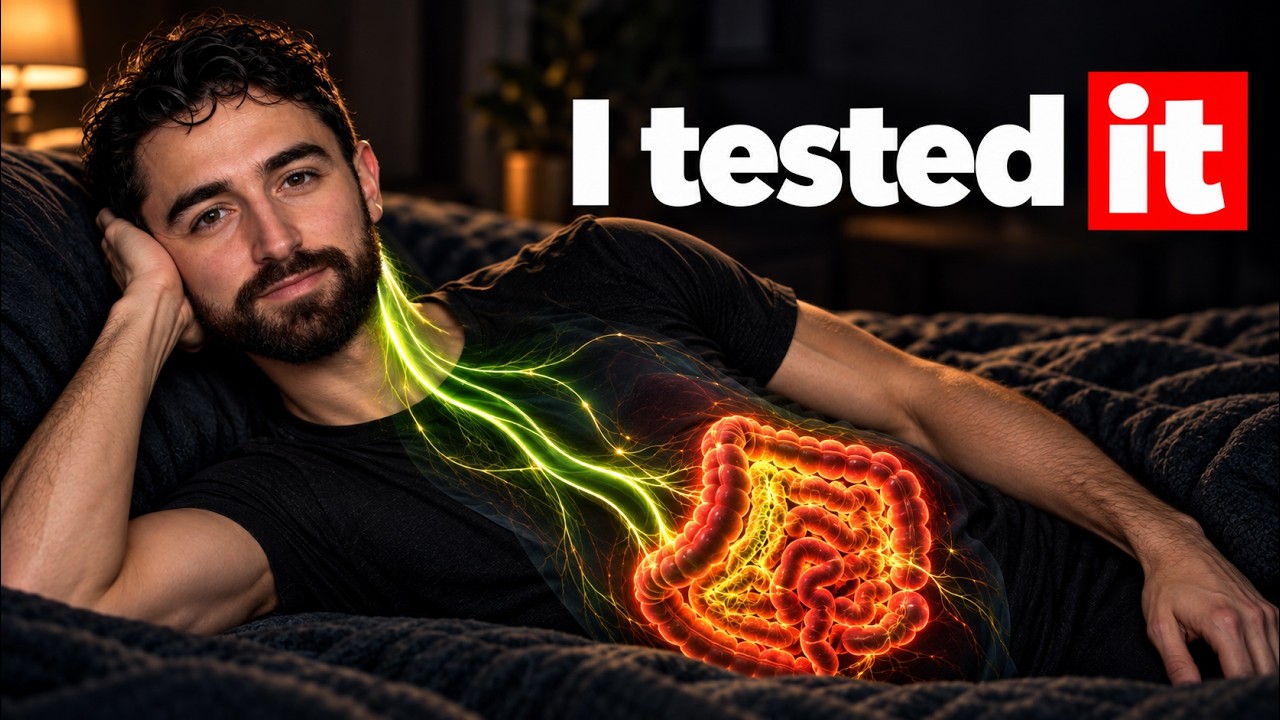
In this video Nick Norwitz shares his personal battle with inflammatory bowel disease (IBD) and how a combination of an anti‑inflammatory diet and vagus‑nerve modulation transformed his health. He explains the biological link between stress, vagal tone, and gut inflammation, citing mouse experiments that showed stress‑induced death and rescue via electrical vagus‑nerve stimulation. He introduces the molecular mechanism of SUMOylation as a stress‑responsive inflammatory tag that is dramatically reduced by vagus activation. Norwitz then presents human evidence: the RESET‑RA randomized controlled trial, which demonstrated that non‑invasive vagus‑nerve stimulation improves rheumatoid arthritis symptoms and slows joint erosion, leading to FDA approval in 2025. He describes the brain‑gut‑immune circuitry, emphasizing labeled vagal afferents that act as an inflammation thermostat. Finally, he offers three actionable levers: (1) breathwork (cyclic sighing) that directly stimulates the vagus nerve, (2) intentional stress‑reduction activities as gut‑health interventions, and (3) non‑invasive vagus‑nerve stimulators such as the Pulsetto device, sharing pilot trial results, his personal experience, and a discount code. Throughout, he encourages viewers to stay curious and experiment with their own biology.
Chapters
For years, my gut tried to eat itself from the inside. That's roughly what inflammatory bowel disease is— your immune system turning on your gut. And what saved my life was an anti-inflammatory diet. But diet was only the start of my gut health journey. Because as I obsessively studied biology, first during my PhD at Oxford and then at Harvard Medical School, I realized there was another lever I needed to pull to bring my gut health from good enough Pull the lever, Kronk! Wrong lever! And that lever is a nerve. The vagus nerve. This is the vagus nerve in cross-section. Isn't it beautiful? It is the super-speed telephone line that allows your brain and your gut to pass messages between one another. Messages about the food you eat, the stress you feel, and inflammation in your body. So here's the claim, and I know how it's gonna sound, but you can use your brain and your mind and Maybe some fun new gadgets, which we will talk about, to change the inflammation in your whole body and ultimately bend the course of inflammatory and autoimmune diseases from ulcerative colitis to rheumatoid arthritis and beyond. This is one of those ideas that is simultaneously far-fetched and rigorously true, but the stakes here are even greater than I realized. Stress isn't merely in your head. How did stress make inflammation go up? Deadly. The whole stress group died within days. Erodes the joints like acid rain on rocks. What if you activated the vagus nerve, literally acting like a dimmer switch on inflammation? Doing that reversed the outcomes. That it can be the difference maker between life and death. Here's a fact I learned from the first paper we're going to discuss today. Inflammatory bowel diseases shorten patients' lifespans by 10 Years on average, largely due to increased risk of complications like sepsis and cancer associated with chronic inflammation. Years on average. I was going over the edit and just fact-checking myself because that seems so remarkable. It's 10%, not 10 years, so my bad, but that's still pretty crazy, and I plan to live beyond 100 anyway, so moot point. So the point is, the lessons we're going to learn here apply to every single one of us, whether you have IBD or not. Because we're all vulnerable to inflammation by virtue of the modern living environments that encapsulate our lives. Chronic stress, air pollution, processed food, sedentary lifestyles— these all provoke inflammation in your gut, in your heart, in your liver, all throughout your body, everywhere. We're going to talk more broadly about how to use your brain to control all inflammation, but let's start with the study that hits close to home for me—
in the gut.
And I also promise you, by the end of this video, I'm going to share with you practical insights that you can use today, many of which are free. And finally, before we really get started, if I may be so bold to ask one favor of you. I realize more than 76% of you who watch this channel aren't yet subscribers. So if you do me a kindness, please, and you enjoy these videos, please hit subscribe. It is the easiest and freest thing you can do to support me and our growth if you appreciate what we're doing here on this channel. So thank you, but let's begin now with part 1. I'll start with a paper that drew a mechanistic line from a stressful state of mind all the way down to the molecular machinery of inflammatory bowel diseases, or IBDs, in both mice and human tissues. The setup was simple. Researchers stressed mice that had severe IBD, inflammatory bowel disease, and the stressed animals didn't merely get sicker. Their IBD, their inflammatory disease, turned lethal. The whole stress group died.
What?
Died within days. The stress somehow made the inflammatory disease so bad it literally killed them. But how? How did stress make inflammation deadly? Well, here's the first clue. A key signature in the animals of vagus nerve activity suggested that the parasympathetic rest, digest, and recover arm of the nervous system had been tuned way down, roughly threefold. Now, real quick, to define our terms, the vagus nerve is the longest nerve in your body and the main communication highway between your brain and many of your organs, including your heart, your liver, your immune system, and your gut, and has many functions. That includes being the captain of digestion, but also helping to calm inflammation. So it makes some sense, right, that stress could, by toggling vagus nerve activity, make inflammation worse. And that is what they were seeing in this study. But if disrupting the vagus nerve signal with stress makes inflammation worse, then what if you did the opposite? What if you activated the vagus nerve? And that is what the researchers did next. In this case, they surgically exposed the vagus nerve in the animals in the neck and hit it with short bursts of electrical stimulation, and doing that reversed the outcomes. Seriously, vagus nerve stimulation rescued the animals from the deadly inflammatory disease. Their disease scores fell, their intestinal bleeding improved, and I can tell you it's very unpleasant from personal experience, and their inflammatory signals in the colon dropped— markers like IL-6 and TNF-alpha, which are inflammatory signaling molecules— while anti-inflammatory signals like IL-10 rose. Again, this is what happened to me in my IBD recovery story, so honestly I feel for these mice. But even in mice, consider what this means. It means tuning the nervous system can change inflammation in the body to such a great extent that it can be the difference maker between life and death. That's pretty cool, right? But the next question is, what is happening at the biochemical level to tune inflammation? Now, hang in with me for like 30 to 60 seconds because this is going to get technical, but I do want to show you some human data. So how this works is a process you probably haven't heard of with a weird name called sumoylation, and there's no relationship to sumo wrestlers here. It's a molecular tagging system whereby cells attach small molecules called sumo onto other proteins, and this changes how those proteins behave. You can think of it as like the molecular stress dial that gets cranked up during inflammation, and importantly, this SUMO inflammation tag is elevated in human patients with inflammatory bowel disease, like Crohn's and colitis and me when I was 22. You can see that here in violent red. That's the SUMOylation in action. But here's the key— vagus nerve stimulation turned this inflammatory dial way down, dropping it by roughly 70%, literally acting like a dimmer switch on inflammation in the gut. That's really cool, isn't it? But if that went over your head, don't worry, thanks for sticking through it. Let me boil this down as simply as I can before we move on to our next paper. Here are the 3 big points: stress lowers vagal tone, lower vagal tone— vagus nerve tone— worsens gut inflammation, and restoring vagus nerve activity calms inflammation. That means, in effect, your mental state isn't walled off from your gut. Stress isn't merely in your head. It has a physical wire running straight through your neck, past your heart, into your gut, into the molecular machinery of intestinal inflammation. And if you don't mind me taking a moment of your time to just level with you and open up, this resonates with me. My worst ulcerative colitis flares always clustered around international travel, which is something that is disproportionately stressful for me. You might ask why. Honestly, I think it's a form of PTSD and self-fulfilling prophecy. My worst flares, those that ended me up in the hospital, were always around travel. The worst I've ever been in my life was when I first moved to Oxford, and within weeks I was in the palliative care ward because of a horrible flare that left me just severely infirmed, and I still have nightmares about it to this day. That's me being honest, but this isn't my sob story. This is the seed of inspiration for why I do what I do, and what gets me excited is papers like this because it offers a mechanism, insight into my personal experience. But now that brings me to the next big question that matters: can stimulating the vagus nerve control inflammatory disease in humans? And remarkably, we now have a randomized double-blind trial that gives us an answer, and that answer is yes. But that brings us to part 2, where I want to zoom out for a moment and give you an example beyond the gut, because honestly, this is emerging science, and it just so happens that the first randomized controlled trial data and FDA approval for a vagus nerve stimulating device in inflammatory diseases exists for something called rheumatoid arthritis. Rheumatoid arthritis is an autoimmune inflammatory condition in which the immune system attacks not the gut, but the joints. That said, autoimmune and inflammatory diseases have similar underlying causes. In fact, having RA increases your risk of having inflammatory bowel disease and vice versa. Therefore, I do think we should think about these trials on autoimmune inflammatory conditions in that broader context. But in this trial, This was a large randomized double-blind trial called RESET-RA involving 242 patients with rheumatoid arthritis who were randomized to receive a device that stimulates the vagus nerve versus others who received an identical device but that was switched off. And crucially, these were patients whose arthritis had already failed drug after drug after drug. So what happened? Well, at 3 months, The vagus nerve stimulation caused significant improvements as compared to the control group. And then, when the patients were treated for an additional 12 months, the benefits grew even further, and on the strength of those data, from this randomized controlled trial, in 2025, the device became the first vagus nerve stimulator ever authorized by the FDA for an autoimmune disease. Sit with that for a moment. What it shows. We have data in humans in a randomized double-blind trial that quietly stimulating the vagus nerve changes the course of autoimmune disease— disease that had resisted powerful drugs in these patients. That doesn't need any further hyper-spin, it is remarkable on its own. But that said, I'm actually not done because it gets even more impressive. Because as with inflammatory bowel diseases, rheumatoid arthritis produces clear signs of biological damage. In IBD, it's the gut. In rheumatoid arthritis, you can look directly at the joints. And over time, chronic inflammation literally erodes them, erodes the joints like acid rain on rocks. So if vagal nerve stimulation were having a powerful biological effect, you might expect it actually slows joint erosion. And that is exactly what they saw in this trial. Vagus nerve stimulation slowed bone erosion as visualized on MRI of the hands and wrist. That, that is the power of your nervous system, and that also brings us to part three. More on mechanism because how physically does a nerve calm down inflammation? Stay calm! Wait, wait, wait, wait! Everybody just calm down! I want to evolve the picture of our brain inflammation communication system a little bit more, and it starts in the brain because it turns out the brain doesn't just sense inflammation as a vague malaise. It reads it in fine detail. One set of vagal sensory nerves going from the body to the brain is tuned to pro-inflammatory signals, and a separate set is tuned to anti-inflammatory ones. Recall that image of the vagus nerve I showed you earlier, the cross-section. All those little cables carry different information, and these are called labeled lines, and these lines run up to a specific control center in the brainstem. And then what happens is the brain acts to control inflammation kind of like a biological inflammation thermostat so things don't get out of control. If inflammation is rising, the brain responds with an anti-inflammatory signal that gets things back in check before inflammation causes more harm than good. And again, I cannot overstate the stakes here. If you silence that brainstem cluster that is the inflammation thermostat, then when your body starts to have inflammation levels rise, It runs wild and the pro-inflammatory signals in the body can more than triple while the anti-inflammatory brake fails. And now connect this back to our first study, you can now begin to glimpse how factors like psychological stress in the wrong contexts can cause the nervous system signals to go haywire, leading effectively to runaway inflammation and, at least in animals, even death. But there's also a flip side. Because if you can activate these anti-inflammatory signals stemming from the nervous system, if you can harness the power of the vagus nerve, the opposite happens. Inflammation is tuned down, even enough to save lives. Put this all together because the picture is coherent. There is a literal wired circuit connecting your brain to your gut and your immune system, and in humans, engaging that kind of circuit could change autoimmune diseases, including in the gut, And beyond. But that brings us to the final part of this video— levers you can use today. There are specific devices like vagal nerve stimulators, and we will get to that, but first, what about levers you can reach for right now for free? The first lever is a slow, exhale-emphasized form of breathing. Because here's the deal— your vagus nerve and your breath are physically coupled, and every exhale is linked to a small pulse of vagus nerve activity. Which is why lengthening your exhale is the fastest way to nudge your nervous system towards calm. In fact, a controlled trial published out of Stanford found that a few minutes of what's known as cyclic sighing, which is a double inhale through the nose, then a long, slow exhale through the mouth, like this. And in that randomized controlled trial, That cyclic sighing procedure improved mood and lowered physiologic arousal more than mindfulness meditation, which is great because I find meditation very boring. In inner peace. What this looks like for me in my personal life is taking time cognizantly to practice this breathing method when I'm in an Uber or on a plane because travel just stresses me, as I mentioned before.
Honestly, airports have stressed me out for some years. Didn't always used to be like this. I think It has to do with the fact that some of my worst IBD flares, colitis flares happened after trips and I ended up in the hospital. So I think I have some sort of like PTSD from this sort of environment, but I'm cognizant of it. So what I try to do when I'm on the way to the airport, in the airport or on a plane is really just focus on my exhales. I just put my mind on Long exhale, and it really does help.
And looking back, my worst colitis flares always occurred around international travel, so this breathing technique is a tool in my toolkit with very real relevance, and it costs nothing. That brings us to lever 2: treating stress reduction as a gut health intervention. Remember that colitis paper, the first one we reviewed? Its most sobering finding is that psychological stress alone can turn survivable inflammatory disease Lethal, deadly, in part by dropping vagal tone, which reframes stress management from just some self-care cliché into hardcore gut therapy. So my version— my version looks like giving myself a break to watch a Marvel movie or cuddle up with a hot cup of licorice tea and a cheese platter. Because as someone who's always go, go, go, appreciating that the stress reduction I actually enjoy is a tool for health and not just a guilty pleasure That's really a health unlock. So if you're like me, give yourself that permission to enjoy stress reduction practices you enjoy— movies, a hot bath, whatever it looks like. You could even tell me in the comments what your version looks like if you want to. And that finally brings us on to 3. Vagus nerve stimulators. Because there are now non-invasive vagus nerve stimulators that clip around the outer ear or around your neck and deliver gentle electrical pulses. And the evidence for these devices is growing rapidly. For example, one randomized controlled trial in chronic insomnia found that stimulation with a vagus nerve stimulator beat a fake device, a sham device, for sleep quality. So if you know me at all, you know what comes next, and I kind of foreshadowed it already. I decided to try it. After a fair bit of research, the device I ultimately decided to try is Pulsetto, what I'm wearing right now. It's a non-invasive device that wraps around your neck, and in simple terms, it generates small electrical impulses That modulates signaling through the vagus nerve between the gut and the brain. Honestly, it kind of tickles. I like the feeling. And the company actually has some really intriguing early data. For example, in one pilot trial involving 40 adults, participants experienced a 56% reduction in depressive symptoms after 4 weeks. Anxiety scores also fell by 45%, and sleep quality improved by 41%. And there were also biomarker changes. Because about 70% experienced reductions in cortisol levels, with decreases ranging from approximately 30% to 50% in both men and women. Now, I don't know about you, but I think those results are pretty exciting. So you can't blame me for being curious about whether this would actually make a noticeable difference in the one participant who matters the most— me.
So what did I do?
I had my team reach out to Pulsetto, not the other way around, and only after I prepared the rest of this video on vagus nerve science. So I'll just say, for those of you who just want the science and the free tools, we have covered those. Feel free to end the video here because honestly I'm about to talk about a commercial product that I actually think is pretty great. Anyway, I was most interested in trying vagus nerve stimulation for those moments when my thoughts were racing, which is pretty frequent, or when I feel bloated after eating, and for sleep. And what I've noticed is about 7 minutes into turning this thing on, I feel subjectively calmer. And less wound up, and with less bloating after eating. And I've had many nights of 8 hours straight sleep, which I'm pretty proud of as a chronically terrible sleeper. Whether this is all the vagus nerve stimulation itself, or a placebo because evidently I studied this stuff quite a bit, or most likely some combination of both, I can't say for certain, but what I can say is I keep coming back to this thing. I kind of enjoy it. And that's something I just can't say for meditation or any breathwork practice which Honestly, I can't stick to because they're just so freaking boring. If you love them, that's great. I just can't stick to them. So yeah, I like this thing. I call it my personal vagus nerve therapist. And if you'd like to try it, you can use my code STAYCURIOUS for 10% off. And importantly, there's also a 30-day money-back guarantee, which is great because honestly, this is expensive. I don't control the price. I just want to try things and then share them with you. So if this is something you want to try, now's a great time because there are no strings attached. And if ultimately you don't like it, Send it back. Seriously. Because ultimately, health is an n=1 experiment. And that, that is really the broader lesson here, one that goes far beyond this video and even this channel. There are so many ways to engage with your biology and learn from it. For me, as I've disclosed, a diet that many people consider fringe quite literally saved my life. And had I not been willing to experiment, to stay open-minded, and to test things on myself, I would not be here speaking with you today. So the goal here really isn't to have you copy my protocol or use tools that I use. The goal is to stay curious about your own body, because when you learn to enjoy, truly enjoy that process of discovery, health transforms from a chore into a privilege and a joy. I personally think that's pretty cool.










