The LMNT Scandal Explained & Nick Norwitz Goes VEGAN with Robb Wolf
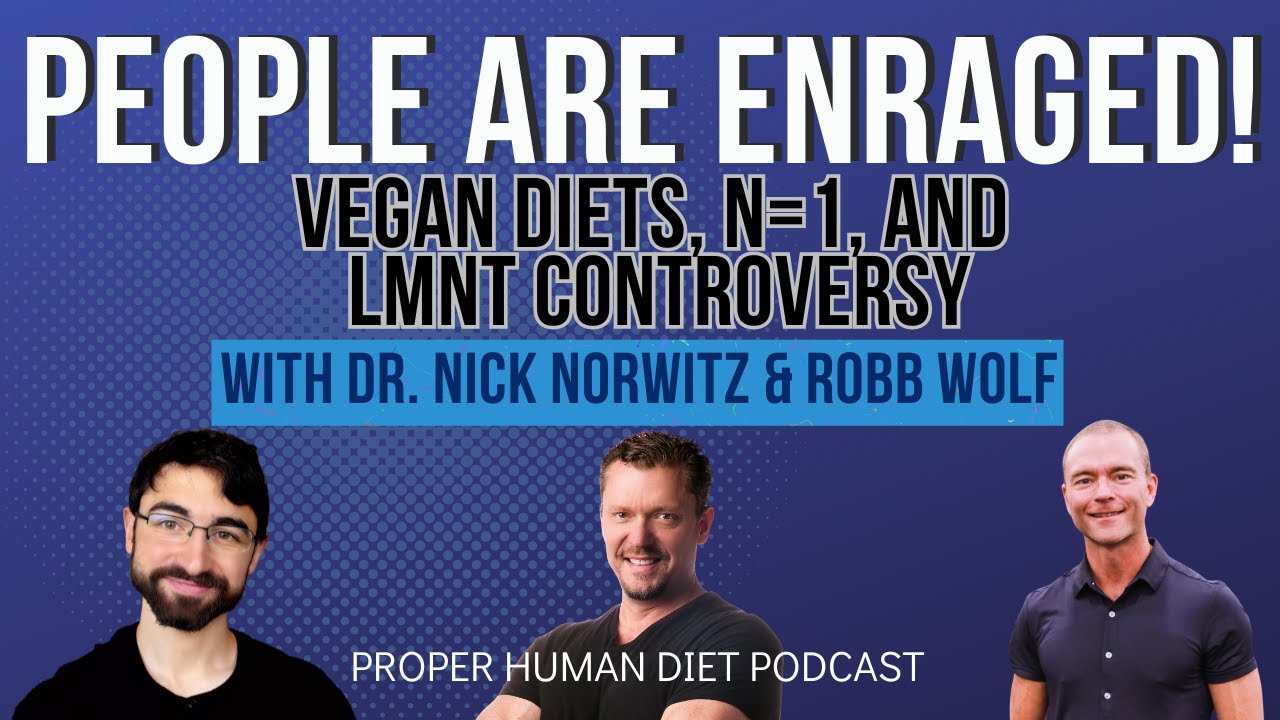
Robb Wolf explains how Element's electrolyte powder accidentally contained 0.4 g of undisclosed maltodextrin, the backlash, and plans to add blockchain-based batch traceability. Nick Norwitz shares his vegan-keto experiment, which raised his LDL by 14 percent despite reducing saturated fat and cholesterol.
Chapters
If you're in the keto or the carnivore space, you've probably heard about the LMNT scandal. Everybody's been talking about it, and I've got a guest today who can help shed some light on this and kind of get to the heart of the matter, get to the truth of it. And then also I've got another guest who has done another crazy experiment. Of all the things that he could possibly experiment with diet-wise, he decided to go vegan. I don't know why. We're gonna find out. So I've got with me today Rob Wolf and Nick Norwitz. Hello, gentlemen, welcome.
Hello, good to see you.
Yeah, good to see you guys again as well. Uh, I've met you, Rob, a few years back at a conference. I can't remember which one, but, uh, it's been a minute. So good to see you again.
Good to see you.
I talk every 10 minutes, so he's like my little brother. Uh, okay, first of all, let's talk about this. Everybody in my group calls it Element, but LMNT, the electrolyte powders. So Robb Wolf is the co-founder and part owner in Elements that makes the electrolyte powders. And so the controversy, this, the, the kerfuffle, is that Element kind of advertises itself as no dodgy ingredients. Uh, if you look on the website, it says it's got 4 milligrams of maltodextrin, which for those of you in the know, you know, that's just long chains of glucose molecules stuck together, uh, kind of like a starch. And then it turns out all of a sudden that there's 2 orders of magnitude more maltodextrin in Element, uh, anywhere from 250 milligrams, maybe even up to as high as 550 milligrams. Um, that's what, that's what was reported was 550 milligrams. And then I think Element issued some kind of release and said, well, it's between 250 and 550, which is what I would say too if I owned Element and we were having some drama. Uh, Rob Wolf, tell us what, what's all this about? How did this happen? Um, I've got some thoughts and ideas because I'm friends with other people who develop a product like Element and then try to scale it up. And my guess is, is that's where this happened. And maybe it was not even— you maybe were not even aware of it, but just, that's my opinion. Just tell us the story. How did this happen and how did you guys find out? What are you going to do about it?
Well, there's a long arc to this. And Nick, are you guys comfortable with me doing the full long arc on, on all this? Uh, 25 years ago, I nearly died from ulcerative colitis, similar to Nick. And you guys know how disastrous that situation is. I'm about 170 pounds right now. I got down to 125, 130 pounds at the low ebb of all that, and I happened to be eating a vegan diet at the time. I was in grad school, burning the candle at both ends, living in Seattle, basement apartment. Um, the idea of vitamin D wasn't on my radar at all, and when I finally got it checked a couple of years later, it was 12. So it's amazing I didn't have even more things going on, but I was in a pretty rough state. As you guys know, conventional therapies in that direction are surgery and immunosuppressant drugs. Neither of those go well. And so I was in a pretty desperate state, and it's a long story how this idea of a keto, uh, paleo-type diet got on my radar and it might be effective for dealing with the ulcerative colitis, but that's ultimately what happened. And I was sick enough that it was kind of like, well, I'll I'll do anything. Like, if it kills me, this will be a mercy killing at this point, because I don't really want to go on with this. And it was magic for me. Like, it put 95, 98% of the issue into remission. I went on to be able to perform at a pretty high level. We— I decided that I didn't want to follow kind of a medical path and ended up co-founding the first and fourth CrossFit affiliate gyms, have been active in Brazilian jiu-jitsu,, and although a low-carb diet was great for a lot of the gut and autoimmune things that I had going on, I just had no low gear at all when it came to like anaerobic activity. So I struggled with that. I would try introducing some carbs, cyclic low-carb diets, different things like that for nearly 20 years. And then I, I just kept poking around online trying to find some way to make a low-carb diet support a high-intensity activity lifestyle., and I met this guy Luis Villaseñor, who's the founder of Keto Gains, and these guys were just— they had amazing body composition transformations. They had a couple of women that were performing in Brazilian jiu-jitsu at the world-class level, and I pinged them. I'm like, hey, what, what do you think's going on with me? Like, what do I need to do? And he looked at everything I was eating, and he said, well, I think you're deficient in the electrolytes, specifically sodium. And I said, well, I salt my food, I'm probably good, you know, I'm a biochemist. So, you know, of course, whenever you reach out to a world-class coach, you don't listen to them on the first go. And it took a good year of Luis wearing me down, and he finally did something really smart, which he said, why don't you weigh and measure everything you're eating, everything you're taking in, and I would like to see you at at least 5 grams of sodium per day. And when I did that, I was at less than 2. And so he said, okay, let's try this experiment. Why don't you go grab some pickle juice before you work out next and take about 8 ounces of that and drink it over a 20-minute period. Don't just shotgun the whole thing at once and tell me what happens. And it was a miracle, like the lights went on and, you know, I felt really good working out. And it shouldn't be too surprising because every nerve impulse, every muscle contraction is driven by sodium potassium pumps. So If you're deficient in sodium and potassium, sodium in particular, things aren't going to work that well. And I had never really thought about the nature of fasting, like this low-carb state, low-insulin environment, just shedding sodium like crazy. So I looked at what Luis was already doing, which he and their community was very savvy to this need for sodium. This was a new thing for me, and this is maybe 7 years ago, 6 years ago. So we put our heads together and we knew that the community that we served, this kind of keto, paleo, low-carb community, when I looked at what was affecting people, you know, the common, you know, brain fog, lethargy, cramping, stuff like that, I was like, man, just about everybody is probably sodium deficient. So we put together this free downloadable guide and we called it KetoAid, and it was how to make your own you know, electrolyte mix, this much sodium, that much potassium, this much magnesium, stevia, water, shake it up and go. And we just put it on our respective websites. And within about 6 months, we had 500,000 downloads of this thing. And we weren't sophisticated at all. Like, we weren't using it as a lead magnet. This was years before Element was even a thought. But what we started getting was a lot of feedback from people. Feel way better. You know, these electrolytes are great. But man, when I'm traveling, 3 bags of white powder are not a favorable thing for TSA. Have you guys ever thought about doing some sort of a stick pack or like a scooper thing or something like that? And so the whole thing was born of just recognizing that there was this huge need in the community for more electrolytes and really people asking us to develop something. So we sat down, started looking at formulations, and when we put this thing together initially, we had a citrus flavor, kind of classic Gatorade kind of kind of deal. And my wife, being smart and in this space for just as long as I have been, she said people are going to have concerns around stevia and a host of other things, including the maltodextrin, which at that point our understanding was that we had 4 milligrams of malto per stick pack. That's what— when we had talked to our suppliers, that's what was communicated to us. And at that point, I made a decision that we weren't going to put that on the package but we would disclose that via customer service and also via our blog. Fast forward maybe 2 years, 2.5 years, and every year or so, about every 18 months, we do an internal audit where we talk to our suppliers. Hey, are we getting our salt from here? Are the, you know, what are the specs on it? Stevia, etc. And when we got around to the maltodextrin, they said, no, you guys have 400 milligrams on this. We were shocked by the change, but it's also, for context, 400 milligrams— for a point of reference, a teaspoon of sugar is 4,000 milligrams of glucose. 400 milligrams is a tenth of a teaspoon, but clearly a significantly different amount. We put that on our blog. We put that on the blog immediately. We did not put it on the packaging, and the reason why for that is I really, I see a lot of people major in the minors. They get totally wrapped around the axle of this minutia, and I just wanted people to motor forward and use some sort of an electrolyte product. And this is where we've always told people, if you don't like what's in Element, you, you know, the flavored formulas, use the raw. If you don't like what's in the raw, formulate your own. We, we have had from day one, how to make your own homebrew formula around that. So that was kind of the baseline. So it's interesting, some things that happened after and really that drove all this thing forward. There was some discussion online about Element and maltodextrin, and one of our co-founders, Luis, chimed in. And Luis is a great guy, but he's not intimately involved in the day-to-day running of the business. And he said we don't have maltodextrin in the product, and that was absolutely false.
That was a tweet in reply to a tweet from Dr. Tro on Twitter, correct? Yeah, there's no maltodextrin in Elements, right? Uh, pretty blunt about that.
Yeah, which is totally false and incorrect. The irony a little bit around this is when everybody kind of correctly, you know, said no, you guys do, is that they referenced our blog, which listed the maltodextrin. So we weren't hiding it, but also I wasn't fully transparent on the front end about the content of maltodextrin in the product. Uh, in retrospect, I probably shouldn't have done that. Uh, post-COVID environment, I'm a kind of neurotic about full disclosure and people being able to make absolutely complete informed consent. Nick and I have talked about this stuff, and even though my intent may have been good in the beginning— I, one of my favorite things is the path to hell is paved on good intentions, and this is a primary example of that. And so we had this situation where we, we had what we thought was one level of malto, that malto, and what we, what we discovered when we, we dug back through all of the communications with our suppliers is that this was being communicated on the back end on our suppliers as 0.4 grams of maltodextrin, and then that got turned into 4 milligrams of maltodextrin when it got communicated to us. So originally on their back end, they were saying 400 milligrams of maltodextrin as, as kind of the, the average on this stuff. That guy miscommunicated. And then, you know, when you overlay one of the founders saying we have no Malto, it— I don't know how you could— like, I couldn't go back in time and create a situation that would look worse on this. Like, I would really have to think about, like, okay, how could we look, like, more nefarious, you know, like trying to hide information and all that type of stuff. Uh, the, the reality is that on the legal side, we didn't have to disclose this stuff at all. I did want transparency, but I also didn't want people freaking out about something that I really just don't think is metabolically, uh, significant. But in retrospect, that was a poor decision on my part. Uh, it's kind of like you guys were talking about, you know, uh, relationships a little bit before we started recording, and like if you, if you damage a relationship because of dishonesty, it is very difficult to claw that back, almost impossible. So I should— and this is 100% my decision, the, the whole company followed my lead. I'm kind of like the, the main, you know, scientific advisor for the, for the company. So this was my call and my responsibility. And again, you know, whether I had good intention on that in the beginning or not was not the appropriate way to handle it.
Yeah, and I think it just came across to the average consumer as fishy. Sure, you know what I'm saying?
Sure. I mean, rightfully so.
And if I didn't have any experience knowing people like you and, uh, good friend of mine Robert Sykes makes the Keto Brick, and I can tell everybody watching this, Robb Wolf does not make Element in his kitchen. He started out making it in his kitchen, the prototype, 100%. But when you're selling as much powder as they're selling, you have to, you have to farm that out to, to a corporation that does that for a living, that formulates these things. And very often they'll, they have liberties with what, what they add, how much they add to make the product meet guidelines. And I suspected that, that the, the packer or the, the manufacturer had just said this needs more maltodextrin, it's still going to be enough that you're going to have to disclose it. It's still a minor amount, we're just going to add it. That's what I figured happened because that's, that's a similar thing that happened to Robert Sykes with the KetoBrick, and that's why he still makes them in his barn because he's like, I don't trust you guys. They, they've got, they've got, um, tolerances. They can say, well, it's less than this amount so it's okay, we're going to tweak that, and not even necessarily tell Rob or Lewis. And so, uh, this, this was— but the, the manufacturers told you guys this right up front. It was just almost miscommunicated because they wrote it in a funny way, 0.4 grams instead of 400 milligrams.
Yeah, yeah. And there's— so you asked a great question also, what are we gonna do about this? We brought in a guy, Jeff Brahms, who is 20 years at Garden of Life. He was their chief counsel, so he handled all their litigation and legal concerns, but he's also their master formulator. And so he's an expert in supply chains, really an expert in vetting out the QA/QC process. Like, is something a non-GMO product or project? Is it organic compliant and whatnot? And so he's going back through every single item in our supply chain, every step of our supply chain, and we're getting validation that is this thing really what we're, you know, what we're asking for? Is it really what we're getting? Is all that stuff accurate? And I'm not entirely sure how this is going to play out. The goal may be to get something where every single run ends up on the blockchain and you get a box, it's got a QR code, you scan it, and then you can see the certificate of authenticity, you know, the GC-MS, the mass spec, the, the whole deal on that. I'm not entirely sure how that's going to play out, but the goal is that we're going to have a degree of transparency and also insight into our formulation and our manufacturing process that is second to none in any of this kind of supplement-based industry. And also, I, like, that's, I think, the thing of, like, trying to make good with the people that feel like that, you know, we've been dishonest with them. But there is another piece of this which kind of goes into a little bit of the majoring in the minor piece, just in that people don't understand the complexities of manufacturing. So like, we, we already have mocked up a video where we've got a 50-gallon drum of sodium chloride, potassium chloride, stevia. How do you take that, spec it, get parameters on the particle size, get it into a machine, have that shake that stuff out, and make 10 million sticks a month that are all uniformly consistent. There's a lot more to it than what would meet the eye. And part of this, the goal, it may be a perfect cure for insomnia. People may watch it for 30 seconds, like fall asleep, and it solves their sleep issues. But I think that there needs to be an appreciation that there's kind of multiple things going on. We have a broken food system. We have a broken healthcare system. There's a lot of nefarious activity. And then there's a flip side to this that like anything that we do from a manufacturing perspective, particularly as you scale, there's some wiggle that has to happen in that. Like there's— if you just want things to come out of a machine properly, there are certain things that you need to do. And even— I don't know that people may not even be aware why we have maltodextrin in the product at all. We use natural flavors, which natural flavors are a whole other bugaboo for, for people, and, you know, they'll lose their minds over that. But if you want a flavor in it, it's, you know, it's either artificial flavor or natural flavor. There are no supernatural flavors, at least nothing that I've found. And within that natural flavor story, you're usually extracting something from a fruit or a vegetable or something like that, gets concentrated down And for what we do on the stick packs, it has to be freeze-dried. And then it's such a tiny amount, you have to agglomerate that with something like maltodextrin, or other people use acacia fiber, and that is the carrier. And it's— let's say that 400 milligrams of maltodextrin probably has 4 micrograms of flavor. It's a tiny amount. But the 4 micrograms of flavor is so tiny, if we were trying to just directly add that to the stick pack, one stick pack would have a mountain of it, one stick pack would have none of it. And so in order to get consistency across the whole manufacturing spectrum, you need something like maltodextrin. In our early iteration, we tried some other things and they just tasted awful. Like, the thing that ended up tasting best was the the maltodextrin. And something that we are going to revisit is to see if we can use any other carriers, you know, besides maltodextrin. There are some things that have a lot more of a health halo around them, and we're definitely going to vet that out. It's possible we might do a couple of flavors that have a more amenable carrier to it, but there is also a reality that what we've seen from the feedback among the communities that Element serves the keto carnivore scene was absolutely up in arms, pitchforks ready to go. Once you took one step outside of that community, nobody cared at all. And there's this other piece of the story, which if you shift over to kind of a high-carb athletic scene, which I'm not a high-carb athlete, but they— people consume maltodextrin by the kilo, you know. And so it's a Those are some of the things that we're trying to do. That's some of the transparency into it. You guys might have some other questions to help clarify some of that stuff. Happy to try to tackle any of that as best I can. The—
Nisha and I just use the raw, the unflavored, and we've both used that for probably a year now. I think that for the vast majority of people, except for the, the people with the worst genetics in the world, like me who fatten super easily and who consume multiple packs a day, this is not a— not, not an issue. Um, during the summer I work out on the farm and sometimes I'll drink 6 or 7 packs a day in, in water. And I know typically I lose weight during the summer because I'm working so much. And but this last summer I, I stayed up 5 pounds. And it's like, that's— I didn't care because I'm, you know, pretty close to my ideal body weight. But it was like, that's weird. And then I, I thought, I wonder, because I always wonder about the cephalic phase insulin response to sweet taste on the tongue, right? And that's what I thought. I'm just going to start using the raw. It has no maltodextrin, it has no sweet flavor at all. I didn't even know about the maltodextrin. And when I converted over to the raw, I was still drinking 5, 6, 7 packs a day because I was sweating probably 3 gallons out there in the 95-degree, 100% humidity Tennessee sun, and I— that 5 pounds came off in 2 weeks, 3 weeks. And so I'm— I don't know if that was, uh, anecdotal, coincidental, uh, but I've just stuck with the unflavored since then. And I would encourage anybody, if you're worried about the maltodextrin, if you think you're that, that weird one in a million person, just use the unflavored. Or like Rob said, make your own. Yeah, on the website you can make your own, and it's literally 3 cents a serving. If you make your own. Now let me— I have one more question, and I'm gonna see if Nick has any questions. You said that you've got natural flavorings in there, and as you know as well as I do, because of recent political events, natural flavorings on a— on an ingredient label is, I predict, going to become a red flag, because everybody knows now you can hide how many hundreds of things in natural flavoring, and it's typically in the microgram range But could you not just put, instead of natural flavorings, could you not just put lemon extract or kiwi fruit extract, or just put— just don't use the term natural flavorings, put whatever it is on the pack? I don't know if that's even something you could do or not.
Oh, this may be a poor analogy, but did you guys just see that the FDA made Kirkland, like the Costco Kirkland, uh, uh, destroy like 80,000 pounds of butter because the butter wasn't labeled contains milk.
Contains milk, yeah.
A lot of what we're dealing with are actually these really vague but at the same time weird FDA rules. And so on the one hand, they look like they're being really precise, but it actually creates a huge amount of ambiguity. And so, you know, like our citrus, to my understanding, it has some tangerine, it has some orange, it actually has a little grapefruit in it. That varies a little bit. Like, people— there's another thing, and we've done really— like, if people want to learn more about natural flavors, if they just search Element natural flavors, like, we do have an exhaustive blog on this. But I think about, like, d-limonene, which is this thing that's in citrus fruit, but it's also in pine trees. And within natural flavors, you might get d-limonene that's an extract of, like, pine bark, and you might get d-limonene this is an extract of, you know, like a lime or a lemon. It's the same molecule, it has different sourcing, but at the end of the day, it's kind of the same item. So—
And that would be up to your manufacturer to pick whichever one probably was cheaper for them, whether it was pine bark or whether it was actually the extract of a grapefruit. And so you might not even have control over that?
Well, it's not just cheaper. There's seasonality to these things. Like, not, you know, so something comes in season, you can get some of these natural products from this, and there's a shelf life on these things. So like, do you want your, your product to run out of this stuff? So like, there's a seasonality, there's sourcing both, you know, domestically and foreign on these different things. I'm— I don't want to turn this into a political podcast. I'm actually pretty stoked about Robert F. Kennedy getting in and potentially doing the stuff that he's doing. I mega appreciate what he's up to. I also think that saying natural flavors is the, you know, one of the primary driving factors of like our healthcare epidemic is misplaced. I think broadly hyperpalatable, highly processed foods, yes, but in natural flavorings, you know, flavorings clearly play a role in that story. But I think that we have to be really careful about what things we go after because we have limited time, limited resources. Nick, I don't know if you want to talk about seed oils on this one too, but we're in like some synergy on that. Like, I'm the guy that's not entirely freaked out about seed oils broadly. I think that, you know, you have a Costco muffin that tastes amazing and it's 1,400 calories. And people blame just the seed oils in it when it's like, well, you had 1,400 calories and you ate 3 other meals and you overate your caloric load by 1,500 calories on the day. Can we just only, you know, ascribe that to seed oils? And I know the pitchforks are really going to come out there, but it's going to be an interesting process navigating this. I would love to be able to be more precise with, with like the way that we We label this stuff, but a lot of this is just up to FDA vagaries as to how we can or can't do this. The cool thing is my understanding thus far, a number of these, these initiatives that are underway, there are going to be governmental portals where people can write in, hey, I suggest we do X, I suggest we do Y. So I'm definitely going to be thinking about this so that we can hopefully navigate the story and get much better transparency to the consumer, but also not hamstring ourselves in a way that it's like, well, it's almost like, like living in like Eastern Bloc Germany where it's like, well, we all have raw and flavored and that's the one flavor we have because like all natural flavors have been taken off the table. Or the flip side of this is that you might create a perverse incentive where people are more incentivized to use artificial flavors because you have less, less need to, you know, disclose on that. So when these people have been in such a furor to, to go after what's going on with natural flavors, if you create a perverse incentive there, then many food manufacturers can say, well, okay, we're just going to use artificial flavors. And I don't know that we're really moving things in a favorable direction that way. So we have to be really careful about the way that we be, I think, the way we tackle this. Or you could— I think people could inadvertently make some things worse, would I guess be the way that I would put that.
Nick, what do you think about all this?
Yeah, so the reason I'm here in this discussion is, um, when this element controversy blew up, um, kind of as a new content creator, I had people reaching out to me like, Nick, you have to cover this, super viral right now. And I started to look into it and I'm like, really? Like, why is this like a viral story? Like there are moments in social media where something arises. Like I just did a video recently on this big science paper. It's like multi-decade study and it was shocking and the data were really cool and I was excited to cover it. And I'm like, 2 calories in an electrolyte pack. Like, why are people worked up about this? And the angle I ended up taking, because I did end up, end up covering it, was the social psychology angle. Which I find very interesting. Not the question of, is this 2 calories of maltodextrin physiologically relevant? I think more or less we can agree, except for people who might have like some sort of weird autoimmune reaction to the maltodextrin, which might be a population, it probably isn't metabolically relevant to most people. Like even people with diabetes, I don't think 2 calories of carbs is going to be a big deal. But the question that arose to me is like, why are people so worked up about this? Why are videos going out, getting hundreds of thousands of views about this topic? And what I came to and ended up being kind of the focus of my coverage was this issue of how valuable transparency is, especially now in the, like, you know, post-COVID world around nutrition and metabolic health. And I think the lessons to be drawn from this case study on Element are the value of transparency. And so what I ended up doing is doing my coverage but also reaching out to Rob because I wanted to get his two cents. I thought it was fair to platform that. And, and Rob can tell you, I mean, he saw my video. I didn't go light on them. I didn't try to defend them. I said, here are the issues as I see it. And the focus was people were enraged, not about the maltodextrin per se. Um, although we can get into that because there's definitely an element of groupthink. And we'll talk about that in my talk about the, the vegan keto study in stuff like that, because you can kind of manipulate that to your own ends. But that aside, I think people were just really upset at a lack of transparency. And it was interesting to talk to Rob and get his perspective because as we just went over, I think the sequence of events when I hear it from him is understandable. In fact, he actually went out of his way to provide some degree of transparency on their website when he could have just brushed it under the rug. Like legally he could have been like, well, this is just a flavor carrier and I don't actually have to disclose it, so I'm not even gonna put it on the website.. And if he had done that, the ironic thing is they wouldn't be getting any flack because nobody would know. But he did disclose it somewhere, but didn't go all the way to do, put it on the package label, which again, he didn't need to do. It's interesting to see how people blew up at that. And also was really interesting to, to get Rob's, you know, hindsight 20/20 like thoughts on, you know, if I were to do this again, I probably would have gone— this is my understanding, Rob, correct me if I'm wrong— but out of my way, even if it would have affected like our base a little bit, our sales base a little bit, to put this on the label. I didn't realize how valuable transparency was to people. And I think—
Especially in this day and age, Nick, you're exactly right, especially in the low-carb, paleo, primal, keto, ketovore, carnivore community. All these people feel like they've been misled. Yeah, their dietitian, the FDA, Kellogg's, General Mills, Post, they've been misled. And in many cases, they're just wrong. And so they're kind of— they got a hair trigger.
And when you hear some whiff of indiscretion, whether it's relevant or not, they're like, "Et tu, element?" And I think, you know, there's a parallel here to something that I forget which one of you alluded to it before, but not wanting to freak people out. Like, Ken, you're a healthcare provider and you know there are a lot of drugs with side effects that sound severe, but they're like, you know, say take something like teriparatide. It's a bone anabolic agent and there's a black box warning about certain cancers, but it's like at an absurd dose shown in rats and then 1 in 2,000 rats get it. So are you going to really talk to your patient about it? Some things you have to, but some things you're like, look, the absolute risk is so infinitesimally small, why even burden them with it? And then you make the executive decision not to disclose that because you think it's for their greater good. And I can see the argument there. And I think that's something that probably Rob did with respect to the ingredients label. I think what we're learning now is while one can make an argument either way, people value transparency so much that in the world we're living in today, my general advice would be to always disclose, disclose, disclose, and very high level, whether or not you or I think, you know, 550 milligrams, so half a gram of maltodextrin, 2 calories in carbs is metabolically relevant. And generally I wouldn't think it would be. It's not up for us to decide. It's up for the end user to decide whether or not they're as scientifically or medically informed. I think it's an individual's right to know what they're putting in their body and decide for themselves. And I think broadly, if we look at the element scandal, so to call it, as like a case study in that, that's what we all learn. And I will give props to Rob when we had this conversation. I think he was not at all defensive and it's like, you know, you learn through these experiences and that's kind of, what I thought our combined lesson was. So I think there was something valuable to learn from this hoo-ha. For me, that was what I learned. What do you think, Rob?
I agree, and I really appreciate both the kindness on the one hand, but also the holding of feet to the fire on the other. And just internally as a company, we've faced different challenges at various points, and what we've tried to be is resilient And, you know, if a mistake was made or, you know, some challenge was met, hopefully we can come back from that stronger. And that's where my hope and goal is, that this deep dive into our manufacturing, sourcing, and then being able to get that to people in a really detailed, immediate way is going to raise the standard for everybody. Like, my goal, I'll be honest with you, is that we do such a good job on this that it's going to be difficult for anybody else in this space to do what we're doing. It, you know, so we really want to elevate the standards on that and make it easy for people to fully get a sense of where we are as a product, and then they can make an informed decision. Okay, Element isn't for me, it's got this thing in it. But it'll be clear, no ambiguity about it. We're always willing to take questions. If somebody's like, well, why are you guys doing XYZ? Then we have a great— we actually have human beings that run our customer service side, not AI. So we answer them with actual living, breathing meatbots and take a lot of pride in that. But yeah, we are hoping to come back from this and be much stronger in that transparency and ability for people to fully understand what's in the product so that they can make an informed decision.
And I've actually talked to my followers about this in our private community, and I'm like, if you guys think that this is the worst case example, I promise you, if we get full disclosure on those keto cakes and keto pancakes and keto syrup and keto all the crap, I guarantee you the amount of maltodextrin in those things is going to dwarf the tiny amount of maltodextrin that's in Element flavored powders. And, and no telling what all else is in there. But I, I think, I think you're on the exact right course, Rob. And I have to tell the viewers, I've known Robb Wolf for over a decade. Known of him, known him. We were friends on Twitter. We've been friends on Twitter for years. I have never detected a hint of dishonesty or trying to trick people. It's just not— I don't think it's part of his nature from, from my personal, you know, just viewing him existing in my realm. I've never got a whiff of any kind of dishonesty like that. So, uh, I think, I think he's telling the truth. I think that's exactly what happened. And like I've said many times, you don't need something sweet all the time anyway. Just get the raw. Use the unflavored. Grow up, you don't need something sweet in your mouth every second of the day. And, uh, you know, that hurts some people's feelings. But that way, because I actually— I looked at the container, uh, I think it was the citrus. I poured the powder out and I poured the powder from a raw one out. There's significantly more volume of powder in the flavored, and I suspect that's the maltodextrin used as the carrier for the natural flavors. But I'd never done that experiment until this controversy came out, and I'm like, wow, there is a lot more powder in this one than there is in the—
the bulk of it is actually, uh, citric acid for the tart flavor. There's a lot of citrate in it.
Yeah, but this significantly more powder. So I just use the unflavored, and that's what I told everybody, use the unflavored and you won't have to worry about it, because I promise you they're not going to put anything in the unflavored that doesn't need to be there, because they'd be wasting money if they did.
Yep.
Now let's turn the tide and let's talk about this insanely stupid experiment that Nick Norwitz, PhD, soon to be MD, did to his own human body. Nick, what did you do?
Uh, I spent a little bit of time on a vegan diet, um, a keto vegan diet in particular.
And how did you do that?
Oh yeah, I ate a lot of, you know, leafy greens and tofu and added oils— olive oil, macadamia oil, sesame oil. And to kind of create a bridge between the conversation we just had, because I want to have some continuity, um, I'll describe what I did why I did it and what the results were, but I wanna put it under this larger umbrella that we're talking about, about, you know, social media communication, like groupthink and, you know, emotional responsiveness. Because the conversation we just had with Rob, you know, what I was trying to tie it to is like how emotionally responsive the community was and why they were that way. And that's something that, you know, as content creators, we can take advantage of, predict, and manipulate, and do so for purposes that can be anti-constructive or can be constructive. So I wanna just highlight that that's where I'm gonna get to. Now I'll tell you what I did. So for a while, me and colleagues Dave Feldman, Adrian Sotomayor, and others have been studying this lean mass hyper-responder phenotype. The phenotype where when lean athletic people go low carb, their cholesterol goes through the roof. And this is a really important thing to study because I don't think I need to sell the viewers of your channel on the idea that therapeutic carbohydrate restriction and ketogenic diets have incredible clinical utility, some of which has been described, some of which is just being described with respect to various neurological diseases, autoimmune conditions, et cetera, et cetera. This is a really powerful metabolic tool, yet the boogeyman remains cholesterol, because in some people cholesterol goes through the roof. So understanding why this happens and the risk associated with it is a really important area of science, and it's an area we've been studying for some time. And we've done quite a lot of work, um, including interventional trials, meta-analysis of randomized controlled trials. We have over 10 published papers on this topic. We put our blood, sweat, and tears into doing the research, the right way, quote unquote. Um, but there's a barrier insofar as, you know, the conventional or certain conventional circles like to either try to sweep it under the rug or discredit it, not have the conversations around the literature. So, you know, it's interesting to watch Dave, Dave Feldman's like journey in retrospect where it's like he had an observation And people are like, well, to be taken seriously, you need to do the studies. And he fundraises, done this, does the studies. And then, you know, there's no follow-up game. People start to ignore it. And so what can you do in that situation? Well, you can twiddle your thumbs and say, this is the way things are. We need to wait for 5, 10, 20 years to go by for the research to accumulate. And then we have a conversation, or you can be, uh, impatient and passionate like this 20-something scientist and be like, no, We're having this conversation now. This is important. And then the question arises, well, how do you force that discussion? And if you've been following me or you're getting to know me, you're, you're going to find one thing I like is to be what I call productively provocative. And I've been exploring different ways to force conversations around difficult, confusing, curious things in science, especially around our research on lean mass hyperresponse. And my first attempt at this was the Oreo versus statin study, which we published. I presented at academic conferences. And then since that point in time, I've been doing other n=1 experiments. So the most recent one was a vegan keto experiment where I went from an animal-based, mostly carnivore ketogenic diet to a vegan ketogenic diet. Now, on the vegan ketogenic diet, I decreased my saturated fat over fourfold. I increased my polyunsaturated fat, including consuming some seed oils in the form of sesame oil. I increased my fiber intake from 0 to 21 grams. I held protein constant, and by virtue of it being a vegan diet, I dropped my dietary cholesterol to zero. So, I have now described all the levers that one could pull to lower cholesterol based on a conventional approach. And there's something I haven't told you though. I pulled another lever and that sole lever, my prediction was, would overpower all the conventional levers. And rather than lowering my LDL, it would increase my LDL. So that was the hypothesis. Big picture. It's taking conventional ideas and pitting them against new ideas and saying, do these new ideas overpower the conventional ideas, fiber, saturated fat, fat, you know, and polyunsaturated fat and dietary cholesterol. And in the end it did, where on the vegan version of the ketogenic diet, rather than the animal-based version, my LDL actually increased by 14%. And that's just a provocative finding. Now, to present the spoiler, the thing I did was my calories were much lower on the vegan diet. So what ended up happening is I got even leaner. And by— as explained by our lipid energy model, you can go read the paper, see the coverage of that. If I lose body fat and my fat cells become smaller, there's more drive for my liver to put out VLDL particles, which end up as LDL particles, and you get this lean mass hyper-responder triad. So again, lipid energy model versus conventional ideas. What won? The lipid energy model. So big picture, this was about me trying to present a metabolic demonstration similar to Oreo versus statin, similar to 720 eggs, which went far more viral in order to provoke discussion around this phenotype. Now I will pause for questions about the physiology from either of you guys, but then I actually want to talk about how people responded and like, was I trying to manipulate people and to what end and whether or not that's ethical? Because I think this is a conversation we actually have to have quite transparently to plan a thing.
How long were you vegan?
One week. I could have done it longer, but actually I couldn't because it was not particularly comfortable. And to that, to that point, I will say, um, people have made the comment in this experiment and other experiments that the body takes time to adapt. And that's true if you're making a claim about long-term outcomes. Which I'm not trying to do. In addition, one of the emphasis— emphasis, I don't know what the plural of emphasis is. I think it is emphasis— of our research is the acute dynamic nature of physiology. So by analogy, if you have a Coke and your blood sugar spikes, that was in response to the Coke. You know that's rapid, but people think about cholesterol moving glacially. One of the things we're showing is this is a lipid trafficking system that moves dynamically. So actually, the focus in part is on acute responses.
I love it. I love it when you do these studies, Nick, because I promise you, I've talked to thousands and thousands of patients and then also lots of people online. The average person walking the street thinks that your LDL is set in stone pretty much. The only thing you're going to do to lower that is to go vegan or take a statin or Repatha, a PCSK9 inhibitor. That's the only that will move your total cholesterol and your LDL cholesterol. They don't realize that they change minute to minute based on hundreds of variables. So I actually love it that you're doing these little studies because I think that, that it— and I guarantee you there are 30, 40% of primary care MDs and DOs who, if you ask them before you did this experiment, I'm going to go on this diet and explain it to them. What's going to happen to my LDL? They would have no— they would literally have to flip a coin. They would have no idea what would happen, even though you gave us the— you gave us the, the wild card in the description. Anybody who remembers their physiology at all will go, oh, it's going to go up, because— but, but the average primary care doctor thinks that your LDL is pretty much set in stone. They have no idea, because I have people in our group They go keto and their triglycerides drop from 700 to 105. And their primary care doctor's blown away, like, "How the hell? That's impossible." You and I know very well you can drop your triglycerides or raise your triglycerides hundreds of points in 2 or 3 days. That's easy to do. But if you don't think about this physiology constantly, you forget all that stuff. And so I love that you're doing this, not just for the patients, but for the doctors who are paying attention.
Well, the intent is to create an expectation in one direction and then break that expectation. Like, that's where learning occurs. I was talking about a prior podcast before about like how to select, you know, the scientist you want to follow. Like, when you're identifying like a true scientific thinker, what are the criteria? Is it they have a PhD or an MD or published papers? I don't think so. I think the number one thing you wanna look for is how people respond to when their expectations are broken. Do they get defensive or do they go, whoa, what happened there? Because when your expectations about physiology are broken, that's where you learn. And I will just point out, if you wanna know about like the response from academicians around my n=1 experiments, to the people on social media, you'll see who are gonna like, you know, have strong opinions and get defensive. But behind the scenes, these have been incredibly valuable. In fact, this is why I still do them, to have academicians at top institutions or top-ranked institutions, Harvard, Stanford, Yale, Oxford, approach me and say, wow, this was unexpected. I kind of know your background, so I assume you have a broader game here. I went down the rabbit hole and oh crap, there's some legit physiology. Let's do some studies together. So now we have pretty big studies that are rolling out and also clinicians that are aware of our models and implementing them with patients because of what appear to be goofy stunts. And to that end, you know, it, it, it, I really try to audit honestly what the major impact is of these experiments, because to some extent they're kind of intended to be— you could use the word misleading. Or provocative or manipulative if you want. It's like they're supposed to be clickbaity. That's the point. We are now, we have to accept engaging in a space with respect to scientific communication where you need to have the engaging package in order to bring people in. And then it's your responsibility to build off that engaging package to have a message with some degree of depth. But nevertheless, you do need to appreciate the currency of realm and play that game a little bit.
Yep.
And so that's something I try to be pretty transparent about because for me being a young person who's like, look, I spent the last decade plus in academia training how to, you know, do science. Now how to build a story around science and make it interesting to people, I think is a whole nother skillset. And I think people are gonna play games with your emotions. They just are. Whether or not they tell you is another story. And I think One thing I try to do that I don't see a lot of other people doing is being upfront about that. Like, you watch the vegan keto video, I open with, here are the results. Now, I literally say this to the audience, I'm like, audit your emotions. Are you curious? Is your mind blown? Are you angry at me if you're plant-based? Like, take note of those emotions because I'm trying to provoke them. Now we're going to walk through. Now I want you to return to what your emotional response was, think about why you had that emotional response, and then what I'm actually trying to do here and what I'm saying. Because what you can guarantee, what you can predict, is people are going to layer on their confirmation biases on either side. So I'm gonna say things and people are gonna read other things into them. If you watch the video, I say nothing with respect to value judgments on plant-based diets. I don't say good or bad, nothing with respect to value judgments on cholesterol, but based on what people are— or even seed oils, I place no value judgment, but people are going to place value judgments on them based on their confirmation biases. I can predict that. I'm not stupid. I'm anticipating that. And that's going to feed the comments. It's going to feed the algorithm and it's going to amplify my message. I'm not trying to be opaque. About that motivation, but in spewing their emotions into the space, they amplify the message. And at the end of the day, it gets people more curious. It reaches the people I actually wanna reach. Like, I don't care about the people that have their confirmation bias that are spewing emotions in. If they wanna troll me, then fine. They're just flaming the fire that I want them to flame.
That's right.
Do I want that to be necessary? No, but it's a reality that I will play into. And what I'm trying to tell everybody is, This is what I'm doing. I'm trying to, to some extent, manipulate your emotions. Just be aware of that because I think in and of itself, that's kind of a meta level because everybody's doing it to you, not just me. I'm just telling you about it.
No, I love that. And I think you're on exactly the right track and you're such a good doctor. I love how you're thinking about the entire viewer, just like you should think about the entire patient, their their emotions, their psychological reaction. A great YouTuber who has just a tiny YouTube channel called Veritasium said that you don't want your titles to be clickbait. Clickbait implies that you didn't deliver as promised. But Nick, here's the term: you want to be click-worthy. And that's what I think you're doing. That's what I try to do. Like this video, I'm going to title it The Element Controversy and Nick Norwitz Goes Vegan. And everybody's gonna be like, oh my God, that element thing. And also Nick went vegan, what the hell? They're gonna click on that, but then they're gonna learn something. And so I'm— that's click-worthy.
If you want to really make it click-worthy, Photoshop my neck to be extra skinny. It's already a little bit skinny for the number of reps.
I'm gonna put Rob Wolf behind bars and you with a pencil neck. That's what's gonna be the thumbnail.
I mean, I kind of like— I'm a skinny person by nature. And the number of like, it's like, we know people jump to massive conclusions based on like little things. So if somebody sees Harvard and just like an unfavorable angle of me, I'll immediately get like, you Harvard vegan shill pencil neck. And I'm like, all right, fine.
Harvard carnivore pencil neck. Get it right. Anyway, but, um, did you have any, any tummy grumblies with your week of, of plants?
I, uh, if you watch—
because I know your stomach history—
I love Brussels, they don't love me. And there's a little like green fart cloud that pops up. Yeah, I know, it made me upset. You know, here's the truth of it. Again, not placing value judgments. Like, I don't think things like Brussels or like leafy green vegetables are unhealthy. I think if you look at the data, on balance, for the population, they're more healthy than not. But there are some people like me, and I probably like Rob, who are just super sensitive. Yeah. And so for our own purposes, we won't consume them. And I think one thing we can do is try to like, you know, as communicators differentiate that, like I can speak objectively on, or try to, on like the value of, you know, certain fibers for the population. At the same time, say, because of my medical history and sensitivities, this isn't something I do, but it's something you can do. So yeah, no, it upset my stomach. Doesn't mean plants or vegan diet is even bad. But it upset my stomach.
Yeah.
Now, you could argue that's because I have terrible microbiome dysbiosis from the IV antibiotics I got as a kid and the junk I ate during my teenage years that maybe we will fix in the coming years, maybe we won't. But the bottom line is I am where I am, so.
Yeah.
And I think anytime, and I try to hammer this all the time, anytime you hear somebody on YouTube say fill in the blank is bad for you, you have to immediately as the viewer Talking to the viewer now, you have to say for whom and compared to what. That needs to be the first two questions. Does he mean blanket, Brussels sprouts are bad for every human on the planet? And compared to what is Brussels sprouts bad for you? Because you know, especially in the carnivore world, I'm constantly trying to get people to meter their tone and choose their words wisely because it gets so militant. And I'm like, for whom compared to what? So if you compare Brussels sprouts to ribeye, then for Nick, for whom? For Nick, ribeye is better. It is better than Brussels sprouts. Brussels sprouts are bad for him. If he had to eat Brussels sprouts every day, you would not want to be in the room with him, I promise you. But that doesn't mean they're bad for everybody.
No, for sure. Just to tie all this together, Dave Feldman first publicly presented the lean mass hyper-responder at a Keto Gains convention that I was also speaking at. And then it was maybe a couple of years after that I, I got in and, and looked at this from just an energetic accounting perspective and, and arrived at, yeah, the, the lipids should go up in, in this scenario because of the the lipid trafficking. And the funny thing with that is I ended up agreeing with the lipid hypothesis and a number of people in the keto carnivore scene got super angry at me because I arrived at it from a different angle than the, the normal approach. I'm not entirely sure what happened on that, but it was, it was interesting.
And I'll tell you, I actually use in a practical way the, the, the hacks and the tricks and the, and the n=1 experiments you do, Nick. I've got several people who they have to get their LDL cholesterol checked, and if it's too high, their health insurance premium goes up. And so I practically use— I'm like, okay, here are your options. You can either do the Dave Feldman loaf bread and fat-free turkey, or you can do the Nick Norwitz Oreo cookie. Either one is going to drastically drop your LDL, get you under where you need to be. Then you can go back to eating a proper human diet. I've probably had 100 people who use that practically to save hundreds of dollars a year. So you're doing good for people you never even met just by allowing them to artificially lower their LDL to trick their health insurance companies.
That's the thing though, it's not artificial, it's not a lie. I know what you mean though, but it's like, it's a genuine phenomenon. If people took it seriously, this wouldn't be a loophole you could exploit. One more point I want to make just to kind of tie this all together together around n=1, because you were just talking about your patients, Rob was talking about his experience, and I'm talking about my n=1 experiments. I want to talk about— I just published a paper, not a paper, an op-ed. You can look it up. It's like the path to n=1 medicine. I dive a little bit into the why of what I'm doing, and I share the story of my first patient. This is actually somebody I met when I was running my clinical trials over at Oxford. Uh, she was a middle-aged French woman with Parkinson's disease. And on top of that, she had some autoimmune issues, some rheumatoid disease, an inflamed hip, obesity, in part because of one, the medication she was on, and two, that she was completely immobile because of her disease. She couldn't even move. And after she finished her clinical trial with me, she asked me about, you know, helping her on her diet to potentially lose some weight. You know, at the time I was in my early 20s, but I just figured, you know, I'd try to help friend out. And so we started working on her diet. When I say she couldn't move, I mean, like, I literally put her like in a grocery cart at Tesco's and we'd like roll around and she would ask questions. We'd pick up, we're talking about nutrition labels. She'd ask me about the nutrition label and I'd have some insights, you know, beyond, you know, what was in the sneaky ingredients, et cetera, et cetera. And what she did is she expressed curiosity and kept on asking questions and we kept on iterating and iterating and iterating. And what she did was engage in the scientific method. She created hypotheses about things that would work for her. Then we executed on them together, collected data in the form of subjective data, but also objective health come out, health come like data in terms of, you know, her weight change. And then non-judgmentally, but with curiosity said, did this work? Did this not work? And why? And then we created a new hypothesis. And we iterated and we iterated and reiterated. Actually, I should have pointed out, she was actually plant-based herself, plant-based, low carb in this case, but was plant-based. And there came this moment in November of 2019, I think it was. I got a text from her. It's one of those memorable texts I ever got in my life. For context, she used to be a dancer, I think ballet, ballet. I don't know why I pronounced it weirdly, but because of her Parkinson's disease and her other diseases, like she thought she probably would, could never dance again. And she sent me a text to the effect of, I was just dancing in my kitchen to an old rock song with my kids. And then my husband came home. Her husband's name was Paul. My husband came home from London. His jaw was like to the floor because he saw me dancing. We never thought I'd dance again. And then we danced together as husband and wife, had that experience where You know, it was— her quality of life was so substantially changed in so many ways. Um, and that was not an exceptional but was a representative case. And since then, I've seen so many cases of people like that, and I know you both have as well.
And that's why I'm a doctor, is for that exact type of story.
How can you beat that?
Though, is not a particular diet per se, but I see the success arises when somebody engages in that n=1 metabolic health journey. And I think something we can all get on board with and something that unifies either our healthcare practices or our stories is what we want to do is empower people with transparent information and the tools and community to be able to execute that process in their own life and find something that works for them. And if that's high-carb vegan plant-based, then fantastic. Like, I don't care. Um, but I think we are living in a world where people are pissed off about a paternalistic healthcare system. They want transparency, they want empowerment. That's what we're getting from this. And we, we need a lot more stories like the one I just described. That's why we're having this conversation in the broad sense. At least that's what my opinion is.
I totally agree. Totally agree. Go ahead, Rob.
John Ioannidis, uh, one of the most cited scientists in history. I think there was a time when he was like the most cited, uh, medical scientist in the world. He did a piece that basically made the case that aggregative medicine has failed. Like we've gone as far as we can. Taken 10,000 people, 100,000 people, however many, and aggregating and averaging the, the results. And this may be a stretch, but it, it's always striking to me. But when we think about the toxicology of caffeine and the half-life of caffeine for an average population, the, the average half-life or clearance of caffeine is 8 hours. You have some fast metabolizers that will clear it in 4, slow metabolizers, it will clear it in 36. And so when somebody says, is caffeine good or bad for you? It totally depends on the individual. And the average is meaningless. And I think that we've kind of snuck up on this spot where we have opportunities for CGMs, AI, personal interaction, you, you know, via telemedicine, group medicine, that we can really take a big step forward out of aggregative medicine and do this n=1 kind of citizen scientist approach. And I think that that is the only way forward. And the funny thing about that is all that that is, is what doctors used to do practicing clinical medicine. They used to be a scientist every day with each person. Now, there was oftentimes some baggage about like what is the recommended diet and different things like that. But Ken, you and I are older here. And so you and I both remember that, you know, one of the common refrains with TV commercials around a host of different medical concerns was get a second opinion. The second opinion thing is gone now because it's assumed that we have this one path that fits for everybody and it actually ends up being like the worst fit of any time in history potentially that we've ever seen. So it's, uh, Nick, what you're doing is, is awesome. And I think it is the pointy end of the spear in getting clinical medicine back at the forefront of medicine. Like, that really is where the rubber hits the road, is what is the clinical outcome for the individual in front of you.
Yep. I actually think that medicine is going to flip on its head, and this is a provocative way to phrase it, you know, I like to be provocative, but the whole idea of the RCT being the gold standard is gonna die in favor of one medicine. And what I mean by that is just what Rob was alluding to, that, you know, RCTs have their benefits, but they sacrifice specificity because you're taking huge populations of heterogeneous humans and then drawing conclusions based on group averages with large standard deviations, or at least standard deviations. So you can have a statistically significant result that sells a drug where 6 6% of people benefit, but what about the other 94%? And I made up the 6 to 94% numbers, but you get the point. Yeah. What matters is to the end, the, the n equals 1 is what is the result in the n equals 1. And the fact of the matter is we are gonna have more tools and technology to answer that question and develop protocols that are not, you know, derived from RCTs, but are derived on physiology-based approaches by taking large sets of data on an individual. You can do this through what's called multiomics. So multi, many omics, the ohms, microbiome, genome, proteome. And as we get technology to like analyze individuals in that way and get a whole picture, and in fact a video, when you do the longitudinal multiomics over time, then you can see with high resolution, you can use AI and machine learning from this, like What's going on in this individual and what's upset in them and how can we target those nodes through metabolic approaches to address the core of their metabolic disease rather than trying to slam it with a pill? I think that's where we're going. It's actually a lot more scientific and sophisticated than what we're doing now, which I think we're going to look back and think is pretty freaking rudimentary, but it all—
it's much closer to the way that physics and engineering have progressed for the last 200 years.
Yeah, it's gonna be cool. I'm super excited. Healthcare is going to change tremendously in the next decade or so. I think there's gonna be— whether or not, you know, upcoming administrations or associated individuals are responsible for it, in the upcoming years and decades, there's going to be a lot of disruption. I'm optimistic we will come out overall better on the other side. Either that or—
yeah, I totally agree. And I think whether the current upcoming administration is a part of that solution or if that fizzles like things have fizzled in the past, it's gonna move Overton's window to the point where people like you, Nick, and you, Rob, and me and others who are trying to teach people about real nutrition and real health, it's going to move Overton's window where we can have those discussions And when, when, where, when Nick says N equals 1, people don't roll their eyes anymore. It's like, no, this is very important. You don't understand this guy. Look at his body of literature based on this. This is a real thing. This is very important. And I think Rob's exactly right. I think it has as much, if not more power than back in the old days when you would go get a second opinion, get a fresh set of eyes. I think the N equals 1 is especially when we can start digging into the omics, which we're not there yet. So nobody waste your money on that microbiome testing and the supplements they recommend. We are not there.
Okay.
But one day is what Nick is saying. One day in the future, we'll be able to literally watch all your omics and just know, oh, you're a special snowflake. You are a zebra, not a horse. I need to treat you differently with pharmaceuticals, nutraceuticals, or number one, diet. We need to make the following dietary modifications for you because you're a special snowflake.
Yeah, I have one more provocative comment, tangential, but I think people will respond well to it. You can give me your thoughts, but, um, I've been observing how people talk about me and the labels that are applied. Um, I'll throw out a few, um, things that I associate with citizen science, n=1 science. Some guy called me some dude in a tweet. And what I've seen in all of those is, you know, by certain individuals, they're seen as like diminutives or something negative, like an insult calling me some dude when then somebody else points out like, oh, he like has a PhD and he's at Harvard, blah, blah, blah, blah, blah. I love it. I love it. And I think what people are missing, especially people that want to associate their egos with Brands and degrees is what we're talking about now, broadly, this like incredible frustration with paternalistic medicine, credentialism. And it's like, truth be told, yes, I do have academic training. And to the, you know, to the extent that they're practical for me to leverage to get a message out there, I will use the brands that are associated with me and the degrees I have, but at the end of the day, what people want, and this is what people are missing, or people are missing, is the relatable person that can just communicate good ideas to them irrespective of where they're coming from. And it is dangerous to overlook that truth because when you do so, you corrode the trust and credibility that you think your credentials might bring.. And people are missing that. People are missing that when they're saying like, oh, citizen science, yada, yada, yada. It's like, I'm an MD, or I'm gonna be an MD and a PhD. And like, I am proud to be these other labels, a citizen scientist, somebody that like doesn't want to rest on their laurels. Yep. And it's also dangerous. We, we talk a lot about confusion around like cholesterol., and people say, oh, you're misleading people because you're doing this Oreo versus statin study. Now they're gonna think Oreos are healthy. I'm like, I have never met anybody that like has been convinced Oreos are healthy. And I'm not saying anything about like, you know, high LDL being safe. I've never, never said that. Where people get pissed off, and I think this is actually where the danger is, which people are overlooking, is while any given individual might not have, you know, mastery of the literature. They can tell when they're being condescended to. So if that self-proclaimed expert says, well, I'm an expert and lower is better and listen to me, the person's like, that's overly simplistic. Stop condescending to me. And now I'm gonna rebel. And that's what the danger is in the rebellion from the condescension. And then those people that see the people that are like rebelling, they're like, well, you idiots, you LDL deniers, you You might know who I'm referring to there. He's like, put terms around and like vulgarities. I'm like, you think you're helping? You're creating the problem. You're creating the rebellion that then you're pretending to stand up against. You're creating the dangerous behavior by being paternalistic and condescending.
Yes.
And I don't think people like take a moment to stop and think about the social psychology of scientific and medical communication in this day and age. And how complex this ecosystem is, which is why I'm having so much fun playing and talking with it because it's actually like, I'm laying out these ideas. I'm trying to do it pretty transparently. It's not that complicated when you stop to think about it, but how often do you hear people stop and think about it and just like reflect on the social psychology around these phenomena? Because when you do, it's like, I'm not a psychiatrist. This isn't that hard to dissect. Um, but it's very predictable, very manipulatable, and you're going to be manipulated. So you better start thinking about how people are doing it and also how you can engage in a productive manner.
Yep.
And doctors— we have, we have many doctors and nurse practitioners and other mid-level providers who watch this channel, and I'm telling them constantly, the patients have had enough. The patients are headed for the exit. And if you don't— if you want to stop that stampede and actually help those people, take off your white coat. And by that, I mean symbolically stop being at this 3 levels above looking down. People are done with that. They're sick of it. They're tired of it.
They—
there are so many people who have watched my channel, have listened to Rob, read his books, watched his videos, and Nick is coming to the front. They're like, dude, I've literally transformed my health watching YouTube videos for free where 10 doctors, a primary care and 9 specialists, could not help me at all. When people hear something like that and they know that person and they look at them like, no, they're a new person, they literally are transformed. They're going to doubt mainstream medicine. And in some ways I'm happy about that and glad, but in other ways that's bad. And so we've got to, we've got to meter our speech. We've got to think about our words. And you're doing a great job, Nick. Keep doing exactly what you're doing because I can tell you're literally considering every word in your script. And that's exactly what you have to do because if you say the wrong thing, it could mean somebody's life somewhere. And so I commend everything you're doing, Nick Norwitz. And Rob, like you saw the comment, we're all very appreciative that you were— you came and, and, and talked to us I think everybody understands now the element controversy and understands that it maybe wasn't as big a controversy as we thought it was and were led by some gurus to believe it was. And I want to thank both of you gentlemen for coming today. Any, any parting words?
Just grateful for what y'all are doing and just being kind, thoughtful people who also are willing to hold some feet to the fire. I think that that is a, it's a rare characteristic these days, and I was having a conversation with a good friend of mine, John Frankel, who's a Harvard PhD, also black belt in Brazilian jiu-jitsu, that brought Brazilian jiu-jitsu to Korea, and he and I had a conversation, and there's a distinction between being kind and, uh, you know, be— oh, what was it?
How did he say, uh, it's failing me now, but it looked like the same thing. Is that what he said?
Something to that effect. But it's just, um, not telling people the truth even though when, you know, when they, they kind of need to, to hear it. And oftentimes just also being, um, open to the fact that we don't know. Like, Nick, you've mentioned this stuff before around, like, the lean mass hyper-responder. You make a case that this probably is a very different metabolic state with regards to lipids and lipidology than, you know, say, like, an insulin-resistant state where we have elevated lipids and elevated blood glucose and, and some other factors. But you also are very transparent in, we don't know yet. You know, and I mean, that's a big leap to take, and it's also harder, I think, in many regards to plow a path in the social media environment by not just running to a polarized place. A nuanced position just, it doesn't quite get the same clicks, and I think that you found an interesting middle ground here where you're able to ask provocative questions, mess with people's head a little bit, which creates a little bit of that controversy, but then at the same time maintain, um, absolutely impeccable integrity around that process. So I, I really appreciate what you're doing.
Thanks for the conversation, guys. A lot of things I could close by saying. I think one thing I'm going to say that I'm going to actually say more for my own purposes than anybody else's is, um, getting into this space, uh, prominent influencer who I will not name at this time gave me the advice that if you want to have longevity and success, uh, you know, in, in social media, you have to become comfortable with being misrepresented and misunderstood. I actually think that, you know, keeping my focus on productive, like promoting the messages I want to and being honest with myself and self-audits, but maintaining that perspective, because some people can be pretty cruel and nasty, um, has helped me. Um, so I don't know why I'm choosing to bring that up. I guess the, the, the flip side of that will be for people to be aware that like extremes are going to be made out of everybody. We saw that with the element controversy. I've certainly seen that would probably cover just some of the things I do. You can choose to take that at face value, or you can choose to just be aware that things are going to naturally gravitate to polar extremes. And if I could give you one piece of advice for being a fair person, it's like, listen to the words that the people are actually saying and then make your own evaluation. Try the best that you can, and none of us can be completely like, like, you know, devoid of bias, but to like evaluate the claims that are being made, you know, for what they are. And then, yeah, just engage authentically. I think authenticity and transparency are a theme that we're playing on. So I hope we can have more discussions like this because I think, you know, in the provocative and the uncomfortable, there are a lot of lessons we can always learn.
Absolutely. That's the perfect place to couch a lesson, is right between those two. Thank you, gentlemen, so much. Have a good evening.
Thank you.










