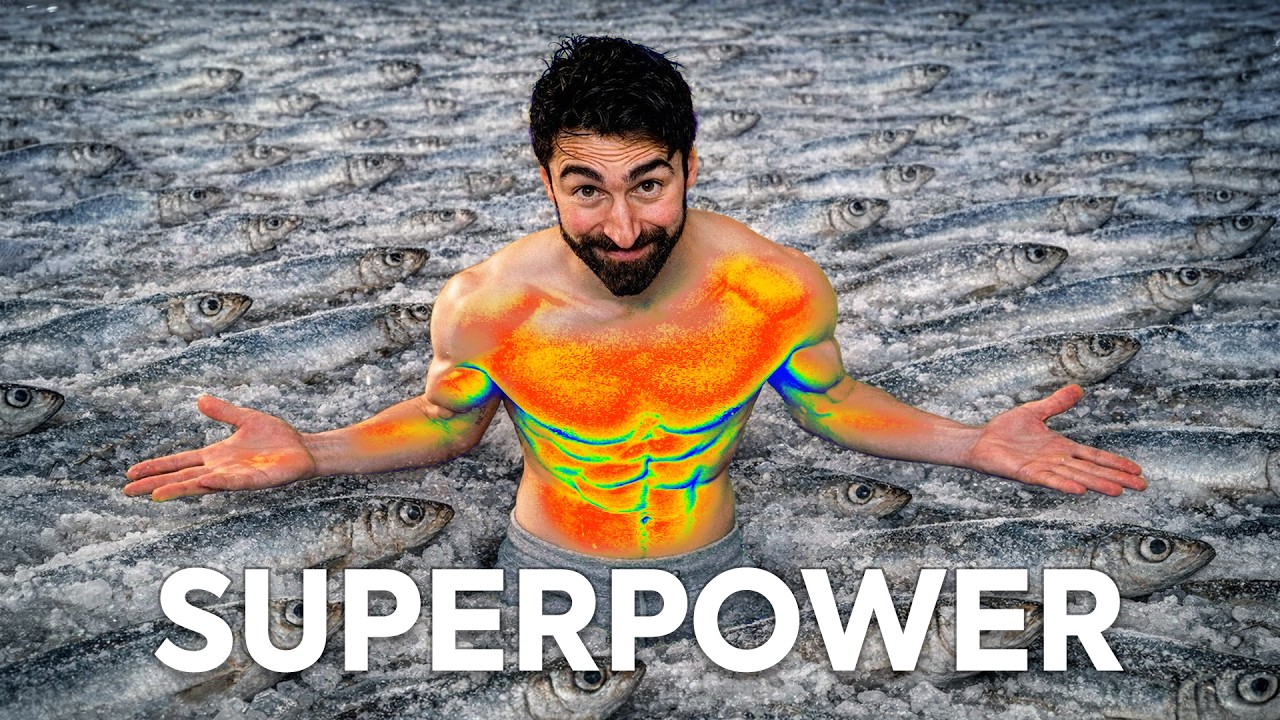
In this YouTube monologue, physician‑researcher Nick Norwitz recounts a self‑experiment in which he ate roughly 1,000 sardines over a month. He describes two striking outcomes: a dramatic increase in cold tolerance and subjective energy (the "superpower") and a persistent, overpowering fishy odor that affected his personal relationships. He links these effects to an extreme rise in blood omega‑3 levels (from a typical ~5% to ~16%) and to the omega‑3‑derived hormone 12‑HEPE, which is produced by brown fat and promotes glucose uptake, heat production, and fat oxidation. Norwitz explains that the mechanism of 12‑HEPE was unclear until a recent Cell paper identified its receptor as OLFR110, a smell receptor that is expressed not only in the nose but also in liver, adipose tissue, and brain. The discovery suggests that a single receptor can be repurposed across systems to mediate odor detection, thermogenesis, and metabolic regulation, thereby connecting the superpower and the stinky side effect. He uses this story to illustrate a broader biological principle: organisms reuse and repurpose molecular components, leading to inevitable trade‑offs (e.g., statins vs. muscle damage). He ends by questioning whether the metabolic benefits outweigh the social cost of the odor and invites viewers to propose the next experiment.
Chapters
I ran a self-experiment where I ate 1,000 sardines in a month. Sure, it made me stink, but it also gave me one epic superpower. Let me explain. Obviously, we know sardines make our breath stink and that they're filled with nutrients, proteins, and healthy fats. That's basic. But what if I told you sardines changed me at a deep hormonal and cellular level? Now, as a doctor who's obsessed with metabolic health, I ran this experiment because I wanted to see what would happen if I indulged in the superfood that's gripping the internet. Sardines. Sardines. Sardines. Sardines. Sardines. Sardines. Sardine fasting. And it truly changed me in ways I could not have predicted. In fact, I didn't notice the first changes. My girlfriend did. You smell like fish. There was a change in me under my skin that made me give off a funk even after showering, brushing my teeth until my gums bled, and putting on enough cologne to knock out a bloodhound. It also went beyond turning my blood from looking like a human into looking like a flipping dolphin. Definitely an unusual number for a human being. It gave me a superpower that made my boy nerd brain imagine myself in a Marvel movie, and it had my scientist nerd brain scrambling frantically behind the scenes to find data that would make it click. The fish, the blood markers, the smell, The superpower. How were they all connected? And then I found it. Data that transformed confusion into clarity, superpowers into hard science, and left me leaning back in pure awe about how incredible our bodies are and how much we still have to learn. Let me show you. In the human body, nothing happens in isolation. Every pathway is connected. Pull one thread, something else moves. Here's the strange part: when I came across this, everything clicked. We humans are the most complex machines in the known universe. Because what you're looking at here is an elegant piece of biology: a single receptor, a core component of how the body works, repurposed across different systems for entirely different functions. Smell, heat and energy production, my superpower, the same tools used for different jobs, and sometimes at the same time. Is the power worth the price? Before we dive in, if you're looking for deeper details, extra nuance, or early access to content like this, be sure to check out our best-selling in science newsletter, Stay Curious Metabolism, an oasis of nuance that readers call the best investment they've ever made in their health. Okay, short plug over. This video unfolds in 3 main parts. First, I'm gonna tell you about the strange superpower I gained from eating 1,000 sardines. Second, I'll talk about the smelly price I had to pay for it. Now, at first these 2 things seem completely unrelated, the smell and the superpower, almost fantastical, like a fairy tale trade-off, like Ariel the Little Mermaid giving up her voice for legs, or the Hulk gaining immense strength at the cost of emotional control. "Puny god." But in the real world, our world, superpowers and their costs aren't arbitrary. So, in the third and final part of this video, we'll be working towards an answer to a genuinely bizarre mystery: how are the power and price actually connected? And what does that connection reveal about our biology? Stick with me, and you might not only feel tempted to try a sardine diet yourself, you'll also walk away with a deeper sense in awe for the incredible complexity of our human bodies, mine and yours. Okay, let's start off with the superpower. When I ate 1,000 sardines in a month, I became cold resistant. Like the Human Torch from the Fantastic Four, the effect was undeniable and uncanny. I ran this experiment in the winter in New England. Okay, I know this looks insane. I'm standing in a Boston blizzard shirtless with a can of sardines. What's going on? And yet I found that when I went outside, frigid blasts of wind and snow and sometimes hail felt almost like a tropical breeze. Totally didn't bother me. And coupled with this heat production energy, I was also just incredibly subjectively energetic. Like, I had the urge to run up 37 flights of stairs to my apartment, do push-ups like a compulsion, and my body fat dropped below 7% all in a month. It was so weird. I'll also point out this is unlikely to have been a placebo because I just wasn't expecting the effect, and other people replicated my experiment and reported the same result again and again. I'm not cold, I'm energetic. And yeah, they stunk too. Apologies to all the girlfriends and boyfriends out there. Now, I want you to think through this with me. What's going on? Put on your scientist hat and hypothesize for a moment. My leading idea had to do with hormones, because consider this: The healthy omega-3 fats in sardines, they're not just fuel, they can be turned into potent hormones. One is called 12-HEPE. It's a hormone made by brown fat, a special type of metabolically active fat that burns through energy like a furnace. And this hormone, 12-HEPE, it functions to overall enhance muscle and brown fat metabolism, the net result of which is sucking glucose out of the blood, increasing heat production, and burning through energy like, yeah, you're the human Torch. Now, you might be asking why nobody has observed this before sardine diets became an internet sensation, and the answer to that is pretty simple. People don't tend to eat as much omega-3 as me and other people doing sardine diets. Let me give you a sense of scale. The average person's blood omega-3 index sits around 5%. My levels? More than tripled that of your average human, reaching 16%, comparable to levels found in marine mammals like dolphins, So, we're definitely in a bit of unexplored territory here, which is exactly where I want to be with you. But there's another problem. Scientists don't really know how this omega-3 hormone 12-HEPE works. At least not completely. It's a mystery. We know it can stimulate heat production in animals. We even know it's lower in people with obesity. Yeah, you heard that right. This omega-3 hormone 12-HEPE is lower when you're fatter as a human and higher when you're leaner. Now, there are two ways to interpret this. Either leaner people like me are more efficient at converting omega-3s in their diets into this 12-HPE hormone, or two, higher omega-3 intake leads to higher 12-HPE levels, and that actually helps cause a leaner physique, lower body fat. In other words, there's the question: is 12-HPE a cause of leanness or consequence. Pause. Think. We'll return to that, I promise. But first, back to that other question: how does that omega-3 hormone 12-HGPE even work? Enter a scientific study that blew my mind. It was just published in a top science journal, Cell, and in it researchers found the lock to which the 12-HGPE hormone binds. And it's Hold on. Another problem. How did the researchers discover the receptor for this hormone? Think about that because it's really not an easy problem. Identifying how a tiny hormone that we can't see binds to a tiny receptor in a sea of organs and tissues and trillions of cells that compose a living organism. How they solved that problem? They went fishing. How's that as an irony? They literally went fishing to find that sneaky receptor for the 12-HGPE hormone responsible for my superpowers. Or likely responsible for my superpower, scientists blended up cells to make an organ smoothie. Not one you'll find on your typical Jamba Juice secret menu. Next, they added that 12-HP hormone to the smoothie and mixed it up. Here is the trick. When the hormone binds to the mystery receptor, the receptor turns into its on state. And when it's in its on state, it's like a hungry fish that bites a hook. It changes shape, bites onto tagged signaling proteins attached to the researchers' fishing line, and then whammo! We caught ourselves a receptor, and you can just pull it out. That brings us to the weirdest part of all, and the connection between my stink and my superpower. When they finally pulled up the catch, it wasn't what anybody expected. It was a smell receptor. Now, if you're confused, that's fair. Don't worry, I'm about to unconfuse you. Because this isn't just any smell receptor. It's called OLFR110, which stands for oily fish reeks 110. Not really, but that's how I remember it. And here's the strange part. This smell receptor, it's not just in your nose. It's in your liver. It's in your fat. It's even in your brain. And when I came across this, everything clicked. Because what you're looking at here is an elegant piece of biology. A single receptor, a core component of how the body works, repurposed across different systems for entirely different functions. Smell, heat, and energy production. My superpower. And once you see that, it starts to make sense why the power comes intimately linked with the price. It's not arbitrary. It's not like Ariel or the Hulk. It might even be necessary. Because consider this: we humans are the most complex machines in the known universe, and yet we only have about 20,000 genes in our genome. And that might sound like a lot, but it isn't. A water flea has 31,000 genes. A lungfish has a genome that's 30 times larger than ours. Even salamanders carry genomes 10 times bigger than our genomes. So how are we so complex? Because our bodies don't just add more parts, they reuse and repurpose what's already there, turning the same biological ingredients into entirely different functions. This is a rule in biology, not an exception. Feathers were first used for insulation, later for flight. Jawbones turned over millions of years into inner ear bones for better hearing, so you can hear me spew jargon at you right now. The same tools used for different jobs, and sometimes at the same time. Now stop and really think about this, because there's a deep truth here and practical learning you need to understand. In the human body, nothing happens in isolation. Every pathway is connected. Pull one thread, something else moves. And that insight goes far beyond Sardine's stink and cold resistance superpowers. Nearly every intervention in biology and medicine comes with tradeoffs, push and pull, yin and yang. Statins reduce inflammation, but they can also damage muscle. Weight loss drugs can lower body fat, but they can also cause nausea and gastrointestinal upset. Antibiotics can kill harmful bacteria, but they can also disrupt healthy microbiomes in your gut. Think of other examples, they're everywhere, and drop them in the comments. It's the rule—a biological butterfly effect. And it's a deep truth most people, even most doctors, never truly appreciate. But now I hope you do. So let's return to the practical. Recall earlier, in humans we know that the omega-3 hormone 12-HGPE is higher in leaner people. Now this might be because leaner people just produce more of it, or it could be because having more 12-HGPE like from eating a lot of sardines, revs up metabolism to support cutting fat and getting lean. What do you think? Me? What do I think? I think it's probably both. My lived experience is undeniable, at least for me. Both cold resistance and scent. The superpower and metabolic upgrade intimately tied with a rank stank that almost destroyed my relationship if I'm being honest. Granted, there's still a lot we don't know. There aren't many people pushing their bodies to this extreme, and that is not a challenge. Okay, maybe a little bit of a challenge. But when those two worlds start to line up, when curiosity and personal experience meet hard data, that's often when the most fascinating discoveries happen. And right now, I'm truly just sitting back content, sitting in awe of the complexity and interconnectedness of our human bodies and how by understanding those complexities, We can begin to hack our metabolisms. My final question for you: is the power worth the price? And now my real last question to you is: what should I test next?