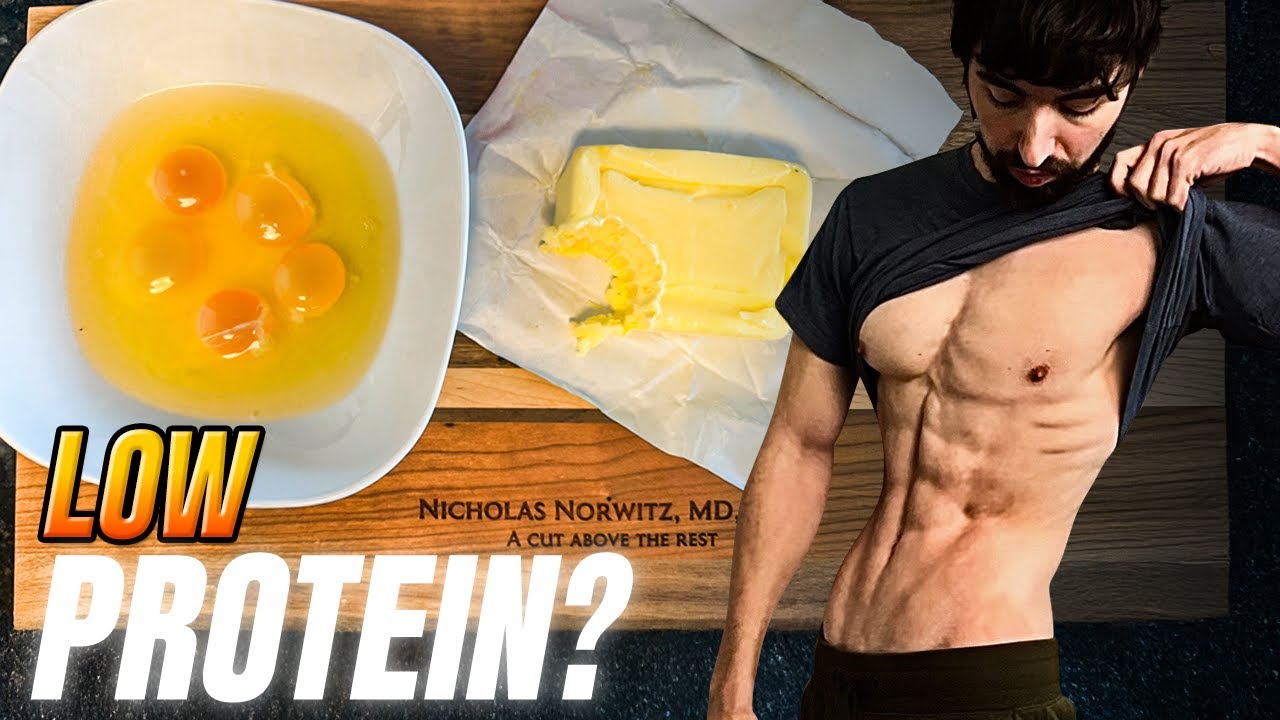
In this video, the creator weaves together three seemingly unrelated topics—sugar‑rich diets, protein restriction, and longevity—to examine how they may be linked through the hormone FGF21. He begins by describing the “sugar diet,” a high‑sugar, low‑protein eating pattern, and explains that its apparent benefits are likely due to the protein‑restriction component rather than sugar itself. He then reviews a Nature Metabolism paper that showed a diet with only 9 % of calories from protein increased energy expenditure by about 20 % (≈600 kcal/day) in young, lean men, an effect mediated by FGF21. To test the generalizability, he conducted a three‑week self‑experiment, cutting his protein intake from 18 % to 9 % of calories while increasing fat, and despite eating ~300 kcal/day more than his maintenance level, he lost 6.4 lb. He notes similar anecdotal replications from friends, including a bodybuilder, and mentions an unpublished follow‑up study suggesting the effect also occurs in people with obesity. The discussion then shifts to longevity: a Cell Metabolism study where mice engineered to overexpress FGF21 in adipose tissue lived longer without a drop in metabolic rate, challenging the usual view that lifespan extension requires reduced energy expenditure. The creator highlights that protein restriction may extend lifespan partly via reduced IGF‑1, yet the FGF21 mice showed unchanged IGF‑1, suggesting multiple pathways. He concludes with a cautious stance—he does not recommend adopting a low‑protein diet without more data, emphasizing the need to balance protein needs, muscle maintenance, life stage, and metabolic health, and encourages viewers to stay skeptical and curious.
Chapters
Brace yourselves, this is gonna be a weird one. Now, typically my videos have twists and turns. I always aim to break expectations in some way, shape, or form. That's how I think you learn and we get to the nuances. But this video presents a unique challenge because I'm gonna try to thread together 3 seemingly unrelated topics: the sugar diet, protein restriction, and longevity. I really implore you to watch this whole video and then I want you to tell me how I did. Did I leave you with deeper insights? Or did I leave you utterly confused? Or better yet, both? Now let's start with the sugar diet. To recap, if you missed my prior video, the sugar diet is a rising trend in the nutrition world that is exactly what it sounds like. The sugar diet. This is my breakfast. I had some Sour Patch Kids, Starburst, jelly beans, 8 ounces of apple juice. Sugar on the bottom, sugar at the top. Sugar. A diet focused on eating sugar. Candy, soda, fruit, fruit juices, honey, and syrups. And low protein at that. And supposedly, it helps you lose fat and boost exercise performance. Now, when I first heard about the sugar diet, I had the same reaction you might have. I assumed its practitioners were headed straight for diabetes and fatty liver disease, and maybe they had a pre-existing psychiatric disorder that they were willing to try something so absurd. But, but biology has a way of humbling and mystifying you if you're open to the data. The study that changed my perspective on the sugar diet was published in Nature Metabolism. Briefly, this Nature Metabolism study included actually 3 sub-studies where young men followed a low-protein diet, with 9% of calories from protein. This resulted in an astonishing 20% increase in energy expenditure, so about 600 extra calories burned per day, without any change in physical activity. Now, the metabolism-boosting effects of this low-protein diet appeared to be mediated by a hormone called FGF21. And based on these and other data, it appears that protein restriction rather than sugar itself—the Nature Metabolism study wasn't a sugar diet study—it's protein restriction that increases FGF21, which in turn ramps up energy expenditure and calorie burning. And this does explain how the sugar diet can work—it operates as a subset of protein restriction diets, to boost FGF21 and energy expenditure. This holds true even if the formulation is suboptimal. You know. Sour Patch Kids. First they're sour, then they still have no nutrient density. Anyway, if you want more on the sugar diet, you can see my prior solo video, and you can also see a new conversation I had with Nick Vee from the Physionic channel. If you don't follow him already, you definitely should. He generates beautiful content, really nuanced. I encourage you to listen to him. Anyway, after reading that Nature Metabolism paper, I became intensely curious as to how generalizable these findings were. Specifically, I wondered whether the opposite extreme of a low-protein diet, a 4:1 ketogenic diet, which means 90% of calories from fat, I wondered if it would produce similar increases in energy expenditure. There are reasons to suspect it might, and there are reasons to suspect it might not, as I've outlined in this letter, you can go check that out if you want the details. But now, speculation aside, I have an answer because I tested the hypothesis on myself. Following a protocol similar to that used in the Nature Metabolism study, I established my weight maintenance intake at 2933 calories per day on an 18% protein diet. Then I reduced my protein intake to 9%, like in the Nature Metabolism study, replacing the difference with fat. What happened? My weight started to drop, and just as in the Nature Metabolism study, I tried to adjust my caloric intake upward to compensate for the weight loss, adding hundreds of calories per day. And yet, I still lost weight. Over the next 3 weeks, I consumed roughly 300 more calories per day on average and uptrending on the 9% protein diet compared to the 18% protein baseline diet, and yet, I lost 6.4 pounds. So, put simply, put otherwise, based on my usual maintenance calories, I should have been in a 6th I was in a 1,000-calorie surplus, but I lost 6.4 pounds. Eventually, I ended the self-experiment after 3 weeks, mostly because I didn't want to lose any more weight, and frankly, I couldn't stomach another block of goat butter for lunch. Now, quickly, two notes on this. First, I did this as a "I did this so you don't have to" sort of experiment. That said, you know me by now, and you know I'm always an advocate of n=1 experimentation. Don't generalize what I do or anybody else does to you, figure out what works for yourself, provided you can do these experiments safely. And getting your own data in your own hands is so important. So this seems like a good moment to mention if you want to try the CardioCheck Plus at-home cholesterol meter that I use, or get easy at-home lab testing kits via Cyfox, you can see the video notes for discount codes and links. Also, I wasn't alone. And this little protein restriction experiment. Friends of mine including bodybuilder Rob Sykes have undertaken or are currently undertaking similar experiments. And thus far, each has reported needing to increase their caloric intake to maintain weight, just like in me and just like in the Nature Metabolism study. We have replication. Now, some of these friends are content creators, so I'll leave it to them to share the results specifically and publicly. I don't want to swoop them. Anyway, Stepping back, the key takeaway here is that protein restriction, whether low protein, high carb like the sugar diet, low protein, high fat like a 4:1 ketogenic diet, or low protein with a mix of fats and carbs, which they did in the Nature Metabolism study, all these low protein diets increase energy requirements. That said, I want to caveat that the published research at this time focuses on lean, healthy individuals, not those with obesity. However, in another twist, the senior author of the Nature Metabolism paper, shared with me and then gave me permission to disclose that they've actually conducted a similar study, but in individuals with obesity. The paper covering that study has already been submitted for peer review and, spoiler, contrary to my own predictions, the results actually appear to generalize to people with obesity as well. Now, I don't have the specifics, but for the exchange between myself and the senior author of the Nature Metabolism paper, you can see the newsletter at staycuriousmetabolism.com. She did give me permission to disclose it. Anyway, that brings us to our final and maybe most intriguing chapter: the longevity puzzle. After the Nature Metabolism paper and my self-experiment were completed, a study was published in Cell Metabolism showing that FGF21, this hormone that is boosted on protein-restricted diets, may increase lifespan, at least in animal models. Now, at first glance, This is interesting enough. A hormone increases lifespan. But several specific details of this study caught my attention. First, the researchers engineered animals to express high levels of FGF21 specifically in fat cells. And second, the increase in lifespan was not accompanied by a decrease in energy expenditure. In fact, energy expenditure was maintained or even increased and relative lean mass was improved. Now, if you're not getting that, the implications are striking— that a change in fat cell metabolism alone could extend lifespan in mammals. This underscores the importance of healthy, metabolically functional fat tissue for overall health and even longevity. Furthermore, typically, lifespan extension is associated with decreased metabolic rate and reduced energy expenditure. But here, do we see a glimpse of the health holy grail? Living longer, staying leaner, and eating as much or more calories as before. I know a lot of people who would want that. Now, to be clear, the Cell Metabolism study was not a protein restriction study. However, multiple lines of other evidence suggest that protein restriction increases lifespan, again, at least in animal models. The metabolic story, though, becomes even more complex when we examine these new findings in cell metabolism. For example, protein restriction is thought to extend lifespan partly by lowering levels of a hormone called IGF-1. But in the FGF21-producing mice, the mice that made more FGF21 from their fat, IGF-1 levels were unchanged compared to controls, and yet the mice still experienced lifespan extension. So where does this leave us? I hope you're not too confused, or if you are, I hope you're indulging in the confusion. I'm left scratching my chin as well, wondering how exactly these puzzle pieces fit together. There's a rationale for protein restriction increasing lifespan, provided of course the protein intake is still sufficient to maintain lean mass and prevent frailty in humans, which is a serious consideration, I want to emphasize that. Meanwhile, FGF21, which is inducible by protein restriction, regardless of the specific diet composition, everything from a sugar diet to a 4:1 ketogenic diet, it appears to preserve lean mass, improve metabolic health, increase metabolic rate, and maybe even extend lifespan. FGF21 is a pretty cool hormone. Now, if these pieces connect in the way they appear to, might we be inching closer to unraveling some of the fundamental links between metabolism, body composition, and longevity? It's possible and it's very exciting. Now, arriving at our conclusion and what I think you should do or not do, I am not suggesting that you, or I for that matter, adopt a low protein diet today. You can if you want, but I'm not advocating for that. Beyond the fact that life filled with only 3-ounce portions of proteins just sounds absolutely miserable, the truth is we don't have enough answers and we don't have enough data. The balance of factors Hormone levels, protein requirements, muscle maintenance or growth goals, life stage, and overall metabolic health, they all play into how this would shake out in any given individual. So, I apologize if this conclusion feels anticlimactic or even confusing. But in science, uncertainty is often where the most interesting opportunities live. For now, I want to leave you with curiosity rather than prescriptions. Because the smartest thing we can do at this stage is Stay skeptical, stay open, stay curious, and keep paying attention as the story unfolds. Thanks for listening. Tell me what you thought and whether you're walking away from this with deeper insights, more confusion, or both. Stay curious. Thanks for listening.