This Particle Raises Heart Disease Risk 230% — How to Stop It
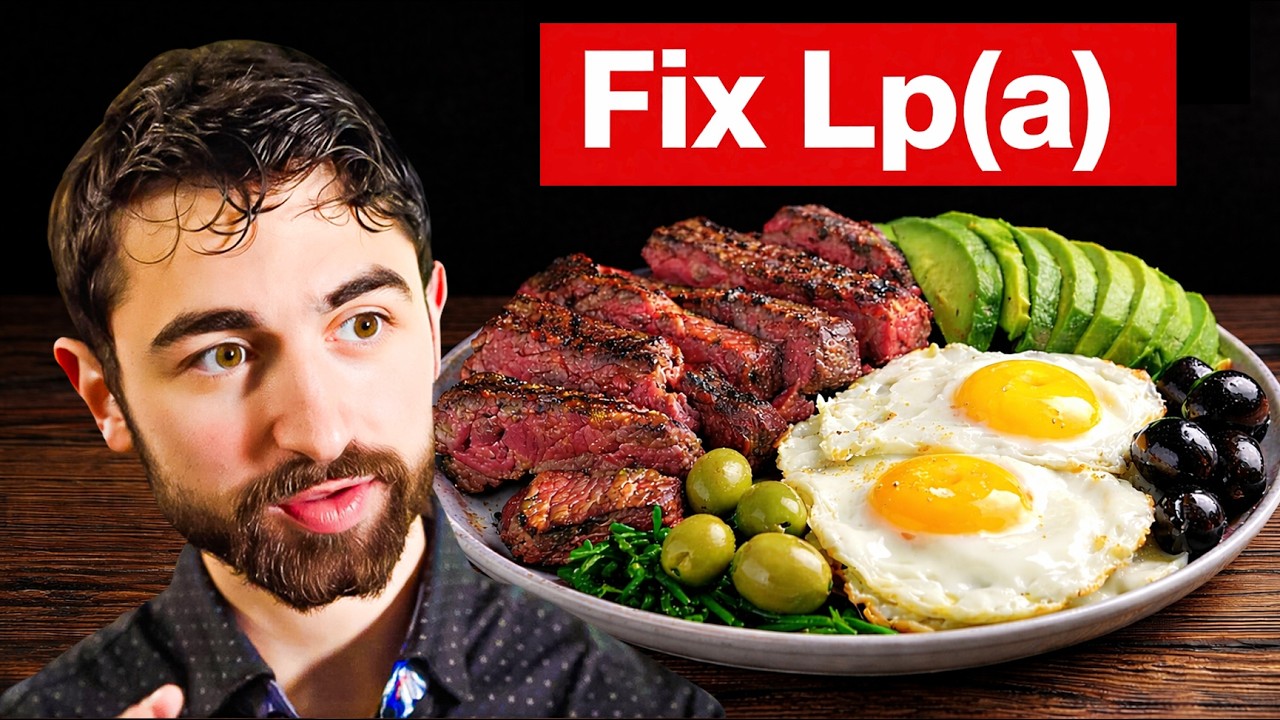
In this video, Nick Norwitz explains why the lipoprotein particle Lp(a) (Lp) dramatically raises cardiovascular mortality risk—by up to 230%—and how its effects are largely genetically determined. He reviews the structure of Lp, then dives into recent arterial‑wall research showing that high Lp levels are associated with elevated superoxide production, which depletes the cofactor tetrahydrobiopterin (BH4) and causes endothelial nitric oxide synthase (eNOS) uncoupling. The resulting shift from nitric‑oxide to superoxide fuels oxidative stress, inflammation, and atherosclerosis, independently of ApoB. Norwitz then proposes a mechanistic, science‑backed protocol to interrupt this pathway: a high‑fat ketogenic diet that raises beta‑hydroxybutyrate, boosting NADPH and regenerating BH4; high‑dose vitamin C; 5‑methyltetrahydrofolate (MTHF) especially for MTHFR carriers; cocoa flavanols; and aggressive visceral‑fat reduction targeting waist‑to‑hip ratios <0.9 (men) and <0.85 (women). He stresses that the protocol is based on mechanistic reasoning, not yet proven by large clinical outcome trials, and acknowledges the practical challenges of such research. The video ends with a call to stay curious and consider informed, best‑guess interventions despite incomplete evidence.
Chapters
What if a carefully formulated high-fat ketogenic diet could actually protect against one of the most feared drivers of heart disease? I know, that sounds like a tall order, so let me explain a bit. Cardiovascular disease still remains a world-leading cause of death. But now, doctors and scientists are turning their attention to new players like Lp, a cholesterol-containing particle that floats around in the blood and contributes to the buildup of plaque in arteries. Heart attacks, stroke, and even death. Those with high Lp, like me, have been shown to have a 230% increased risk of heart attack-related death. And if that weren't scary enough, Lp is thought to be 90% genetically determined. So if your parents passed it on to you like my dad did to me, I guess we're screwed. Unless we're not, and I don't think we are. So in this video, we're gonna assemble together pieces of a biological puzzle for how a very specific high-fat ketogenic diet might reduce or eliminate the impact of outputted light on your heart. Maybe. Today I'm gonna walk you through the science and reveal tools that can make life or death differences for people like me and maybe you too. Let's go. Your genes are a ticking time bomb, increase your risk of dying from cardiovascular disease by up to 230%. A structure believed to significantly increase cardiovascular risk. It's not a superhero, it's more like a supervillain. Bounces around chaotically in cells, damaging whatever it touches. So you're not just losing a good thing, you're generating a bad one. Here's an evolutionary twist. The reality turns out to be much more nuanced and more interesting. Real quick before we begin, just know you can always find more in-depth content at the Stay Curious Metabolism newsletter, including multiple letters on Lp alone. So if today's topic sparks your interest and curiosity, just know there's a lot more long-form, highly referenced articles over at the newsletter. So stick that in your brain for after this video, because there's always a deeper level and that's one of the great parts of science. But with that, here's a roadmap on what we're going to discuss. In Chapter 1, we're going to talk about background on Lp and why it poses such a serious cardiovascular risk. In Chapter 2, we're going to dig into the mechanisms—what exactly Lp is doing inside your arteries that makes it so dangerous. Then in Chapter 3, we're going to talk about a science-backed protocol to defuse the Lp bomb. And if you make it to the end, you won't just walk away with practical insights, you'll leave with the kind of knowledge that might even let you school a cardiologist. I know, again, it's a big claim, but that's the goal, and it's my job to get you there. So Chapter 1: Background on Lp. Lp is a spherical molecule made up of fats, proteins, and cholesterol that floats around in your bloodstream. In many ways, it's similar to an LDL particle. You know, the bad cholesterol one. But Lp has a little twist, literally. It includes a unique sticky tail called apolipoprotein a, a structure believed to significantly increase cardiovascular risk. The tail itself is made up of kringle repeats. Yes, really, that's what it's called, although I know it sounds like a potato chip. Anyway, if you want a deeper dive onto the structure and background of Lp, I have a totally separate video for that, but here's one thing to remember: Lp can increase your risk of dying from cardiovascular disease by up to 230%. You can see that here in this survival curve. As the lines drop, risk goes up—risk from dying. And that red line? That's people with high Lp. They drop fast, like flies, relatively speaking. And because Lp is 90% genetically determined, as I mentioned in the intro, it's easy to feel like just bad luck, like your genes are a ticking time bomb. But I'm here to tell you that is not true. That brings us to Chapter 2: Mechanism. So, in a recent study, researchers had a rare, a special opportunity. They obtained arterial tissue samples, actual blood vessel walls, from humans to look directly inside the artery. Now, the conventional view is that Lp, like LDL particles, promotes heart disease by sticking in the arterial wall, getting trapped there, and seeding a plaque, literally seeding a plaque. This is the foundation of the lipid-heart hypothesis. It's called the response-to-retention model. Basically, cholesterol-rich particles like Lp get stuck, and over time, they trigger, they seed plaque growth. Lp is just extra sticky, so the theory fits, right? It's simple. But the reality turns out to be much more nuanced and more interesting, as the researchers discovered. So what they found was that patients with high Lp levels also had significantly higher levels of a molecule in their arteries called—ready for it? Superoxide. It's a damaging metabolic byproduct. And despite its name, superoxide, it's not a superhero. It's more like a supervillain. At the molecular level, it bounces around chaotically in cells, damaging whatever it touches. It fuels something called oxidative stress and inflammation, which really go hand in hand. Both of these are core drivers of atherosclerosis, the buildup of plaque in arteries. So basically, If heart disease were a tree, oxidative stress, fueled by superoxide and inflammation, would be part of like poison soil. But here's where things get striking. The more Lp, the more superoxide was produced in the arterial wall, so poisoning the arterial soil. And this connection, it won't necessarily show up on a standard blood test, it's kind of hidden inside the artery wall, but in the artery samples that these researchers got, it was clear. So the next big question is how does Lp cause the generation of superoxide, fueling oxidative stress and inflammation? And this is where things get really technical, so brace yourself, but I know you can handle it. There are several ways to produce superoxide, but one major pathway involves something called— are you ready? Are you sure? Endothelial nitric oxide synthase uncoupling caused by reduced vascular tetrahydrobiopterin availability. Alright, deep breath. Here's the translation, and I know you can understand it. Nitric oxide is a molecule your blood vessels need. It helps them to relax, stay healthy, and is essential for proper blood flow. And nitric oxide is made by a protein called endothelial nitric oxide synthase, because it's in the endothelium and it synthesizes nitric oxide. But that protein needs a helper molecule called tetrahydrobiopterin, or BH4 for short. Give me a hand to climb down the stairs. No, you're a big boy, you can do it by yourself. And you guessed it, it's true. I am tetrahydrobiopterin. So basically, the eNOS protein and BH4 work together to keep your blood vessels healthy by making nitric oxide, but here is the kicker. Lp can reduce levels of BH4, the helper molecule, and when that happens, the nitric oxide synthase malfunctions. Instead of making nitric oxide to help arteries, it uncouples, it falls apart, and switches to making superoxide instead. So you're not just losing a good thing, you're generating a bad one. Less nitric oxide, more superoxide, fueling oxidative stress and inflammation. It's almost as if Lp can get inside artery walls and molecularly possess nitric oxide synthase, turning it from good, making nitric oxide, to evil, making superoxide. And it gets worse. This creates a vicious cycle because superoxide also decreases levels of the helper molecule, BH4, perpetuating the cycle. So more superoxide, less BH4, more uncoupling, more superoxide. Around and around the vicious cycle goes. Yikes, right? And this is how Lp can increase cardiovascular disease-related death by 230%. So let's recap: LP interferes with nitric oxide production by depleting that key helper molecule, BH4, needed to make nitric oxide. That leads to reduced nitric oxide and increased superoxide, which just rounds back and irritates the whole process. This leads to oxidative stress, inflammation, and perpetuates atherosclerosis, the buildup of plaque in arteries. The damage happens inside the artery wall, so you can't see it on a basic blood test. It's fascinating and terrifying, right? But stick with me because this understanding opens doors to some promising possibilities, including how a targeted, well-formulated ketogenic diet might intervene. But before we jump onto the ketogenic solution, let's pause for two really important nuances that clarify the science we just explored. First, in the study we just discussed, when researchers adjusted for superoxide production inside artery walls, the Lp-associated risk for cardiovascular disease-related death lost statistical significance. That's really promising, and it's consistent with the idea that the process we just described isn't just academic jargon—it's mediating the cardiovascular risk we fear is associated with Lp. Now, this doesn't mean superoxide explains everything Lp. Biology is never so black and white unless you're a penguin biologist. But it does suggest a powerful insight: superoxide could be one key mediator and biological target in how Lp causes cardiovascular damage. So in other words, we're not just talking correlations anymore, we're seeing signs of a clear causal pathway, a biological explanation, with a level of specificity and mechanistic clarity that is honestly unprecedented in the Lp research landscape, at least in my opinion. And that excites me. Also, the second important nuance is that the risk is independent of ApoB. Across multiple analyses in the same study, the relationships between Lp, superoxide, and cardiovascular risk were totally independent of ApoB levels. Now, a lot of cardiologists will tell you, "Well, it's all about the ApoB." ApoB is a protein found on LDL and Lp particles, and lowering ApoB— it's kind of become a catch-all mantra for reducing cardiovascular risk. It's simple and intellectually sticky. But these data challenge that simplicity, and we know we like doing that here on this channel. Even the authors of this paper themselves wrote very explicitly, —that the effects were not explained by ApoB. And that's big. Because it means this isn't just a story of more particles, more risk. It's a more nuanced, more interesting, and more biologically rich picture than that. Which brings us to the— moment of the video I know you've all been waiting for— Chapter 3: Science-Backed Protocols for Diffusing the Lp Bomb. So let's return to that helper molecule, tetrahydrobiopterin, BH4. Lp depletes BH4, leading to reduced nitric oxide and increased superoxide. So what we want to do is regenerate BH4, and here's where things get fascinating because when you go on a ketogenic diet, your body produces ketone bodies, particularly beta-hydroxybutyrate, and research shows that the ketone body beta-hydroxybutyrate can increase levels of something called NADPH, and NADPH regenerates BH4. So sorry, I know there's a lot of players here, a lot of jargon, but to clarify: ketones boost NADPH levels, which boost tetrahydrobiopterin, BH4 levels, which support nitric oxide synthase in making more nitric oxide and less harmful superoxide. So in effect, trying to simplify here, ketosis reduces superoxide generation and not only breaks but could reverse the vicious cycle created by LP, leading to less superoxide, more nitric oxide, and less oxidative stress. There is in fact some evidence that ketones can increase nitric oxide synthase activity, also relevant to epilepsy, one of the main clinical indications for a ketogenic diet. And what's more, as a bonus, ketones may also reduce superoxide generation through a completely separate, second mechanism in mitochondria. It's called reverse electron transport, where basically electrons go backwards onto oxygen, generating superoxide, and ketones can diffuse that bomb too. If you want more on that, see this paper I wrote when I was a PhD student. I just wanted to pause here and celebrate you. Like, if you're watching to this point in the video, even if you don't get everything from the video, which is fine, the fact that you're sitting through all that you just sit through really is a testament to how hungry you are for metabolic knowledge. I know this stuff isn't easy, so If you made it this far, kudos. Now let's continue. So what we're seeing here is a double benefit: more nitric oxide, less superoxide. And actually, I almost forgot to tell you, ketones also improve antioxidant defenses through this same mechanism because that NADPH molecule also regenerates not only BH4 but also antioxidants. So actually, it's a triple benefit from ketones: more nitric oxide, less superoxide, and more antioxidant defenses. So take a moment to digest all this. Digest this graphic because if you understand it, seriously, applaud yourself. That's impressive. So give yourself a pat on the back. Now, we're going to flesh out this protocol a little bit more and I'm going to give you some practical tips. Before we do that, I want to give a very clear caveat. All this is an intellectual framework. The idea that ketosis could help reduce or neutralize Lp-related risk is based on mechanistic reasoning. It's rooted in biology, but when it comes to actual clinical outcomes, we don't have definitive proof. And I want to be clear about that. That's not a flaw in the logic, it's just a limitation of the evidence base. One that comes from the practical challenges of conducting long-term, large-scale randomized studies on interventions like ketogenic diets in people with genetically elevated Lp. The funding, the recruitment, the compliance are all extremely difficult. And honestly, in living humans, it's all but impossible to isolate a key causal mechanism even were we to see a difference in clinical outcomes. So what we're doing here is assembling a coherent picture from what we can based on what we know. And that picture, it makes sense to me. I would bet my health on it. But I cannot say with 100% certainty that ketosis will reverse Lp-related damage. And I just want to be honest about that. But with that caveat in place, we are not done. So let's explore a few more mechanisms by which a ketogenic diet and additional supplementation in a ketogenic context might help reduce Lp-related risk. First, ketogenic diets are well known for reducing visceral fat, the inflammatory fat that wraps around your internal organs. This type of fat is very metabolically active and it spits out inflammatory molecules like interleukin-6, which are known to amplify Lp-associated risk. And if you want more really cool data on how to reduce visceral fat, see this letter on resistant starch. Super popular, really interesting. And here's something else fascinating. There's compelling human data showing that people with low waist-to-hip ratios, which are a proxy for visceral fat, have essentially zero Lp-related cardiovascular risk. Just look at these graphs. What it's showing is that high waist-to-hip ratio here and here is associated with increased risk. But when you have a lower waist-to-hip ratio, a low visceral fat proxy, the risk completely vanishes, the lines overlap. Now this isn't exclusive to keto, by the way. Any intervention that helps you reduce visceral fat and improve body composition could help neutralize Lp-associated risk via this mechanism. I just think a ketogenic diet is particularly potent at eviscerating visceral fat, but in theory you could achieve the same outcome through any diet. Low-fat diet, vegan diet, or if you can, the miraculous invention of human photosynthesis. And if you can do that, more power to you. Solar power. But the fact that this waist-tape ratio visceral fat connection to Lp isn't widely known does reflect something simple but important. Clinical studies, most clinical studies, just have people with a lot of abdominal fat. This is now the population norm, so the baseline of the population is skewed. But just because something is common and normal nowadays doesn't mean you have to settle for it. In fact, I advocate you shouldn't. But let's move on with some more practicals. I definitely can't leave out vitamin C when it comes to talking about Lp, because here's an evolutionary twist. Only a few species make Lp, and interestingly, they're the same species that don't produce their own vitamin C endogenously naturally. So this includes humans and European guinea pigs, among other animals. So to cut the chase, high-dose vitamin C, around 1,000 to 2,000 milligrams per day, may reduce the atherogenicity of Lp. If you're looking for a simple protocol, try 500mg of vitamin C twice daily with meals to reduce bloating. And if you want a deeper dive, I have an entire video devoted to Lp and vitamin C. See that here. Now, a few additional honorable mentions. MTHF. This is 5-methyltetrahydrofolate. I know, a big word. It's the active form of vitamin B9, and it can also support BH4 production. Thereby enhancing endothelial nitric oxide synthase activity and improving vascular function based on the mechanisms we just discussed. This may be especially relevant in people carrying the MTHFR polymorphisms, mutations, which are relatively common in the population and impair the ability to convert vitamin B9 into its active form. So in such people, this MTHF supplement may be beneficial. Dosing protocols vary, though one could start with a low dose on the order of 500 mcg per day and titrate up as needed. I'll also add as another honorable mention cocoa flavanols. Yes, dark chocolate. If you've heard that dark chocolate is good for your heart, one of the primary mechanistic explanations is that cocoa flavanols activate endothelial nitric oxide synthase, so directly interacting with the pathway we just discussed. So stepping back, if I were to summarize an overall dietary strategy aimed at mitigating Lp-related risk, it would look something like this. It would be a ketogenic diet sufficient to raise ketone body levels, beta-hydroxybutyrate levels, above 1.0 millimoles as measured by finger stick. It would include vitamin C at approximately 1,000mg per day split into 2 doses and taken with meals to reduce bloating. Maybe it would include MTHF supplementation at around 500mcg per day, particularly in those with the MTHFR polymorphism, and it would include high flavanol dark chocolate, at least 90%, and ideally from chocolate brands tested to be low in heavy metals such as lead and cadmium. And of course, all of this sits on the foundation of low visceral fat, low abdominal adiposity, with a target waist-hip ratio of less than 0.9 for men and less than 0.85 for women. These are the optimal targets. So with all of that, I know we went through a lot, let's wrap up. We started with a troubling premise: that Lp is one of the most genetically determined treatment-resistant drivers of cardiovascular disease-related death. And there's no FDA-approved drugs, no standard therapies, just a red-lined survival curve that drops too fast, too early, indicating doom and gloom. But what we uncovered is much more hopeful, and much more interesting. We've walked through a detailed mechanism showing how Lp disrupts nitric oxide production, and ramps up superoxide production inside arteries where it's kind of hard to see, creating a perfect storm for inflammation, oxidative stress, and plaque buildup. We've also seen how these effects can be independent of the common culprits like ApoB, and we've looked at how ketone bodies might break that vicious cycle, reverse it, restore nitric oxide, reduce superoxide, and protect blood vessels at the root cause level. Altogether, what we've gone over—this and the other tips we reviewed—builds a picture that isn't just about lowering numbers, it's about changing the underlying biology that determines risk. And let's be honest, We don't have definitive clinical outcome trials yet, and we might not for a long time. But science moves forward in pieces, mechanisms, associations, and testable frameworks. And here's the truth: you don't need to wait for perfect proof to make an informed choice, a best guess. Because sometimes that's all we got. And sometimes that's good enough for me. Stay curious. Let me know if you could hang along with this one.










