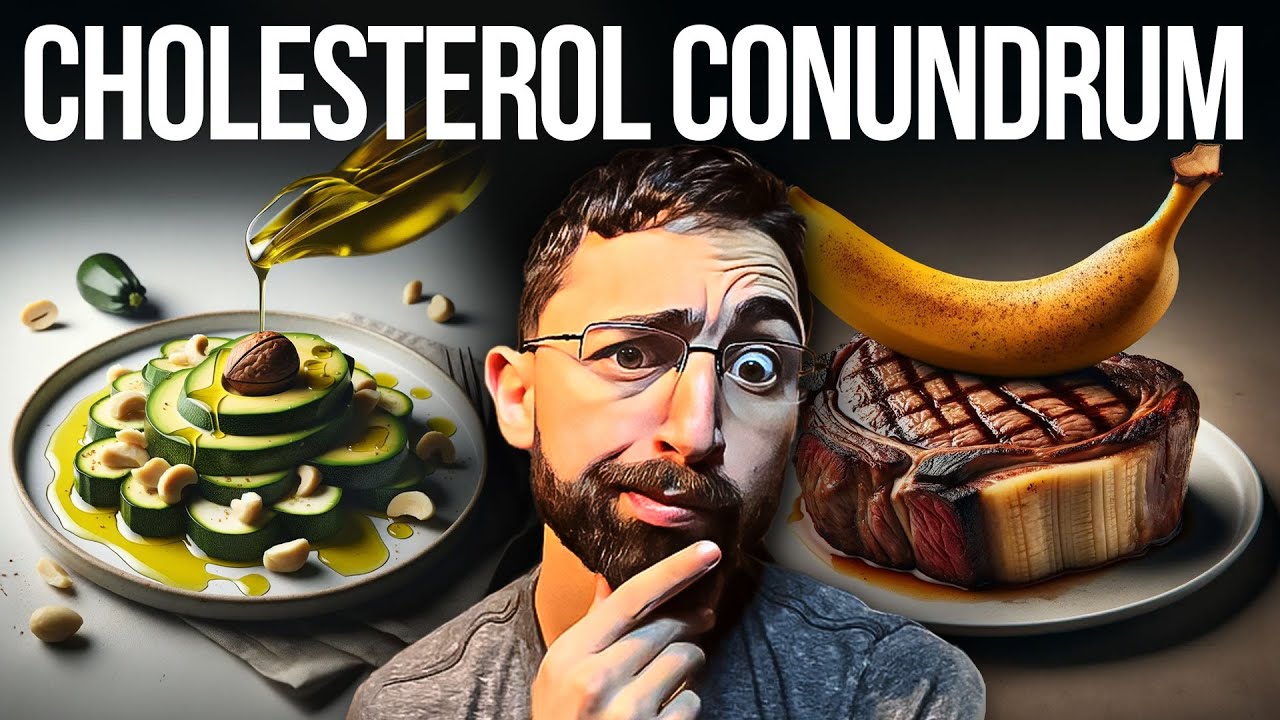
In this explanatory video, Nick Norwitz investigates why his LDL cholesterol spikes dramatically on a low‑carb, whole‑food plant‑based (vegan keto) diet but falls when he adds carbohydrates to a meat‑heavy, low‑carb (carby carnivore) diet. He introduces the "lipid energy model," which posits that lean, insulin‑sensitive individuals (the so‑called "lean mass hyperresponders") mobilize large amounts of free fatty acids in a carbohydrate‑depleted state. The liver repackages these fatty acids into VLDL particles that are rapidly cleared by lipoprotein lipase, shrinking into LDL particles while triglycerides in the blood drop. This creates a characteristic metabolic triad: high LDL, high HDL, low triglycerides. Norwitz cites his own self‑experiment (adding Oreo cookies) and other evidence—a case series of five patients, an interventional trial by Dr. Isabella Cooper, and a meta‑analysis led by Adrian Sotomayor—that show re‑introducing any carbohydrate dramatically lowers LDL in this phenotype. He notes that the effect is specific to lean individuals; in overweight or obese populations, low‑carb diets do not raise LDL and may even lower it. The video frames the lipid energy model as a hypothesis‑generating framework, urging viewers to engage in community‑driven scientific exploration rather than waiting for definitive proof.
Chapters
Here's something weird. My cholesterol, in particular my LDL, bad cholesterol, is actually much, much higher when I'm eating low-carb, whole-food, plant-based as compared to eating a saturated fat-rich meaty diet but with some added carbs, say a banana or even cookies. So the question you should be asking yourself right now is, why? Why does this occur in me and in other people who are the so-called lean mass hyperresponders? If you stick around, I'm going to explain the mechanism behind it, the existing science behind this phenomenon, and why you should care. Welcome to my channel. Stay curious. So let me address the "how" question first. How is this even possible? Well, the answer to why my LDL cholesterol tends to be higher on vegan keto versus carby carnivore is explained by something called the lipid energy model. The lipid energy model explains why some people who go low-carb, be that low-carb animal-based or low-carb plant-based, can see these massive rises in LDL cholesterol, which occurs because the body is responding, having a metabolic response to energy demands in the low-carb state when people are lean and insulin sensitive. So, here's the mechanism in a nutshell, probably a macadamia nutshell since they're very low-carb. Sorry, I can't help the puns. But when you go low-carb and you're lean, you mobilize a lot of fat, right? Your fat cells release free fatty acids, those will circulate around the blood to feed some of your muscle tissue, but they also get taken up by the liver. The liver sops up these free fatty acids and then resynthesizes them. Takes 3 free fatty acids, puts them on a backbone called glycerol, and you get these triglycerides, these stored forms of fat. Now, as part of a systemic trafficking system, think of it as like kind of a flywheel, those triglycerides in the liver get packaged into these VLDL particles, these boats carrying triglyceride fuel around the body. They get shipped out of the liver, and then what happens, and this is really important, the VLDL are being shipped out at an elevated rate., and then at fat tissue and muscle tissue around the body, they're turned over really rapidly, specifically by a protein called lipoprotein lipase. And what this does is generate the triad, the metabolic triad we see in these lean mass hyperresponders, people with very high LDL, very high HDL, and low triglycerides on low-carb or ketogenic diets, again, be it animal-based or plant-based. So what happens is the VLDL packaged with triglycerides the triglycerides are sucked out of them to replenish fat cells and to fuel muscle cells. And as that happens, the triglycerides in the blood go way down, so your triglycerides are gonna be low, and the VLDL shrink. And as they shrink, these big spheres become littler spheres, and those littler spheres stick around in the blood longer, and they're called the LDL particles, so your LDL cholesterol goes up. And then also, if you think about it, if you have a sphere, and you suck out the core, so you're decreasing the volume, you need to decrease the surface area as well. What happens to that surface area? Well, it kind of gets blebbed off and taken up by HDL particles. And so the cholesterol fraction in your HDL goes up. So your HDL cholesterol goes up, your LDL cholesterol goes up as those VLDL shrink down into LDL, and your triglycerides go down as the core's being sucked out. And so you end up with this triad of high LDL, high HDL, and low triglycerides. And this is very common in lean people who go low-carb, irrespective of whether it's plant-based or animal-based, high saturated fat or low saturated fat. In fact, my LDL cholesterol peak of 545 mg/dL for just the LDL occurred when I was eating 1 gram of saturated fat for every 5.67 grams of unsaturated fat.. And when I eat higher saturated fat, it really doesn't have much of an impact on my LDL as compared to other levers like changing my activity level, which increases overall energy needs, increases the spinning of this flywheel, or changes in my body composition. If I gain weight, gain fat, my LDL goes down. If I lose weight, lose fat, my LDL goes up. This is all explained by the model I just put forth. Now here's the thing. Well, what would be the most effective way to attenuate this response, reduce this response, and in so doing decrease LDL as part of that lean mass hyperresponder triad? Well, it will be to remove the driving factor behind what's causing the flywheel to spin, the energy demand for fat fuel when your liver is carbohydrate depleted. So all you have to do if you're a lean mass hyperresponder is put carbs back into the liver. This can be in any form. I did a self-experiment that we published on with senior author William Cromwell, a highly respected lipidologist, showing that I could add Oreo cookies to my diet and drop my LDL cholesterol. Now, that seems to translate across other forms of carbs. A question I often get is, "Nick, well, why'd you use Oreo cookies? Are you just trying to be provocative?" And the answer was, well, yeah, because we've done this with other carbs before. There was a case series we had of 5 patients. They added back various forms of healthy carbs, the fruits and the starches, LDL dropped dramatically by over 200 mg/dL on average. One patient saw a drop of 480 mg/dL. And then in Cooper et al., we did an interventional trial, or Isabella Cooper, Dr. Isabella Cooper did the trial, we helped with the analysis, but she added back carbs to the diets of 10 lean women who were previously keto, added back carbs, LDL went down. We see this again and again. You add back carbs in this phenotype and LDL decreases. And this also explains, again, to the overall, well, thought puzzle that was proposed in the title and thumbnail of this video, why when I'm, and I have been, vegan keto, my LDL can run 300, even in the 400s. But if I'm carnivore, chugging butter, eating meat, but I add some carbs, and I've done this before, have a banana, or, well, actually several bananas, maybe a little bit of honey, or even per the Oreo experiment, cookies or ice cream, really any carb, my cholesterol will be much, much lower when I'm carb carnivore versus when I'm vegan keto. Isn't that interesting? Now the question, why is this important to you? Because you might not be a lean mass hyper-responder, and say you adopt a low carbohydrate diet to treat obesity or diabetes, you're very unlikely to have this high LDL response. We've actually shown that In high-tier evidence, we, uh, colleagues and I, led by Adrian Sotomayor, an MD-PhD, published a meta-analysis in the American Journal of Clinical Nutrition showing that across the BMI spectrum, in particular the lean people had the high LDL on low-carb, whereas if you had overweight or class 1 obesity, there was no increase in LDL. Actually, if you had class 2 obesity and went low-carb, then LDL actually tended to decrease. So this you know, isn't per se relevant immediately to someone who's treating obesity or diabetes with a low-carb diet. But again, the question: why should this matter to you? Well, aren't you curious? Isn't this cool? I think this should be appealing to anybody who's just fascinated by biology and science, trying to unravel the mysteries, the curiosities of when something happens that diverges from what we'd expect. This thought puzzle, why my cholesterol is lower eating carby carnivore than keto vegan, it's something that should provoke you to think irrespective of if it's relevant to you because you're low-carb and lean or not. So this is really just about productive provocation, thinking through mechanisms, exploring and generating hypotheses, which I put forth this lipid energy model hypothesis, but it hasn't been fully proven. That takes a lot of time and resources. And frankly, I think you shouldn't have to wait for these ideas to be presented and join us scientists— consider yourself a scientist— on the journey of thinking and exploring through hypotheses and what we need to do next to, you know, investigate them. You shouldn't need the highest level of proof before the science is disseminated and you can join in on the thinking, because science isn't a protected property. It's a community engagement, a community project. So, you know, that's kind of what my channel is all about, bringing you along the journey of science. And I hope you found this kind of interesting. I really love these kind of thought puzzles, and yes, they're intended to be provocative.