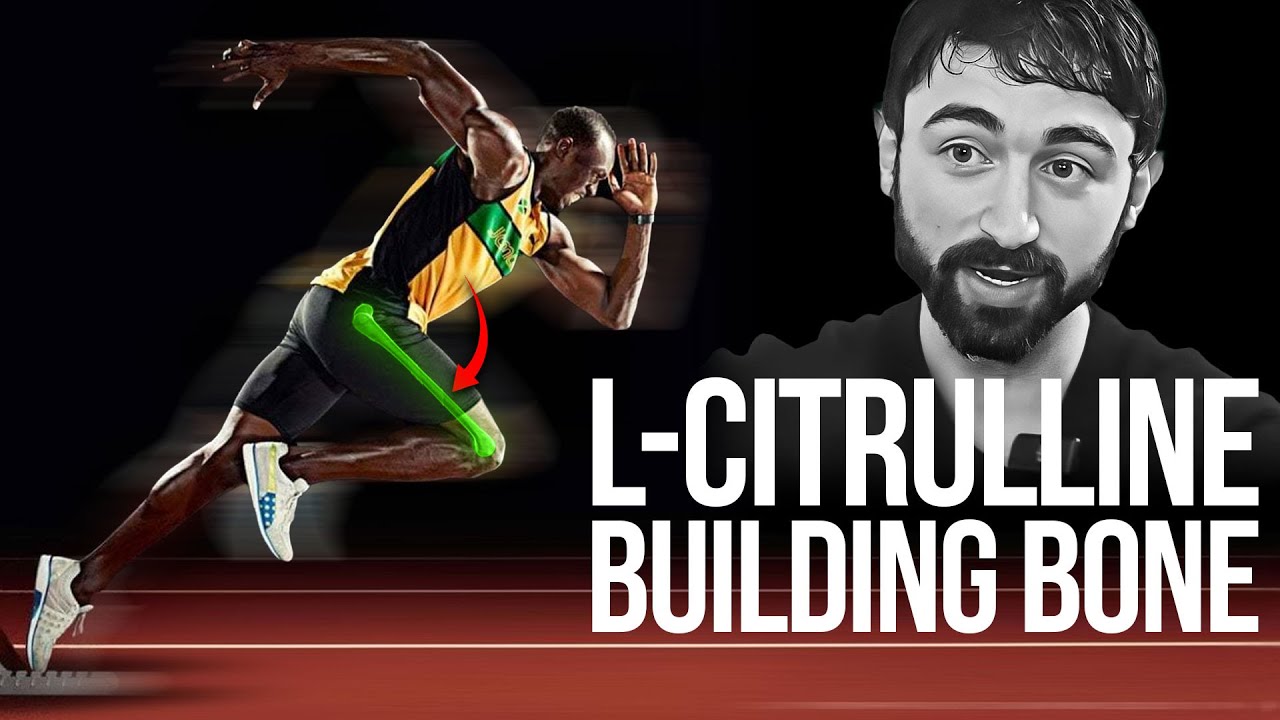
In this YouTube paper‑breakdown, Nick Norwitz walks viewers through a recent Cell Metabolism study that links gut microbial arginine metabolism to the bone’s ability to adapt to mechanical loading. He begins with a personal anecdote about developing osteoporosis as a teenage marathon runner due to a rare genetic mutation, using this story to frame the scientific question. The video then details a series of mouse experiments: (1) broad‑spectrum antibiotics wipe out the microbiome and abolish the bone‑strengthening response to unilateral tibial compression and treadmill running; (2) mice are stratified into high‑ and low‑responders after a six‑week running regimen, revealing that high‑responders harbor elevated levels of a specific Lactobacillus species (Lactobacillus rhamnosporicidae). Causal transplant experiments—first fecal, then a pure culture of the Lactobacillus—show that restoring this microbe rescues the adaptive bone response. Metabolomic analysis pinpoints L‑citrulline as the key bacterial product; oral L‑citrulline supplementation in mice reproduces the bone‑strengthening effects, increasing osteoblast activity, reducing osteoclast signals, and suppressing osteocyte‑derived sclerostin and RANKL. Norwitz explains why L‑citrulline, not L‑arginine, is the effective oral supplement, and outlines dietary sources (watermelon, cucumber, zucchini) and speculative human dosing (≈3 g/day versus the mouse dose of 250 mg/kg). He returns to his own case, noting that a rare mutation impairing his bone’s mechanotransduction mirrors the low‑responder phenotype, and that personalized experimental therapies helped reverse his osteoporosis. The video concludes with a brief sponsorship disclosure for RXSugar products and a reminder that while the data are from mice, the mechanistic insights may inform human bone health strategies.
Chapters
How does microbiome metabolism interact with weight-bearing activity and bone health? That's the question that a new Cell Metabolism paper aims to address. But before we get to that, I wanna give a quick personal aside. When I was a teenager, I was a marathon runner, and honestly, I was pretty good. By age 18, I could run a 2-hour 45-minute marathon, and I was the youngest qualifier for the 2014 Boston Marathon. But then something happened. I developed osteoporosis. I ended up with a tibial fracture, which was the first hint that I was developing osteoporosis a few weeks out from the race. And a few years later, I was diagnosed with bone density of an old woman. And that raised the question, how did I, a healthy young male, develop osteoporosis? It was so weird. Took years to get a diagnosis, and what I ended up learning was really quite astonishing and relates to the findings of this paper. So I'll get back to my personal story at the end of it, but I wanted to give a real human clinical case, mine, to help frame these data, which I think alone are incredible but have incredible relevance and something really important to teach us. So I'll wrap it all back at the end, but now to the data. Welcome to my channel. Stay curious. The paper is entitled Gut Microbial Alterations in Arginine Metabolism Determine Bone Mechanical Adaptation, and it's about how amino acid metabolism in the microbiome, specifically the amino acids arginine and its precursor Citrulline alters how bones, our bones, respond to mechanical stress to get stronger or not. By way of background, the main bone cell type in question is called the osteocyte, and the osteocyte coordinates bone's response to mechanical stress and kind of serves as a conductor between the osteoblasts, which build up bone, and the osteoclasts, which break down bone. And throughout the study, they used two forms of mechanical loading in mice: a unilateral cyclic compression cycle of the right tibia, which is useful because it allows the left tibia of the mouse to serve as an internal control and treadmill running tasks. So just by way of background, again, those are the kind of two mechanical loading exercises they use, where they use unilateral cyclic compression of one leg and a treadmill running task. Now, in the first experiment to show the microbiome is important in mediating the response to mechanical stress in terms of bone quality improvement, they took a set of mice and they treated them with broad spectrum antibiotics to wipe out the mice's microbiome, and then compared control mice here in black to the mice that were treated with the antibiotics to see how does the bone respond upon loading. And what you see here very clearly is when you give control mice a mechanical stress— this was the cyclic compression cycles— they have improvements in bone quality. You see the black bar with loading is increased on all these metrics of bone quality. But what happens when you give mice antibiotics? That response is eliminated. You see that the blue bar with the loading isn't any higher than the blue bar without the loading. Basically, the mice treated with the antibiotics do not have the adaptive response in their bones to mechanical loading. What they then did was go on to identify high responders and low responders, i.e., mice who, when you give them a mechanical stress,, in this case, a treadmill running task, have massive improvements in bone density versus those who just naturally don't have improvements in bone density when you give them the same stress. So they took 55 mice and subjected them to 6 weeks on a treadmill running task and then stratified to see who are the high responding mice and who are the low responding mice and how did they differ. They then wanted to figure out what was unique about the high responding mice versus the low responding mice that might confer the property of the high responders having that massive increase in bone quality in response to mechanical stress. And what they found very interestingly was that the high responders were characterized by levels of a particular gut bug, Lactobacillus rhamnosporicidae, that were quite high, particularly in the high responding mice, bringing forward a hypothesis that maybe the Lactobacillus rhamnosporicidae were conferring the ability of these mice to have large improvements in bone quality in response to mechanical loading, for example, treadmill running. So they then did two experiments, transplant experiments, to prove causality where they take mice and they wipe out their microbiomes with antibiotics, then they give them transplants fecal transplants, poop transplants, from the high responders and the low responders, here shown in green, high responder, and orange, low responder, and see if the mice that have had their microbiomes wiped out by antibiotics but then given transplants from various mice adopt the properties of the mice from whom they got the transplants. And indeed, you see that here, where the mice that got the transplants from the high responders had large improvements in bone quality when they were subjected to mechanical stress. And then they did a similar experiment, but rather than using fecal transplants, they used a specific gut bug, Lactobacillus Lacnosporiciae. And what they found was, again, if you give the transplant this time with Lacnosporiciae, you could confer the property of having a great, great response to mechanical stress in terms of improvements in bone quality. So this really showed in a causal manner that Lacnosporiciae were conferring the ability of the higher responders to have large improvements in bone quality in response to mechanical stress, unilateral compression stress, and treadmill running, which is super cool and super powerful. The next obvious question that arises is, what is the key product that is produced by the Lacnosporiciae bacteria? What is the key metabolite that confers the effect on the high responders? What makes the high responders special beyond the bacteria, but what the bacteria produce, the active component? And what they found was the answer was L-citrulline. L-citrulline is an amino acid, and what happens in the body is L-citrulline is converted by the kidneys into another amino acid, L-arginine. Then L-arginine can serve as a precursor to nitric oxide, a volatile hormone in osteocytes, and that this hormone can improve bone's response to mechanical stress, at least in theory. And this suggests that maybe oral administration of the active component L-citrulline, which can be converted into L-arginine, could make bones more responsive to mechanical stress. Now the question: does that work? And the answer: heck yeah, it does. They gave mice oral administration of L-citrulline, and again you see the same response, the same response you got with the fecal matter transplant, the same response you got with the Lactobacillus rhamnosporicidae transplant. You see improvements in bone's response to mechanical stress with L-citrulline supplementation, which is really cool and has pretty interesting implications. But before I get to those implications, let me just read a quote from the paper because that really hammers it home. I think L-citrulline administered mice were characterized by significant increases in cortical trabecular bone mass and bone mechanical strength in response to loading. L-citrulline significantly augmented osteoblast-mediated bone formation— osteoblasts being the cells that actually produce the bone— reduced osteoclast-mediated bone resorption— osteoclasts are the ones that break down bone— and suppressed osteocytokine L-citrulline inhibits sclerostin and RANKL expression— these are some mediators— and osteocyte apoptosis in antibiotic mice subjected to mechanical loading. This is just more jargon for me hammering home the point that the L-citrulline was the active component that conferred the ability of the mice to respond well to mechanical stress. Now, I do want to admit that one thing I'm intentionally skipping over is that oral administration of L-arginine in theory could work, but it actually doesn't work that well. L-arginine being the derivative of L-citrulline because it's eliminated by the body in a what pre-systemic and systemic means. So basically the idea is in terms of supplementation orally, it makes sense to do it with L-citrulline, not L-arginine. That is kind of an aside. Now I know what you're wondering, where can I get L-citrulline in my diet? Well, weirdly, one of the best dietary sources of L-citrulline naturally is watermelon. Watermelon can provide a 250mg dose per 154g serving, which is pretty high. And you can actually get even more, about 60% more, from the watermelon rind, which you can make into pickles. So you can make pickled watermelon rind, which is a great source of L-citrulline. You can also get L-citrulline from cucumbers, about 150mg per 300g cucumber, and also from zucchini. But in all honesty and transparency, I think if you want to dose up on L-citrulline, probably the best way to go is supplementation in order to get a speculatively therapeutic dose. Because, you know, you actually need to get pretty high doses, maybe something like 3g. For reference, the mice in the study were administered 250mg per kilogram per day, which for a 70kg person would be 17.5g of L-citrulline, or about 23.6 7-pound watermelon equivalent per day. And I don't really want to eat 24 pounds of watermelon per day. Granted, again, I think the human therapeutic dose, speculatively, will be a little bit lower. Other studies suggest maybe 3 grams would be sufficient, but I'm still not a fan of having very, very high levels of a high glycemic index fruit, literally by the kilogram. So for me, what I might try is L-citrulline supplementation. I actually think I will give it a try because I think there are other benefits to L-citrulline that I'm not covering in this video, but it's an amino acid. It's not going to hurt me, so I think I might give it a try. You can do what you want to do. I just want to confer the data. No medical advice here, but it is an over-the-counter supplement that's a freaking amino acid, so you can look up L-citrulline benefits and decide for yourself if it's something you want to give a go. Now, returning to my personal story as promised, and now for a sponsored message that I promise to make as brief and painless as possible. If you've been following me, you know I have a passion for sharing nuanced science, and I want to do so in as engaging and entertaining a manner as possible so you can have fun while learning, and so I can expand my reach to expand our camp of metabolic health enthusiasts. Don't you want that too? But here's the thing, I'm at a distinct disadvantage because I'm not a career influencer, I'm not salaried, I'm a researcher, a PhD researcher, and a medical student. So I depend on philanthropic support, including from my friends at RXSugar, who I truly believe are a metabolic wellness company disguised as a food company. So if you want, you can consider trying their products, including their incredible RX their Swelthy Sticks, and their awesome Swelthy Snack Bars. I don't generally have a sweet tooth, but I have to admit they're pretty delicious. And if you want to try these products, you can try my discount code NICK20 for 20% off. But before you do so, I'd actually suggest taking a look at the deep dive I did on allulose and fructose below so you learn about the science behind these products and why I think they're pretty awesome. And then afterwards, if you think it's a tool that you or a loved one can use, consider giving it a try. Again, thank you for hearing me out, and thank you for being a citizen scientist. Now returning to my story, as promised. I developed osteoporosis because of a very, very rare mutation that impairs my bone's ability to respond to mechanical stress, just like the mice in the study treated with antibiotics or the low responder mice that are deficient in Lactobacillus paracasei. I don't know what my Lactobacillus paracasei levels are, maybe I'll get them tested, but for me it had to do with a rare genetic mutation. Now that was a discovery that took a couple years to get. But once we had it and we had the diagnosis and we had the etiology, it allowed me to undergo some experimental therapies, especially for my demographic, young healthy male. And over time I reversed my osteoporosis, or I with my doctors reversed my osteoporosis. I no longer have incredibly weak bones and I can do just about anything, although I don't distance run more or less for my own safety and just because I don't want to deal with the headache of getting more fractures. But I think that's just a beautiful example of how even if there aren't, say, randomized controlled trials on a population, understanding the physiology can help inform individual experimental, sometimes, treatments that can really help people as they help me. So I prefer if people don't scoff this off as just a mouse study because it gives us a lot of really interesting insight into physiology and helps us understand how things like the microbiome and amino acid metabolism can connect to lifestyle activities, running, and bone health. And I think putting that puzzle together does require basic and translational science, mouse models, and those can be incredibly valuable. I hope you found these data interesting. I thought they were incredibly exciting. And I appreciate all of you for joining me in nerdthusiasm and sticking with me through these paper breakdown videos. I have a lot of fun with them. I hope you enjoy them as well.