Why Doctors Aren’t Taught Nutrition: Dr. Nick Norwitz Exposes The Truth
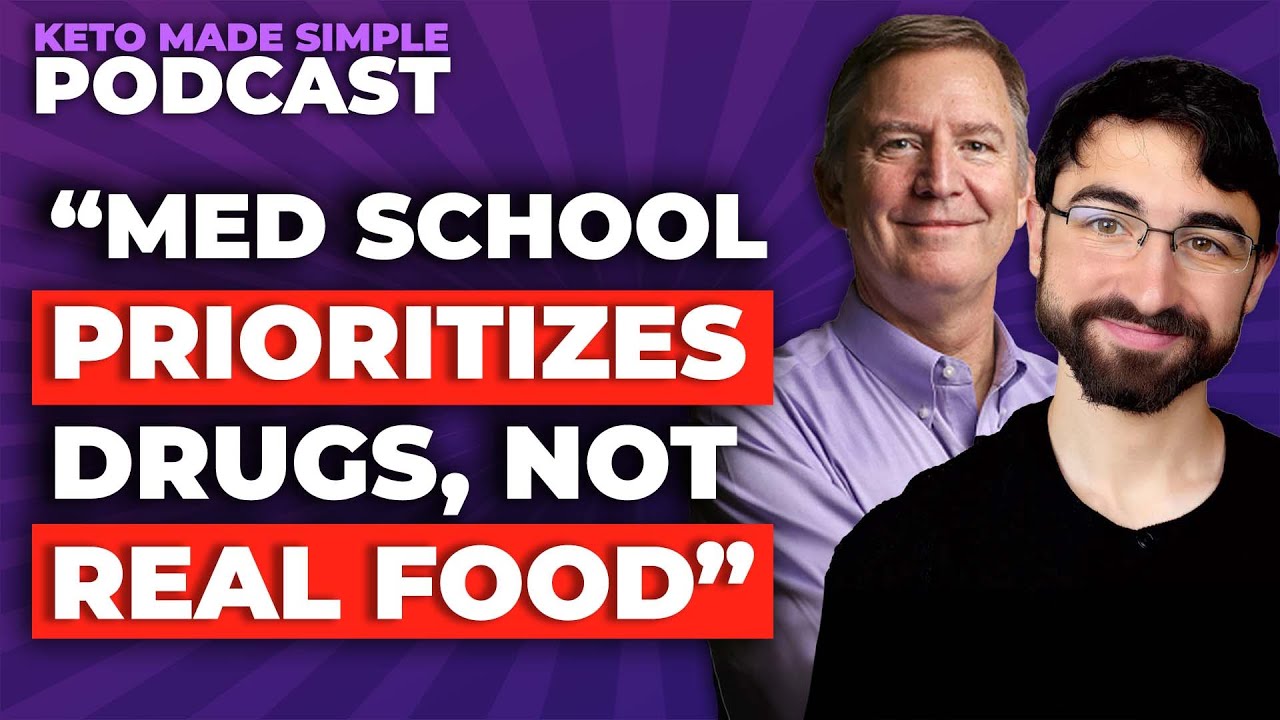
Dr. Nick Norwitz, a Harvard Medical School graduate, reversed severe inflammatory bowel disease with a ketogenic diet after conventional medicine failed. He argues medical schools ignore nutrition and that the evidence hierarchy favors drugs over diet, while discussing how AI and patient biomonitoring could reshape metabolic health care.
Chapters
Hi, I'm Dr. Eric Westman, and this is the Keto Made Simple podcast. Hi everyone, Dr. Eric Westman here. And as you know, in my channel, I typically review and debunk nutritional misinformation online. So sometimes I like to interview movers and shakers in the low-carb keto, well, or general nutrition and health sphere. And it's my great pleasure to have Nick Norwitz with me today. How are you, Nick?
Excellent. Thanks for having me on, Dr. Westman.
My pleasure. And for those who don't know who you are, and to the folks, small folks we have at Adapt Your Life Academy who have decided to stay on after doing classwork, they get a first look at these videos. Who are you and how did you come to where you are today in the medical influencer world. I would say you're a rising star.
Thanks. I appreciate it. I feel very lucky to be where I am in my life. I recently graduated Harvard Medical School. I was 5 months ago after doing my PhD at Oxford. And I'll kind of back up to the beginning because I could never have imagined that I would be in the nutrition space or the metabolic health space. And this, you know, really started for me at the end of college. I always knew my entire life I wanted to, uh, go into medicine and go into science. Both my parents are academic physicians. I come from a house of MD-PhDs. There's 5 of us in the immediate family, and among those, 9 doctorates. So that was the environment I grew up in, and I always were—
where was undergraduate?
Yeah, Dartmouth. Went to Dartmouth in, uh, Hanover, New Hampshire. Yeah. And really enjoyed my time there. I majored in cell biology and biochemistry. And as I was getting to the end of college, I knew I wanted to go to medical school and I also knew I wanted to do science. So I was lucky enough to actually get two placements, one at Oxford for my PhD and one at Harvard Med. And Harvard let me defer. So I had a few years to go do my, my PhD studies, but then something serendipitous happened. I got kind of sick. Actually, I got really sick. I had been healthy most of my childhood, but I started to develop GI issues, in particular inflammatory bowel disease. And apologies for getting a little bit graphic, but this isn't your run-of-the-mill, my tummy hurts. It's like bloody diarrhea 12, 20 times per day. And my life really started to fall apart. I don't need to go into the gory details, but what surprised me is how ineffective conventional medicine was. Not that conventional medicine is bad for what it's built for, but for a lot of chronic diseases, this won't be news to your audience. You know, it's not built to address them at their root cause. So despite engaging in the best quote unquote evidence-based care, I wasn't getting better. And I am someone who had all the resources, financial, familial. I was hooked up with the best healthcare systems. I had two double doctor parents advocating for me. Despite all that, I'm not getting better. And so it got worse and worse over the timeframe of a couple of years to the point that I was in and out of the hospital intensive care while doing my PhD. And I had gone from being, you know, a high achieving academician and athlete to being socially withdrawn, physically very frail. Like I had gone from running 2:45 marathons a couple years prior to being like, it's exhausting to go to the bathroom. I deteriorated very quickly and I got to a place of just hopelessness and desperation. And when you're in that place, anybody who's listening, who's been in that place knows you can try any, you will try anything, not because you expect it to work, but because you have nothing to lose. So I started doing, uh, you know, fringe dietary therapies and, you know, low down on my list of things to try was keto. I eventually tried it and you can guess what happened next.
Wait, you mean Keto's the lowest of the fringe.
It, it was in my mind at the time. I mean, like my entire exposure was Magazine Keto, you know, like the worst of the worst that you can imagine was just like what I had been exposed to. That was my concept of it. And I also just, I considered myself quite attuned to my nutrition. Like I knew how to read a nutrition label. I knew how to eat a quote unquote balanced diet. And I had internalized that as the gospel of nutrition. And prior to that, it had always kind of worked for me, you know, I was right, you know, always very carb-fueled, high-performing athlete. And so to consider that the prevailing knowledge had worked for me, at least in terms of body composition and just like appearance and performance. Was, you know, a, a, a, I think the saying is when you're free to adopt it, but bottom line, that's, yeah.
I, then the saying is when you're young and healthy, you can get away with things.
That, so that, that's what I thought.
Impersonally.
Because yeah, there was, for me, obesity wasn't a canary in the coal mine, so I could get back from a long run and literally like drink a jar of Nutella. I kid you not. Boston, go on a 22-degree, 22-mile run in like zero-degree weather. You get back, you're a teenager. You know, you slam a jar of Nutella and also just the culture in college. You know, you work out with the athletes, you get back, go to the dining hall and you all share in the pasta and cookies. And there's this idea that, you know, you can burn off the quote unquote empty calories. Now that's become a big pet peeve term of mine. I don't think there are such thing as empty calories. We can get into that. But yes, I tried keto.
I remember I, I watched a video of this story and, and it's a little hard for me to find if someone wants to watch the video you did of being healthy and then, and getting sick. Is that at your website or is it—
I think it was the first video I ever put up on YouTube was like the, my, my, a friend made it after my recovery story about my food is medicine, medicine journey for like 5 minutes. But yeah, it was, I mean, I was in critically ill condition. Like my mom flew over from the US because she thought I was dying. I was in like a palliative care ward with a heart rate, bradycardia of the 20s. Like it was, it was that. But then I tried keto and lo and behold, I just came back into myself, you know, and went into remission fast.
How, well, first, which keto did you do and how fast did you find improvement?
My keto was more Mediterranean style to start, like a decent amount of vegetables, a lot of fatty fish, a lot of olive oil. I kind of was blending what I thought of as healthy at the time with, you know, a macro ratio that will be ketogenic. So I got into ketosis and it was, you know, a few days I was feeling more energetic, you know, within a week my bloody diarrhea had gone away. Yeah.
And it's so fast. That's, that's fast.
It is very fast. It was very fast. It was, I mean, look at it.
You, you said that really fast. Um, your bloody diarrhea was gone in a week.
In a week. And then it was a while before my next colonoscopy, which is the gold standard for you go into the colon, you take a biopsy of the colonic wall, and then you can look under a microscope. Is there intestinal inflammation? And on my next colonoscopy, there was actually no sign of disease. So this wasn't just like, I feel better, I feel better, it felt better if I removed it off and there's no disease.
Was that the colonoscopy was a few months in or later, or?
I don't remember exactly when it was. Okay. But yeah, so it was, wow. It didn't evan— let me put it this way. It didn't evangelize me to keto. Like I knew this was an n=1, not documented in the literature, but it was a sufficiently powerful experience to at least get me interested in the metabolic health space. So I'll kind of fast forward. A little bit to bring you to where I am now and just make the point that personal experience was the experience I went into medical school with. So it framed my entire medical education. And what I came to see is the limits of quote unquote evidence-based medicine. It sounds like a great term. It's a nice virtue signaling and it has its pros. However, what I came to realize to like make it very concise is evidence-based care is not the best care., and what I mean by that is standard of care is determined by what gets studied and what boxes are checked and what determines what gets studied and what boxes are checked is a business model behind medicine. It's not to say anybody's evil, big pharma's out to get you. It is just the incentive structure reality of what we have. And it is also the basis for why we are where we are, where people are suffering with chronic diseases and continue to suffer. Because the evidence-based model we have isn't looking, you know, under the proverbial lamppost, if you know that.
Well, I remember, uh, this is maybe 20 years ago when in the Society of General Internal Medicine, it's the kind of teaching group within internal medicine. There were thought leaders who were, who created the field of clinical epidemiology actually. And then the ladder of evidence-based medicine. And then the, the critics were saying, well, if you make the bar so high for evidence, pharma is the only company that's going to be able to afford to get in the game and create the evidence unless there's some other source of information. So if you require the bar to be that high, you basically exclude a lot of knowledge. And, and actually I'd like to get into that in a little bit. How do we value and learn from the grassroots movement? But, but back to your story that if the the reversal of a, a major medical life-threatening disease didn't get you into keto. What, what did it take?
Well, that, that got me interested. That just got me interested in the space. And then I started like delving into the hard sciences, like waking up every day, 4:00 or 5:00 AM. And I'm just like reading Cell Science, Nature, and having my eyes opened to how incredibly interesting and hard a science this is. And also at the same time, I'm just dabbling with social media, getting into like, you know, groups where I can hear other people's stories. And one thing I say on repeat is the most remarkable thing about my story is that it's not at all unique. You know, I'm an oddball in certain ways, but the motif of struggling in the system, becoming desperate, trying something quote unquote fringe, and then finding it works for you and wondering how nobody told you about it before is a pattern I know you see again and again.. And so that's what compelled me to put more of my effort into delving into this space, communicating just around metabolic health broadly. Because when you start to unpack the basic science, even as distinct from the quote unquote, like, you know, top of the hierarchy of evidence. And I have an issue with a hierarchy of evidence that I can explain. It's so remarkable, like from a scientific perspective, it just makes me like smile and get goosebumps all the time. In fact, the newsletter I put out yesterday actually opens with a photo of my arms getting goosebumps because I read the paper. I'm like, this is so cool. And I just, I just needed to talk about it.
And the mitochondria jumping. Yeah. And I'm mind-blowing, but you know, I learned what I do through two of my patients who did it without me. They, my patients taught me, I'm practicing at the VA in Durham here here in Durham, you know, in 1998. And 2 patients lost over 50 pounds each. And I— and this was remarkable. I sent my patients to the dietitian. I was— it turns out I was a rare bird. I was a preventive-minded internist, which at the time, well, even today is kind of an oxymoron because we usually react to things with medications. So 2 of my patients lose all this weight and I said, I'm curious, What did you do? And one of them looked at me and said, all I did is eat steak and eggs. And, you know, I fell outta my chair and learned by going to visit doctors who were doing this at the time. Now, if someone comes in, I'm eating steak and eggs, they go, oh, you did carnivore. That's great. You know? So 27 years later, I realized that it's actually fine to eat steak and eggs. But so, My problem with the academic world at that time, and even today, is that wanting to find the mechanism, there were too many. So we started publishing papers on obesity and, and then diabetes, and then they said, well, but they reversed or improved the diabetes. Reversal wasn't shown until the Virta studies, late years later. But diabetes is better, but people lost weight. And you change the diet and people— so you don't really know what it was. Was it the diet or the weight loss? And I was like, well, it did both. So when you have a multifactorial kind of approach and you're in a mechanistic, we want to know the one, you know, variable world, that doesn't fit. So you're coming to this, you're in medical school at one of the best medical schools on earth, was there any mention of nutrition, let alone keto metabolism?
When you— any serious mention? No. And nutrition isn't required in the curriculum. Like you sit on a one thing where they hand you a MyPlate handout. But no, oh no. Oh yeah. There were worse experiences than that. I'm going to not try to badmouth my experiences because there were a lot of great things. That I experienced at Harvard Med. But well, you know, it's not Harvard particularly, like nutrition is just not well taught. And when it is even taught, I, I don't think it is, is taught with a mind to like the rigorous sciences that should be the basis of guidelines. Even if there are any guidelines, it's more repetition of the guidelines as far as what I'm hearing from peers at other medical schools as well. But I do wanna emphasize something very positive. Which was the student body. My peers were very open and interested.
You slapped, you did a study with CGMs with your—
so, so there was one day, and this is when I only had like a Twitter presence. I wasn't like big on, this was first year medical school. I'm just kind of dabbling around. This was a moment, it was in our first year. And after class, a student got up and said, hey, We were just talking about like, you know, fundamental metabolism. I'd really like it if Nick can get up and talk to the class. And I was just kind of like, I guess I will. So I got up and I babbled. I thought I was an idiot. But after that, a cohort of students stayed after class, which medical students are busy. They all have their own things going on. For people to stay after class to talk to was awesome. And we just ended up standing around in the hall for like a half hour. And after that, you know, forged a little, um, pilot trial of using CGMs for medical education. So I basically just got hooked up with a bunch of Dexcoms, gave 'em out, and then we used that as kind of like, just wear this, see what it's like, what do you learn? And then use that as a nucleus for discussing some literature. And what I found in, in that experience, and then just throughout medical school, is like, students are really interested and engaged, and that has just developed and evolved beautifully. From where I am now. Like we now have all graduated, we've gone our different ways, but I have friends like in various expertise and then something comes out and they'll like DM me like, hey Nick, there's a really cool paper, do you wanna cover it because of what you're doing? And so we continue this dialogue. I just think I'm really grateful to my classmates for being amazing people. And then, oh, they learn to learn from each other. Like that's what you need in medicine is medicine is a team sport. And unfortunately my place.
And you also had, you also had, um, unusual access. I saw the interview you did with Professor David Ludwig recently. You had access to Dr. Ludwig, which was Professor Ludwig.
David was a rock star in my corner. Uh, I won't go into the details, but I did get myself in trouble more than once. David was there to talk to me. It was actually, we just had a barbecue. He was, uh, over about, he, the he was in Denmark a lot of the time now, but he came back and we had a barbecue at my house. So he met my parents. And one of the first things I said, or he said when I met my dad, David says like, my dad, I'm sorry I couldn't keep Nick out of trouble. And then my dad's like, or I'm like, you know, it takes a village to keep me out of trouble. So collectively my family and David made sure that I didn't get kicked out for grad.
What can you talk about this publicly? This sounds—
I'll tell you off air. There's some things. I'll explain, um, I can't say it publicly yet. At some point I will, but let me—
it wasn't until I was in residency that I started to, you know, ruffle feathers.
I will say, just, I will emphasize all of my behavior I feel was very ethical. Let's leave it at that. Sometimes when you go asking questions that people don't want you to ask, you get in trouble, but I, that's what's got me in trouble. That's what got my dad in trouble his whole life. My dad, I'm gonna blame him for this. When I was little, he always told me, if you're asking a question and you don't get a satisfactory answer, keep asking. If you keep asking, oh, and then people get angry and still don't give you a satisf— satisfactory answer, it means you're probably onto something. So you definitely should keep asking the question. So I've lived by that my whole life. It's got me in trouble once or twice or many times.
Well, now I can imagine you're at the sandbox and your parents are having you do experiments in the sand while you're a little toddler with— I was, I, I know a couple children of MD PhDs anyway. But that, that's great. And so now your, your ulcerative colitis is in remission years later. Yep.
6.5 years. No, the first, I, the first day of Triketo was July 19th. Sorry, June 1st, 2019. And basically since then it's been in remission with the exception of one episode following. I do some n=1 experiments and I, got a little bit cocky and that, that came—
you sacrificed, you've sacrificed your body for science and your Oreo experiment. This is the other—
people think these are easy, not easy. They could be pretty unpleasant. So anyway, yeah.
Well, I, and I see these as kind of straw men here for other people to either replicate or refute, especially one of your one trials where I believe what happened is you ate A lot of calories, many more calories than you needed, and you gained weight, but you didn't gain as much. And your, your body, uh, body heat went up.
Yeah.
You measured your temperature.
Yeah, it was a 6,000-calorie overfeeding study. I didn't even gain like even a pound. I've done various studies.
And who, who factors that into the weight loss studies? The body temperature?
Well, the thing is calories in, calories out isn't a model of obesity. I want to like really emphasize it's not even a model, but the way I see it is that you burned off the calories, right?
So it's the thermogenic effect of food in the old world discussion of—
there's a lot of variables. There's the calories you excrete. There's the calories you burn off as NEAT. So many things. And it's still a model. Like you're not shoving Reese's into a bomb calorimeter.
Someone wants a great, although it was kind of an advanced discussion of it, I have to say, about the calorie in, calorie out and carbohydrate insulin hypothesis. Watch your video with Professor Budwig. I thought it was great, except there's some times in there when, you know, nobody knows what a tautology is. And, you know, I have to explain that to people. Gary Taubes would say, you know, in his language that, you know, this kind of stupid. I mean, everyone knows that if you're gaining weight, you have to more have more energy going in, you know. And so David and Professor Ludwig in the paper that put all these people together, and I'm an author on it, he used the word tautology, and I had to look it up. I mean, I'm a history major, you know, and yet that word is kind of a way to code something that's kind of silly and obvious.
It's circular logic basically. Yeah, basically. So the idea that, that what, how, how do you define, like, how do you operationalize? Now I'm using another word, basically like what, what is the consequence of calories in, calories out? You're saying if you overeat calories, you gain weight, but how do you actually define overeating calories by gaining weight? So the dependent and independent variable are effectively the same thing. This isn't even a model of obesity. It's just a beautiful description of what happened. It's just not functionally useful.
And I'm so glad someone like Professor Ludwig can be so articulate and spend so much time on this, 'cause me, that's too much work. I want to get in front of my patients and, and get some results. So, so back to you. So you're now in medical school, did the— published a paper on giving students a continuous glucose monitor. It's a Brilliant. I hope, I wish every medical school would do that. Even dental, you had dental students, I think, as well. Yeah. Just to see metabolism. When I was in medical school, we did blood pressures and we had a tennis ball and watched our blood pressure go up and showed the dynamic aspects of it. CGMs hadn't been discovered yet or created. So that's pretty awesome. Other while we're still at this phase of your life, what should other medical students do? What, or what did you come up with as ways to teach and for yourself and for others?
So my off-the-cuff answer is gonna be a little bit pessimistic but realistic, which is that, you know, medical school's a very busy time and the curriculum's very compressed. So there's not a lot of time in the formal curriculum for medical, for metabolic health education. It then falls upon the students to seek out this information by themselves, which you're just busy. You're studying for exams, you're doing rotations, you're doing your extracurriculars and your research, you know, for residency if you wanna go into academic programs. And so it really needs to be internally motivated right now. I do see that changing, but I think to your earlier point, or what you alluded to, I think it's going to be forced by grassroots bottom-up pressure. Because I thought it was relations just becoming interested and people—
There was a group, the group Physicians Out of Care, and it was an anti-smoking group, really anti-tobacco, you know, tobacco group, but it was an organization at the medical school level that it would be cool to get a metabolic health organization that, you know, there'd have to be some external support. To get it started, but to band together, students were interested about it. But I don't see the same anti-sugar groundswell at the moment that there was for anti-tobacco years ago. But that's too— so, you know, at a medical school level though, you know, when I have tried to interact and change things, yeah, they say it's full, but then I say, well, what do you— what drives what you teach? And they say, well, we need to teach the medical students how to understand what the drugs are going to do. The drugs that they're going to be prescribing. Like, wait a second. And so I, I started watching lectures on cholesterol and then the biochemist would bring in the, and here's where we block the HMG-CoA reductase and this is where it's gonna be important for your life. And, and you know, it's like, wait a minute, what if you don't use an HMG-CoA reductase? HMG-CoA reductase inhibitor. So gosh, I mean, someone that really does kind of have to take a view of, of, you know, does what someone put in their mouth matter for human health that, or medical school? No. You know? Yeah.
I, so, so here, here's what I think is gonna happen. I think both you and I probably share the opinion that things could be reprioritized. And basically the entire curriculum could be rewritten. Realistically speaking, neither you and I are gonna make that happen. However, however, I do think most doctors really want to help their patients, and most doctors in my generation are also seeing what we're currently doing is not helping. So they're looking for solutions and where are they best looking for solutions, or they should be, is in their patients. So just that the experience you had, you said 27 years ago. I see that's gonna be happening more and more with people having access to information via social media, just the internet, bringing it to their doctors, going through their own journeys, and their doctors just discovering, look, this is undeniable that we need to change, you know, the way we approach chronic disease. Still build on some of the amazing innovations that conventional medicine brings for like acute care. I don't wanna discredit those, but I think there is gonna be a shift both with, um, patients bringing information, but just also with, I think, a revolution in biomonitoring technology and personalized care. Right now, when we talk about that hierarchy of evidence, you kind of put these, you know, randomized controlled trials on the top, and at some level that makes sense. However, an undeniable truth of that approach is these trials are still done on heterogeneous groups of humans. And so you can get a statistically significant result even with an intervention that does not help the majority. So the real question is how can we approach this with more precision? And as we are developing tools to identify with finer resolution, what's the unique pathophysiology in an individual? And I can give examples of that in the diabetes space. I think there's gonna be a shift towards the RCT not actually being the gold standard anymore, and the gold standard being using machine learning and AI to direct personalized care targeting what are the dominant pathophysiologies in a given individual?
Well, so there are times when all you need is one person to show penicillin for meningitis, penicillin for— so if something is uniformly fatal and you administer a dose, so penicillin never went through randomized controlled trials. It didn't have to, right? So the, uh, but the idea of knowing the safety of something, so you can know something works, that's pretty easy to demonstrate.
Right.
But the, the problem with safety is even let's, and I've seen surgeons get up, well, any medical person who has a new treatment and I've done 10 in a row and there's no problems. Well, let's see. So the 3 over N rule says the upper 95% confidence limit of having no outcomes in 10 people means it still could be 30%, 30% death rate. Yeah. So, so the more people you have, the more confident you are on the, the safety of something and tolerability. So let's, well, wrapping up on your personal story, I wanted to get to a more scientific question, but so nowadays you're, you're healthier and you continue to eat in a low-carb, kind of way. I, yep. Yeah. Yeah.
I have no reason to stop.
Yeah. So I'm seeing a lot of young researchers and doctors eating even not even having many vegetables at all. Certainly the, you must have fruit every day. I'm okay. You don't have to have fruit. And then I'm getting more comfortable with the idea of no vegetables because there you can get all the nutrition you need. And yet these other scientists are looking at pretty careful biologic measurements. And the study by Isabella Cooper where she took 10 people, women already on keto for average of I think 3 to 5 years, and all the metabolic parameters look great and then look terrible after just a couple weeks of a UK 280-gram carb diet and then went back to low-carb keto, things normalized again, starting to answer or give some insight into the question. Maybe you didn't really need to eat carbs at all even before your medical issue that came on. So, and that's a huge leap. So we've come through the last 20 years where I think it's pretty accepted that using low-carb and keto is a therapeutic tool. Yeah. To reverse diabetes. You have the Virta studies and, and now. But then get them off. My colleagues will say, but once you're there, get them off that diet because it's going to hurt. You know, that was a slide from 25 years ago and it was called the Atkins diet. There was a cartoon of the doctor going, I know it reversed your diabetes and obesity and you're feeling better. You're off your blood pressure medicine, but that diet's going to kill you. You know, it was a joke. And now we still, we have to be honest and say no, if it there's no evidence that getting off it is bad, except— so in the clinic, I'll say, well, staying on it long-term is bad. Well, yeah. Or if we, yeah, staying on it may be okay. And the, and the other thing is we're not using research that's been done before. We're following people in real time in their own lives. Like you're saying, we can't study everybody. And the personalization of this is to a point where if we can examine, you know, the insides of the coronary arteries of somebody to see if what they're doing is harming them, that's gonna help combat the big naysaying that this is necessarily bad. But so you decided to continue not to eat carbs, that's great. And so now my question for you, and I need help on this one, is how, to value or not the grassroots movement. So when I started to look online 25 years ago, there were some pre-post pictures of people doing Atkins. You know, they're heavy and then they're skinny. They're heavy, then they're skinny. And so I, you know, people can climb Mount Everest, but not everyone can, right? So you can see that people are doing it. And that, that, or, or maybe not. Maybe we don't trust internet information. Maybe, are there validated questionnaires or, or comment section where, where, so with this grassroots chain and, and change in this enormous amount of information, how can we harness that information? Or maybe we shouldn't. I've seen surveys done of self-described carnivore eaters. And we've done surveys of Facebook groups and things like that. How are you looking at this as a new source of information? If someone writes a comment on your video, YouTube video, does that have value? I mean, it could all just be selection, but it could all be bots. Or, you know, so how do we handle the information and figure out for whom, as you're saying, this might be good, might not be good? With new data synthesis tools we have.
So I guess, you know, the infinitely difficult question is what is the source of truth? And academics look at it—
Well, let's say, let's say the human, the health of the human in front of me.
Yeah, no, no, I'm unfolding. So I guess the juxtaposition could be this idea of a hierarchy of evidence. Like the most rigorous evidence, the, you know, metabolic ward controlled trial. It sounds nice, it has the bells and whistles, and so you wanna put it at the top of the pyramid.
But the fact of the matter is, but if it was only 2 weeks, it will happen.
This is actually my point is that you can have something that looks rigorous, has the bells and whistles, has gone and through and gotten the stamp of peer review, and it can be tremendously misleading. Now it's true, the internet on balance has a higher chance of being misleading. But I guess what I'm saying is there's no direct and easy answer to saying this is where you can find truth because all the data pools are a little bit messy. So I think the best solution we have is to have open and nuanced discussions, not settle for simple answers, and provide frameworks and ways to think about things. And provide tools for people to then go safely experiment on themselves. I can provide you all the information, you know, from the basic metabolic studies or randomized controlled trials. At the end of the day, the question the patient needs to ask themself is, how can I experiment with this safely on myself and does it work? And then who can I ally with, like, you know, a physician to help me work through this process as an ever ongoing journey. So there is no clear answer to the question, how much value does X have versus Y? Because the answer to that is going to depend on who the receiver is.
Well, but so to, but if you're in an echo chamber of even, I suppose this happens probably on vegan YouTube. I don't follow them on keto carnivore YouTube there. You'll get people who tend to be your, your followers or that echo chamber reverberates. And then if someone comes in saying, hey, that's not the only way, they're called a troll. I mean, well, hang on, this isn't— that's not science.
It comes down to individual responsibility. I mean, fundamentally, and this is important, science is not a democracy. It is not. It is not determined by the vote of peer reviewers. It is not determined by the vote of the public. It is a process for approximating truth. And that means my challenge to the listener, my challenge to myself is how can you like most authentically interpret the data and stand up for what your perspective is, being willing to be in the minority, being willing to be wrong. That's part of what the scientific process is. So as humans, we are tribal. We are influenced by our social circles. We are influenced by the mere exposure effect. And the best we can do is be aware of that and then try to compensate for it and be courageous enough to say, hey, this doesn't make sense to me, and here are my questions. And then seek people who are willing to approach the conversation with that authenticity and have discussions openly and be willing to be wrong. That shouldn't be a sinful thing. In fact, I had a— I tweeted this, my last tweet earlier today. I got a comment on, I did a, uh, I thought a respectful response video to Peter Dratia talking about causality and ApoB. And somebody wrote in the comments that I was challenging Peter, who takes on the experts, and they use this word, this is not my word, he regurgitates the opinions of the experts. And that I am challenging that. So the, the atten— and this is not a commentary on Peter, this is the comment. The accusation to me was that I wasn't regurgitating the opinions of the experts. The accusation was I had the audacity to think independently. So I don't know if they intended to basically say, hey, independent thinking is a sin. And like, when did that happen?
It was, it's, but, but sincerely, I think humans, I wouldn't say, I wouldn't say it's a sin, but there's always been hegemony or influence or, or paradigms, if you will, where you, we as scientists see things through a certain lens. And it finally occurred to me that Jeff Volek and I had, uh, broken a taboo. On studying high-fat diets. Best I could tell, there was no law against studying it. In fact, there was no study that said high-fat diet was bad. It was just kind of understood that you wouldn't study it. The study sections wouldn't allow it. When I finally got to talk to one of the researchers, Mary Gannon, very, very wonderful person, and Frank Nuttall in Minneapolis, they had no particular diet. She looked at me and said, Well, but if we were gonna study lower carb diets, we'd have to increase the fat and we couldn't do that. So, you know, she wasn't, so it was, it was, it was if the medical world said fat's bad without any evidence. And then, so the researchers were, who were not medical, they, you know, they're PhDs and were beholden to this kind of artificial Taboo. Gary Taubes's book, Good Calories, Bad Calories, the first half of it tells the story that was so helpful for me that the science was not solid about low-fat diets. And even yet, the, there are organizations that will always say fat is bad because they were started on the idea that fat was bad.
So they're not gonna change. You know, like, you know, with guidelines, there's the acceptable macronutrient distributions.
Yeah.
Do you know where those come from? I looked this up because I remember getting a lecture and the person gave us these guideline-based acceptable macronutrient distributions.
They're like, probably what people typically eat, right?
Where do they, no, no, no, no, no. So they were, they were saying like, you know, carbs between, I don't know, I, it's like 40 and 60%. And when I went and did some digging, the logical chain was as follows. High cholesterol is bad. If you eat saturated fat, cholesterol goes up. If your total fat is increased, that means your saturated fat's gonna go up. So in order to keep your total fat below a threshold, so your saturated fat is below a threshold, we need more carbohydrate calories. And that's where the carbohydrate fraction comes from.
This 20 years ago in string of logic, I, I presented the low carb, the Atkins induction paper to a group at a, a local nearby pharma company just thinking they might be interested. And they said, well, your L— the LDL there went up 5 points. And I said, well, yeah, but it wasn't statistically any— no, no, that's a deal breaker. You know, FDA says no, a drug cannot raise LDL cholesterol. I mean, this is even before small LDL.
SGLT2 inhibitors raise LDL.
Like, there are— this is way, way before that, right? So, but the, um, so we've come a long way, I'm trying to say, in, and be able to study. And, uh, it finally occurred to me that science is a self-righting endeavor. Eventually we'll find the truth, but only if you can fund or get access to funding for every question. Right.
That actually is poking me in the brain about, um, speaking about pushback about ideas. Did you see what, um, Peter McCullough wrote? About Jan Buzuki?
No.
So this, this is rel— so they were at a dinner and, uh, he ended up then thereafter posting a blog post where he calls her, he didn't name her, but I have permission to then share it was her. She actually reached out to me to give my 2 cents. He calls her a twitchy keto crazed conversationalist based on the fact that she was talking about keto. And I bring this up in this context, it's not a non-sequitur. Because she and her family just put $50 million in to the Coalition for Metabolic Health to do unbiased research that is free from the current business model.
Yeah.
And it's so interesting to see the pushback against not even generating something— I guess in some ways it's competitive, but when like a family of philanthropists and altruists through their own suffering wants to fund research into metabolic health, Like questions that are genuine open questions. That's taboo. And so what I find— go ahead.
There are those who come to keto to be nihilistic and anti-establishment. I saw that during COVID times where the people who came to keto who wanted to just rabble rouse, they thought widely beyond what science was saying. So, But they were rabble— so keto can be perceived as kind of quackery and way out there by people in the mainstream. You know, but the idea that a family affected by someone is influential started, best I can tell, with the Charlie Foundation where the child happened to be fortunately the son of a movie producer. And so the Charlie Abrams. And so his parents start looking and they, the experts said, we want to operate on your child for epilepsy. And they said, hey, wait a minute, let me, let's go look. And so they found this, it was like embers brewing at Hopkins. There was one person still teaching the keto diet for epilepsy and they went and created this fire starting to burn again. And Charlie, best I can tell, saw him at a metabolic health meeting. Metabolic health summit meeting a few years back, doesn't need to do keto anymore. I mean, he's a grown man and he kind of grew out of his seizure disorder, but we need to be able to get access to funny funds beyond just family of people affected. But your parents haven't started a foundation yet.
Wait, my parents? You think my parents have the wealth to do that? They're physicians.
I'm just joking.
Anyway. Yeah, I know.
But it's, that's sad that it has to be kind of a grassroots people-funded sort of thing. And I hope there will be other sources of funding for the research. At the same time, I'm using this in my clinic for the last 20 years. When I visited Dr. Atkins in 1998, I said, you need to do research. And he looked at me and said, why do I need to do research? I've been doing this 30 years. I know what your research is going to show. And I kind of, he's got a point. He's got a point. But I convinced him that the other, the world didn't believe him. So there was this big disconnect. And so he funds the first science with Volek and me. With a check from his personal checking account. They create a foundation then, and sadly he dies and the money is used in other ways, gets lost in the recession, that sort of thing. So, but at the first paper we wrote and submitted to the, uh, um, JAMA, the Journal of Medical, uh, Journal of the American Medical Association, one of the reviewers said, we're not used to seeing papers funded by doctors. Was, how is that for a non-scientific reviewer?
I've gotten similar weird pushback. I remember when we did the, we did a case series on carnivore diet for inflammatory bowel disease. And this is, to be clear, this is a retrospective case series. We did have like medical records. These were confirmed cases, but for a retro, like this has happened to the patients. We just wanna report on that. But we still wanted to dot our I's and cross our T's. So we went to go to an IRB. Weirdly, they wanted to go us, have us go through the whole process. It should have been an exemption because it wasn't human clinical trial research that's been done. We had to go to 6 IRBs before we got in one door. And then the reviewers, oh my God, we were getting pushback from reviewers and like, did you control for water intake? And I'm like, are you, it's like, what is the biological plausibility of like 38 versus 40 fluid ounces of H2O affecting their ulcerative colitis? Gimme a break. There is pushback about things that are outside the mainstream and it's anti-scientific. There shouldn't be taboo conversations.
Well, unfortunately, so another thing that happened, uh, Richard Feynman, the other F-E-I-N-M-A-N at SUNY Downstate, a biochemist, we're at a meeting and he says, you know, I, I think we need a new journal. And I, and I said, you can do that. I'm not, I didn't know. I, I'm a professor at, at Duke, but I didn't know you can create your new journals. And I said, well, that's a lot, a lot of work. He said, well, I'm gonna do it. So to get a fair peer review, we had to create a journal called Nutrition and Metabolism. Of course, you have to find all the editors and all that, and it's not trivial to do that. Fortunately, today, the Journal of Metabolic Health, I'm working on a case study. Where someone just kind of signed the form that said we didn't need to go through an IRB. And so it depends on the journal that the— so I've even had professors tell me, well, you can't get it published unless you have an IRB approval. Well, it depends which journal, depends the level of the story you're trying to tell. We're just telling an anecdote. I mean, you know, it's in the medical world, it doesn't carry much weight, but the point is, I guess, that you can use an anecdote then to market something inappropriately. So the safeguards there. For sure. Yeah. Well, well, this is great. I'm sorry to hear that you had— and, but people need to know that it can be a lot of work and hassle to get into that kind of medical publication world. And if you're doing it, you know, in your spare time, you know, you're not hiring someone else to do it. It, it's a lot of work to do that. Yeah.
Yeah. I mean, most clinicians aren't academicians, so like it, they're busy with a clinical workload and it's not something they're necessarily trained to do. It's a different skillset. So it does create barriers to, to circle back on something you said earlier, just to kind of, you know, emphasize when you were talking with Dr. Atkins, he's like, why do I need to do the research? I know how it pans out. I think the term there is scalability. Like, and this is great for the individual listening because you don't need to wait for standard of care to change to take information accessible to you now, even via the internet, and apply it. However, if we want to treat the masses, there is going to need to be a shift in what convention is. And the only way for that to happen is for the evidence base to evolve, which I do see happening. I mean, yes, we need more than the Bazookis giving $50 million, but those kind of efforts create breakthrough points. And eventually this becomes self-fulfilling.
Um, well, I think the, there's a, um, there are, uh, places, uh, Michigan is one of them where there's a group, uh, Alabama is another one where there's a group of funded researchers through NIH, through other, uh, means and the other, but the, the, hard battle. It's easy to get a K award relatively through NIH. And then these folks basically need to continue to get funding, then leap to the R01 level through the K awards. And then now I think Laura Saslow at Michigan is just full of— she's, you know, oversubscribed to grants. So, you know, if anyone wants to do research on this and can't find money, I think, you know, UAB, you know, Michigan, we don't have that at Duke at the moment. I don't, you know, someone wants to do research here, I said, well, I have a clinical group. Well, there was a medical student who for his continuity year stayed in my clinic, got to know the patients. Many of mine come back over the course of the year. And he wrote a case series that's now accepted for publication on heart failure. So he, he's interested in cardiology. He, um, had learned the low fat was best and then came, saw this clinic and was like, whoa, there's another way to go about this. And we had, I think, a couple hundred people. You just searched the medical record for Keto Clinic and heart failure. He presented it at a meeting and now it's gonna be a paper. Of course, this is a very interesting twist, isn't it? That, um, The SGLT2 inhibitors, which reduce heart failure events, probably work by giving ketones. And so now doctors know about— cardiologists know about ketosis through the drug treatments that they— and they don't— but they think eating diet is bad, dietary fat is bad. And so therefore they can't understand that a keto diet might actually be doing what the SGLT2 inhibitor is. Doing, but without the risk.
You, you just pointed out something very important, which is that attention in medicine is determined by what pharmacological interventions are often like pointing the spotlight. So like LP, it's the hot kid on the block now. I wrote a newsletter on it that I thought was like, this is esoteric and academic. It ended up being one of my most popular. Why is it in the spotlight now? 'Cause there are 5 drugs under, you know, trials to treat it and you're getting these NEJM papers and now it's a hot topic issue. But when you start to look into a lot of these conditions, they always have some degree of metabolic underpinning. I'll give you another example, depression. Now, there are a lot of examples when it comes to depression, but an interesting paper came out early this year in Nature where they were looking at autophagy in the brain, this basic cellular recycling process. And they found that autophagy was dysfunctional in one particular area of the brain, and that led to basically overexpression of glutamate receptors and excitation. So basically you're turning the knob up on the depression center, but This is why I bring it up. How do antidepressants work? Different antidepressants have different mechanisms of action, but we still don't really know. So for example, selective serotonin reuptake inhibitors, SSRIs, you might just think they increase serotonin, but when you start taking them, they increase serotonin very quickly, but they take a while to act. So it's not a direct serotonergic effect. Um, there are kind of maybe metabolic and adaptive changes that occur over time. Guess what? SSRIs increase autophagy in this part of the brain, as does ketamine and other antidepressants. So when you start to look under the hood, a lot of these interventions hit nodes in the metabolic web. And I do like the idea of a web because you said earlier, you know, we're always looking for like the answer, the linear pathway. The way I think about it is like every new really cool paper, it's not the be-all end-all. It's like a new thread in that web. And as we study it, it just develops this better resolution. And you're right, from the clinical level, if something's working, it doesn't matter what it is. It could be a placebo. Patient doesn't care. They're better.
But yeah, nailing the way it's cool, but it's harder. So it's easy to prove efficacy. It's harder to prove long-term safety and, and that one thing is better than another. And I've kind of just kind of diplomatically agreed that there are a lot of ways to be healthy. I mean, you know, but so I went to a couple meetings in Europe this summer and the Cooper paper kind of blew me away. I hadn't seen it. It's been out a couple years and yet she had no trouble recruiting people already in ketosis. Turns out I think she was one of the people in the study. And then I also met Adrian Sotomayor in Europe. I know you've met him and first time I met him, he's solid. Wow.
Uh, it saved my life on occasions.
And fair enough to evidence-based. Um, and actually we were chatting and I remembered a colleague of mine in Canada within the evidence-based medicine world. And he said, well, you know, I got on the exam board. So, and we put likelihood ratios on the exam that doctors have to study for. I'm like, oh, then actually Adrian said, They asked me to write a paper for the Mexican board and I said, get on it, make sure they know, you know, because people will study for the test, right? So if you're going to drive curriculum, at least in some ways you can change, alter the test that people have to be trained for. I thought, so a lot of these things come around, you know, just in a different form, which reminds me of my 90-year-old patient who was the oldest one to march at West Point, he told me. He was in Durham, but would go up to West Point every year. He said, I've seen everything twice. You know, so a lot of times it's the same kind of things recycling, and we can learn from the fact that the powers that be have different motivations.
Yeah.
And it, the patient in front of me was always the kind of clinical epidemiology purpose, applying statistics to this. So let's say there are, you know, 1,000 people that are saying, no, 5,000. How many do we, how do we know how many people have done a carnivore diet? How, how can we know?
I don't know. How?
I don't know. No, this is a really, yeah, I have a question. So even, I don't know that it matters because here's the thing.
Well, not that it doesn't matter entirely, but I think people get wrapped up in these really weak heuristics. Like, a larger sample size makes a better study. That is not true at all. People are like, well, it's an old study, whatever. I'm like, what question are you trying to answer? And is this study sufficient to answer the question? The N value isn't that material. It can be, depends on what question you're asking. But it could be that even if like, you know, if, if 1,000 people had done carnivore rigorously and got X results, it doesn't matter if it's 1,000, doesn't matter if it's 10,000, it's sufficient to propel the next question in the next study, I think.
Yeah, I guess as a dyed-in-the-wool clinical trialist who, you know, trained in randomized trials and all that, I, I guess I, I'm, I want before I give a policy to my patients, I want some sort of framework, you know, so a doctor today, internist like me, and then I went into obesity medicine as a subspecialty, if you will. The doctor has no qualms saying, well, here's an SGLT2, here's a GLP-1, or here's an SGLT2 inhibitor. It's FDA approved, which means it's gone through some vetting. Some studies, and a doctor doesn't pitch it like, well, you know, this might work, it might not be good for the long run, and you know, you don't want to stay on it too long. But you know, so how can we tell doctors, and you know, this is like an FDA-approved drug with that kind of emphasis and confidence, you can tell people to do this. Of course, the way you teach it Pharma is brilliant because they put it in a little pill and if the pill's too big, you can put it in powder. And so we're teaching something that needs to be simple, I think, for it to be doable and sustainable, that scalability thing. And so getting back to where Dr. Atkins said, I know what you're, you know, you're going to find. I realized that no, there's selection bias. He might have talked someone and they might have died and he never knew about it. You know, so in a clinic you can't see the people who don't come back. My, my parent, I had a father who was an academic psychiatrist and the old joke back then was doctors bury their mistakes. You know, that being the surgeons and the errors that they have. So that dark humor was in my mind when I said, well, a referral obesity medicine specialist like Dr. Atkins, one can't necessarily know unless they do a systematic study what happened to all those people. So I still, you know, how many people have done carnivore without any side effects? Or, you know, so I did a reacts video and some of these people were like, well, I didn't feel right, or well, you know, I was a little tired. And it was like they didn't drop dead. They, you know, doing a carnivore diet, it was all like, so I guess I, but great question. Why do we need to know? I, I wasn't expecting that reply. That's good.
Um, let me evolve that statement. I don't need to tell you the art of medicine is making difficult choices with imperfect or incomplete information. And I think we just need to have more evolved and open discussions about what we don't know and what we might speculate on. So I'll give an example that came up recently. You probably saw it circulating around the internet 'cause I made kind of a hullabaloo around it. It was this paper in Cell Metabolism around statins and GLP-1.
GLP-1.
And this was a human-controlled trial. What was showing was that statins like slash GLP-1 levels, GLP-1 being a very important hormone for metabolic health. It was a 16-week trial and in humans they just tanked straight line down GLP-1 levels. Now, my purpose is not to scaremonger about this. It is not to say if you take statins, then you're going to X, Y, and Z, but it does fit into the broader literature and it begs questions. If you're using this in a healthy person for primary prevention who has isolated high LDL, what is the risk-benefit analysis and what are going to be the long-term consequences of, say, slashing GLP-1 levels? And the truth is, and we just don't have a complete answer. Right. So, so what I'm just saying is then, then how do you have that conversation? Because you can't have that conversation with the utmost confidence. And it's the same way with other drugs that we just, you know, brush under the side effects of the drug. So PCSK9 inhibitors, people talk all now about like Mendelian randomization, how they're great for proving causality. But then what happens when you see a forest plot in a study where it says PCSK9 inhibitors quote unquote cause an increase in Alzheimer's disease risk? It's not proven without a shadow of a doubt. But we're not going to have that complete information. So then how do you have an evolved discussion saying, here's the risk-benefit analysis at the individual level, but quite honestly, for both the risks and the benefits at the individual level, there's a lot of unknowns. And I don't think there's a simple answer. I think it's a matter of saying, hey, this is never going to be simple, but let's just have an evolved conversation about it. And these shouldn't be taboo things, provided we come with humility to the conversation. Mighty sense.
Yeah. Well, you know, I wanna be respectful of time. Um, thank you so much. You know, I wanna say again, maybe it was busy, you didn't hear me. You're welcome anytime to visit my clinic at Duke. You could come for a day. I'll teach you everything. You come for a half day, you come for a week. Um, I'm, I've set up the clinic here in part to be a teaching platforms because there's so many things that are different. And, you know, when someone reverses, as you know, when someone reverses a serious medical disease, you don't worry about this hypothetical red meat down the road problem. It fixed you. So those trade-offs become decisions we make without randomized trials. And I love that you're trying to inform people as best they can, but there's some times when people are so vulnerable, they'll look for the, you know, and you were in that situation, they'll look for the weirdest, craziest thing. And then you found keto. Oh, that's so deliciously ironic.
You roll the dice sometimes in life.
Anyway, I say that again.
Sorry. And you roll the dice sometimes in life. Sometimes you get me at times.
And yet everyone goes into ketosis, u-ketonemia, when they don't eat for 2 days. So, you know, how, how would we all have survived evolutionary pressure if ketosis was bad? Right.
Right.
And that didn't occur to me till like 25 years after I saw those patients that, who had done this. So, uh, I'm just trying to erode some of those barriers and maybe they're not Maybe they're not there. Again, Nick, how do people find you? What's, what's the latest?
Yeah, you can, I mean, Nick Norwitz is a pretty unique name, so you look it up, you can find me on any social. My biggest right now is probably YouTube, although my favorite and where people can find the most information up to date is at staycuriousmetabolism.com. That'll take you to my Substack. So at least 3 times a week I publish deep dives on all things new and the basic and translational science journals, and I just have a blast with it. So yeah, staycuriousmetabolism.com, any socials. And thank you so much for your generosity and hosting me, and I look forward to for the future conversations and collaborations.
Yeah, let's talk again.
Cheers.
Keep it up. All right. Bye-bye.
Awesome.
If you enjoyed this video, consider joining our YouTube membership for early access and exclusive live Q&As with me. Just click the join button below or support us with a PayPal in the description.










