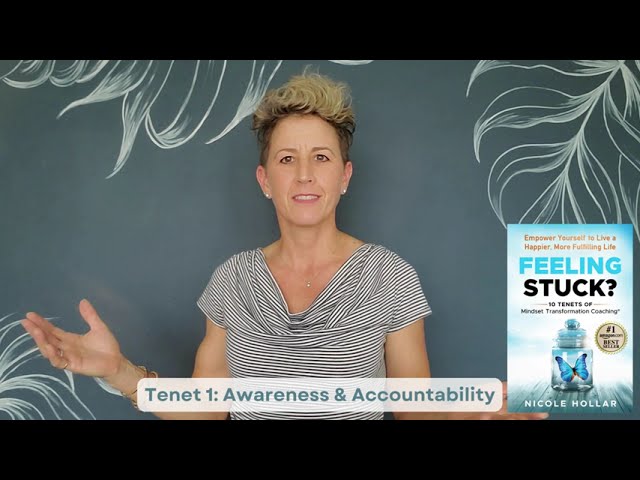
Nicole Hollar introduces the first tenet of her book: awareness and accountability. She walks through workbook exercises like the Honesty Chart and Values Elicitation, and explains how owning past mistakes and forgiving yourself can help you move forward at your own pace.
Chapters
Hey guys, welcome back to your springboard into feeling stuck. Empower yourself to live a happier, more fulfilling life. As you move into tenet one about awareness and accountability, consider their importance. They are absolutely necessary for all of us if we want to move forward and to grow. Personal awareness and accountability to both the good and the not so good parts of ourselves is totally necessary. And with that said, so is personal forgiveness. You know, maybe you have been or done or said things in the past you now wish you had not. I mean, I think we've all done that before. But here's the thing, since you can't change the past, all you can do is own it, learn from it, and move forward as a better person. Too often I found that people get stuck on defending their past as if it was their present. And it's important that we learn to own our own missteps and our lack of knowledge, and then seek to be a more open learner. You know, you, you are who you are, and if you're okay with that person, that's fantastic. That means you shouldn't need to become defensive to other people even when they challenge you. Rather, it means you should be able to explain your perspective Whether you're talking about maybe your own personal behavior or your beliefs even. Now, I'm not talking about subtle arguments that people have. I'm talking about, you know, bigger, deeper issues. So as you move into Tenet 1, I'm going to ask you where you may feel disconnected or lost. But I'm also going to ask you if there's any changes that you can make to better a situation. Now, keep in mind, sometimes change means not doing something. Likewise, where are you doing great and what positive qualities about yourself should you consider maybe leaning into a bit more? We tend to focus on the negative so much. You know, too often I'd say people shy away from embracing their best selves or the parts of their life that are going great. And they spend too much time focusing on the things that they wish were different. So for those of you using the companion workbook, there's going to be an exercise in there called the Honesty Chart. And what that's going to do is ask you to describe yourself, your values, your judgments, your obstacles, and then your accountability to them all. And there's a further exercise called a Values Elicitation Which basically helps you list and define your values for any of the sectors of self. And I found that it's really eye-opening when people do it because, especially when people do it with respect to work, they can evaluate if their work aligns with their actual values about work. Or I've had couples do it together to see where their values align and even how the same word might mean something different. So as I wrote in the book, if you can't own your stuff, it means you can't share your stuff, which means you're lying to yourself and to other people, most often the people around us that we care about. And that's why accountability is so important. Remember guys, this book is intended to meet you where you are, so you might relate to some of the stories I share or see those examples in other people. Or you might choose to really think about some of the examples I give or questions I ask. Like, I know a few people who have chosen to use this book, which I think is cool, as a sort of a study guide or self-development course. Yet I know some others who just want to give it some high-level time right now, like I mentioned in the last video, and that's absolutely awesome too. Whatever path you choose Just know that every now and then something is going to inspire you, and you can choose to do with that inspiration what you want, but know that it's always going to be there to return to you for you at any time. So you can always return back to anything you read, look it over again, say, I want to address that now, maybe I'll deal with that later, and that's absolutely fine. I mentioned earlier on, I certainly recommend you read the whole book From 1 to 10 in order. I still recommend that, but maybe some things you really dive into and some things, like I said, you mention— or not you mention, you look at a little higher level. And that's okay. Just return when you're ready because we want to meet you where you're at.