When Sadness Looks Like Anger [ #7 #Anger #Anxiety #Attachment ]
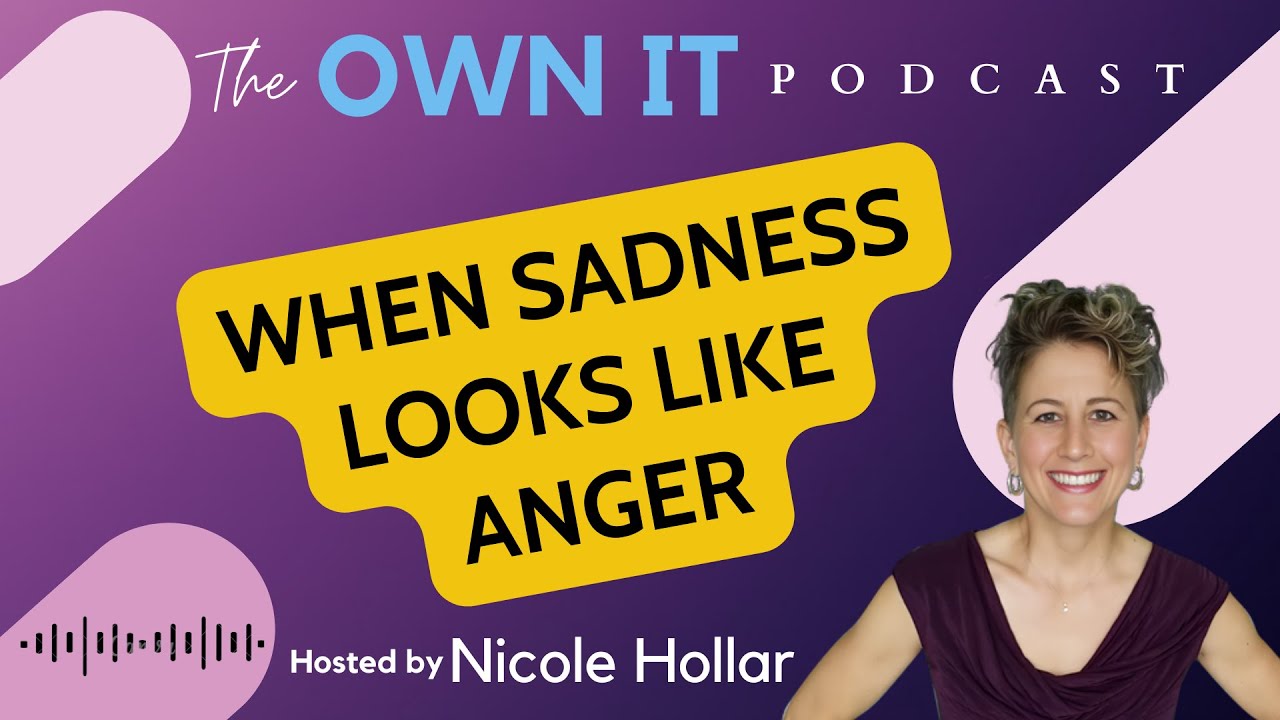
Nicole Hollar traces how sadness becomes anger, rooted in childhood attachment wounds and fear. Growing up in a loud, critical Italian family without overt affection, she learned to armor herself with anger. Recognizing these reactions as signals of unmet needs, not character flaws, opens the door to healing through therapy and self-compassion.
Chapters
Welcome to the Own It Podcast with me, Nicole Hollar, where we're going to talk about stuff to help you get out of your way, take charge of your life, and, well, other stuff too. Hey guys, thanks for joining me, Nicole Hollar, with another episode of the Own It Podcast. I wanted to talk to you a little bit today about how sadness sometimes looks like anger. And it looks like anger because people are angry. They're like angry, horrible people. They say nasty things. They are short-tempered. They're shut down. They're closed off. You're like, that's a horrible person. My experience with people is that most people aren't horrible. And it's taken me a long time to get to that space because certainly as a younger person, you know, I grew up in a very loud home. There was a lot of like criticism. And when I say home, I mean like globally, it could be like grandparents, aunts, uncles, my family, the whole thing. Big Italian family. Right. And I guess those were the things that were intended to propel you. But in addition to that, There weren't a lot of I love yous or lap times, and that trickles down. So what happens over time with people— and I've told my family, thank you for being role models of what I don't want to be, and you can feel whatever you want about that because there are role models around us all the time— instead of having a victim mindset or taking things personally and being angry all the time or jealous or bitter or resentful or being short-tempered or triggered, I decided at some point in my life when I was young That I needed to create an actual physical distance so that I could figure out who I really was and wanted to be. I didn't want to be a sad, disconnected person who didn't have confidence, who went into the world fear-based with anxiety and anger. It's a very difficult place to come from, and I know it can't feel good. In fact, I was recently with family and I told one of my younger relatives Who's kind of closed and shut down, and she doesn't really want to talk, and she's very quick-tempered. I said, "You know, I know how hard it is to be in this situation, and I realize that you are a very sensitive person, and you haven't gotten the love, attention, and connection that you need." And I said, "You know, angry—that feeling of anger—is a very energetic feeling, and it takes a lot of energy all the time. When you bite down, think about it: when you're angry, you're tense, and and you bite down, and you're just." Shut all the time. It's a very tiresome experience to feel that way, to feel shut down, to feel disconnected. When people are more happy and carefree and leisurely, they're like more fluid in the world. They're more light. You can feel their energy. Now, the difference in circumstances, if you're living in a parent's home, which I'm going to suspect that most people who are listening or watching this are no longer living As maybe teens or whatever in a parent's home, but you could be. It's a little bit more difficult because you're in a confined space. But for those of us who've had the opportunity to create space and distance, if you don't like those feelings, it's so important to recognize all of the positive, good qualities of yourself and to learn to depersonalize things. That not everything is about us. That if I want my own time and space, it doesn't mean that I don't like you. Maybe I just need my own time and space. And learning to depersonalize things when I was younger was probably one of the biggest things that I had to overcome. And my point in sharing that is that we can always overcome that. And there's two sides to the coin. Now, I've been in personal development and fitness and wellness for over 20 years, and it's been a long process. The point is, is that it's been a process, and that idea of— and you can see it— most anger comes from sad, meaning it's a fear base, it's a disconnect. You have to consider that fear and anger both come from the same place. They are both from that fight-or-flight reflex. So anxieties, anger, anxiety attachment from people who didn't get the love, attention, and connection they needed as a child often looks like bitterness or anger in people because they don't feel connected, grounded. They don't have that tribe within themselves or feel like they have it in the world, and they're waiting for people to constantly fill that cup for them of feeling needed, loved, wanted, instead of knowing that we are good quality people. And it can become something that looks like anger, and it pushes people away. So what it does is this place of wanting to be loved, to have attention, to have connection, that fear of not having it, that, that program that's been running in the background for so many years tends to push people away because those types of people, they lash out. They're bitter, they're resentful, they can't be appreciative of people. It doesn't mean they never show it. And that's why I said I know that most people are fundamentally good people. So if you're listening to this or watching this and you happen to feel like one of those people who's just short and you're bitter and you're angry all the time, and you know it because you just feel it, you just want to feel calm, cool, and collected, then if you haven't already done it, perhaps it's time to talk to somebody. Perhaps it's time to work with somebody in NLP. Talk to somebody regarding any type of trauma therapy. By the way, trauma doesn't mean you were necessarily physically abused or something like that. It can be the lack of— sometimes trauma is that thing we didn't get as kids. And the reason I want to have this conversation about how sometimes I'm calling it generally sad looks like anger is because I recognize that there are a lot of people who may feel that way. Because that fight and flight response is so powerful. If you are somebody who feels that way, you have this opportunity. You have an opportunity to feel good inside, to feel loved by yourself first, and then to know that you're loved. But in order to receive that love, you can't push people away. You can't be angry. You can't take a loved one, your, your boyfriend, your girlfriend, your parent, your kid, and tell them why they're horrible all the time. As the way to think that that's motivating them to be what you need them to be. It doesn't really work that way. Likewise, if you're somebody on the other side and you can see in, like I can see into the general picture of people, and I've had a great opportunity into family, none of them are horrible people, but they were missing something. And we can lean in a little bit sometimes to help bring somebody back. But it does take somebody who's open and receptive to it. So what I would encourage those of you who are on the outside looking in going, ah, that's a pretty horrible person, to decide, are they really a bad person or are they demonstrating their emotional spectrum in a bad way? Is it maybe misaligned? Because sometimes if we can see into the bigger picture and not just be triggered by what we're hearing, seeing, feeling, or observing, we can recognize that there's something much bigger and deeper with somebody. And perhaps you can actually be a person to pull them out of that a little bit, to help guide them to maybe seek additional help or therapy that they need, or somebody that they can lean into, because sometimes one tether of connection is what somebody needs in a new environment in order to ignite something different. I'm going to leave that for today. If you guys want any more information about unconscious coaching, of course you can always go to my website, nicoleholler.com. You can also find me on most social media sites at the handle Nicole Holler Coaching. And of course, if you're loving the Own It podcast, go ahead and give it thumbs up on the episodes on YouTube. Star it, like it, rate it, review it. I'd appreciate all of that. Thank you guys. Have a great day.