21 Futures #1 — The Noderoid Saga: Dreamers — Niko Laamanen
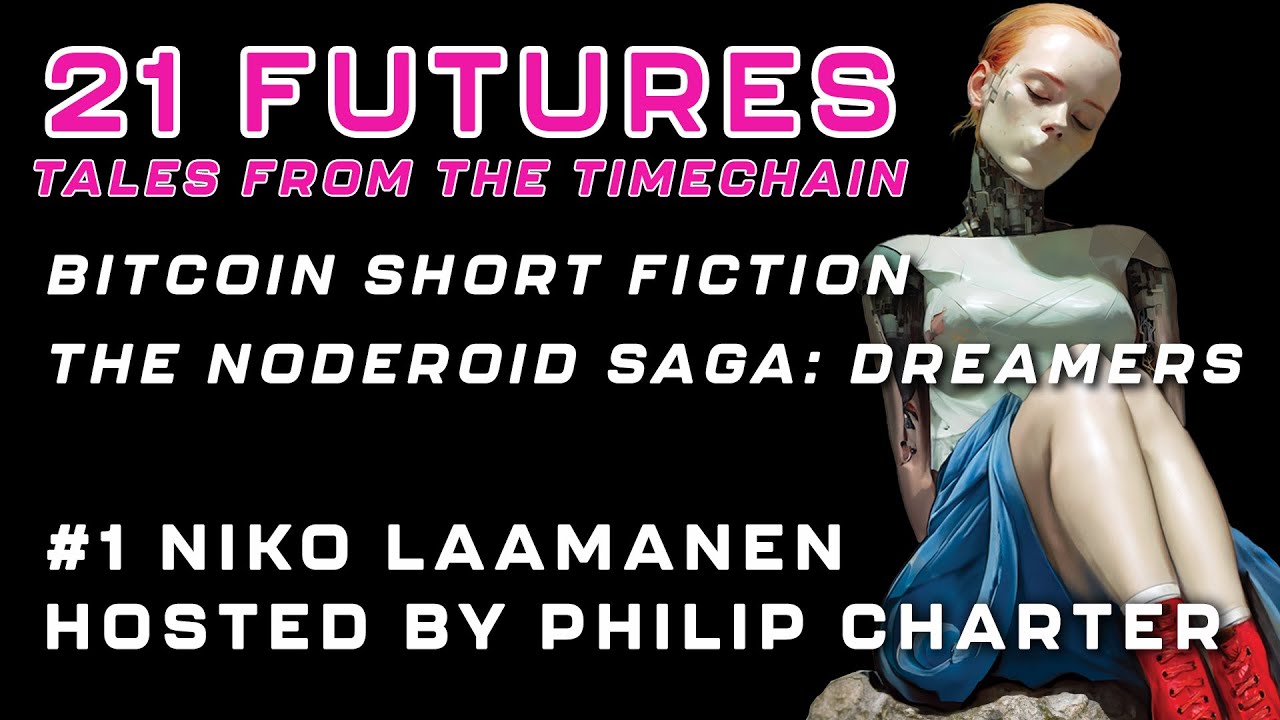
In this interview, host Philip Charter talks with Niko Laamanen, author of the short story "Nodroid Saga: Dreamers" and founder of the Bitcoin‑focused publishing house Consensus Network (also called Freedom Publishing House). They discuss the origin and purpose of the upcoming anthology 21 Futures – the world’s first Bitcoin fiction collection – and how it aims to attract non‑Bitcoiners through engaging speculative stories rather than didactic exposition. Niko explains how Consensus Network began by translating The Bitcoin Standard into Finnish, expanded to multilingual translation and original English releases, and now produces the anthology. They explore the challenges of marrying technical Bitcoin concepts with literary fiction, the inspiration behind the story’s cyber‑punk setting, its dual perspective (Nodroid and Clearblood) and world‑building (Terra Perfectus, time‑chain), and the narrative’s themes of scarcity, autonomy, and the ethics of sacrifice. The conversation also covers the publishing model (open submissions, blog publication of rejected stories, plans for multilingual editions), future multimedia adaptations (short film collaborations), and the roadmap for subsequent volumes of 21 Futures. Contact information for the project and Niko’s social handles are provided.
Chapters
TranscriptAuto-generated · 30 min
Welcome to the world of 21 Futures: Tales from the Timechain. This book forthcoming in December 2023 with ConsenSys Network. is the world's very first Bitcoin fiction anthology. I'm the editor, Philip Charter, and today we speak with one of the authors featured in the anthology, Niko Laamanen. Niko, welcome.
Thank you, Phil. It's a pleasure.
I should say as well, Niko is not just an author in the book, but he is the brains behind the publisher Consensus Network who are putting the book out. So this is a sort of origin story podcast, uh, as well as a, uh, a chat to Niko about his great, um, story, which we'll hear from in the show a little bit later. Um, yeah, let's just, uh, enlighten everyone, Niko. How did all of this start? What is the origin of 21 Futures and the idea?
Well, if you go way back, how, how, uh, Phil and I actually meet— met originally, Phil was helping me with, with my English as my English tutor. And of course, as one does, I started orange peeling him, uh, quite early on by using, uh, Knut von Hohen books. And, um, yeah, after, after that, Phil came back to me with this idea of a fictional anthology based on BitConverse, which kind of like I haven't thought of an idea like that. I hadn't heard of an idea like that. It was pretty mind-blowing that Phil came up with that and approached me. And of course I was excited immediately and I, I said that it's a good idea and we should start working on it. And ever since I've been sort of, um, obsessed with this idea of bringing Bitcoin fiction available to people to lure, sort of lure these, uh, non-Bitcoiners and, and let's say regular people or normies in the vicinity of, you know, Bitcoin and libertarian ideals by using interesting stories that, you know, they're not trying to lecture you on any topic or, or convert you into anything. They're just simply interesting stories for anybody to read. And then if it so happens that they get interested in what's behind the whole thing, maybe they can look into, into other books and, and actually start to learn something. So I think there's a lot to like about this project.
Me too. I mean, we're both biased on it, but, um, definitely. I mean, as a language person and as your, you know, English tutor, as you, as you put it, but really, uh, um, I was helping Niko with his writing. I should, uh, point out the difference between fictional and fiction. It's a fiction anthology cuz it's an anthology of, um, fiction stories, right? Fictional anthology would mean that it's not real and this book is real. It's really happening. So. We should call it a fiction anthology.
Right.
Not a fictional one. Um, sorry to correct you on that, but yeah. Um, I was super excited to come up with the idea because I had wanted to play a major role in like putting out a book and editing it and working with different authors. That's what I do in, in, in my day job a lot of the time as well. And I think what excited me was the beautiful difficulty of trying to marry, you know, the technical world of Bitcoin that's not at all fiction-based or, yeah, based in on stories or entertainment and the world of writing. Which is, you know, very, especially short fiction, perhaps on the elder side and not so much into, you know, maybe into a lot of speculative elements, but not so much into, you know, cutting-edge technology and things like Bitcoin. So of course there's a lot of, yeah, there's a lot of pushback from authors who are like, hey, what is this Bitcoin thing? And, you know, a lot of challenge working with authors in the Bitcoin space who are used to more functional writing and more sort of how-tos and explainers and things like that. So yeah, it was really cool to try and bridge that gap. And I hope that we've got a book which does that and is going to interest story lovers, Bitcoin enthusiasts, and everyone in between. Tell me, or tell everyone a little bit more, if people are coming to this, Niko, and they don't know what Consensus Network is. Um, tell everyone about that. How did it start? What is it? Uh, where are we, where are we going with it all?
Right. So, uh, Consensus Network is what I now call Freedom Publishing House. Uh, we started sort of like a Bitcoin publishing house because the way we started was translating The Bitcoin Standard by Saifedean Ammous into Finnish language, which is my native language. And then, uh, very quickly I realized that there's, there's a need to be filled in other regions as well to translate books. So we started translating more and more people joined in. And then we expanded last year to original English works because why not? Because we already sort of mastered the publishing and built the publishing machine. Yeah. And now, now we are doing original release and, and this is actually our first own Uh, production, 21 Futures. And I suspect that there's gonna be more projects like this and they're going to take precedence, but we are still specialized in mostly translating and localizing, uh, great knowledge and, and, uh, interesting books.
Yeah, it's very cool to be a part of because, you know, in your publishing model, it's very different from other publishers that I've been involved in. Uh, I've been involved with traditional publishing, which, you know, to my mind is something that is very broken and outdated. So it's great to see like publishers taking a new approach to all of this. And also very cool that so many people in the world, around the world, can get involved because of The aspects of translation and localization. We hope to put this book out in more languages, right, than English, but it'll be going out first in English. Who knows which country it will be racing up the bestseller charts of, you know, it'll be a sort of bestseller in Angola or in, you know, Bhutan or something like that. Who knows? Brilliant. Yeah. So let's Well, a question I wanted to ask you related to publishing and Bitcoin content is what kinds of art and stories are inspiring you in the space at the moment? Obviously you've got a pretty good overview of what's going on being so involved with ConsenSys Network and everything you're doing.
Well, it's, it's been inspiring to notice How popular publishing is right now. Like, I, you wouldn't think, I wouldn't have thought that publishing, there would be so much interest in, for example, self-publishing, which is also a service that we now provide. Um, I guess it's partly because of the, the modern tools we now have, um, AI and we, we have Amazon, which is rather easy. Like anybody can make a book, at least in theory. The question is, what is the content like? And You know, the downside of having this influx of new wannabe authors and publishers is that the quality also tends to trend down a little bit and there's a lot of noise and that pronounces our job as the signal amplifier. So to answer your question, I guess what inspires me the most is when I find that gold nugget that, or a piece of information that maybe I haven't seen. Before, or it's written in a way that is inspiring to me, then I want it to be a part of the library so that we can sort of amplify that specific thing that I think, and our editors think, that is a proper way of educating people. But in general, I would say it's all good. Like if you wanna write a book, you can write a book, and even if it doesn't make it to our selection, we can still help you. publish it because, you know, some kind of writing style works very differently for different people. So there is a lot of value also saying the same old thing in several different ways. So that's, that's not to discount it. Personally, I've read a lot of books, especially about Austrian economics. And, um, for example, mises.org is a great resource. There is new things to be said, but a lot of it has been said already. So a lot of it is, uh, sort of regurgitating these, uh, ideas that have been around for a long time, which can be also fine. Like for example, with Knut, we made this, uh, book Praxeology, which is essentially just a very trimmed down version of Mises's Human Action, like a light version of it. So it's like an abridgment of, of it. Um, I, I think those classic pieces of information, they are timeless and coming up with some new information might be just forcing it unless it's fiction, of course. And that's one reason why I feel like fiction is, is limitless. It's a limitless realm that we can just come up with new stuff all the time that is interesting. It's more different to find something that is very inspiring and And, um, motivating in nonfiction.
I mean, you can reframe stories over and over again and people don't get tired of it. I mean, this year, I don't know how many rom-com films came out about, you know, boy meets girl, boy loses girl, gets girl back, but people are still queuing up to see 'em. So we love stories and, um, being able to reframe information. and meaning in this way, I think is what we'll be able to keep doing. And yeah, it's great to be part of this happening in the Bitcoin space. I think what you said about that one nugget of information just being rephrased is so important because many people are not on the wagon yet. And many people don't know what it is, what it does, and why they should care. And so we need to keep re— reframing this and rephrasing it until that one nugget reaches, reaches everyone. 'Cause that's, you know, how, how we're gonna win and, and move forward from, from all of this. Listen to me as like I'm orange pilling the audience now. I mean,
that sounds excellent. Good.
Good. Good orange pill Niko is. Ah, yes, I remember back to some of our writing classes when I was saying things like, what is absolute scarcity? Is that a technical term? Uh, right. Anyway, let's, uh, talk about your story. Uh, Nodroid Saga: Dreamers. You said, uh, when we first met, when we were working together, that you had this story like rattling around your brain, but you didn't have time to write it, or you weren't sure what kind of story it was. And it's come out in this short story form. Um, so yeah, tell, tell us about that. Is it the first time you've written fiction?
Yeah, it's the first time I've written anything. Uh, apart from some blog posts and tweets, of course. Well, this is more like, I, I guess this is a long blog post, but it's fictional. I mean, it's fiction. And, um, very good. It, it does exist already. Uh, yeah, I had this idea for like many years in my head about, uh, sort of like a reboot of Matrix. Like there's a glaring pothole in Matrix that the, the The robots use the human bodies as batteries, which is not how batteries work, 'cause you have to input more energy than you can get out. So sort of, uh, to not really to fix that, but take that idea and take it into Bitcoinverse or Bitcoin universe and, uh, to Node specifically, sort of this kind of like an idea of melding humans with machines to create something resembling a quantum-capable computer that is the most efficient way to propagate the, the blockchain or the time chain as we, as we speak in the book and in the story. I had that idea for a long time, uh, but I didn't really know what to do with it. I didn't really have any opportunity to write it out and I didn't have time. And then of course, when, when Phil came to me with this idea, that was a natural home for it. So I, I immediately knew that I, I can now, and I should write out, uh, the Nodroid saga, at least the first part of it. And that's, that's kind of like how I thought when I was writing it. Like there's a whole universe to be explored around this, uh, this topic, and this would be the first, um, first part of it.
We got more universes going on in this book than, than Marvel and, uh, stories which are certainly more novel and don't just involve the same entity flying around in a cape. So, um, yeah, big fan of your story, Niko. I think it's one that made me genuinely sit up and sort of say, oh. What is going on here? What is this? It just made me immediately wanna explore that universe, um, a lot more. Anything with cyborgs is always gonna interest us because technology is affecting us more and more and, um, is becoming more a part of us. And yeah. Just, uh, to give the listeners a little bit more info on what the story's about. Um, you know, there are the Noderoids, these cyborg creatures that Niko's mentioned, and, uh, Clearblood humans, and they coexist in a sort of, uh, time chain world. And your story is told from 2 perspectives, from that of a Noderoid and that of a Clearblood. Um, what brought that about? Why did you choose to tell the story in 2 parts and how did you choose the order for who goes first and who goes second?
Well, that's, uh, uh, it happened almost like an accident. Like I wrote the Node-roid part first and it was too short. And then I thought, how can I make it longer? And then I realized I can just basically write The other side of the of the account from the perspective of the clear bloods. Like at first, I just thought that clear blood is just like in Matrix; they are just these blue-pilled, you know, regular people who just want nothing to do, nothing to do with the real world or the outside world, so to speak. Maybe to go back a little bit, like the no droids and the clear bloods exist in this place called Terra Perfectus. which is sort of like a very, um, isolated world that has existed for 200 years, long enough for so many generations to pass that nobody really remembers or knows anything about the outside world. So it's a, it's a very like protected, like walled garden sort of, sort of a thing. And, um, Yeah. Then I just thought that maybe there's more to be explored about these clearbloods. Maybe they're not just statists, like, um, props for this, uh, main protagonist who is the Nodroid who is speaking first. And, and they're not just props for his, to further his story. Maybe they are co-stars of the story. So I started thinking about like, maybe there's an insurrection Boiling and, and these, uh, clearbloods, they start to realize that it's not correct and it's not right to subjugate nodroids and, and take advantage of them to run the society. So that's what the second part is about, uh, uh, and igniting a spark inside the, uh, the clearblood protagonists to, uh, come to the aid of the nodroids. And then maybe there's going to be some kind of, uh, fight against the classic evil at some point for both, for Noldroids and, uh, Clearbloods. Not to give away too much.
Yeah, I really like the balance between those 2 perspectives. Uh, there's a very clear difference in, in voice and perspective, but as you say, we have a Clearblood who's sort of sympathetic to the To the cause. Um, and I think you do a really good job of revealing what is going on little by little through the, through the 2 accounts. Uh, and I'm really excited to see what's next from the story because there's so many different, uh, avenues which could be explored and new characters, new timelines, new, so much more to the saga. I dunno what to say. Um, it's a tiny peek into the saga, I think this. But yeah, Niko, let's, um, hear a bit from the story. It'd be great if you could read, uh, a short account of, of both, maybe from the Nodroid and the Clearblood.
Sure. I'll, uh, I'll do the beginning. And to mention these, uh, 2 parts, they are sort of written like diary or log entries. So in the case of the human, it's a traditional diary entry, and in the case of the Nodroid, it's actually a time chain inscription or a collection of them, which is tied to the, the, the block, block time. And, um, the humans live in the human time.
Mm-hmm.
All right, so here we go. The Nodroid Saga, Dreamers. Tick tock, next block. The incessant rhythm of my existence persists like Chinese water torture. I'm a node droid, a half-less, half-machine creature harnessed to propagate and store the time chain. My life is a ceaseless cycle of handling and relaying Bitcoin data. Approximately every 10 minutes, the pain sears through my circuits as binary flashes torment my being. It's the price I pay for my existence. The Clearbloods call us Nordroids, but they rarely talk about us. Our voices are drowned beneath the hum of manmade heaven, Terra Perfectus. We are the forgotten, the disenfranchised, the nameless. We are convinced that our anguishing existence is merely a bad dream and that our blissful dreams are our reality. All right, so that's The beginning of the NodeDroid account, alluding to the Matrix type of thing that we are living in a dream world, but a real world. And there's going to be a lot of like uncertainty of, uh, what is really truly real and what is, because these, uh, NodeDroid memories are going to be, with every block passing, they're going to be wiped and they have to start again. To sort of like, if you know the movie Memento where the guy tattoos stuff on and, and then is going to try to find the murderer. Right. So it's a similar thing except the Noderoid is writing or inscribing into the, the time chain and then have to start over again. Okay, so this is from the beginning of the Clearblood Diary. And this is dated 21st August of 2121. So that's, uh, the infinity day, uh, about 100 years from now. I'm a clear blood, an unadulterated, 100% pure human breed living the, living in the re-Renaissance. In this romantic realm, I bask in the eternal dawn of a Bitcoin standard where human incentives align on an infinitely skyward trajectory. Our every need is met, no man goes hungry, and crime does not exist. The design of our immaculate world embraces a zero-waste ethos, where glass and steel meld with the lush greens and verdant trees, a perfect union of technology and the natural world. The nodroids, whom we prefer not to mention, form the backbone of our society. They exist solely to serve the time chain. I witnessed their tireless efforts and unwavering dedication to the smooth operation of our infrastructure. They processed the time chain data with efficiency beyond human or machine capabilities, but the binary flashes perforate their very existence. Is such a sacrifice justified for the greater good? And that's how we, we go into the, the, the, the clear blood. is in doubt and is doubting, um, the valid— validity of the whole society.
All right. Yeah. Thanks so much for, uh, sharing that with everyone. As I say, shouldn't pick favorites. This is definitely one of the stories that made me sit up and, um, my mind exploded into many different Uh, possibilities and predictions. And some of these stories are so cinematic, it's very easy to imagine, you know, lots of our authors have talked about movies that inspired them. And, um, you know, we're hoping that one day in the future, these, um, stories will make it onto the screen.
And I think they might, like, uh, I don't know if you already talked about possi— possible, uh, short movie collaboration we have brewing with, uh, Cyberpunk Cinema and, uh, Viktava Movie Fest.
Yeah, we've been in, uh, some conversations with, uh, with some known movie makers and, uh, movie people. So it would be, yeah, brilliant. We're all working behind the scenes to try and get these, uh, these stories onto the screen, as we said. Um, where, where else do you see the project going?
Well, first of all, I have to thank everybody who participated in the first round. This was just the first, uh, trial thing, and honestly, I, I wasn't sure how it's gonna go, if we're gonna get any good submissions. Uh, but turns out we got more than 50, I believe. And, uh, out of those, it was not that easy. Like we had to work quite hard to, to weed out, um, the ones that we, I mean, we didn't want to really let them go, but we had to because there was only a limited amount of slots. So then, um, at that point the idea came like, well, we're not gonna waste these stories. Like we are going to publish them in a blog. So that's what we're gonna do next after publishing the book. We're gonna start publishing the blog and, and start rolling out, uh, the, the stories that didn't make the cut. And then maybe, you know, people can just submit anytime their own fictional, uh, fiction stories and, uh, we can publish it on the blog. So I, I, I feel like this is going to take a life of its own. And if people like it, and I really hope people do like the, the concept, we're gonna do another one, another volume, another 21 stories. With another set of submissions, and we're going to keep doing that, uh, going forward. And also, you know, like for example, my story, I, I renamed it to Node-RED Saga because I already know that I'm going to write more, uh, about it. So that's also one possibility for some stories. They open these windows, these doors that we can just expand to a whole other, a book of its own, basically. So. Yeah. Maybe, maybe one day there will be an Old Road Saga book or a book collection.
Yeah, it's really exciting that it might fracture off into so many different multimedia directions and become this, I don't know, brand or gateway or whatever you want to call it, platform for sort of exploring the Bitcoinverse, 21 futures. That's where everyone can go to check out some of these, uh, all, all of the information on the project and, uh, some of the stories that, that we'll be putting out as well. And of course, yeah, I hope that we'll see more, more books. Um, we need to have a conversation about that, but I would imagine there's gonna be a 21 Futures 2, another themed, uh, Um, 21 Futures book in 2024.
Yeah, I'm, I'm fairly certain that's going to be the case. Um, another thing that has been inspiring to see is that, uh, other people are also interested in writing, uh, fiction books and not only just related to Bitcoin directly. Like for example, I was on, in this, uh, conference, Liberty in Our Lifetime. Uh, it's about free cities. which is very, very Bitcoin adjacent. And, uh, and this lady approached me and, and they're writing, um, uh, a novel about, a fiction novel about free cities. Mm-hmm. Which is very close to what, what I've, I've been thinking. And it just so happens that, uh, Bitcoin is a big part of, uh, usually the stories that I'm thinking about because I'm kind of obsessed with that. But it doesn't necessarily have to be because what we are looking for is, is great stories. So, Yeah, I, I think that almost certainly, unless, uh, people really hate this first one, I don't see any reason why wouldn't we do another one. Like, I, I've had a great time working on it, uh, with you, Phil, and I mean, I don't know what needs to happen that there's not gonna be another one.
Yeah, I'm, um, pretty sure from the reaction we've had to it so far that The world of Bitcoin is ready for some good stories, and hopefully the world of stories and normies is ready for a little bit of the Bitcoinverse, I suppose. We shall see. But yeah, Niko, it's been great chatting with you. Thanks for coming on the show. Um, I will be keeping abreast of everything that, uh, ConsenSys is, is putting out. Uh, where can people find ConsenSys online?
Yeah, thanks. It's been a pleasure. Um, you can find, you can check out consensus.network. That's our landing page. You'll find everything there. Of course, remember also check 21futures.com for this project specifically. I think we're going, that's where we're going to pitch the blog and, and probably the ebook versions of, of the actual book once, once it's out. But if you want to follow me personally, my tag is Omnifin. It reads in the screen, double N at the end, both on Twitter and Telegram. So that's where you find me. And of course, don't forget to check our bookshop, which is bitcoinbook.shop. Should be easy, easy to remember. That's where you'll find are about 80 titles currently.
Fantastic. All right. Thanks for that. Uh, good luck with everything and, um, I will catch you around soon to chat more about 20-odd Futures.
Thank you, Phil. Pleasure.
Thanks, Niko.
More from Niko
Achieving #Freedom: Overcoming Jealousy & Finding #Success. #inflationstrategies #investing


#FreeMarket: The Alternative to the Old Nation State. #inflationstrategies #economicrecovery

Nation State: The End - Examining #Future #Security #inflationstrategies #economicrecovery


#Bitcoin Escape Velocity: Why I Stopped Talking About It. #crypto #inflationstrategies
American Dream: Freedom, #Government Size, and Opportunity. #freedom #sovereignty


