21 Futures #17 — The Galactic Playbook — Reed
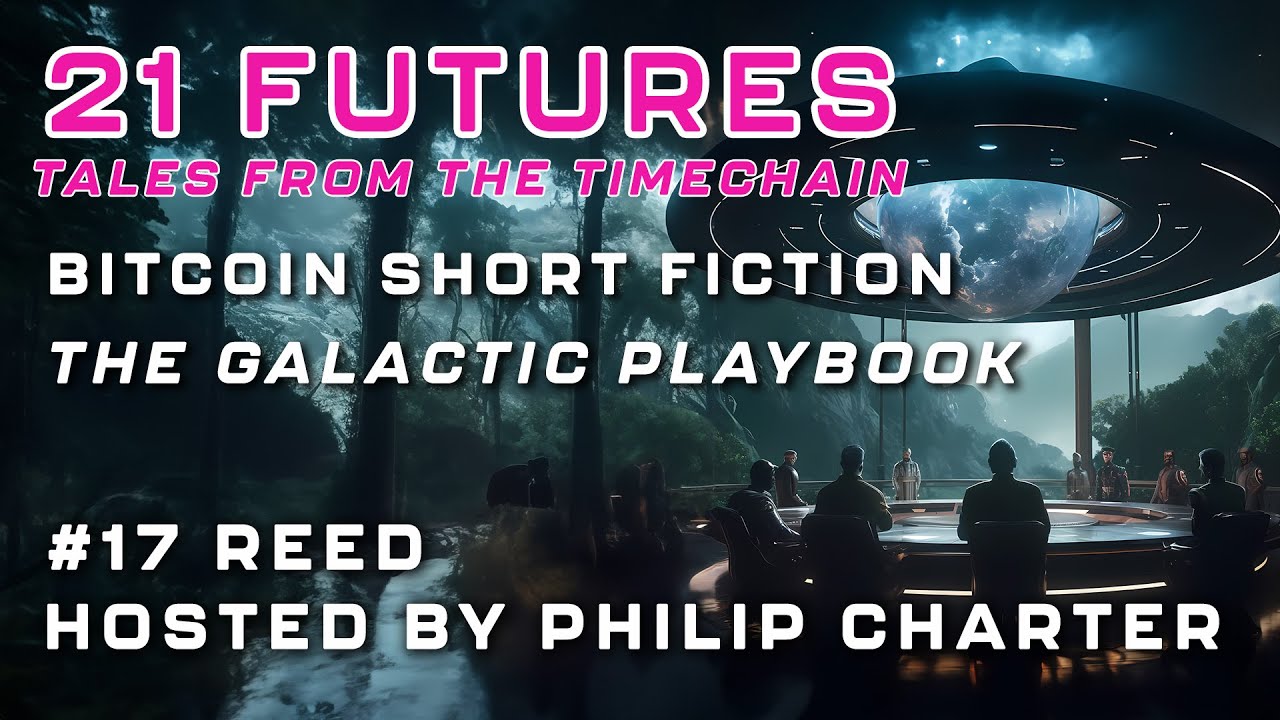
In this recorded interview, host Philip Charter talks with author Reid, an engineer who works on nuclear safety assessments, about his contribution to the upcoming Bitcoin fiction anthology 21 Futures: Tales from the Timechain. Reid explains how he discovered the call for submissions, his inspiration from the Bitcoin Astronomy Series, and his decision to frame his short story, “The Galactic Playbook,” as a formal memo from a non‑human Galactic Council. He describes the story’s core premise: Bitcoin is presented as an “inviolable absolute scarcity” that serves as a universal signal for emerging civilizations to pass the Great Filter, prompting the Galactic Federation to consider humanity for admission. Reid discusses his writing process, leveraging his technical memo‑writing experience and sci‑fi reading background, and notes that a debated section referencing the real‑world Bitcoin Mining Council was trimmed. The conversation also touches on the broader “Bitcoinverse” concept, the anthology’s aim to bridge Bitcoin‑savvy and non‑Bitcoin readers, and the potential for multimedia expansion of the series. Finally, Reid shares his outlook: Bitcoin will ultimately become Earth’s dominant money, but interplanetary colonization remains speculative; the focus should remain on maximizing humanity’s potential on Earth while hoping Bitcoin’s scarcity model may one day be recognized across the galaxy.
Chapters
Welcome to the world of 21 Futures: Tales from the Timechain. This book, forthcoming in December 2023 with ConsenSys Network, is the world's very first Bitcoin fiction anthology. I'm the editor, Philip Charter, and today we speak with one of the authors featured in the anthology, Reid. Reid, welcome to the show. It's very short name.
Thanks for having me.
It diminishes your presence, but welcome to the show anyway. Great for you to be here.
Thank you very much. I'm happy to be here. I think a long time ago I decided that That's gonna be my, uh, using first name only will be my form of a, of a pseudonym. This way I'm not all of a sudden just a, a random name, but it is my name, but you know, not my full name. So I like it.
I'm, I'm too much of a normie to have a pseudonym. Like I need, need to sort that out, but a bit too late now 'cause I have other, other things going on. Um, anyway, uh, welcome to everybody watching and listening. We are gonna hear some of Reid's story, and it's a special story because it's actually the close of the book, end, the last story in the book. And there's a real reason for that. And I'm sure you'll figure that out once you hear a bit of it, um, which Reid is gonna read later. So tell us first off, um, how did you get involved with 21 Futures? Uh, why did you choose to submit a story or write a story for it?
Yeah, sure. So I think like, probably like a lot of other people, I saw the call for submissions on social media and I remember as soon as I saw it, it hit me that I had had some ideas about, you know, long-term futures for Bitcoin, like on the galactic scale, let's say. And I never really had the right way to articulate any of my ideas. Like I was really inspired by, I think Drew Bonsall had a series called the Bitcoin Astronomy Series, and I always, I just really liked that framing and it just really got my gears turning about what, you know, what could this possible future look like, like on the galactic scale with Bitcoin, you know, involved in some way. And so, but again, I never really had the right way to put my ideas forward. I had done a little bit of Bitcoin writing, like I had some Medium posts and things like that, but I couldn't figure out the right way to frame it. And as soon as I saw this call for short stories, short fictional stories, I thought, man, this really actually could be a perfect way for me to get some of my ideas out there, you know, without having it to be all this conjecture and things like that. I could just state things as fact. a fictional universe. So I was really excited when I, when I saw that and, um, kind of jumped on it right away and started writing like as fast as I could to get it in by the deadline.
Yeah, great. I think, um, I like what you said about, you know, you, you write something and people just go along with it. You know, you can start a story by saying there was a, a flying elephant who was called, you know, Ninja, and people would be like, right, okay, what's Ninja gonna do next?
That's right.
So, I mean, yeah, I think, and one of the things I like about a lot of the stories and their bigger perspectives is they're not based on like, oh, Bitcoin is going to allow us to blast ourselves into space and achieve all of this thing for personal gain or for the gain of humanity. It's a, A necessary step in maybe the evolution of our society rather than just technology. Uh, you know, we already have things that can blast us into space, but yeah, I really enjoyed the perspective of your, um, of your story and especially how it's a more, um, uh, what was I gonna say? Like a, It's less of a plot-based story. It's not a manifesto, but it's a kind of laying out of, of rules and this playbook, right? It's called the Galactic Playbook. Right. Um, tell, tell me a little bit more about how, um, it developed from idea to fully fledged story, because I know we, we played around with it a bit and, um, cut some parts of it, right?
Yeah, that's right. Yeah. No, I'm really happy with the way that it turned out for this, like you said, the last chapter in the book. And I think you sort of alluded to it. It is, so it's written from the perspective of a non-human society, right? So from somewhere else, let's say in the galaxy. And when they find out that we have discovered Bitcoin, and so like, what is their perspective on it? It's, I think kind of the, I try to frame it in a way without actually saying it, sort of framing Bitcoin as the idea of one of these great filters. You know, there are these concepts out there that there's some great filter that so many galactic societies come and go and they just either destroy themselves or something happens. There's a big, you know, meteor impact or something wipes them out. But there's something that takes place that allows people to get past this great filter. And again, I sort of frame this as the discovery of Bitcoin is like a flag for the rest of the societies in our galaxy to say, hey, you know, I think they're onto something here. They may actually make it, you know, past the great filter event. So like, let's start paying a little bit closer attention. So I think that's definitely the perspective that I took. And then with respect to the how it's written. Um, uh, I, I think it'd be at this point, maybe it would make sense for me to talk a little bit about my writing background. Like my, my—
Oh, yeah.
I, so I'm not really a writer, I'm an engineer. Um, but the type of engineering that I, um, am involved with, which is like safety assessments for nuclear power plants, Uh, I end up writing a lot of methodologies and a lot of it requires technical framing that just makes a lot of logical sense about how you're gonna construct an argument. Um, and so I have no experience writing fiction. I certainly have read a lot of fiction. I've always been a big sci-fi, uh, fan. Um, you know, I've read a lot of stuff from like James S.A. Corey wrote The Expanse series. Um, Orson Scott Card stuff from Ender's Game, but also the entire Ender universe. Uh, Andy Weir's books have all, those are all kind of on my list. And so I have this great, um, appreciation for the development of a, uh, maybe not, maybe I don't have the personal ability to like write out a plot with fictional characters, but I love the concept of being able to frame out the universe. that these characters are living in. How does society function? Where do they live? How does it work? And a lot of the scientific arguments that go into that. And so partially, I mean, I think mostly I'm focusing on the economic landscape here. It's only 1,500 words, but, you know, I think I, I had a really good time writing it, you know, from, from that perspective. And so I sort of played to my strength, I would say. And I wrote it as like a technical memo that gets sent out to all the societies in the universe to let them know about this discovery that the humans have found here in Bitcoin.
I mean, that's great. You know, stories come in many forms and I think if you've got a deep technical knowledge and a passion for something and you're a big reader, then there's absolutely no reason why anyone out there can't be a writer. You know, it's just the organization of words. And I often say, I think the idea of being a talented writer is bullshit. Like writers learn how to write. There are, you know, geniuses like Stephen King who can lock themselves in a room and magically invent these plots and stories. I think some people are predisposed to being able to understand story more and what it is, but really it's something we learn and we learn all these writing techniques, um, through school, through reading and, and elsewhere. So yeah, I think it's great that you can come to it and offer a different kind of story. I think the book really benefits from it.
Yeah. And just to, um, I think you alluded to before, some parts got cut out. I think originally I had this idea of having sort of a debate follow this memo. And actually a lot of it, I'll sort of spoil where it was inspired by. In the memo, the memo is from the Emerging Civilizations Council. And a lot of that was inspired actually by the Bitcoin Mining Council. that came around in 2021 and actually stirred a bit of debate among Bitcoiners. And I thought playing that type of a debate out on a much larger scale, but using a lot of the same framing and argument about decentralization, how much authority does this council actually really have? I sort of had, I sort of had fun with that. And, and there's actually even a nod to that in the title because it was, Tales from the Crypt podcast number 263 was a big debate between Michael Saylor and Marty Bent on this exact topic of the Bitcoin Mining Council and what their narratives were and how Bitcoiners felt versus how the corporations felt. And so that part of the story, I think maybe would be a good aside or a good opportunity for like another, or something that's maybe set in this universe. that I've sort of laid out as part of the memo. But I think it works just as a standalone memo for this particular story.
So. That's, you know, that's really interesting. It's great how, you know, I often, we often with 21 Futures talk about the Bitcoinverse. I don't know if that's a word that was around before. I mean, I suppose. Or if it's become more popular because of the Marvel multiverse. Uh, I'm not a big Marvel fan, but I understand the concept and the, like, the power of a universe which can fracture off into so many different interesting areas. And I think just with this one book of 21 stories, we already have that, you know, they're connected in an interesting way and your own story could be developed in so many different ways, so many different Multimedia opportunities. It's just mind-blowing to think that with, you know, just one book, uh, how this could all spiral and snowball. And, uh, of course we're hoping to keep the ball rolling and, um, have a 21 Futures future book or another book.
Love that idea.
Perhaps themed, you know, we could have, uh, different themes for it. So, I mean, space and, uh, other, other worlds is, is definitely like a theme we could explore, but we haven't talked about that really yet. I'm just, uh, giving a few spoilers to everyone out there.
Yeah, I think it's a great idea. I mean, um, I think even I, I knew sort of going in that, um, it being You know, you're pitching this idea to Bitcoiners and a lot of us especially, you know, I feel like we're still so early in Bitcoin that I think a lot of us are more into maybe like sci-fi type narratives and things like that. And so I knew writing mine from like a galactic perspective would be maybe a little bit, maybe not cliché, but maybe quite common to think about it from that lens. I was still excited to, at least like I said before, like just set up a framing for this, you know, quote unquote future universe where Bitcoin is just one piece of the puzzle. And there's certainly a lot more going on.
Yeah. I mean, I think the, one of the original ideas of the book was for it to straddle the world between Bitcoiners and non-Bitcoiners. So to try and get people interested in it through Stories. And, you know, while more people who are likely to read this book are going to be knowledgeable about Bitcoin, at least I really hope that, you know, if you have a copy, you can just pass it to someone and go, hey, I'm in this anthology. Hey, here's a storybook, you know, and it's not evangelical, it's not preachy. It's just a bunch of stories. People like them, great. And that's going to pique people's interest in learning more. I think that's the, the idea, but, um, we'll see how it goes. Yeah, I love it. I wanted to talk, Reid, a bit more about your story. Um, the tone of voice that you use is quite, uh, kind of formal, and as you said, it's, it's written from the, uh, a head or a member of the Galactic Council. How did you Um, how did that sort of authoritative tone come about? Was it conscious decision or did you just start writing what that non-human was saying to you?
Well, I, I think it, it came, it probably came, I would say from, from 2, um, like 2 kind of major influences. The, the first I mentioned before, which is I was trying to play to my strengths. Like I, I have a lot of experience, let's say writing memos, right? Like writing, uh, novel concepts down as methodologies and framing out the background of a situation and then tying that into where I'm going for this, you know, solution to a problem. Um, so, you know, first of all, I had already some experience writing like this. Um, But then also, I think it was also based on, you know, I mentioned before that I was a big fiction reader. In fact, I would say before Bitcoin, I was almost exclusively a fiction reader. But then of course with the Bitcoin rabbit hole came a whole giant slew of nonfiction, which I—
Yeah, you can do both at the same time.
Right, exactly. Exactly. And You know, all of a sudden now I have this huge appreciation for nonfiction as truly a way to learn and a way to absorb information through writing as opposed to, let's say, like a university course or something like that. Like I found like reading like Saifedean's books, which I've read all 3 at this point, and I just get so much information from those. And I think Kind of the way that he writes, but a lot of Bitcoin authors write this way, is you just present facts and then you string together logical arguments about how whatever your argument is going to be, and it's based on fact. And then you follow that up with, you know, just basic logic that hopefully anybody should be able to follow. And all of a sudden you're, you're all these breakthrough kind of moments are like making sense to you that never really did before. I mean, at least that's, that's kind of the way that it went for me. So I think when I was, when I was writing this, it really, I, maybe I mentioned this before, but I was trying to write this as I'm stating all these facts from a fictional universe, but I'm stating them as facts because from the perspective of the person writing this, of course they are facts. These are all historical. Events and things like Bitcoin have been discovered by all of the societies in this Galactic Federation that they're in. And so it's just, you know, this is like no news. The news is that a new planet discovered it, right? We don't have to get into the technical details about how it works. You just have to know that it's this source of what I call inviolable absolute scarcity, which is like this. They don't even call, of course they wouldn't call it Bitcoin on their own, you know, implementation of it. But here we call it Bitcoin. Somewhere else, of course they would call it something else. But the idea is that it's absolute scarcity, but it's also inviolable, meaning that it, it can't be violated. It's, it's truly can be trusted to be the backbone of an economy.
Yeah, I think it's great, as I said earlier, that You've been able to use your strengths to present a different kind of story. Like you've bent the wheel of storytelling towards the Bitcoin community. And, you know, a lot of the other stories in our book have gone in a lot of different ways. And what you said about these logical arguments, I think that's the way that quite logical. I don't know whether it's left or right-brained, which one is the logical side.
I'm not sure either.
That probably shows that I'm more of a creative-brained person. But, you know, many Bitcoiners currently are more technical and, you know, have this logical perspective. And so it's great that we have this variety of stories that can approach things in a more, emotive way as well, a more emotional way because, you know, a lot of the objections to it are like, oh, but, you know, like the objections to Bitcoin or the naysayers, you heavily rely on emotion and fear and yeah, these techniques which are not based on empirical rhetoric and logic. So I think the Bitcoin community can use a bit of that in stories to help reach more people. I think not that it needs to lie or bend the truth anyway.
Yeah, I really like the idea of writing fiction that incorporates Bitcoin. You know, I think that that's a Massive, not, not even just audience, but I think there's, there's a lot you can learn from fiction books. Um, like I, I actually, so I recently actually finished, um, Atlas Shrugged, which is of course a fictional, you know, quote unquote universe, right? Like none of, there are inventions in that book that don't exist and never did exist, never will exist, but they were built on, those were sort of the backbone of the society that they were describing. And there was a lot, still a lot to learn from, I think a lot to learn from that book in particular. And so I think one of the other authors said that they've already started or finished even some Bitcoin novels that are fiction. And so it's really exciting. I'm really looking forward to this part of the Bitcoinverse, I think you said before. So this part of the Bitcoinverse with Fiction novels getting built out. It's going to be fun times.
Yeah, it's really interesting. Like quite a few authors are working on stuff and Sven Holm, I was talking to him about his story in the book episode still to come out, I think. Yeah. And he was saying, well, you know, in the future we might just have like a sort of pre-Bitcoin and post-Bitcoin that will be a watershed in fiction and art, just, just as the internet is, right? Um, and it, it won't be like, oh, we won't have to have stories about Bitcoin. It'll just be, that's, that's what there is. So, right. It'll be interesting to see whether we're in this period of like 10, 20 years where we'll be the forebearers to, um, well, just using stories about it rather than stories in general. I dunno if I expressed that very well. Uh, Reid, we would love to hear some of your story. So it's time for you to share a bit of it with the listeners. Uh, I think you said you're gonna read from the middle of the story. Is that right?
Yeah, that's right. Yeah. So I think, I think I sort of set up from this discussion enough. I think that You'll sort of get the idea of, of, you know, like I said, this is written in the format of a memo to the other intelligent societies in our galaxy, letting them kind of know, you know, that this milestone has been reached on, you know, planet Earth. And so this is just kind of an excerpt from the middle that sort of frames out kind of why this is a big deal. As more or less background for the, for the memo. So if you're ready, I can, I can start reading.
Great. Yeah, take it away, Cisreed, with an excerpt from the Galactic Playbook.
Okay. The dominant intelligent species of the specific civilization that is the focus of this memo identify as humans. and collectively inhabit a planet they call Earth. The humans of Earth have yet to discover any advanced technology that would be useful to our members at this time. However, based on a key recent milestone in their development, their status has been upgraded to that of pre-Federation, making them the leading candidate for our next admission into the Galactic Federation. As such, it has been estimated that first contact with the humans of Earth may may be possible within the next 1 to 2 GMRs. Footnote 1: 1 Galactic Micro-Rotation, GMR, equals approximately 200 Earth solar orbits and spans approximately 10 human generations. Their recent promotion to pre-Federation status is based on their discovery of inviolable absolute scarcity, a key event that was independently reached among all Federation members and typically triggers exponential advancement Within 2 to 4 local generations. As is the case on Earth, inviolable absolute scarcity is virtually always used to develop undiluted interspecies communication of value, the so-called perfect money. This has been shown to be critical for cooperation and advancement around, among planetary apex predators throughout our galaxy. The Earth-based discovery centers around a simple massless ledger. system that is secured by electric power projection and is rapidly being adopted among the humans of Earth. As with most apex predators, human trust is extremely difficult to scale across their entire planetary population. However, the new Earth-based monetary system, which they have named Bitcoin, is quickly gaining the trust of humans as it continues to prove its inviolability. As has been the case among all emerging civilizations since the formation of the ECC, Scarcity alone, even absolute scarcity, has never been enough to trigger exponential technological growth. The source of absolute scarcity must also be inviolable, or it will never be sufficiently trusted among a population.
Amen. Great reading, Reid. Thanks. Thank you so much for sharing that with us. Brilliant. Yeah. So, I mean, all that remains to be asked is what future do you see for Bitcoin and maybe interplanetary exploration?
So with respect to the future of Bitcoin, I think that better money always wins when humans need to choose between 2 different monies. The better money, the harder money, the more inviolable money, if you will, is always going to win. And of course, I'm not going to be able to tell you a timeline where that happens, but I think in the longer run, you know, Bitcoin will win and Bitcoin will eventually become the monetary system of Earth. With respect to where Bitcoin plays in the universe, I actually think that This, this, the type of universe I've laid out in this fiction story is actually pretty close to what I, what I think is going to happen. I think Bitcoin and, and Drew Bancel, I mentioned his series earlier from the Bitcoin Astronomy. He points this out also. I mean, Bitcoin is, is going to be destined for Earth. So the question is, you know, what are humans going to do if, if we leave Earth? And I think for right now, I don't really even see a future where humans are colonizing the galaxy. I think there's still a lot that needs to be discovered in terms of, are there worlds out there that we can actually live on? Even, you know, some of our nearest neighbors, I think like Mars is pretty inhabitable if you ask me. You know, you, you're asking, you know, a whole civilization to develop in a world where air isn't free, which is kind of dystopian if you ask me. You know, a world where you're being bathed in radiation that's like 50 times higher than Earth. Yeah. So I, I don't know that I'm a big believer in, in Mars civilizations and traveling even interplanetary is, Extremely dangerous. Traveling to another star system is a little bit insane. So I think that my focus for sure would be on Earth. Let's get to our maximum potential on Earth. And I think that Bitcoin's going to play a big part in us finding our maximum potential here. And with respect to the rest of the universe, You know, we can always cross our fingers that, you know, we just haven't found these extra, so, uh, you know, extraterrestrials because they're intentionally hiding from us. So, uh, 'cause as far as we know right now, there are none. The universe is empty except for us. So we'll see.
Once they, once they hear we've got those sats, they're gonna be, they're gonna be coming. That's right. They're gonna introduce themselves. Come and have a party back at ours. Great. Thanks so much for your thoughts, Reid. Really interesting. And, uh, all the best with your future writing. Really looking forward to everyone out there getting ahold of the book and seeing your story. Reid's story is gonna be the last in the book, so go to the back first if you wanna read that one. Great. All right. Thanks again then, Reid, and see you around.
Okay. Thanks so much for having me. This was a blast. All right. Bye-bye.
More from Niko
Achieving #Freedom: Overcoming Jealousy & Finding #Success. #inflationstrategies #investing


#FreeMarket: The Alternative to the Old Nation State. #inflationstrategies #economicrecovery

Nation State: The End - Examining #Future #Security #inflationstrategies #economicrecovery


#Bitcoin Escape Velocity: Why I Stopped Talking About It. #crypto #inflationstrategies

American Dream: Freedom, #Government Size, and Opportunity. #freedom #sovereignty


