21 Futures #18 — Legacy — Philip Charter
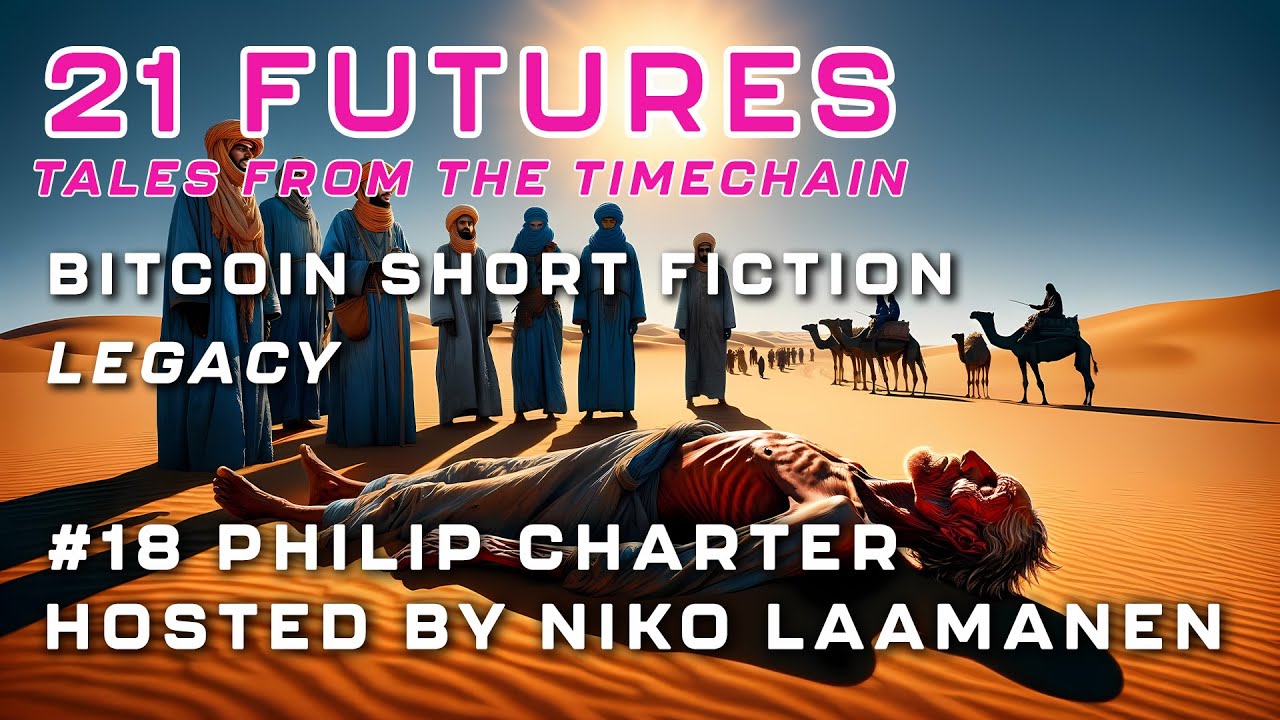
In this 21 Futures podcast episode, host Niko Laamanen interviews Philip Charter, the lead editor of the Bitcoin fiction anthology "21 Futures: Tales from the Time Chain". The conversation begins with the origin story of the anthology, tracing Philip’s earlier attempt to edit a "Book of Nowhere" and his partnership with Niko through Consensus Network’s publishing platform. They discuss the unique "starfish" publishing model—adaptive, antifragile, and community‑driven—that enables rapid, quality‑focused releases of Bitcoin‑related works. The bulk of the episode centers on Philip’s contribution to the anthology: his story "Legacy," a seed‑phrase treasure‑hunt set in Algeria that explores Bitcoin inheritance, wallet security, and cultural context in a country where Bitcoin is illegal. Philip reads the first two sections, revealing a narrative about an Algerian inventor’s daughter decoding twelve seed‑phrase words to unlock a community‑saving Bitcoin fund. The dialogue then shifts to broader reflections on Bitcoin’s future, with both guests expressing bullish optimism about Bitcoin’s role in economies facing hyperinflation and financial exclusion. The episode closes with a plug for the book and an invitation to the launch event.
Chapters
TranscriptAuto-generated · 26 min
Welcome to the world of 21 Futures: Tales from the Time Chain. This book we've been working for 1 year now is finally out. from Consensus Network, bitcoinbook.shop. It is the world's first Bitcoin fiction anthology. I'm the shadowy super publisher, Niko Laamanen, and today we speak with one of the authors and none other than the lead editor and the father of the 21 Futures project, Philip Charter. Welcome to the show, Phil.
Hello. I'm finally the father of a book that's been born. It's out in the world and live.
Yeah. Good stuff.
Got a copy right here as well that we can show everyone. So yeah.
It's real. It's not fictional.
This is a little joke between Niko and I. The difference between fiction and fictional. It's a bit, it's difficult on that. It's a bit like, um, you know, historic and historical. Right. Or economic and economical, you know, they have different, different words, different meanings, but you often want to use the -al one. But in this case, it's a fiction anthology, not a magazine.
I also happen to have the original manuscript here. First print version.
Very cool.
So yeah, why don't, uh, why don't we let Phil tell, uh, fill us in how, how the project got started from your perspective? I think everybody's heard of Uh, my, my side of the project. So it's, uh, let's hear yours.
Yeah, this is, um, you might not know this actually, cuz, um, I don't think I've told you this background of the book, but I was in talks with a publishing company that put out, um, short fiction anthologies based on cities. It's a series called Reading the City. It's very cool. So they feature cities in Lesser-known countries, let's say, like non-Western countries, you know, like Sudan, or there's the Book of Shanghai, the Book of, uh, like Cairo, the Book of, you know, countries all over the place. And they sort of feature short fiction authors from all over these places. And I was in touch with them to try and, uh, put together Book of Nowhere. I thought, this is a cool idea, like Book of Nomad, basically. Like nomadic peoples, like digital nomads, people who are stateless, or people who, you know, authors who are moving around or living in different places. And I thought that would be an interesting anthology, and it never kind of got off the ground. Like I had a meeting with the publishers and then, you know, nothing came of it. And that Fired my ambition to edit a book, cuz I was thinking, right, here I am gonna be collating these stories, editing them, like working with the authors. And yeah, I'm a short fiction author myself, so I've published some anthologies and I have, uh, some novellas, uh, published in the UK and the US as well. And yeah, my like desire to edit a book and to sort of help put something out into the world rather than just write it myself. That's what started all of this, uh, being burnt by another publisher. And then Niko and I got to know each other because I work as a writing coach for multilingual, um, professionals and writers. And Niko is a great, uh, nonfiction writer and he's writing a book. And articles, right? And you do a lot of work on social media and, um, other types of writing too. So we were working together in 2022 and yeah, after that course finished, I got in touch with Niko and said, hey, let's, let's do this. Let's put out a book which tries to bridge what I see as a massive chasm between Bitcoiners and people who don't know much about Bitcoin. And the way we can bridge that gap is with stories. So I read some books which Niko recommended, and they were, they were interesting and they were helpful, and I got a good understanding and a good start on what Bitcoin is and Why it's something that we should be learning about. And yeah, I thought what these books lack is an emotional connection. It's so technical, Bitcoin, that yeah, sometimes we, we lack that. So yeah, that's what sparked the idea is I thought I wanna do, I wanna edit a book and I was reading a lot of Bitcoin. books and, uh, yeah, thought this could be a thing. And I know the perfect person to help me put this out into the world. And, um, the longer the project has gone on, it's sort of, I think we originally put the call out in December '22. It's now December '23. But the closer we got to publication, like the bigger it felt and the bigger it's gotten. And it, it really feels like a sort of movement now with all the authors and Uh, you know, people buying the book. So yeah, that's how it came about. And, um, that's the background of the book, I guess.
Yeah. I mean, the synergies between me and Phil have been pretty amazing. I don't know if you know this, Phil, but it was around the, the time that we finished the course with you. I, I took the writing course with you and I started the, the English editing division of Consensus Network. we launched the first, I believe that that's probably the first book that I gave to you is the, the one by Knut Svahnholm, Everything Divided by 21 Million. That was the, our first original English publication that was also edited, uh, co-edited by me and, uh, Mel Schilling, who is, uh, who is our lead, lead edit, one of our lead editors.
Great editor. Hi Mel, if you're watching.
Mel was also working on 21 Futures, by the way. Huge shout out. Shout out to her. So you, Phil, you played a, a big role in, in, uh, you know, helping me create that product for Consensus Network. So now, you know, I'm confident to offer this service to authors that we, we have this team of not, not myself alone. I do some editing, but I'm not the best editor. We have this, uh, knowledge that we can, we can now use and help. Others, uh, to get the words out. And it's actually a quite good product that I'm really proud of and I'm, I'm looking forward to developing it, uh, more. So, so that's a huge thanks to you on that.
That's, that's good to hear, Niko. And yeah, I hope that it's, I mean, I know you're putting out a lot more books and constantly saying people are getting in touch, you know, wanting to self-publish or publish through Consensus. So I hope it's something that, you know, allows you to keep growing and keep putting more books and content out because that's what helps, you know, spread the message and, um, help people enjoy and learn at the same time. And yeah, I think, uh, the cool thing about my experience with Consensus and what you do is it's, I kind of hate this word, Agile, but it's something which is able to transform and change. And like, no matter what kind of author comes to you, whether it's somebody who's, you know, complete genius, but they've, they, and they've got a fantastic idea, but they're a very new author, or if they've someone with a big following, um, and you know, who's a more, uh, established writer and they maybe know about book publishing, you can cater to them. And Niko just organizes team, his team who are all on board and like passionate and willing to do things at all hours to make sure these books get out into the world. And I don't think other publishers work that way. And, you know, without that kind of approach, all of these authors and books and podcasts and things like that just wouldn't happen. So, uh, yeah, I think it's a really good approach to have to try and be a gatekeeper of like quality publications, but in a way which is realistic for The way that people put out their thoughts into the world now. Because if, if, if you don't publish these books from people, they'll just, they're just gonna put it out on social media. They're just gonna hit publish on YouTube. They're gonna hit publish somewhere else. So isn't it better if you can do it in a way which, you know, leaves good quality books and publications there for everyone to see in the world?
Yeah, I mean, we all, We've been known to be pretty fast sometimes. I, I, I don't like the word agile either. I don't, I wouldn't use that as a first word to describe our model. I, I like to call it the starfish model. So it's more like it's adaptive and antifragile. So sometimes it's really slow and clunky, but, uh, eventually the things get done provided that there's interest to get those things done. So that's basically just the framework. We, we provide the tools and the framework, and then people come in and, and do the work, and then we publish it. And usually people are very enthusiastic and, and allows, which allows us to get books out really rapidly. Like for example, The Bitcoin Standard is a very popular book. And, uh, we, we've been publishing, uh, 2 and a half of those every year. Since we started in 2019, which looking back seems pretty amazing. Um, it did, it didn't feel that fast, but it, it did happen really, really quickly. But that's not the point. The point is to get it done and get it right. Like we don't, we don't rush into it. And, and, uh, it just so happens that people who are driven by passion do the best possible work and do it fast. So yeah, maybe that's enough about the publishing. We, everybody wants to know about 21 Features and your experience specifically.
Just one last word on that. I would say my experience on working on this, but if you want something done, ask a Bitcoiner, 'cause they do it instantly. They're just like, yep. And they, there's no fuss. There's no, they just immediately do things to the best of their ability. So It's been a pretty good crowd to work with.
Oh yeah, that's, that's true. Yeah. And, and like, to add, to add to that, like, people, Bitcoiners are honest. Like, if they can do it or if they can't do it, they will just tell you, no, I can't do it. But I know a guy who, I know a person who, who might be able to help you and they will hook you up. So you will eventually get your shit done after you talk to a, to a Bitcoiner about it.
Yeah.
All right. Let's, um, Let's talk a little bit more about 21 Futures and specifically, uh, your story without spoiling too much. Uh, what was the inspiration for, for your story and what is it about?
Yeah, my story is, uh, called Legacy and it's about, you know, what happens when a, uh, an important figure, like an, an energy inventor who is from Algeria dies and what happens to His fortune. Um, it came about cuz of one of our chats with Knut actually, who, he mentioned about keeping 12 words in your head and, you know, what that, what, what a kind of treasure hunt for those 12 words would mean. So I think that's what excited me and that's what I, um, I went for was a kind of treasure hunt story. So the story follows, uh, this man's daughter. Who is trying to unravel the mystery of these 12 words so that she can capture the or unlock the Bitcoin that's going to help her community to survive in quite a harsh future in Algeria. And the reason I chose Algeria as well is wanting to. I like to do research on places that I don't know that well. I haven't been to Algeria. But it's a kind of fascinating country full of different peoples, deserts, and harsh conditions. It's also one of the few countries where Bitcoin is actually illegal, I believe. So they have quite a hardline policy against it. Yeah, so that kind of provided the backdrop for the book, like wanting to represent places and people outside of the Western world. And, uh, yeah, just wanting to do some cool research about these, uh, this desert town in the middle of the Sahara.
That's actually really cool. I, I didn't know that it's, uh, Bitcoin is illegal, uh, in, I know it's some, some jurisdictions, but not, um, Algeria specifically. If you, if you look into the, through the lens of foresight, do you see like your, your stories about this, uh, treasure hunt or scavenging hunt or whatever you want to call it? Do you see in the future that this could be like a viable profession for somebody to simply hunt for keys? Like, do, do you think we're gonna move to that kind of a future?
I, I think, you know, in my story it's a little bit different because the, uh, the guy who dies sets up the treasure hunt essentially, uh, in his will. And you'll hear that when I read the first part of the story. So he wants people who are truly deserving of his fortune and who know him and his work and his life and his mission well, uh, to be able to access those funds. Uh, so he kind of sets that up. I, I think we're still in the early stage of like, how does one even go about providing A legacy which includes Bitcoin. I know there are services for that and people are talking about it more, but I think as of today, there are probably many people who die without setting that kind of thing up. So there will certainly be more services in the future which are dedicated to helping people to overcome technical issues and lost keys and things like that.
And like we find in the story, you know, even, even if you do set it up, it's, it can still be quite of a kind of adventure and challenge, uh, for the, for the grandkids or, or the generations that come after to track down. Even if you leave a good set of instructions, things change and, uh, yeah, you know, you can't expect people to have that kind of level of knowledge. So it's a tough problem to solve.
What I find interesting about seed phrases as well is they're like just too long. I mean, humans, all the mnemonics that we remember, like ROYGBIV or Richard of York gained battles in vain. These were ones that I was taught to remember the colors of the rainbow. So you can easily remember about 5, 6, 7 words. Uh, you know, for things like memorizing the order of the planets or things like that, you know, there's like 8 words to remember, and we can do that. But 12 or 24, it's just out of our reach, or it is unless you have a pretty clever way to do it and manage it. So it's a bit of a catch-22 of like, if you try and hide keys in a way which is too clever, It won't help you at all. And if you put them in a way which is easy and obvious, then it's not secure. So I think it's one of the challenges that we are constantly trying to solve and to— and I think it'll be solved technologically, to be honest. There'll be some technology which is a fail-safe way to Encrypt your keys somehow, either on a device or on some kind of unhackable network. I hope so anyway, 'cause that will, that will prevent losses and prevent people from being scared of losing access.
Yeah. I mean, of course the software and the wallets get better all the time, but As it stands, it is pretty scary and oftentimes introducing too much complexity and try— whilst trying to guard your funds. And I've done this personally. I'm not even ashamed to admit it because I want people to understand that you can be the biggest risk to your savings as well if you, if you try to be too clever and create something unbreakable, and then in the end you will not be able to break in yourself. So that is something definitely to keep in mind.
Yeah, for sure.
So, um, maybe can we hear a little bit of your story now?
Of course. Yeah, I'm gonna read, uh, it's actually split into 12 sections. You may be able to, to guess why on this treasure hunt, but I'm gonna read the first 2, so get an idea of the story, uh, which is called Legacy. Ecology. When my father died, an entire ecosystem of beneficiaries withered. Musa Ag El-Kheir funded scholarships and community projects, paying thousands of dinars monthly to stop the oasis town of In Salah from burning up. The few families we knew operating outside the oilfield economy would be forced to flee to the Mediterranean coast. Along with just about every other Berber. It wasn't unexpected. My father had cystic fibrosis for all 61 years of his life. So far, that's the only legacy he's passed on to his children. My brothers are just carriers, but me, his precious daughter, ended up like him in more ways than one. We sat there in the lawyer's office in Algiers, my brothers and I, staring at the ledger, which contained payment for his life's work. And he only left one word in his will? asked Ibrahim for the third time. Ecology. The lawyer said Musa was very clear. He chose each of the keys himself. The contents of the ledger would belong to whoever could decode his life. Those who understood the real meaning, Then he cut all communications and walked into the Sahara. The Tuareg caravan on the road to Akalb-Akabli found his body a week later, reddened by sandburn. Part 2: Earth. We made an agreement that day, to share each word we discovered. We could break the code together, Of course, Ibrahim and Hama didn't share anything. We barely speak. That's what happens when one child follows their father into science, and her 2 brothers move to France the minute they get rich enough to buy a wife. I bet they spent longer looking into legal loopholes to get their hands on my father's assets than they did trying to identify the keys. That day was the start of my second life. And I went from research assistant at a regional university to private key detective. 2,048 words and few clues where to start. Although I was 27, I was virtually a grandmother according to Insula Wives. But of course, I could never be a grandmother, or even a mother. Every night I scoured photos in the family archive, An initial sweep of his digital footprint returned no out-of-place instances of any keywords. It took me a year to find the GPS tag he'd added to one photo: an 18-year-old daughter standing next to her father, proud of his first Infinite Solar prototype. The panel has long since been torn out by the corp. But the base is still there. I drove the 3 kilometres from the town limit and shone the high beams at the spot. When I got out, the air was cool, but still thick with sand. A few more steps through sinking dunes, and I saw it. He'd scratched a little globe into the blistered metal, and for a moment, My mucus-laden lungs tasted clean air. So there you have it. Ecology and Earth are the first words on the treasure hunt contained in the legacy.
Thank you, Felix, for the, the riveting reading. And if you want to read the rest of the story, you have to get this wonderful book. All right. You're relatively new to Bitcoin, so do you have any, any Prediction on where, where are we going? How do you see it?
I mean, I don't have a prediction. I have a pretty determined and bullish feeling. I just see no way that it's not something which is going to be—
That's a great way to put it. I look forward to hearing what you have to say.
It's gonna kind of take over the world and it's, you know, reading all of these stories has just made me more Engaged with it and think this is where we're going. Let's get on board. I'm not somebody who really cares too much about prices going up and down. I just want to see how it can change lives in especially first, you know, I've been paying a lot of attention to the news in countries, you know, with hyperinflation and. where people have been just kicked out of the financial system, places like South Africa where most people don't have bank accounts and Bitcoin is taking off like crazy. So yeah, I think let's see what next year brings, but feeling like it's become a reality, like it's hitting critical mass. I mean, you've been in this much longer than I have, so.
Yeah, I mean, it's, it's still early days, but I think that's the perfect way to put it. And, and to sum up the sentiment of most, most Bitcoiners, long time or, or short time, is that there, there's no way this is not going to work. Or if it, if at least if this is not going to work, then we are completely and royally screwed. So this must work because there's such a big need for it. And, uh, I, I guess that's the source of the bullishness. And I'm the same, like I'm, You know, the price can do whatever it, it does, short-term volatility. But, uh, yeah, come for the riches and stay for the revolution. I guess that's the way, way to put it. All right, maybe we should wrap it up here. This has been the 21 Futures podcast. It is the final episode. We have done all the, all the stories that wanted to be, uh, the authors that wanted to be included. Um, remember to watch the launch event recording from our playlist. We have a playlist for the 21 Futures. Uh, podcast, most of it done and hosted by, by Phil here. A great job there. Remember to subscribe and like, and, um, we'll see you soon.
All right. Yeah. See you at the launch event.
And buy the book, of course, from bitcoinbook.shop.
All right. See you then.
Bye-bye.
More from Niko
Achieving #Freedom: Overcoming Jealousy & Finding #Success. #inflationstrategies #investing


#FreeMarket: The Alternative to the Old Nation State. #inflationstrategies #economicrecovery

Nation State: The End - Examining #Future #Security #inflationstrategies #economicrecovery


#Bitcoin Escape Velocity: Why I Stopped Talking About It. #crypto #inflationstrategies
American Dream: Freedom, #Government Size, and Opportunity. #freedom #sovereignty


