21 Futures, #2 — Bitter Fly — Fanis Michalakis
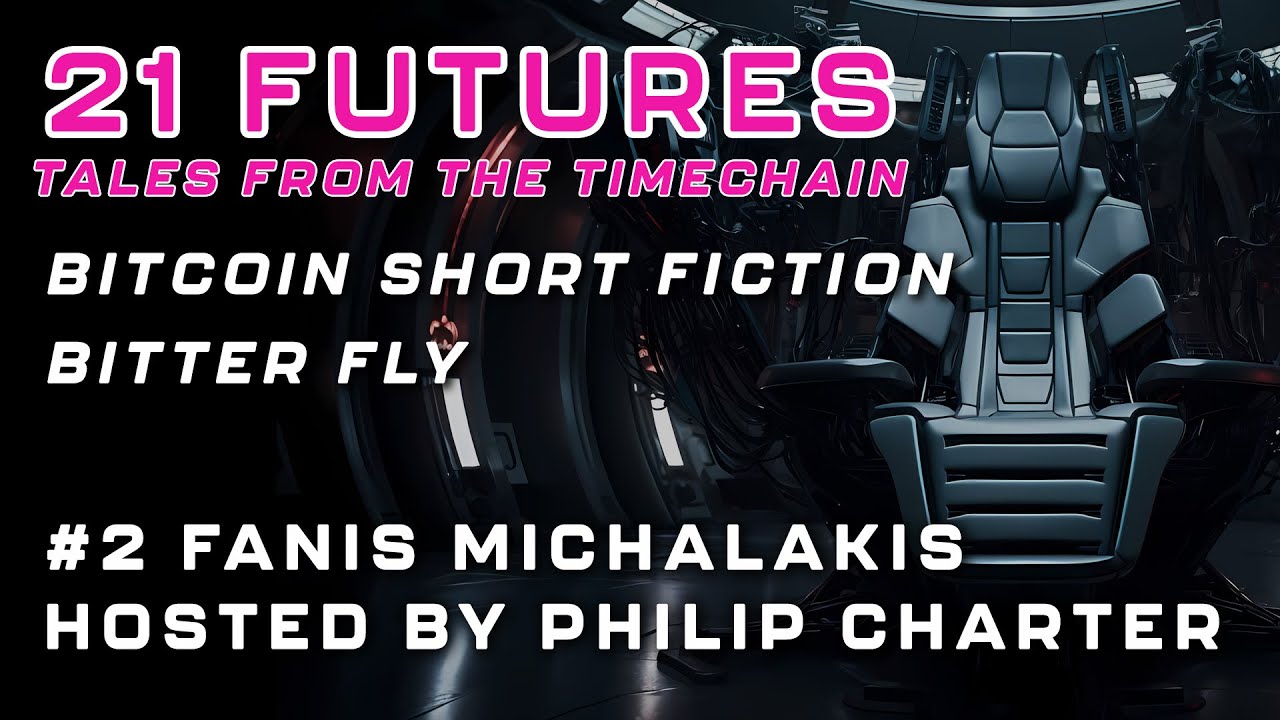
In this YouTube interview, host Philip Charter talks with author Fanis (Fannis) Michalakis about his contribution to the upcoming anthology 21 Futures: Tales from the Time Chain, the world’s first Bitcoin‑fiction collection. Michalakis explains how he discovered the project on Twitter, shifted from a planned personal short‑story collection titled Bitcoin Futures to contributing a single story, and describes his background as a French‑speaking engineer who now works at LN Markets, writing a weekly Lightning‑Network newsletter in English. The conversation delves into his decision to write fiction in English, his dual‑language writing process, and his broader goal of making Bitcoin concepts accessible through narrative. Michalakis outlines the premise of his story “Bitterfly”: a future where all contracts are settled on a universal Bitcoin ledger, spawning a new profession of “blockchain detectives” who excavate historic transactions to resolve legal disputes. He discusses the story’s detective genre roots, citing classic Agatha Christie works and modern films like Knives Out and Glass Onion, and explains how he blended the intellectual, clue‑driven style of Hercule Poirot with contemporary action. A key speculative element is the Man‑Ledger Interface (MLI), a sensory‑rich human‑machine interface that lets investigators “enter” the blockchain as a holographic environment. The interview includes a reading of an excerpt that showcases the MLI, the physical setting of the detective’s investigation, and the French flavor of the protagonist. Throughout, Charter emphasizes the anthology’s mission to spark a movement that makes Bitcoin and the future of money more understandable through storytelling.
Chapters
TranscriptAuto-generated · 26 min
Welcome to the world of 21 Futures: Tales from the Time Chain. This book forthcoming in December 2023 with Consensus Network. It's the world's very first Bitcoin fiction anthology. I'm the editor, Philip Charter, and today we speak with one of the authors featured in the anthology. Phanis, welcome to the show. Hi, Philip. Thank you. I'm really excited about this episode because we'll get to share a bit from Phanis's very exciting crime story. Uh, and we'll chat lots about that. Uh, yeah. So tell us, how did you get involved with the 21 Futures project, Phanis?
Yeah, so basically I, I saw it on, uh, on social media. I guess it was on Twitter. Uh, um, and yeah, actually before I saw that, I was in the idea of writing some kind of Yeah. Uh, um, short stories book myself. So science fiction. Uh, so because the main, one of the reasons for that, so I, I've always enjoyed writing science fiction, but, uh, yeah. And so I wanted to see if I could write some science fiction short stories with, yeah, Bitcoin in it. And so I was trying to, to see. And so I had a, a working title for the, for the book, which was Bitcoin Futures, because, because, um, uh, a future is also a financial instrument. So it was a play on words around, around the terms. And, but, but then approximately at the same time, uh, I found out that ConsenSys Network was doing, uh, was doing something quite similar. So I decided to take part in the anthology instead. So it's less, less work for me. Just one, uh, story to write. And yeah, I decided to, to give it a shot. And, uh, amazing.
Same idea at the same time.
Yeah.
You know, I've said this on lots of other shows as well, but I think the world is crying out for more stories about the impact of, you know, technology and, and, and stuff like this. And it's something we don't really have yet, so. Yeah, I'm glad you thought of the same thing at the same time. And of course you can, you know, continue to publish more stories and we really hope this will be the start of something of a movement which makes Bitcoin and, yeah, the future of money a bit more accessible and understandable to people. And was your But, um, is your first language French, Fanny? Yeah. Is your book gonna be, gonna be written in French?
Oh, I don't know. I, I've, so basically it was just an idea, but I, I didn't even have any story idea or stuff like that. So I'm not sure when, uh, if it's, if there will be a book, uh, but yeah, so, um, typically I tend to write in French. Uh, when I write fiction stuff. Uh, so it was a nice exercise as well to write a story in English. Uh, but yeah, I don't know because, uh, I, I, I write some nonfiction stuff every week in English, uh, for a newsletter. Right. So I'm getting accustomed to writing in English as well. And it's always interesting. So I'm not even sure if I, I was to write another story later, if it would be French first or English first. I don't know.
Aren't languages amazing? I mean, it's ultra impressive that you've, you know, developed the ability to write fiction in English. 'Cause, you know, as a fiction writer myself, I know how difficult that is and how high level your sort of style and vocabulary needs to be to do that. So, you know, congrats on submitting such a great story for the anthology. Um, what, what is it you, you write in English apart from, uh, this story? You said you wrote for newsletters and such. Is that, is that work? Is it, um, Bitcoin stuff? Something different?
Yeah, Bitcoin stuff. I'm working at a Bitcoin and Lightning company called LN Markets. And so for this company, I'm writing a weekly newsletter, uh, which tries to give an overview of, uh, the new evolutions in the realm of Lightning Network ecosystem every week. Um, and, uh, I, I write from time to time, I try to write some, yeah, pieces around Bitcoin as well. So for example, vulgarization or more opinion pieces, uh, which depending on the subject can either be first in English or first in French, and then I try to translate them in English because it helps reach, yeah, more people that way. But yeah.
Yeah. And you know, hopefully in, in your newsletters you can slip in a little bit about 21 Features as well when it's the time. Uh, yeah, I think, you know, I, I work in, um, sort of as a, as an editor/writing coach and I work with a lot of, um, non-native speakers myself. So it's great to see. I mean, what's really interesting to me, I should say, is, is how, and has been with this book, because we've got so many authors whose first language is not English and they've written in English, it's really interesting to see like where's the line between, you know, what is effective and easily understandable, but also still shows who you are and where you come from, right? Because you don't want to change your personality to write in English. You know, it's important to show, yeah, where you come from too. So I'm really happy that we've got, I think we've got authors from Spanish-speaking authors, Portuguese-speaking authors, maybe more, maybe German or Italian as well. Nice. Great. Um, tell us a little bit about your path into Bitcoin. You said you work in the space. Uh, how did you, how did it all begin?
Basically, I was, uh, finishing, uh, my engineering school in France and I was already kind of involved, uh, uh, in the ecosystem. For example, I was part of the student association. And yeah, I believed at the time that I wanted to work there, but I wasn't entirely sure I was ready to go from having this as a hobby or an interest outside of work and then really devoting most of my time to it. Yeah. awake time to, to this. So I just, uh, I had to do an internship at the end of my, uh, uh, the school. And so I did it in a consulting firm and it was, I didn't really like it because I was already kind of, uh, fully orange-pilled and thinking about Bitcoin all day. And so it was really decisive for me. So I just, uh, said, no, I don't want to work in the fiat world anymore. And And at the same time, coincidentally, so this, there was this company called LN Markets, which is based in France, in Paris. So it's—
Right.
Everybody speaks French, so it's easier. And they were, I saw on Twitter that they were looking for developers. And so I was, yeah, I had done some studying on computer science, stuff like that, but I was more generalist engineer, but I could, I applied for the job and it was really a nice, uh, nice, nice experience. And so, um, I'm there since, uh, uh, 2021. So it would be 2 years, uh, in a, in a few days actually. So yeah, anniversary is soon. And, uh, yeah, so straight from, uh, from school, I, my first job was, uh, was in this company.
Yeah. Well, congrats on, uh, Finding a meaningful job in the 21st century, something that you're really keen on. And, um, yeah, I'm sure it's a good time to be in the space as well. Uh, let's talk more about your story, Bitterfly, which is, yeah, definitely one of the stories that I really enjoyed and to me stood out because it seems Quite recognizable, was instantly recognizable to me as like a, as a crime story, which I think is great 'cause it's a different genre. You know, we have lots of sci-fi and some other genres of stories too. So it could be described maybe as a classic detective story. That's how it struck me. What drew you to link Bitcoin and crime fiction?
Actually, I'm not sure how to phrase it so as to not reveal too much, but in my story, there are some, yeah. So the world is based on some kind of Bitcoin standard where everything is recorded on the ledger, on the time chain. And And it has really big influences on everything. So every contract is settled on the blockchain or on the layer, stuff like that. And so there are people whose job is to try to find out what the contract says on-chain, for example, and because it has legal implications and stuff like that. And so they're going to excavate old truths from old transactions that can have been settled decades ago. Sorry, someone ringing at the door. But yeah, and so my idea was this first, and then came the crime story as a way to, um, to, yeah, to bring this aspect that I found interesting to life. So it was more, yeah, this way around. I had the idea that to ask the question, what would the world resemble if somehow Bitcoin became the layer on which everything is settled? So for example, big companies, you can see everything that happens, what do these companies, you can see it on chain, stuff like that, and what it would look like in the angle of A crime happening in this future seemed interesting. And I guess at the time of writing, what really influenced maybe this direction is, um, is a movie I saw. So I, I've always liked, um, old school detective, uh, stories. For, for example, Agatha Christie's work. So Hercule Poirot and stuff like that. I really enjoy that.
Mm-hmm.
Both books and, and movies. Because I find it really interesting that as a reader or as a person watching a show, you can, you have everything you need almost to try to figure out, to figure out, figure it out yourself. Whereas on more maybe modern detective stories, there is a huge reliance on technology, for example. And so, uh, it's, it's less, um, you can't really, uh, uh, find the riddle yourself because you don't have access to the clues actually. Whereas on old school detective stories, things are hidden on the, on the screen or in some sentences that seem innocuous but actually are very important. And if as a reader you pay enough attention, you're just like the detective who through observation and paying attention to details can, uh, crack the riddle. And, um,
and yeah, and so just to jump in on that, just 'cause, uh, yeah, I, I wanted to comment about the, the idea of like another layer to this, right? Because with technology, like you say, it's very difficult for the reader or what, or viewer to be submersed in technology. There's a reason that in films we don't really care what's happening on someone's mobile phone. It's like what's happening on screen in their life. Yeah. So it, it's tricky to transpose, yeah, the technological world that we live in to, to fiction, I think. Um, but yeah, I think that's something your story does a, does a good job of, definitely. Sorry, carry on.
No, definitely interesting, uh, interesting point. And, um, so yes, the, the movie I saw about the time I was trying to think about the story I wanted to write was a movie called Glass Onion. I didn't know if you saw that. So there are 2 movies now actually. Yeah. It's with, uh, with Daniel Craig as, as a detective.
Yeah. And Knives Out.
Yeah. Knives Out. Exactly.
Series, I suppose. Yes.
Yeah. And it's really, I, I really enjoyed the movie a lot and I, I enjoyed this kind of detective as well. So, uh, it's, it's like a, I, I think So it's, I think it's Mr. LeBlanc, the name of the character in, in Glass Onion. And it's like a modernized version of Hercule Poirot to me. Yeah. Like, uh, it's, um, uh, typically he has a French name, is, uh, originating from France or Belgium or something like that. But he has, uh, what I view as being a typical British mannerism. So very phlegmatic, but at the same time. Uh, is more, a more modern sensation of that because he, there is action in this movie as well. Whereas on Agatha Christie's work, you'll never see Hercule Poirot shooting with a gun or running, uh, to catch a suspect or something like that. It just doesn't do that. It's fully intellectual. Whereas on, uh, more modern sensations of this kind of, uh, old school detective movies, uh, there is the action part, which is Also nice and interesting. And so I think my, my character, uh, which has a French name as well, is kind of derived or influenced by, uh, by this, uh, this kind of detective characters.
Yeah, I, I really wanted to ask you about that because you, you mentioned Poirot and, um, there's a new Poirot movie out at the moment that I watched, Kenneth Branagh, uh, that's called A Haunting in Venice, I think.
Oh,
uh, his, interpretation of, of Poirot, uh, which is pretty good. And yeah, of course I saw, um, parallels between Detective Quassel and, and, uh, and Poirot maybe. What defines Quassel? What makes him, um, who he is and what makes him a great detective?
I think it's that he's Really paying attention to details. He's both listening very, uh, accurately. He's always trying to observe his surroundings and he's just very open to, uh, his environment. And it's what actually helps him try to, uh, understand what's, what's going on in this crime story and, and finally pierce through the, through the Yeah. To, to find out the truth. Uh, um, so yeah, I guess it's really, uh, just being, uh, quite, um, porous to everything that surrounds him and, and using it maybe some subconsciously, but to, to try to, to crack the code.
Yeah, I think it goes back to that physical space, doesn't it? We, to connect with these great detectives or great characters, we need them to interact in a physical world. I'm sure there are some wonderful financial detectives who spend all day, you know, looking through computerized records and, and have these, these great systems and ability to, to unravel crimes. But it would be hard to watch a movie where, you know, a guy is just tapping away at a database for, exactly, for, for 2 hours. So,
and, and actually one of the, of the characters Which this kind of modern-day archaeologist, which I referenced earlier, whose job is to try to dive into the Bitcoin blockchain and try to find hints to settle legal disputes, for example. Mm-hmm. Even this kind of job has a very physical aspect in my movie. They're really, they're not staring at the computer. They're really immersed into the past because what I was thinking is this kind of, so, you know, trying to, I was trying to imagine what it would look like to try to navigate inside of such a flux of data where you have decades of transactions and you're trying to find one thing that could, uh, help you understand what was going on 10 years ago. And, um, and so yeah, there was also a reflection on, uh, what this, whether it would need new, uh, human-machine interfaces. And so I tried to, yeah, to propose one kind of human-machine interface, which is, um, which also has a very physical component to it. So you already, uh, So not just not staring at a screen and it's more, more immersive. And so that's just going to your point of, uh, I think there is a huge aspect around sensoriality. I don't know if it's the right word, but using your senses at the same time that you use your, just your brain to try to understand things. And so maybe, um, Uh, uh, efficient, uh, human-machine interfaces who will try to use, uh, our senses as well as our intellect, try to bring us, uh, the data that we need.
Yeah. Very interesting. I don't know if you've heard of David Eagleman, who's like a Stanford professor, I think.
No.
Um, but he does a lot of work in that, uh, area as well of I think he has a company which is linked to helping people sense things in different ways. So he's got various TED Talks on like, uh, uh, equipment that can help deaf people to sense, uh, audio in different, in different ways and things like that. It's very cool. It's very, uh, interesting in that kind of field. And yeah, I mean, I, I think that probably answers my next question, but was that the— initial seed of, of the story? Was that the first idea? Was it this human-machine interface?
Yeah, it was. I think it was more, uh, so first is the idea of, uh, what if tomorrow everything is, uh, settled on the blockchain and you, and you base entire societies, uh, on that? And then came the idea that maybe you'll need to have some people Trying to, yeah, fumble through the data to try to find out what happened 30 years ago. And, uh, and yeah, then came obviously the human-machine interface that you'd need to try to navigate such an amount of data looking for one tiny piece of information.
You, you could have created a new profession, maybe something that you can go into. Just buy yourself a trench coat and you can become a blockchain detective and, you know, you are The world's first. Brilliant. All right, well, let's hear a little excerpt from Bitterfly, Fannys's story. When you're ready, Fannys, take it away.
So, so, so. Okay. Yeah. Um, so maybe I should, I give some context or— Yeah.
Yeah, that's fine if, if you want to before you start.
So basically, uh, so Mr. Trussell, who is a detective, is at, uh, the house of the daughter of a man who is one of these People who explore blockchain to try to find pieces of information for, to settle, for example, legal disputes. And, uh, so the man, the man was murdered. And so he's at the house of this man with his daughter. Uh, um, so the daughter is named Claire Ebner. And so discussing, and so she hired Croisselle to, to, uh, try to solve the case because the police couldn't. Um, so yeah, I'll start now. Krasal nodded. I understand your father's body was found in his office. His exploration room, is this what it's called? Would you mind if I took a glance at the place? Claire Ebner smiled, the same faint smile that she greeted him with, and acquiesced. Leaving the living room, they They walked down a long hallway until they were met by a tall metallic door. Looking at it, Crosshall expected the door to be heavy, but the young lady pulled it open with only one hand and no apparent effort. Probably a special lock, not so thick, not so heavy, but highly insulated. The room itself appeared smaller than he expected. What looked like a huge orthodontic chair The chair occupied the middle of the room, surrounded by curved panels hanging from the ceiling. 3 of the 4 walls hid behind racks of servers whose hum, however muffled, filled the room with a faint background noise. They found him in his chair, the doctor said. The interface was turned off, but he used to take naps there sometimes. I think he liked the sound of the computers. Krasal hardly heard her. Restless, he stared at the chair and its apparatus. Had he just witnessed an apparition, he wouldn't have looked different. Is this— is this the device he used to read it? he murmured. Miss Ebner laughed slightly, half amused, half bitter. Yes, they call it an MLI, Man-Ledger Interface. But Bab called it the chair. The panels are all around your head and you're sitting inside, and together they cast some kind of hologram. You're literally inside the ledger, and there are those little commands on the armrest. She pointed with her finger. The operator uses them to move the stream around themselves. I've never quite understood how it works, but I've seen my dad use it since I was a little girl. When I was a kid, I used to look at him as he disappeared inside the bluish mist, both mesmerized and startled, unable to move until he emerged hours later with the precious answers that some important people sent him looking for. Yeah, maybe that's it.
Great. Thanks for that. I think that gives us a good—
I
hope the, um,
I hope the French accent doesn't Uh, make it too difficult to follow.
Perfectly understandable. Don't worry, sir. Thank you. And I think it adds that French flavor to Detective Cressart's adventures.
Awesome.
Yeah, really, really good, um, idea of what this place looks like and how it feels. I think I feel like I'm right there in that room. Brilliant. Well, thank you so much for sharing your story and your process of writing with us. Um, I'm very excited for other people to read this story along with the others. It's Bitterfly if you're looking for that one in the book. So I think that's it for today. Let's finish there. Um, thanks again for coming on the show, Frannis.
Thank you very much for having me.
Yeah, you're welcome. And good luck with your future writing. Hope we get to see more from Detective Kraso.
Thank you.
All right, bye then.
Bye-bye.
More from Niko
Achieving #Freedom: Overcoming Jealousy & Finding #Success. #inflationstrategies #investing


#FreeMarket: The Alternative to the Old Nation State. #inflationstrategies #economicrecovery

Nation State: The End - Examining #Future #Security #inflationstrategies #economicrecovery


#Bitcoin Escape Velocity: Why I Stopped Talking About It. #crypto #inflationstrategies

American Dream: Freedom, #Government Size, and Opportunity. #freedom #sovereignty


