21 Futures #3 — The Construct — Knut Svanholm
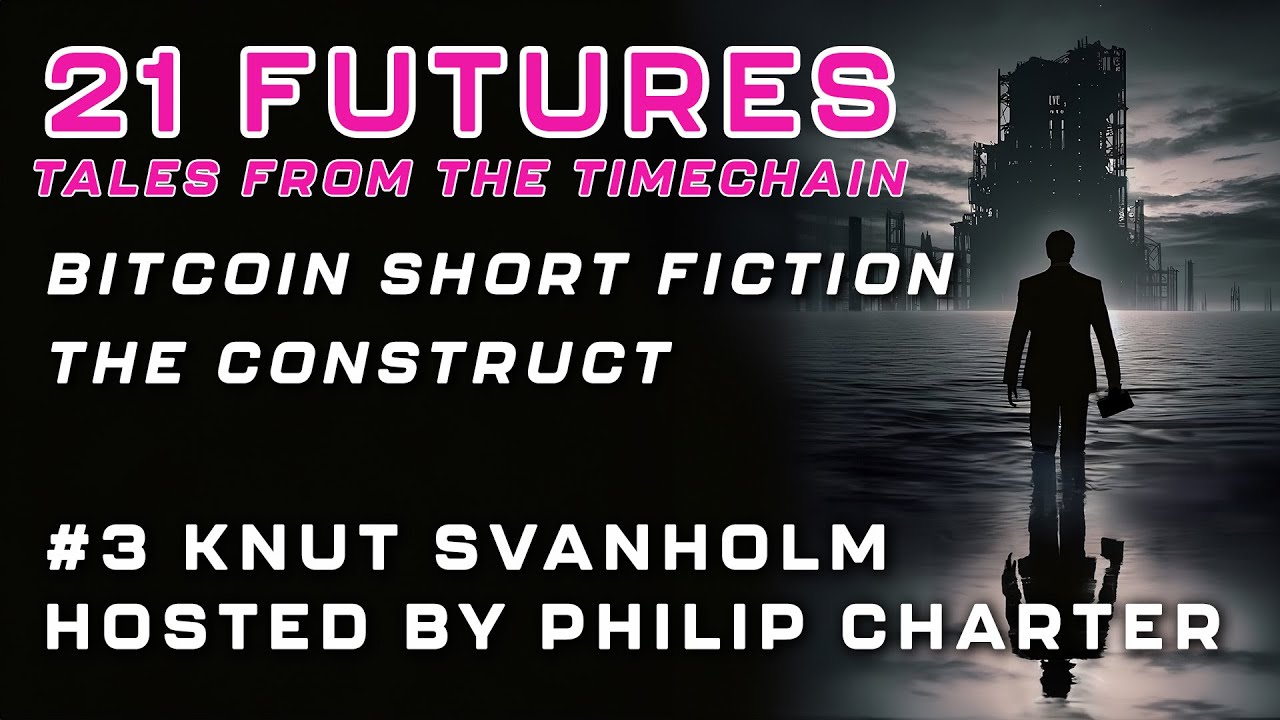
In this interview for the 21 Futures Bitcoin fiction anthology, host Philip Charter talks with author Knut Svanholm about his transition from non‑fiction Bitcoin writing to short‑form speculative fiction. Svanholm explains how his earlier ConsenSys books (Everything Divided by 21 Million and Praxeology) led to his involvement in the anthology, despite not seeing himself as a traditional fiction writer. They discuss his writing process, emphasizing the power of a single evocative image—a suited man walking into a lake—as the seed for his story "The Construct," and Svanholm reads a vivid excerpt. The conversation moves to Svanholm’s literary tastes (1984, Terry Pratchett, Hitchhiker’s Guide, Breaking Bad, etc.), his love of rich, metaphor‑laden language rooted in his background as a musician and lyricist, and his view that English offers a broader vocabulary than Swedish. They explore storytelling concepts such as the hero’s journey, foreshadowing, and the challenges of conveying larger ideas within a short story. The interview also touches on the broader purpose of the 21 Futures anthology—to bring Bitcoin narratives to a wider audience—and Svanholm’s perspective on the future of Bitcoin‑centric fiction, predicting that as Bitcoin becomes as ubiquitous as email, stories about it will become period pieces akin to historical fiction. Finally, Svanholm promotes his Freedom Footprint podcast and directs listeners to his Bitcoin books.
Chapters
TranscriptAuto-generated · 30 min
Welcome to the world of 21 Futures: Tales from the Timechain. This book, forthcoming in December 2023 with ConsenSys Network, is the world's very first Bitcoin fiction anthology. I'm the editor, Philip Charter, and today we speak with one of the authors featured in the anthology, Knut Svanholm. The great Knut, welcome.
Thank you, Phil.
Yeah, it's great to have you here. Can't wait to chat to you about all things writing, be that fiction, nonfiction, and this project. 21 Futures. So tell everyone, uh, what got you interested enough to submit to this, because you've told me that you are not, that you don't consider yourself a fiction writer really. So how did you get involved? No.
Well, I've published a couple of books with Consensus already, uh, specifically, uh, Everything Divided by 21 Million and the new Praxeology book. Uh, that are the, I believe Everything Divided was the first original work, um, published by ConsenSys in the original language. It used to be only translations. If I'm correct.
I believe it was also the first proper Bitcoin book I read, so. Oh, really? You to, to thank for getting me into all of this.
Yes. What did you think of it?
Yeah, really interesting. concept and I liked how it, it wasn't a manifesto. It was more thoughts with some arguments and, um, yeah, it made me think a lot and push back on some of the ideas maybe. Um, and then get into reading lots of other stuff. So yeah, it was, um,
good
to definitely recommend it for anyone out there. So.
Yeah, I think, um, That book is, uh, some of the chapters are better than the others. And, uh, some of the chapters I'm really proud of and some of the later chapters maybe less so, but, uh, I think, still think it, it's an okay book overall. Um, the, the Praxeology book became much more concise, uh, chapter to chapter, but it's a fun project writing. Um, and especially now that I ha— each time I write something new, I have a team. Like when I first started writing, there was nothing like that. I mean, uh, it's been great to work with the editors and proofreaders. Uh, yeah. And, uh, I need a lot of help from both you and Niko for this story for sure. Uh, because I've never written fiction before and I, the idea I had was only really an image or a scene. Uh, yeah, we'll, we'll get to that later and, uh, try to build a story around that.
Well, you know, story ideas can come from so many places and I think for short fiction, an image works pretty well because I always think of short fiction as, you know, let's say the story, the big picture is, is like what we can see in front of us. And it, short fiction is like taking a snapshot, like a viewfinder. And
yeah,
we want to show what is outside of that, but we don't want to explicitly say it. So using an image is, is a great start for, um, for anyone out there looking to, to write short fiction. Yep. Not much has to happen in a short story. It's not really plot-based, but, um, something has to happen outside of the bounds of the short story, which is, you know, bit harder to, to write sometimes.
Yeah. When you're writing nonfiction, you don't have to worry about story at all, really. Uh, still, I'm very interested in story structure and like the hero's journey and all of that and foreshadowing and character development and such. I, I, I'm a movie nerd, so I, I watch a lot of analytical, uh, videos about, about storytelling in general. I, I love doing that and, and I think it helps my writing somehow, but not sure how, but, but, you know, being aware of what a story is doing and what the building blocks are, I think that's—
I totally, yeah, I totally agree. That's how this project came about, is thinking that the world of Bitcoin has so many great creative people within it, but we are not really effectively telling stories because people at this point, people are still worried about explaining Hash rates and
yeah.
Yeah. You know, stuff like that. So what is gonna get your, your grandma interested in, in this kind of stuff is, uh, is stories. I think so.
And I think whenever a person finds Bitcoin and then, uh, like Bitcoin is the call to adventure in, in, uh, Joseph Conrad's hero's journey, right? So was it Joseph Conrad? Uh,
yeah. Yeah. So, uh, Joseph Campbell, sorry.
Campbell. Yeah. Campbell. Yeah. So, um, you get this call to adventure, um, this thing that you don't fully understand, but you get some—
Therefore reject it at first.
Yeah. And you reject it at first and, and blah, blah, blah. And all of a sudden some, some societal shit happens to you, inflation or, uh, lockdowns or whatever it is. And, uh, you decide to give it another to give this thing a second chance. And then you throw yourself off of the cliff and see, to see if you can fly on your own. And that's, I know many Bitcoiners who have a similar story to that.
Yeah, I think with all great change, it has to be prompted when people have to make that change. You know, people don't willingly Make a change when everything's okay. They're like, they make a change when the shit hits the fan.
Yeah. Not necessarily when the shit actually hits the fan, uh, but when you see the writings on the wall, when, when you, when you know it's coming sooner or later, some people choose to act beforehand. Like, and,
uh, when the fan gets, gets plugged in and somebody, somebody brings the fan into the room and shows it to you.
Yep.
Tell me about what kinds of fiction you enjoy reading. Do you read a lot of stories? You mostly reading nonfiction?
Um, mostly reading nonfiction. I, I tried to read a book that Alex Svetsky recommended to me here, but, but like, I get bored with fiction, uh, easily, unfortunately. Um, Yeah, my favorite fictional book is probably still 1984. I, I think it's absolutely brilliant. And if you combine that with The Emperor's New Clothes by H.C. Andersen, you, uh, you get a pretty good picture of what's going on in the world.
Yeah, I think a lot of the stories in the anthology are, um, these, you know, they have these underlying morals and Uh, sort of sci-fi principles in them. And a lot of our authors are, are keen on that kind of work. But I mean, short fiction is cool because you really can't get bored in a 5-page story. It's, it's over before it's begun. So,
yeah,
I hope that these stories inspire.
Yeah, I have, uh, I like, I like fiction that has, uh, you know, lessons in it, life lessons in it. Um, like I was a big Terry Pratchett fan. I plowed through all of his work. Uh-huh. But that was like 20 years ago now. Um, of course, The Hitchhiker's Guide to the Galaxy as well. And, um, uh, yeah. Uh, Atlas Shrugged is great. Uh, I mean, uh, the, but I consume more like, uh, uh, TV shows or movies like that. I, I find that format easier to like, because I need to do it in one go. I'm, I, I'm lousy at like getting back into a story. If I, if, if the, the break between reading sessions is too long, then I lose interest. So, uh, so I need to have it like streamed into my brain.
One thing that interests me is, is how much we think about stories outside of the time we are watching, listening, or reading to them.
Yep.
So, you know, with something like a Netflix comedy or whatever, it's fine when you're watching it and it's funny, but you don't give it a second thought after you've seen it. And I think we don't watch TV in the way that we used to where you discuss it and like analyze it and stuff. So, Um, yeah, for me, like novels, you, you sort of dip into, yeah, you, you, you have to get back into the world. Yeah. And short fiction is something which has much greater effect when you're not reading it rather than when you are. That's what I find.
Yeah. Um, it depends on the quality of the story a lot, I think.
Of course.
Like, like I, to me, perfect, the closest thing to perfect storytelling I know is probably Breaking Bad and Better Call Saul. I, I'm absolutely fascinated by how, how they, um, how, how the, the, how it's so coherent and how, uh, they're, they leave no ties, no knots untied in the end. And, uh, no, I, I, I think that's an example of damn near perfect storytelling.
Yeah. Great direction as well. And the. Um, what was I gonna say? Yeah, it's one of the few American series I think that didn't spiral into season 29 or whatever. It's like if you have a finite idea about a story, then it's, it's easier to wrap it up. Unlike,
yeah,
our good friend Game of Thrones.
Yeah. Yeah. I got, uh, like I, I tried to watch that a couple of times and then after I, uh, managed through the 3rd episode, I got completely hooked. And I read like 2 of the books, I think. Um, and I absolutely loved it up until season 4. I think that's, uh, uh, I think they pulled that off very good. Yeah. And then they slowly but surely committed the, uh, uh, what do you call, serieside or something? Uh,
serieside. Yeah.
The, um, the last. Uh, the last season was absolutely awful in every conceivable way.
Yeah, true that. Let's get back onto your story, uh, in 21 Futures, The Construct. So in the story, we encounter this weary traveler type arriving after a long journey. Uh, can you tell us a bit about that? Who is he? Where's he going?
Yeah, that was one of the criticisms both you and Niko had that I, I didn't really have a specific character in mind. There is, it was, he was supposed to be, um, somewhat mysterious character. The, the thing we know is that he's remembering 12 words and this is his last contract, uh, on this job he's doing. And, uh, after that he'll be set free. Um, this is the last thing he needs to do before, before emancipating himself, and we don't really know how or how that's going to play out or, or where he's going. Uh, but we know that this, these 12 words that he remembers are important to him.
All right.
And, uh, yeah, the, the, the setting is somewhat inspired by a job I had, um, on a wind farm, um, a, a small village in, in northern Germany. Um, That's, that's like the setting I imagined in my head when, when writing the story.
It reminds me a little bit actually, just, just thinking of this, there's a, a British sci-fi writer called China Miéville. That's written M-I-E-V-I-L-L-E, China Miéville. And he wrote a story called Cove, Cove Tide or Cove Tide, which is, yeah, about like oil rigs that come to life and it's a sort of futuristic sci-fi. It's a father and a daughter sort of trying to, um, like get a glimpse of them cuz it's all been shut down by the military and stuff. It's very like dark and atmospheric and yeah, I think it, there's definitely parallels with, with The Construct. Um, but I highly recommend China Miéville as an author if you like Sci-fi, short fiction, sort of strange stuff. Cool. Yeah, I wanted to chat about the, your writing voice. I told you that, you know, your book 21 Billion of Everything was the first Bitcoin book I read, and I instantly sort of recognized your strong writing voice. You're quite verbose. You like to use, you know, rich vocabulary, lots of adjectives. And I think that's the same in this story. I think people could instantly recognize it as your writing style or your voice. So where does this love of rich language come from? How did you develop that writing style?
Yeah, I love metaphors as well. And I'd like to, I like to put eyebrows on the text, like the It needs to be somewhat humorous from time to time. Um, and where it comes from, uh, well, that's a very good question. I mean, I've always enjoyed writing, but I haven't like proper— I properly done it until I started writing the Bitcoin articles back in 2016. Um, but I've, uh, been a musician all my life and composed a lot of songs and writing song lyrics. And I think a lot of it comes from there. I'm, I'm fascinated by good song lyrics, uh, and, uh, how they can be interpreted in different ways, how metaphors can be used, and, and also like purely stream of consciousness things that make absolutely no sense but sound good. I think there's so much in, in a language, uh, to unpack. I mean, there's, uh, there's so many different ways to express yourself and, uh, The English language is so rich, way richer than— I think there are about 3 times as many English words as there are Swedish words. So that's why I find it much, a, a much richer language to express myself in than Swedish. So that's why I don't write in Swedish mainly.
Um, I think, I think a lot of people say that a lot of, um, you know, Baltic and Northern European And Scandinavian, um, writers I know say that their languages have just so many, so fewer words or—
Yeah.
They're not as colorful. Yeah.
They're not as colorful. I mean, um, and I, I really like improving my English in general and, and like improving my vocabulary and, uh, The, the writing helps me, um, put my thoughts together in a coherent order. So, so, um, in arguing with people or interviewing people or being interviewed, I'm able to express myself more easily because of the writing and vice versa. I mean, uh, conversations like this improve my writing. Uh, so, so it's a, like the 2 aspects of what I do now are, are, um, Which is talking and writing, uh, they, they fuel one another. And, and it's a very— I've always liked the process of just improving a skill, um, and seeing how far you can take things. Like, if, if there's something you enjoy doing, just do it and see how far you can take it, and you'll be surprised.
That's it. I mean, it never ends. Even for native speakers, you'll find that, you know, really experienced writers with many years under their belt are still improving their vocabulary.
Yeah. I mean, there's no, no such thing as a perfect text. And, uh, when you start writing, you, you, you, uh, one of the main mistakes is that you make it too convoluted and too, like you try to use fancy words and stuff. And, uh, then you realize that there are easier ways of saying this that are still To the point and beautiful in another way. Uh, I think maybe this short story, it, it's deliberately full of strange words. Um, but, uh, they're there to, uh, to create a certain atmosphere. I wanted it to be sort of Lovecraftian, um, the feel of it. So,
well, there's another, there's another influence, I guess you could have.
Yeah.
Yeah. Mentioned earlier. Um, yeah. Yeah. Good point. And, um, yeah, really interesting to find out a bit more about your, your writing background and your love of language. So one, we, you talked about this image that you had. Um, I'm guessing it's the image, uh, of the mysterious figure who submerges themselves In a lake.
Yeah.
How did that image come about and how did it inspire this story?
I don't know. There, there was an, uh, oh, what was that called? Um, yeah, there was an old computer game called Half-Life. You remember that?
Yeah.
It had a great story. And there was a character in that game called the G-Man, which was just a suited man with a portfolio who showed up here and there and was mysterious, and then he disappeared. And then I had it, this image in my head of a man in a suit and tie and a, a, and a leather portfolio just walking slowly into a calm lake and disappearing, submerging himself under the water and just disappearing. And how, what a frightening image that is. So I guess this is sort of a horror story.
To me, it really seemed like That what that image means is so connected to the rest of the story that we have to fill in. As you said, it's quite sparse in details. We don't know that much about the character, but I think that image is something that helps, that helped me, um, yeah, to think a lot about what the, what this story means and And, and what the character is really up to. And like I said, sort of outside the bounds of what you expose in the story. Yeah. Can you give us any hints about your ideas on the significance of that image, or is it up to the reader to decide?
It's probably up to the reader to decide. Um, I wanted it to be mysterious and, uh, a half-life is a good metaphor. Uh, I haven't thought about that before, but it's, it's sort of inspired by Half-Life. You don't, you don't really know, uh, the main, what the main character is in that game either. He's in this mysterious industrial complex and he's got a security clearance and he's supposed to do something, but he doesn't really know what, what they're up to there. And, uh, so that's—
Is there a sort of memory loss aspect of Half-Life 2? I haven't played through the game, but I've played it a little bit. Uh,
no, I don't think so. Uh, but, but the thing is that when you're in a, a big fiat company, uh, and there are mid-level managers and stuff, and, uh, you have a security clearance, you, you, you, you're not allowed to, to, uh, quite often you're not allowed to see the bigger picture and, uh, you're not allowed to see the numbers and you, you're not allowed to see what actually is going on behind the curtain. Of the company. You just know your specific task. And, uh, I think there's something, something spooky about that.
Yeah, it's definitely by design, isn't it? It's not by, uh, by accident.
Yeah. And I guess, you know, as a company owner, you can't, you, you, you don't necessarily want every employee to question every decision you make. You want it to be. Somewhat obscure. And, uh, you know, you selectively reveal, uh, your, your intentions depending on who you're talking to.
True. Well, um, can you read us a, a few lines from the story, a short excerpt to give everyone a taste of the construct?
Okay. We can, uh, we can do the scene where Where the man walks into the lake. Vincent woke up swiftly, shaken and groggy from an uneasy slumber. Shrouded in darkness, his room seemed impervious to the passage of time. The silence was deafening. His mobile, neglected and uncharged, offered no support in its silent oblivion. With a swift motion, Vincent yanked the blind open. Moonlight cascaded into the room, unveiling the eerie tableau that lay beyond the glass pane. His eyes fixated on the moonlit beach that morphed the landscape into an otherworldly realm. Then suddenly, amidst, amidst the tranquil scene, he, his gaze, his gaze alighted upon a lone figure standing steadfast, facing the, facing the impenetrable depths of the lake. The distance between them obscured the finer details, yet Vincent discerned that the silhouette of a, uh, discerned the silhouette of a man adorned in a tailored suit, clutching a mouse-eared leather portfolio in his right hand. Uncertainty gnawed at Vincent's psyche, compelling him to rub his eyes in disbelief, hoping to dispel the surreal apparition before him. But when his vision cleared, the man remained a bewildering sentinel amidst the moon-kissed night. Before Vincent could muster his faltering thoughts, the man embarked upon an incomprehensible course. He strode purposefully into the watery expanse with measured strides, never wavering from his determined path. Vincent's eyes Widened with morbid fascination as the suited figure pressed onward, each step plunging him deeper into the enshrouded depths. And then, with an unsettling finality, the man vanished beneath the lake's surface, swallowed by its inky embrace. Only the faint ripples and concentric circles of disturbed water bore witness to his fleeting existence. Jeepers titty fornicating Lord, what in the heck was that? Yeah, I'm not gonna spoil it more.
Great. That's a really eerie scene with quite the exclamation at the end of it.
Yeah.
Love it. Yeah, great. Thanks so much for reading that, Knut. I've got a final question for you before we go about fiction and Bitcoin. We have Kick things off with 21 Futures and hope that it's going to spiral into something much bigger. But where do you see Bitcoin and fiction going in the future? Do you think it's something that will take off and yeah, go into fracture into lots of different areas?
Well, I think, I think these I think these pieces and Bitcoin fiction in general, if there were, we'll probably see a bunch of fictional Bitcoin books in the next decade. But as we move into the future and into hyper-Bitcoinization, like Bitcoin will be like email, uh, something that everyone takes for granted. And at that point, it makes little sense to, to write a specific thing about Bitcoin. It will, just be a part of, uh, how the world functions. Uh, so, so I, I see these pieces as like, uh, something very specific to a specific, to a particular era, uh, what we're living in now, the late stage fiat and the early stage, uh, Bitcoin times.
I suppose you could look at it the other way. And say that in a hyperbitcoinized world, you know, fiat fiction will be like historical fiction. So it'll be, you know, just as we look at, you know, feudal peasants in the medieval realm as fantasy and sort of medieval historical fiction.
Yeah.
Through technology fiction now we, you know, later it's gonna be, oh, these people used to hand each other $10 notes and The government would make those notes worth less.
Yeah. I mean, just a simple thing as a mobile phone, uh, was unimaginable to, um, James Bond a mere 40 years ago. Like, it was the most advanced gadget in the world and now everyone has one in its pocket. So, um, that's how it'll be, I guess, like we, when You read a modern story, the internet is not a thing. It's, it's just there.
Yeah. It's actually ignored though, quite a lot in, in fiction. You know, how many movies have you seen where they're like, oh, I'm out of cell reception. I, you know, all my phone battery's gone dead. Like the easiest way to take that fix out of a, out of a conflict. So yeah, a lot of writers sort of ignore it and historical fiction's more popular than ever because Um, the storytelling that there's such massive information gaps historically. You know, if you are in a church or something, it's like nobody knows anyone's business apart from the gossip that you hear and the things that you work out and the letters you read. That's not appealing.
You don't know what the king looks like. Like you just know that there is a king, but you've never seen him.
Google is ruining storytelling.
Uh, yeah, well, well, that, that particular thing about phone batteries running out, that is used quite a lot. I mean,
it makes me mad whenever I see that on a, on a film. I'm screaming at the screen. You're so lazy. Well,
not if done properly. I mean, there's a great Breaking Bad episode about exactly that when they're stuck in the, um, in the desert and they're trying to get their car to work again or the camper to work again.
Yeah, more plausible.
And they just keep adding these, uh, Hindrances in their, in their—
I suppose it's, it's also because it often happens in America and I think in the US there are large sections of the country which are without coverage.
Yeah.
Yeah. And, uh, in the UK that's pretty much not true. I mean, in England it's not true. You can go pretty much everywhere in England and get reception. So it's, yeah, smaller place. Anyway, Knut, it's been a pleasure talking to you. Uh, have you got anything else you'd like to, to shout out or mention? What are you working on next?
Uh, I'm not working on a book at the moment, but I'm hosting the Freedom Footprint show, um, with, uh, Luke de Wolf. And, uh, this is a, um, philosophical show about Bitcoin and where we talk to a lot of interesting Bitcoiners. Uh, yeah, and you'll find my books on bitcoinbook.shop. Um, so enjoy.
Great. Like Knut says, enjoy. Um, brilliant. All right. Thanks for coming on the show. And I urge everyone to check out Knut's books and podcast. See you around.
See you around, Phil.
More from Niko
Achieving #Freedom: Overcoming Jealousy & Finding #Success. #inflationstrategies #investing


#FreeMarket: The Alternative to the Old Nation State. #inflationstrategies #economicrecovery

Nation State: The End - Examining #Future #Security #inflationstrategies #economicrecovery


#Bitcoin Escape Velocity: Why I Stopped Talking About It. #crypto #inflationstrategies
American Dream: Freedom, #Government Size, and Opportunity. #freedom #sovereignty


