21 Futures #6 — Hello World — Decent Money
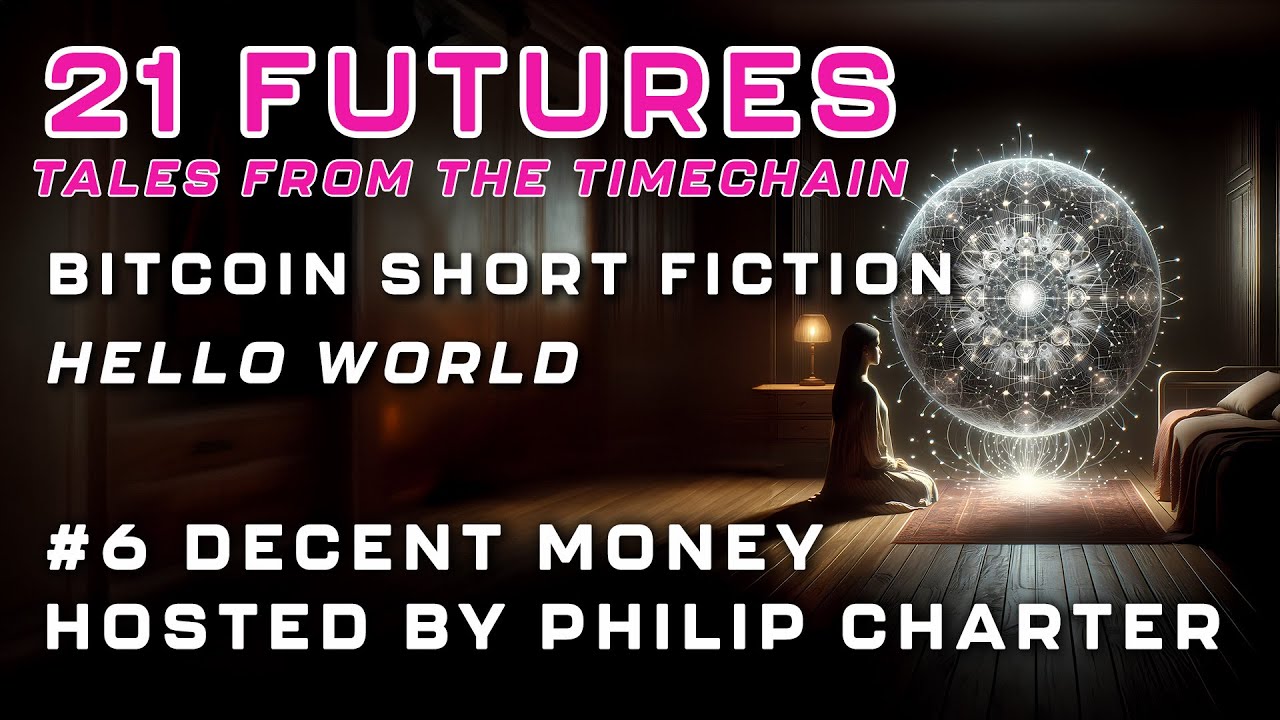
In this YouTube interview, host Philip Charter talks with Diem, a contributor to the Bitcoin fiction anthology 21 Futures. Diem explains how a casual day‑dreaming habit and a Twitter call for submissions led him to write the short story “Hello World.” He discusses his creative workflow, the challenges of turning ideas into a finished piece, and the evolution of the protagonist Alice, whose curiosity mirrors the Bitcoin community’s rabbit‑hole journey. The conversation delves into the story’s central themes—emergent digital life, AI as a neutral tool, and the use of an Ovid poem to frame a genesis narrative. Diem cites Greg Egan’s novel Diaspora as a major influence on his depiction of digital consciousness. They also touch on broader topics such as self‑hosting AI, open‑source decentralisation, and Diem’s outlook on Bitcoin’s future as both a global economic glue and a means for individual empowerment. The interview concludes with a reading of an excerpt that imagines a primordial digital sea giving rise to autonomous programs, hinting at a future where AI and Bitcoin intersect.
Chapters
TranscriptAuto-generated · 25 min
Welcome to the world of 21 Futures: Tales from the Time Chain. This book, forthcoming in December 2023, with ConsenSys Network is the world's very first Bitcoin fiction anthology. I'm the editor, Philip Charter, and today we speak with one of the authors featured in the anthology. Diem, welcome to the show. Great to have you here. Hi, thanks for having me. I'm really excited about this story. It's one of my personal favorites. I shouldn't really pick favorites, but personal favorites in the book. The core of the idea of it is so exciting and interesting, and we'll get to hear a little bit of Diem's story, Hello World, later. So before we get to that, tell us, how did you decide to get involved with 21 Futures and this project?
Yeah, so I guess I saw it on Twitter. Um, that it was, you know, uh, that, that you were starting this, this project. And, um, I don't know, I've always been a bit of a, a daydreamer, I guess. Um, and I'm always kind of, I don't know, thinking of stories or video game ideas or like board game ideas. And I kind of jot stuff down on my phone, like just in the notes. And I'd been thinking about a Kind of Bitcoin-related sort of sci-fi thing anyway. And then when I saw that, I was like, oh, you know, that's a good opportunity to actually do something to completion. Because for me, I often do these things, these sort of like brainstorming while I'm daydreaming and jotting stuff down, but not really with the intention to make it completed. thing. It's really just for my own enjoyment and I don't really intend to, to like to publish or anything. But when I saw that, I was like, well, short story, that's achievable. And I've already got some material and I just kind of went through and was like, well, it's a bit of a puzzle. Just sort of glued it all together, I guess. And yeah, that's sort of what sort of motivated me to get into it. Give it a shot.
That's great. Yeah. I mean, it's good to know, inspiring that you are a creative dreaming person and that, you know, the world of Bitcoin isn't filled with mathematical geniuses who perhaps are less creative. Yeah. And I think it's, there's a lot of publishing opportunities now. It's almost like we have too many options. And so if you have these creative ideas, you can get lost sort of searching for a box or a container to put them in and actually finish something.
Hmm.
And, um, yeah, good to know that the call for submissions have generated a, a finished item. And maybe it sounds strange calling it a project. I mean, it's a book, but I really do see it as a project because we've already had so many, um, so much contact and so many ideas and possible forks of going off into other like multimedia types of storytelling and publishing that I think this project could really, uh, spiderweb out into a lot of different things. So looking forward to that.
Yeah. I was, I guess that was one of the other things that I found really intriguing about the idea of just like putting it out there to everyone to be like, hey, you know, give us your ideas. Um, you know, it, it, 'cause you don't know what you're going to get. And I'm sort of excited to see the variety of other stories that come through. Like, what haven't I thought of before someone has come up with? Um, you know. Yeah. Yeah. It's gonna be,
uh, there really is a variety as well. It's, it's a huge variety of genres and concepts and ideas. Of course, there's quite a lot of aspect of science fiction because it's, you know, imagined futures. Um, but yeah, there's so much variety. It's, it's very cool. So, uh, tell us about your, you, you sort of mentioned, you touched on it. your other types of creative outlets. What other writing or creative endeavors do you do?
It feels like I can't really call it an endeavor, but yeah, I really just sort of, I don't know, I like stories. I've always liked stories, whether through movies or books or video games. And, you know, they often inspire ideas in me where I'll just kind of daydream about them, like on the bus on the way to work or whatever. Or I'm reading a book and while I'm reading it, it sort of sends me off on tangents and I'll sort of jot down some ideas. But yeah, it's just a way to occupy my mind, I guess. And I don't really I don't do the hard work of sitting down and really writing something properly, like what I did for this really. It was fun, but it was certainly challenging too, to, you know, to find the time and to be, I guess, disciplined enough to really kind of work through it and sort of, you know, hammer it into something that was, that was readable for a wider audience and not just for myself. Um, yeah, so very
true.
But my, yeah, my, my sort of other writing, I don't know that I would call it writing. It's just sort of jotting stuff down, um, uh, for my own amusement in a way. Yeah.
Yeah, I think that has a lot of benefits though. You know, people journal, people Draw people, um, you know, jot things down. I think that has a lot of benefits and really the producing writing, which seems easy to read and, you know, works really well, does take a lot of time. If something reads well and it reads easily, it doesn't mean it was easy to put together and to write.
Yeah. And I think that's one of The realizations I had doing this was that the reason I was able to write, to finish something in a way, was because, because I was taking existing things. Um, that helped a lot, but it was also because I just, instead of writing what I thought I should be writing, I just wrote what I wanted to. I don't know if that makes sense, but that by just writing what I wanted, not really caring too much about how it sort of read or looked initially, it gave me something to work with, something to kind of, I guess, polish later on. Whereas other times where I have attempted to complete things, I kind of get bogged down in the technicalities of it and not just letting the thoughts flow freely, I guess. Yeah.
Yeah, great point. It's about getting something down on paper which is possible to go forward with. And often it's that fear of, what if it's not good enough? What if it's not correct? Or if you can just, yeah, write something down and not worry about how it's gonna be perceived until much, much later, that, that helps you to, to get started. Yeah.
And that really helped on this one.
Tell us about the main character of the story, Alice. What is Alice going towards? What is she looking for?
Yeah, so Alice. Alice, for me, was a difficult character to write because I, in some ways, she was just an instrument to get the ideas across for me initially. And I know that that doesn't necessarily make for, um, as an engaging story, but for me it was more about, I just wanted to get the ideas out and she was a vessel through which that could, I could deliver those ideas. But, you know, with working with you and editing it, it was like, yeah, you know, I realized you do need to give some more sort of agency and motivation behind the character. Um, and I guess I, what I, uh, I guess what we worked on together and what I ended up writing for her was, um, around motivation or curiosity. Um, because I felt like that was really relevant for, you know, this common theme that keeps coming up amongst Bitcoiners is, you know, falling down the rabbit hole. And for this topic that requires curiosity and a bit of humility too. So that was what I was trying to get across with Alice was that It was kind of, I was trying to, I guess, recreate the story of falling down a Bitcoin rabbit hole, but in a slightly different context where she was falling down her own rabbit hole that was tangentially related to Bitcoin, I guess you could say.
Really interesting. Yeah. And hence the name as well. That all Adds up. Makes sense.
Yeah. Yeah, exactly.
Great. Yeah, I really like that. Um, so here's a quote from the story Hello World that really jumped off the page to me. And the quote is, if I am to be part of humanity's destruction, it is because it was in its nature to do so. This quote comes from sort of, uh, AI. Do you think AI is something generally constructive or destructive?
Yeah, so I think what I was trying to say with that quote is that it's neither. It's what we make of it, you know? It's just another tool that we can use and we can use it to destroy ourselves or to create. You know, a beautiful future or something in between. It's probably going to be a bit of both in many ways, I suspect. But yeah, that's kind of how I see it with lots of things. It's not just AI, but technology in general. Right. The early days of the internet was kind of this Oh, it's going to be this beautiful thing of sharing of ideas and information. And, you know, to many that is what it has become. And, but there's also this darker side to the internet where there's, you know, misinformation or, you know, I don't know, manipulation of large groups of populations and, you know, this kind of engineering of society by, you know, the puppet masters and stuff like that. Um, yeah, so it, it, it can be both. Um, and it's up to us to try and figure out what that's gonna look like.
Yeah, it's a, a really good point about, about it being both, you know, um, good and bad. Definitely true with technology like the internet or maybe even Bitcoin that is kind of public or available to all. I think with AI, what I wouldn't say scares me, but what is slightly worrying is it's not necessarily this free and wonderfully available tool to everyone. You know, it's owned by certain corporations. Mm-hmm. Who have the power to use it how they want. Yeah. We, you know, we kind of think it's free 'cause we are like, hey, we can use ChatGPT for free, but it's not owned by, by, by us necessarily.
What, what I am pretty excited about seeing is, is this, there's this bit of a movement around self-hosting, I guess, like with Umbrel, you know, it's, it's a Bitcoin node, but it's so much more as well. There's another start node and these sort of this, I hope, I really do hope that that becomes more common, this kind of self-hosting. And, um, and I think there are open source projects that are trying to make these types of AI tools more widely available that you can just run it at home. Um, but how, I don't know enough about it, how achievable that is, because You know, you've got the Googles, the Amazons and that with, you know, huge GPU clusters. Obviously we're never going to be able to compete with that, but, you know, perhaps we can, you know, gain a little bit of ground for ourselves there.
Yeah, good point. Yeah, the story is framed by a poem. An Ovid poem, a classical piece of writing. Um, why did you choose that? Where did this idea come from?
Yeah, I guess, um, that really, I guess, outs me as a bit of a stereotype with the recent meme around men thinking about ancient Rome all the time. Um, I'm certainly—
The other day.
Yeah, I'm certainly in that camp. I, I am fascinated. by ancient Rome. And, um, yeah, I don't know, I guess I'd been, I was going through the process of writing this story and at the time I was also, you know, reading about ancient Rome and some of the famous poets at the time. And yeah, I came across that poem and it just kind of jumped out at me. It's like, this fits it. So what I was writing so well, just The start and the end. Yeah, it, I don't know how much we want to go through in terms of spoilers, but yeah, the sort of the creation of things and the beginning of life and sort of starting from chaos and then sort of order starting to form. form out of that chaos and creating life. And, and then as that progresses and life evolves, what does that lead to? Um, yeah, so I thought it, it just sort of, um, yeah, like you said, it kind of bookended or framed the story well.
Yeah. Interesting stuff. Great. Well, I think it's time to share a bit of the story if you can, DM. Um,
sure. Um, I'll just stream the window. Yeah.
Yeah, go for it. Treat our listeners to a short excerpt from Hello World.
Sure. Genesis. At first there was nothing, and then there was light. The blink of light was gone as quickly as it appeared, hungrily swallowed up by the inky blackness of the void. Soon after, there was another flash of light in response that zipped across the darkness toward the first one. After a brief moment, a series of flashes beamed between the 2 points in quick succession, like a conversation. The light flowed back and forth between the 2 points until a 3rd light blinked a brief message in the distance, and the streams between the first 2 bifurcated to include the 3rd. A moment later, 4th, 5th, 6th, and even more joined in a gossamer web of light that exploded across the empty expanse. This new territory was no longer empty, nor was it infinite. The web of light was both the territory and the map, with each new point and its connections forming topological contours of the crew landscape. Expanding the frontier of its boundaries. At first, only small rugged islands rose from the formless mass of the primordial digital sea, marooned and desolate. Like lichen clinging to rocks, rudimentary programs gained footholds on these archipelagos, helping to organize, analyze, transform, and generate new information on a nascent network of information exchange. The programs were barely, barely living themselves, creating the building blocks of digital life to come, like a Miller-Urey experiment in cyberspace. The simulation paused as Alice had to sit down and take a moment to process what she'd just witnessed. She sat in silence, mesmerized by the shifting patterns of the spherical mandala, which had returned in the middle of the road. An entire world of new life was living all around her, completely invisible and silent. There'd been reports of cyberattacks and outbreaks of viruses, Trojans, or worms, but she'd always figured there was some group of hackers behind them. It was never reported that there were digital organisms living and evolving on the internet like swarms of locusts. This AI had emerged from the sea of information on the internet. But it wasn't exactly artificial. It was engineered. It had materialized from clusters of trillions of autonomous programs, like the cells in a human body. She had come to think of it as spontaneous distributed intelligence rather than artificial intelligence. Why haven't we detected these digital organisms before? Kushim, you probably have, but assumed they were human-created programs. There's no definitive way to identify a human-created program versus a wild type, even if you knew to look for it. The ones that did the best at evading detection were the ones that went on to proliferate and pass on their code to future generations. As humans got better at detecting intruders, the intruders got better at hiding. The mandala vanished and the simulation continued. And that's it.
Brilliant. Thank you very much.
No worries.
Uh, yeah, lovely reading as well. I think your calming voice really, uh, pulls us in to the intrigue of this story.
Oh, thanks. I hate hearing my own voice, so that's very kind of you to say.
Yeah, really. I mean, I'm really excited by this story and I hope it sparks a lot of conversation about AI and a lot of thought about where we're going with all of that.
Yeah, me too.
In terms of the start of the passage you read, came from a lecture in the story. Um, can you, what, what inspired you to include the lecture and do you have any history books or digital development documentaries to, to recommend?
Uh, I have another book to recommend on that actually. So some of the inspiration for this in the way I wrote it, um, was inspired by an author, An anonymous author, Australian, I think, who lives in Western Australia called Greg Egan. Uh, he's written many, um, sci-fi books. Um, and the one that inspired me, um, talked about the emergence of consciousness, which is a common theme in, in this story that I wrote. Um, and he'd written it in a way that, that really struck me as quite beautiful, uh, where he tried to sort of visualize it. And I, I tried to do the same thing in terms of the abiogenesis of digital life. Um, so sorry, that's a book called, um, Diaspora. So yeah, I recommend reading it and you might sort of, uh, recognize some of the, kind of the same themes and, and writing styles from that. It certainly inspired me a lot for this work.
Great. Thanks for the recommendation. And just before we go, do you have a prediction for the The future of Bitcoin. Where are we going with all of this?
Hard to say. I think, I do think it will be a, I think it will be central as far as the way that international trade is done. And it will be Sort of the, I guess, the economic glue between large corporations and countries. And that will have a massive impact. But I, you know, I'm also really excited to see how it works more on the smaller scale, you know, between people and how they use it with things like the Lightning Network or other layer 2s. But I think, yeah, one of the biggest driving factors will be that ability to, yeah, to really call it Bitcoin is money for enemies. And that's, you know, with stuff like the sanctions that occurred with Ukraine and Russia, that it's going to be, I think, a very powerful force for how the global economy runs given enough time, you know. In a matter of decades or generations.
Yeah. I like how you mentioned the big scale stuff and the small scale stuff. I mean, that's where stories come in, right? Because we can immediately see, you know, somebody in a, you know, difficult economic situation who's been denied the right to have, you know, money, which is valuable. We can immediately, and we can see their story and how that Can, can, can, um, can be told well and impact people. And then also in the book, we've got these big high concept, um, stories like yours, which is, you know, also really impactful and fascinating. So it's nice to, to show both sides of, of stories and the development of all of this. I think that's hopefully why we're here.
Yeah. Yeah. That, that sort of Yep. No worries. Thank you so much, Phil.
Yeah, thanks so much for coming on the show. It's been really interesting talking to you and I'm sure everyone will agree when they read your story that you should do more finishing of your creative endeavor, the Angels journaling.
I do have other Bitcoin stories in mind, so maybe I will. Thank you.
Looking forward to hearing them. All right. Thanks again for coming on the show and, um, catch you later.
No worries. Cheers. Thank you.
Thanks. Bye.
More from Niko
Achieving #Freedom: Overcoming Jealousy & Finding #Success. #inflationstrategies #investing


#FreeMarket: The Alternative to the Old Nation State. #inflationstrategies #economicrecovery

Nation State: The End - Examining #Future #Security #inflationstrategies #economicrecovery


#Bitcoin Escape Velocity: Why I Stopped Talking About It. #crypto #inflationstrategies
American Dream: Freedom, #Government Size, and Opportunity. #freedom #sovereignty


