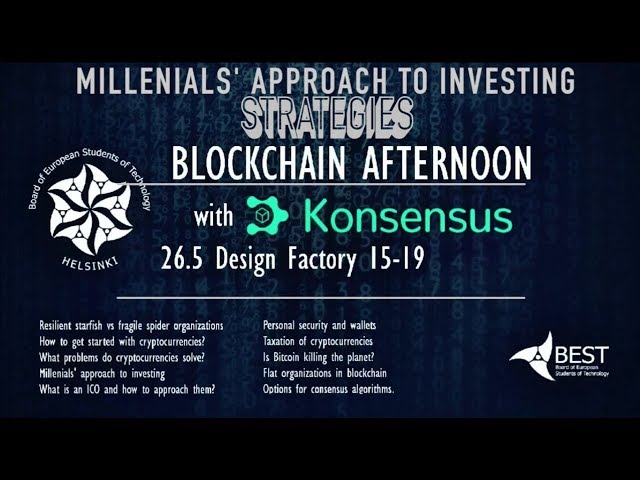
In this YouTube presentation, Henri, a finance researcher from Lappeenranta University, discusses how different generations approach investing, with a focus on cryptocurrency. He contrasts the rapid price movements of crypto markets with the slower cycles of traditional stocks and commodities, arguing that speed is the primary challenge for newer investors. Henri outlines a simple three‑component framework—time, price, and the why—advocating a buy‑and‑hold strategy for learning market dynamics while emphasizing the importance of diversification across crypto, stocks, commodities, and cash. He shares personal habits such as limiting daily market monitoring to ten minutes and concentrating on a handful of coins. During the Q&A, he addresses practical questions about coin allocation, the role of algorithmic trading, the potential impact of futures markets, and the prospect of institutional adoption, concluding that futures could serve as a gateway for larger investors while algorithmic manipulation remains a manageable risk.
Questions this video answers
I usually consider about three coins at most, spending roughly ten minutes per day on market monitoring. I have tried looking at 50 coins, but it was too time‑consuming.
Algorithmic trading exists and can lead to manipulation, but I don't think it's the main problem. Crypto markets move faster than traditional ones, and algorithmic trading is just part of that speed.
Futures could help investors understand the market better and serve as a less intimidating entry point for those unwilling to hold actual crypto, potentially attracting more participants.
Hello, my name is Henri. I'm okay, but my Achilles heels are a bit hurt, so I might sit a little bit during this presentation. Okay, first of all, I'm very pleased that you're all here and proud because competing with the beautiful weather outside and all the drinks and bikinis, it's usually quite hard. It's quite the same as competing in the internet with the cat videos. That's usually quite difficult. Okay. So I think this is the second time I'm here. I had some friends in academia studying here, and we had nice parties here. It was not this building, it was the other building, but the parties were great. Okay, a little bit of background. I'm from Lappeenranta University. I studied finance there, and I have always had an interest in history. And history has been a big reason why I usually invested, or invested my time on investing. And one of the things which is very important to me has been the structure of time. That's not the case here. I'm not going to tell what is the structure of time. I'm just— some info about my research and my background and what is the interest for me in the investing in cryptocurrencies. I'm interested in the new opportunities and the possibilities. And if I see a market that usually in the stock market, if stock market moves like it takes 5 to 10 years movements that in a cryptocurrency market it takes like a couple of weeks. So obviously there's a monetary interest as well, but the technology, that is the main purpose. I'm not the tech guy necessarily, but I study the market reactions of the— usually what happens about a certain cryptocurrency. Okay. There's a history of us, generations before, and we always have to remember the generations before because it's like a continuation process, accumulation of knowledge, and we have to be very thankful for the generations before, like baby boomers who were born in the '40s and The next was the Generation X. They were born in the— the baby boomers were born in the '40s and '60s, and the Generation X was after that. And I believe there are quite a lot of millennials who were born from the '80s, early '80s to '90s. So there are different approaches how different people invest And of course the history and what has happened affects greatly on how we invest today. If I have done some consultation, legal consultation and some financial consultation of the big guys there in the investing in Finland, I was quite surprised because back in the day when there was a commodity boom in the precious metals market, I was a student and while I was interested in history and I made some studies about gold and silver markets. Well, they hit the moon very quickly but during the years— but final year 2011 it was like profits were like 100% almost for silver market and I made a presentation for the One of the bigger investors, and they haven't heard about precious metals before. So I would encourage you usually to pay some attention about blockchain technology because it could be in 6 months you know more than they will ever know. There's also a big proponent, a big thing in the technology side. We have to remember that baby boomers did not have access to technology. In many countries, like in Finland, we had the first regulation in the '80s in the stock market. But you guys are quite familiar with regulations already. That was not like before. It was like an old saying that with baby boomers, they can drive a car, they can drive a plane, they can drive a— Well, a jet or whatever, a rocket even. But we have the regulations, so we have to license, and that is a good thing. So what about investing, investing attitudes of our younger generation? I believe I am in the Generation X and the middle of the Generation X and the and in the millennials. So I know a little bit about both worlds. That was like the time when the Generation Xers had a couple of crashes, and I know these people quite well. They had some bad experiences of the stock markets. Baby Boomers had huge rise, and what I have learned from the bigger investors that they were usually invested only in stock markets, which is quite remarkable because we have heard about, in the investing world, diversification. They don't know about it still. And when it comes to Generation Xers, they have much better diversification. They have much better access to the markets and they have a knowledge and a thirst to understand the markets. But when it comes to millennials, I have to say millennials learn these things very fast. It takes like— if you watch a YouTube video how to invest and learn it in a couple of weeks, I think it's possible for all of you because the tech is not the problem for you. You can find knowledge as well. So I think there's also huge possibilities in investing. I also encourage everyone to make their own decisions like there has been before. But if we think about easier strategies how to invest in some cryptocurrencies and when we compare cryptocurrencies to the stock markets, is it easier or is it harder? Well, the only thing what I have I have realized, I have noticed, is the speed. That is the speed. So if you are afraid of the crypto markets, don't be afraid. The tech will be solved in a couple of years maximum. So that is not going to be the problem. It is the speed at the moment, but that usually scares the bigger players, the older guys like Warren Buffett, which was mentioned before. Warren Buffett missed the dot-com bubble as well, but as we all know what happened after the dot-com bubble, everybody knows how to use computers. Everybody. So, what I encourage you to do is to trust yourself in the investing world. There's nothing new to you. It only requires 3 components. And those components are time, price, and the why. Why is the most important thing because I encourage you to invest in a buy-and-hold strategy just because that is the way you learn how the market actually works. If you are there trying to make different things like Well, I have practiced and I do research about turbo warrants and the fastest markets in the world because I believe that you learn best when you fight with the bear. So that's the best way and quickest way to learn because you need to survive there quickly. Okay. I don't have the memory sticks because that had an earlier summer vacation, but if you have any questions here, I would like to answer it right away.
Yep. So, okay, yep. So I was wondering about class coloration. So How many coins do you have? Or do you also— or do you only invest in Bitcoin?
Yeah, good question. I don't really— I pay interest on a few coins because the time is there, a very important thing. I put a time limit usually in every day how much I pay attention to different markets. Is like 10 minutes maximum at the market. So I usually consider about 3 at the max. Sometimes I have considered, paid attention on 50 coins at the same time, but that is too time-consuming and you can't really make that much progress. That's my experience of it.
So during the last few years, I think algorithmic trading is something that has really risen in the stock markets. Do you think this is something that will take hold of the crypto markets as well, or what do you think of the situation there?
That's a very good question. I remember when the algorithmic trading became more popular and there was lots of talks about manipulations in the market and usually in every market there's a possibility of manipulation so you don't really have to fear that. And the algorithm trading is quite funny because if somebody finds a flaw there, there's a possibility of quick gains also. So, but if I look at the algorithm and the past history prices of the certain cryptocurrencies. I don't really think that the algorithm trading is the problem there, because if we look at the commodity markets, stock markets, uh, it's just faster. Movements are just faster in some coins. I don't say what those coins are, but they are those coins that no one should be investing. But you can see if the market is too unpredictable. You can see basically the chart has like this kind of movement. It's usually stable, but the movements are like this. If you see those patterns too often, I might stay away from those markets for a while. But I think the algorithm trading is part of it. It's just faster, faster movements. Thanks.
Yes? What do you think how the futures market will affect this cryptocurrency investing?
Good question. Well, I think they might have a— I'm not sure about it, but I believe they have an effect. One of the effects is that people will know the market because futures market for investors is usually the normal place. And I think futures market is a very good thing for cryptocurrencies because those investors who are not willing to invest in cryptocurrencies use futures. And there they can see that cryptocurrency world isn't that scary place.
So do you think that would also bring in the institutional investors coming in?
I think it could be a very important link there too. Yep.
Do you still invest in other asset class or only cryptos? So do you invest in commodities or precious metals or—
Good question. I would— this is my advice, but I also, I always encourage diversification. So I would not put all my money on cryptocurrencies. I would use stocks and also savings, savings accounts, and commodities as well. Diversification is very important unless you are, let's say, doing some business related to blockchain technology, crypto coins, then you have to be all in on your own project, of course.