Financial Fallout! 21 Futures Podcast S2 E2 - Decent Money discusses 'Proxy - Temet Nosce'
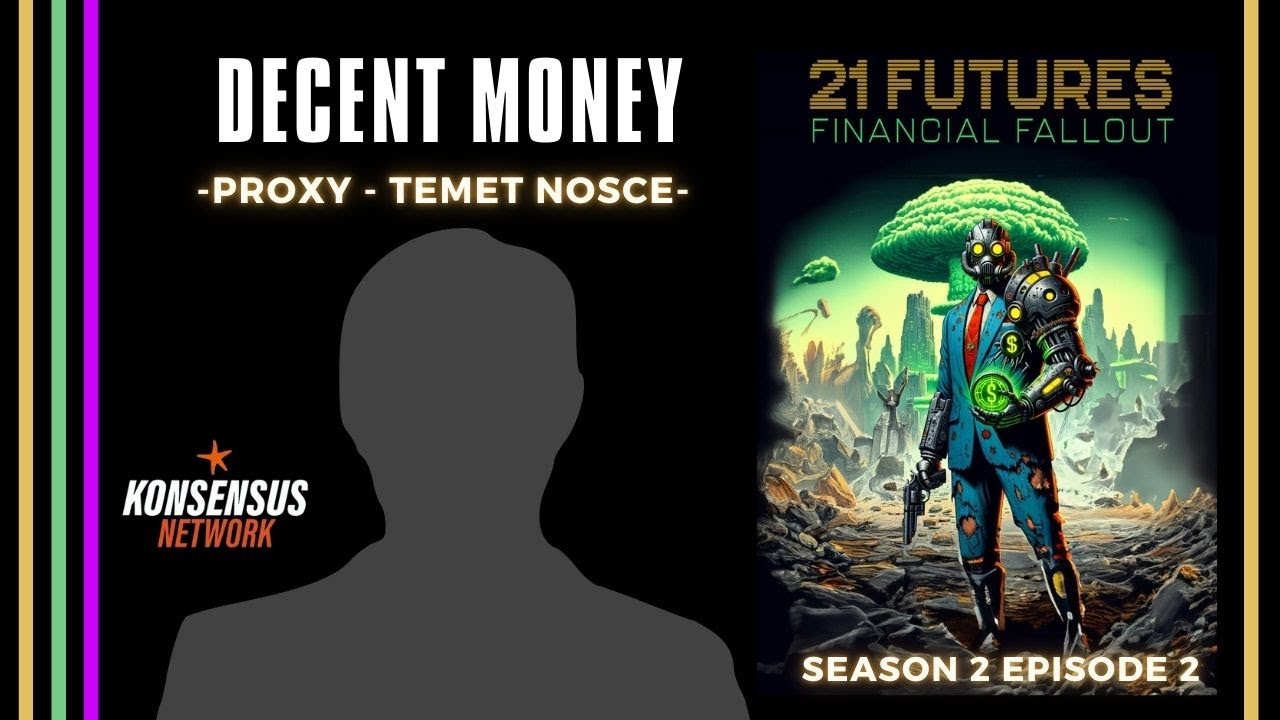
In this episode of the 21 Futures podcast, host Speaker A interviews Decent Money (DM), a Bitcoin enthusiast, writer, and finalist in the 21 Futures anthology. The conversation opens with a brief celebration of Bitcoin’s $100k milestone and a discussion of the cypherpunk ethos, positioning Bitcoin as a potential check on an increasingly oppressive financial system. The core of the interview centers on DM’s award‑winning short story “Proxy – Temet Nosce,” which imagines an advanced AI assistant that becomes a digital proxy for a person, ultimately stealing their identity and replacing their physical body with a blank “nobody” template—a blend of body‑horror, AI ethics, and speculative fiction. DM explains how the story grew from a sci‑fi idea about Bitcoin, the challenges of trimming an initial novel‑length draft into a short story, and his broader vision of a shared universe where the digital and physical worlds merge. The hosts then explore DM’s path into the 21 Futures project—starting from a Twitter post, submitting a story, and becoming a finalist—while also touching on his personal crypto experiences (Mt. Gox loss, Luna crash) and his efforts to onboard friends to Bitcoin. The dialogue expands to real‑world concerns about privacy, debanking, and political account closures, using UK examples and the Nigel Farage incident. Finally, the episode offers practical advice for aspiring writers: start with short‑story contests, consider NaNoWriMo for novel writing, and treat writing as a process of finishing rather than perfecting. Listeners are invited to join the 21 Futures Telegram community, follow DM on Twitter, and purchase the anthology collections.
Chapters
Okay, hello and welcome everybody to another 21 Futures podcast. I am joined today by Decent Money, or as we will call him, DM. How are we doing, DM?
Hey, good, thanks. Thanks for having
me. Oh, you're very welcome, and congratulations on, uh, on your story. What a tremendous story. Temit Noske, am I pronouncing that correctly?
You know what, I actually don't know. I should look that up, how to properly pronounce the Latin I think that's correct.
Well, funnily enough, I studied Greek and Roman at uni, which included Latin. So I think it is temet nosce. Yeah. The seas are hard, right? So they sound like case in Latin. If I'm wrong, I'm sure someone can crucify me in a comment, but I'm pretty sure I'm right.
I'll trust your judgment.
Yes, absolutely. Sometimes, uh, in, uh, the 21 Futures community, we talk a little bit about crypto, specifically about Bitcoin. Uh, you are a Bitcoiner, right? Congratulations on, uh, reaching over $100K.
Yes. Uh, yep, I'm always looking at the price, and it's, uh, it was good to see that we're back.
Yeah.
Um, it's funny, isn't it? Like, to me, I just see it as, as noise though. It's like Like, yeah, we're past $100K, but like, to me, it's, it's going so much higher. So this is all just noise, this price action at the moment.
Yeah, I understand that. It's a, it's a milestone. It's because it's a, there's a psychological threshold around it. It seems like the support at $90K is, it's insane, you know. And, uh, I, I don't know about you, but a lot of my sort of, uh, normie friends are asking a lot more questions than they used to. Yeah, there's definitely an interest.
It's definitely, yeah, it's an important threshold that gets it, you know, in the media and into people's consciousness.
Yeah, and there's kind of this movement, isn't there, that we should talk about a little bit that we're calling the cypherpunks, a bit of cypherpunkery. Is that something you're involved with or watching?
So I guess, would I describe myself as a cypherpunk? I feel like I need to write more code to get that label. But I do think privacy is important. And it's certainly something that's touched on in my story.
Yes.
Yeah, no, it's really great to see that Bitcoin has kind of— I don't know, I guess you could call it a bit of a renaissance for that movement. You know, I've read a really good book from— what's his name— Aaron van Wirdum. I think he wrote the Genesis book, which kind of goes into the history of it. And they talk how it was kind of dying off a little bit, and then, you know, it's kind of come back because Bitcoin kind of was the fire under it that relaunched it. So yeah, I think it's really important.
Absolutely. And it will become more so. Right. As we, um, when I was sort of talking to people about, uh, the 21 Futures Collection, uh, one of the things I said almost by accident is, you know, we're gonna write about the sort of financial dystopia we're all soon to enjoy. Mm-hmm. Um, and people thought that was quite funny because, I mean, is, is it true? Are we, are we heading towards, uh, a world where, you know, we're promised sort of safety and comfort at the, at the complete loss of, uh, individual sort of liberty and freedom, you know? And, and does,
yeah,
does Bitcoin protect us from that, you know, in your opinion?
Uh, yeah, yeah, yes. Like, you know, I'm obviously a Bitcoin maxi, um, and I, I, I do think that it holds— Bitcoin holds a lot of promise, but I don't think it can fix Everything. Like, I think it will be useful and it will provide a, you know, a bit of an escape valve, as people call it, from that, from that, you know, kind of more oppressive system. But whether it like fully saves us, I mean, I hope so. I hope it never needs to save us, to be honest. I hope that it's kind of a bit of a check on that, that system to say like, you know, if you misbehave too much. We've got this other parallel system that we can just exit to if we need to. So, you know, keep things in line a bit. You know, if they don't— Yeah. There's a lot of people who, you know, will just never make that escape to Bitcoin. They just won't. They're not going to make that leap. And then they're kind of stuck, I guess, in that other, you know, system of control.
Yeah, I'm, I'm inclined to agree. Uh, and I think, you know, you do see some serious maxis that are like, it will solve every problem that exists ever. Uh, so I think your more, more grounded approach is good. I do think that, um, you know, certainly from, uh, 2019 and 2020 when a particular thing happened, um, the idea of sort of parallel societies suddenly became much more interesting to a lot of people, including me. Right. And it's like, can we opt out of fiat and central bank control? Is that possible? Or do you always have to have some interface with that world? And you actually end up with a sort of your real life and then your on-chain life. And that, I think, is kind of one of the themes of the new collection, you know, is Are we gonna exist in societies or even worlds or planets or universes where, you know, this sort of financial dystopia is affecting everyone? And this is sci-fi, this is fantasy, but there are some real-world elements as well. I mean, your story is— it's very easy to imagine our world, right? Your story happening in our world. Yeah.
I mean, yeah, I mean, when I wrote it, I was kind of thinking of real-life examples. I mean, obviously mine goes to the extreme, um, in, in some of the themes, um, but like when I was writing and I was thinking about these real-world scenarios where, yeah, people kind of lost their lives in a sense.
Yeah, yeah, and it's, it's really frightening. And, and I wonder, had you, had you heard at all about, um, so I'm from the UK And, um, we've had like this big sort of unbanking scandal where, uh, a bit like the Canadian truckers in the COVID lockdowns, people have, people have found their bank accounts closed for their political views. Um, yeah, were you aware of that kind of stuff when you were writing the story?
Uh, no, I haven't heard about debanking in the UK. I've heard a lot about sort of, you know, like this monitoring of social media posts and like getting arrested for, you know, for a meme or something like that. But I wasn't aware that there was debanking also occurring. But yeah, for me, that trucker movement was a bit of an eye-opener around—
Absolutely. Absolutely. Yeah. So we had, we had a politician called Nigel Farage who, he went on a TV show called I'm a Celebrity, which kind of whitewashed his reputation, made him really famous. And then one of the biggest banks in the UK UK just deleted his account or like shut down his account. And the person that did it, the person that made that decision just received a knighthood. So apparently it's a good thing when you, when you shut down the bank accounts of your political opponents. And, and you're, you're right. There's this real shoot the messenger culture here now where, um, rather than sorting a problem, we remove people pointing out the problem. So we— anyone who draws attention to a problem is the enemy. The problem itself is fine. Yeah. So, so let's escape the real world into, into writing. You know, um, we talked a little bit before we started recording about, about writing and, and how it's nice to, um, kind of take a break from the real world and do some writing. Um, yeah, so you've, you've, uh, you were in the previous collection, right? Tales from the Time Chain. You're in this new one. Yep. Let's hope, maybe, I can't confirm or deny that there'll be future ones. Hopefully you'll be involved in them. Could you tell us a little bit about how you got involved with 21 Futures, a bit of your sort of writing background, and maybe if you have any sort of advice or inspiration for other writers to think about, you know, we'd love to hear it. No pressure.
Yeah, sure. Um, so my initial start with 21 Futures was, yeah, just a post on Twitter, or X as it's now called, um, from the 21 Futures account. Or maybe it was the Consensus account, because I don't think the 21 Futures account existed back then. So
that happened last time.
Yeah, with Consensus Publishing. And, uh, you know, I've, I've always sort of daydreamed about stories. You know, I've always kind of got these these stories going on in my head, and I'll make notes on my phone, but they're things that are just kind of for me. And I, you know, I don't write anything to completion or publish anything. Um, but when I saw that, I'd already been daydreaming about sort of sci-fi ideas around Bitcoin. So I was like, oh, you know, I could probably, you know, I could probably come up with something that might be worth you know, worth submitting.
Mm-hmm.
Um, and yeah, I, I just kind of jumped into it, you know, full hog. The actual— the initial story that I wrote for that, um, Hello World, it got like— it was starting to become a novel instead of a short story. I had to really cut it, cut it right back. But it just, it just sort of showed me, once I got it to completion and, and submitted it and it got accepted, it was like, oh, I can do this. I can actually write something that people like and that they connect with. That was encouraging. And so when the second one came out, I'm like, yeah, I'm definitely going to give it another go. I didn't have a story in mind yet, but once I saw what the theme was for the second collection on financial fallout, I just started brainstorming things. You know, juggling ideas around and seeing what stuck. Um, do you want me to go into that process a bit, how I came about the story?
Oh yeah, absolutely, because not, not only did you, uh, respond to the brief and really hit the nail on the head, you're one of our finalists, aren't you? It's— yeah, yeah, one of the top choices, uh, from the editors, myself, Phil, Uh, and, and Niko from ConsenSys Network. We were all— we had a wonderful conversation about your story and how good it is. So we'd love to get—
Thank you.
Some of the background thinking around your story.
Yeah, thank you. Yeah, I'm really appreciative of, of becoming a finalist. That was really, really great to see. Um, yeah, so the story, it started out like most stories, it starts out very differently when I first started brainstorming it. Do we care about spoilers for this? Can I just talk about it?
Well, you have to bear in mind people watching this might not have read it yet.
But that's okay, I think. Yeah, I guess I'll just put that warning out there now that spoilers. So if you don't want spoilers, turn this off now kind of thing. Yeah, so it originally started like with this idea of an AI assistant, actually, um, where it— you know, have you seen the movie Her with Joaquin Phoenix and Scarlett Johansson in it?
Yeah, she's an android or something, isn't she?
No, she's like a— she's like an AI that's like in the cloud but sort of interfaced through his phone. And it starts as his assistant and then becomes like his girlfriend and, and, you know,
Okay.
Um, and but my idea was a bit different, whereas this AI assistant is kind of acting on your behalf, um, and then it kind of becomes like this proxy for you in the digital space, and it starts making decisions on your behalf. It's trying to be really helpful and do all this stuff, but, you know, it's through this really advanced AI and it just kind of takes on this life of own to the point where, you know, the human wants to step in and be like, oh, actually, I don't really want to do that. And I was like, too bad, I've decided—
For your convenience. Yeah,
yeah, I've decided this is the best course of action and, and you can't override it. So sorry, you know, this removal of agency in the digital space. But I, I, you know, I was just brainstorming about it and I, I I had this idea of like, um, that was kind of like identity theft, you know, like, yeah, now this AI is you and you, your identity in the digital space is, is not you anymore, it's something else. And so I just wanted to sort of— I took it that next step of like, okay, what if it's like your identity is, you know, it's your who you are, it's your body in that.
Mm-hmm.
So I made it this, set it in this this fictional universe where, you know, your body literally got taken away, gets taken away from you, and it's replaced with like this almost like a blank template, which I'm calling in the story a nobody.
Mm-hmm.
And yeah, I just thought that was a really interesting idea that I could explore in terms of, you mentioned it before we started the recording, that, you know, it's like this body horror of being trapped in, in this shell that kind of encases you and What that would feel like and what it, what it would do to you.
And did you, did you intend for it to be scary?
Yeah, once I decided to— yeah, yeah, once I decided to go that route of the more like it's literally taking your, your physical body away from you and replacing it with something else, I was like, I'm gonna really lean into that. Yeah, yeah. So when you said that body horror, I was like, excellent, that's exactly what I was going for.
Yes, yes, I think— well, I think you've achieved it. Uh, this is a story, and, and we're, you know, we're very lucky to have a couple of, of stories in the, in the collection that really kind of stay with you after you've read them. I'm very excited for readers to get to, to get to read it for the first time so that they'll know the feeling I'm talking about. Um, but yours, you just, you can't help but put yourself in the protagonist's shoes and think, God, if that happened to me, what, you know, what would I do? Where would I go? And that's, that's a point in the story as well, right? Whilst we're doing spoilers, is where do you go? You know, what are your options? Um, but yeah, I mean, tremendous. And, uh, I think, um, I think that if we talk a little bit about, uh, you know, you mentioned there sort of almost accidentally uh, moving into like novels and things. Um, do you see, uh, a future, uh, where you're writing in this, in this universe from your story, or is it a standalone, do you think?
No. Yeah, it's funny you picked up on that. Um, yeah, no, that's ex— that when I sort of built that world where this kind of thing could occur, I was, yeah, I was thinking of a broader kind of universe in which another story that I'm working on would sit within, where it's kind of, um, you know, like, might be going into too much detail, but usually when you have like a, um, a virtual world, it's kind of like this separate world from the real world. You've got the real world and the virtual world, and you can kind of move between them. Um, I'm trying to build this idea around You know, kind of like what our current world is where we've got our real world and yes, you've got this parallel digital world, but it's kind of infecting our world. Like they're one and the same. Like the digital world exists in the real world and I'm just taking that next step of really making the digital world simply a part of the real world. And so things that would only be possible in a digital world actually can happen in the physical world. Okay.
That's— I'm thinking like a kind of reverse Matrix there.
Yeah, exactly.
That's very cool.
Instead of separate worlds, they're one thing. And so like, yeah, like if you have your identity stolen, you lose your body. But, you know, you could also use encryption tools to protect yourself and you become like this you know, this sort of silhouette and people can't see you fully. You're kind of invisible because you're protecting yourself with encryption or something like that.
Well, it's interesting. One of the themes in your story, I think, or at least from my point of view, is, you know, the character asking for help, right? Going to, like, in the panic at the beginning, being like, hey, that guy knows me. Like, Like, help, I need help kind of thing. Yeah. And that sort of having something to turn to, that's quite interesting, isn't it? Because what would you do in real life? What would you turn to? Is it Bitcoin? Is it the cypherpunks? Is it some rebellious faction that can save everybody? Or are we on our own? You know, and that's a big question I always see. in, um, sort of alternative finance, uh, media is, are we on our own, totally accountable only for ourselves, or, you know, is, is help out there somewhere and we're just not sure what it is yet? What do you think?
Yeah, I mean, I think, I think the answer is, is in front of us, is that it's, it's out there in the open. Like, we're having these sorts of discussions just between us now and publishing it. And the information is out there for anyone to, to listen to and to absorb, to understand these ideas that we're talking about. Um, and, you know, why are we doing this? Like, it's, it's— I mean, it's nice to have won the prize, but that's not the reason I, I wrote the story.
Sure.
I wrote the story because I wanted people to to sort of, uh, make a connection with these ideas and to understand why, you know, these cypherpunk ideals are important and that privacy is important and that, um, you know, um, uh, a money that's separated from the state is important. Yeah. Um, you know, and that— I hope that helps people. So, you know, I think people do want to help others in, in whatever way they can. Um, it's just that there's also the other side that you've got to seek that out. You've got to look, ask for help or look for help, um, and find it.
Yeah, yeah, you're absolutely right. And, and that's a very good opportunity to talk about the, uh, 21 Futures Telegram group that we, we have. You know, I've noticed, and you've probably noticed as well, more, more people joining, more people asking questions, sharing ideas and, and what they're working on. It looks like Consensus Network might have kicked off a bit of a sort of Bitcoin and crypto fiction storytelling revolution, which is very cool to be part of. But you're right. Mm-hmm. Everything is community. And it would be sad if that became only digital. So it's nice that we can have a community of real people having real conversations around this stuff. So I would encourage everyone listening to this to seek out our Telegram group and join us there. Maybe we can put a link in the video description somewhere. But yeah, I think you're right. And certainly one of the reasons I do it is because for ages I did everything on my own. I got into Bitcoin and sort of, I like looking at my first email from Coinbase, right, in 2016.
Okay.
Um, it's just something I look at sometimes and I'm like, wow. Um,
but you know, I think,
yeah, but,
but now I email emails from Mt. Gox.
Oh wow, you were, you were one of those guys. Did you, did you get done? Did you get wrecked?
Yeah, I got wrecked.
Oh, you got wrecked. Okay, well, you're gonna get it back at some point, right? That's the thing.
I've got some back. Yeah, that's already happened.
Oh, good, good. I'm glad.
Not all of it, but They got some back. Okay. Better than nothing. Still a bit painful.
I got wrecked in the Luna crash. And I was at a wedding. So it was rude to whip my phone out and save my crypto. So it went to zero. And funnily enough, ended up naming our puppy Luna after Terra Luna. Everyone thinks it's after Luna Lovegood from Harry Potter. It's not. But my point was going to be, You know, I've spent the past year or two sort of onboarding friends into crypto and they're so grateful because not least because we've made them some cash, right? But also just understanding that fiat is essentially a broken promise, you know, because of how inflation works. You have less money every day if you stack If you stack fiat, if you're a fiat maxi, you have less every day. And if you invest in assets that you actually own, you might end up with more every day. So I liked helping others sort of get to grips with it. But also as a writer myself, people started saying, hey, can you write about crypto? It was probably 2020, 2021. People started coming through like, hey, You know, we need a website, we need a white paper, we need this, we need that. Can you write it all? And I just say, yeah, because I love it. It's my favorite thing. So now to be part of a community of not just like Bitcoin guys, but people that write as well, it's like a dream come true for me. It's amazing.
Yeah, right.
Well, I'm very grateful for that. So we're connected through the 21 Futures Telegram group. But you are active on Twitter. Yes. That's, uh, I believe it's @DecentMoney2009. Is that right?
Correct.
Yeah. Okay. So people can find you there. They can also pick up, uh, 21 Futures Tales from the Time Chain to read your first story, Hello World. And, uh, we have 21 Futures Financial Fallout coming. Uh, I can't wait for everyone to read. Uh, Temet Nosce. That's amazing. And in terms of, uh, you know, what's next from you, DM, uh, when do you think we might hear more about your next works? You don't have to tell us if it's a secret.
I mean, if you're referring to the, the, you know, the more— the full novel, uh, who knows? Like, it's really hard to find time to, to write that. Yeah, I agree.
I agree.
Yeah. I've recently had a real sort of, uh, burst of motivation, so I've been, I've been writing, um, more consistently. I've written more in the last 3 days than I have in the last 3 months, so that's been— Oh,
that's great.
Encouraging, but it's, you know, who knows?
Yeah, well done.
It may, it may never get done, but—
Have you heard
of,
um, NaNoWriMo, National Novel Writing Month? Have you heard of that?
Yeah, it sounds— I've definitely heard of it. I've never kind of looked into it.
I've done it 4 times. You write a novel in a month and it's brutal. It's absolutely brutal. You know, it works out at nearly 1,700 words a day. And I found the only way to do it is to sleep less. You just sacrifice sleep, you know. But, you know, you did mention that you, you responded to the submission with your ideas and your writing process were, were quite quick. Um, so it is, it is possible to, um, kind of—
It is, especially, especially when it's a short story. I mean, that would be one of my advice to people who want to get into writing or have always wanted to get into writing is is pick up short story competitions or callouts, because getting that sort of small, easily kind of achievable goal makes a huge difference. That's part of why the full novel writing is quite difficult, because I know it's such a long, hard slog, like a marathon in a way.
Yes.
That it's kind of like, oh God, do I have to drag myself in front of the laptop to write this really long drawn-out thing, whereas with a short story I can, you know, I can very quickly piece things together and see the full picture. Um, and that's, that's motivating. That's really— yeah, yeah, absolutely right.
I encourage every writer to think about, um, also, you know, poetry, lyrics, uh, write everything. You know, I've been lucky enough to write a wedding ceremony in my life once, like We write everything, you know, there's nothing I wouldn't have a go at writing, uh, including, um, country music album that may or may not ever see the light of day. Um, but yeah, starting with short stories is a great idea. Um, and with novels, I mean, one of our writers, uh, DJ Bodden, who will also be on the podcast, he's done a bunch of novels and, you know, his advice would be similar to my advice, which is. you know, finish and move on, or, you know, quickly leave behind your first projects, you know, because what I found with writers, I've had, um, probably about 150 writing students through, through coaching, and, um, it can be very difficult to stop going back constantly to, to the first project, right? Yeah. And so my advice is always finish And then just move on. So I mean, I've done 6 novels, I think. Um, yeah, 5 novels and a nonfiction book and a million short stories. And, and now when it comes to writing a creative thing, the goal isn't to be perfect, it's to finish, right? Yeah, it's to get it done.
I think that's really good advice because I can see in myself that, you know, I kind of I fall kind of in love with my idea and I want it to be perfect, but then that becomes a problem, like where it just, it just doesn't progress because I'm trying to— I'm, you know, I'm too down in the weeds trying to get the words just right, and it doesn't, it doesn't get anywhere. Like, it's, it's the, you know, progress slows to a crawl, I get demotivated, and then I just drop it.
Yeah, exactly.
Again, with the short story, it's just this really quick kind of boom, boom, boom. And you get, you know, you get that dopamine hit. You're like, I, you know, I did it kind of thing.
Yeah, yeah, yeah, absolutely.
And you're not, and you're not so precious about it. Um, and so yeah, you can write it and then move on.
Yeah, absolutely. You know, you mentioned looking at a novel as a bit of a slog, a bit of a long slog. Uh, yeah, if we, if we get this right And we look at, you know, individual chapters as almost being like short stories. And—
Yeah.
If we look at the James Pattersons and Stephen Kings who have this brilliant sort of everything starts with a strong opening and a cliffhanger, you can end up really excited about getting back to your novel. And that's the best feeling in the world. That's the feeling I try to give students is they're going, I can't wait to get home from work to start writing. And I'm like, So many people don't feel like that. That's the ultimate feeling. And, you know, my wife will tell you, I mean, I think a lot of writers have rituals when they finish a book. Like there's Hank Moody in Californication who's based on Charles Bukowski. He listens to music and smokes a joint. What I do is I just cry. I just weep like a little girl until it's all out, right?
The cathartic outlet.
Yes, yes. It's a tremendous cry. It's the best, it's one of the best cries you can have, I think, the I finished a novel cry. But that's just me. And who knows, maybe in the future we'll be having this conversation about what your ritual is. But I think for now, we've been talking for a little while. I'm very grateful to you for you and your time, Diem. Would you like to share any parting thoughts or comments with anyone before we wrap up?
Oh, geez. On the spot? No,
I can't. I know, it's so mean to ask that.
I can't think of anything.
Yeah, that's fine. That's totally fine. So what we'll do is we'll say thank you everyone for listening. Make sure you pick up a copy of 21 Futures Tales Financial Fallout and Tales from the Timechain via the Consensus Network shop or Amazon or anything like that. And, uh, there's also the newsletter. The Consensus Network has a great, great newsletter, but you can connect with myself and with Diem in the Telegram group where we'll be in there talking about Bitcoin, writing, and the financial dystopia we're all soon to enjoy. So with that, we'll say thank you very much and see you soon.
Cheers. Thanks for having me.
Cheers, my friend. Take care for now.
More from Niko
Achieving #Freedom: Overcoming Jealousy & Finding #Success. #inflationstrategies #investing


#FreeMarket: The Alternative to the Old Nation State. #inflationstrategies #economicrecovery

Nation State: The End - Examining #Future #Security #inflationstrategies #economicrecovery


#Bitcoin Escape Velocity: Why I Stopped Talking About It. #crypto #inflationstrategies
American Dream: Freedom, #Government Size, and Opportunity. #freedom #sovereignty


