Making it Clear: Demystifying Quotes and Estimates When Building Your Home
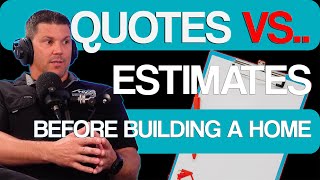
Norm Wales explains why estimates mislead and quotes matter. An estimate is a rough early guess, often free and vague. A quote is detailed and site-specific, built on full plans, soil tests, and engineering. Get multiple quotes and make sure they spell out what's included and what's not.
Chapters
An estimate really isn't worth the piece of paper written on. A quote is generally ascertained from when you've got full plans and specifications put together. A quote could be 20, 30, 40 pages thick. People don't know what they don't know. Hey, guys, welcome to the Builder's Edge. I'm Norm Wales from Norm Wales Constructions. Now, for me, the whole purpose of this podcast here is to bring a little bit more awareness around the construction industry. I've been feeling for many, many years that there's not enough helpful information out there to support you guys to make the right choice. Now, we are a smaller family independent building company and we're not here to build everybody's home, but we would definitely love to be able to work with you to facilitate your dream home. But if we don't build your new home, we want you to be able to make the right decision in choosing the right builder for you. So hopefully the information that I'm able to provide through this podcast can be informative and helpful that you can now create your dream home. So hope you enjoy it and thanks for watching, Norm.
In this episode, we're going to talk about quote versus estimates and some of the misconceptions around the difference between the two. What would you say the main difference is?
Yeah, so short and simple. A quote and an estimate. Now, a estimate is generally the early stages of a bit of a guide. So, you know, you might have a bit of a chook scratching. You come in, you have a chat and you can sort of get a bit of indicative idea on what something's going to cost you. An estimate doesn't generally cost you to get put together an estimate, you know, could be a basic one page or three page document if it goes that far. But an estimate really isn't worth the piece of paper it's written on because there's still so many ingredients and missing parts that isn't really going to give you a full roadmap to what things are going to cost. So that's where you'll get that in a quotation. A, A quote there is generally ascertained from when you've got, you know, full plans and specifications put together, the outsets of what the customer is wanting has been identified and then it is actually quoted live and accurately. And a quote could be, you know, 20, 30, 40 pages thick with all the detail of, you know, what the actual project is meant to involve.
Yeah, I mean, based off that description, I would say that they're two different things. Right.
100.
So at what point do people sort of run into hiccups when they're looking at quotes and estimates? Is it when people think they're looking at a quote but in reality they're actually looking at a rough estimate or.
Yeah, yeah, look, it can be very misleading, that size of things there, because some people don't realize that it is two different things. Like in the early stages, people have been told these prices, you know, and I said they're more of a guide and estimate, a bit of a starting point. You will get some building companies there that will call a quote an estimate or, or vice versa, you know, through things. But, you know, the, the main truth is to understand an estimate is a guide, a quote is actually a detailed proposal. So you're actually going to get some building companies that will say, oh, look, yes, we have quoted it, but it's actually more of a glorified estimate. As I said, you might get that 1, 2, 3 pages of, of detail there. And people don't know what they don't know. And I think, okay, this sounds great, all that, that's awesome. Let's proceed now and assign contracts from that there. But they haven't done all the plans and specifications. They haven't got soil test, you know, done. Or even if they have done a soil test and basic concepts, they may not have energy efficiency reports or engineering done. So to obtain a true quotation, you need to have all those specifications put together to get the right price point. Now, until that is done, if your builder hasn't had all that done that quote mores an estimate, you know, it's a guide. There's a big difference in the time spent on an estimate compared to a quote there. You know, an estimate can be done in half an hour, a couple hours, you know, whereas a quote, that can take weeks, you know. So it's a level of detail really between the two there. So it's really important to not get the two mixed up because a lot of people have come to us in the past and said, oh look, such and such can do this for that price. And my first question is, well, have they got a soil test done or have they got this or have they done the engineering? It's like, oh, no, not yet. So it's like, well, how can I give you this? Pricing? Yeah, it's a guide, it's an estimate, not a quotation.
Yeah.
So people get hooked into signing up for something that sounds too good to be true. And unfortunately, that's where some people can end up spending a lot more than they anticipated.
So that. So really, you've hit the nail on the head in terms of where the problem is at is when people think they're looking at a quote, but in actual reality they're looking at an estimate. And they, they commit to that estimate thinking, oh, that's what it is. And then before they know it, all of a sudden, oh, well, we didn't factor this in or that in or this in. The price of that glorified estimate then goes up, up, up, up, up.
That's all right. Unfortunately, that, that it is the case more often than not. And, you know, that's why it's so important that when people actually start going down that building journey, that they take the right path and invest in themselves and start from the beginning there, getting your full plans and specifications done and get the detail put into that so then you can actually obtain a proper, true and accurate quotation.
Now, I know that some builders charge for quotes.
That's correct.
What's your impression of builders giving out free quotes? What's your take on builders charging for quotes and builders not charging for quotes? Quotes?
Look, we all know nothing in life is for free. Now, if someone's going to be giving you something for free, there's generally got to be some form of a catch to it there. Now, there's not going to be any building company or any reputable building company that's going to spend those hours that's involved in doing a quotation. As I said, it can take up the weeks to get a quotation put together properly and collaborated than ones that are only working off concepts and doing base, you know, estimates. Basically, like building companies don't have the time to invest into delivering quotations on every single project that comes through there. That's why they create these shortcutted estimates there. And people coming through taking these estimates as factual, that's where they get very misleading.
So how can, then how can a family or homeowners make the right decisions when it comes to asking for a quote or when it comes to asking for an estimate, is it knowing when to ask for an estimate versus when to ask for a quote or.
Look, in the early stages, you will get an estimate there just through conversations and, you know, comparing previous projects and guides upon what people are wanting there. But the next step really is that if you're going to take that step forward and you're seriously going to be building, you need to invest in yourself and actually get full plans and specifications done. And then you can take that to multiple builders and get comparable Prices there. And it's going to be a matter of then comparing the quotations that are. I said 20, 30, 40 pages, six. That's detail to your site and your requirement specifically to compare equally.
Are there any non negotiables that you're like, yep, these absolutely must be in the quote and if they're not, we need to go back and get these done.
Look for a customer there. It needs to be identified with all the things that they've discussed with their builder that it should be listed into quotation. So a quotation should be very clear and easy to understand, you know, to the level of even yes or no that it's included or not. Do you know? I mean like if you don't understand the quotation, you definitely. I don't recommend signing something like that. You know, it's really important that everybody's on the same page and if it was on the same page and you know exactly what you're getting for the money that you're looking to invest, you know, then it's a much clearer path for everybody to take. If there's questions in gray zones, you know, more often than not you'll probably find it's maybe a glorified estimate, not a quotation being prepared for you.
Do you find that like with perhaps some of your customers or even some of the inquiries that you had, that there are some parts of the quote that people are perhaps still don't have full understanding across, that you find yourself having to explain over and over to get people sort of on the same page.
Look for ourselves, I believe our process is actually very clear and it's something that we spend the time actually going through the building proposal, the full detailed quotation there, in detail there, that line by line, item by item, it is very clear what you are getting. And in the event that if there's something that was listed there that didn't make sense, that's where you'd have a conversation around, that you would reword that or rephrase that there. Make sure it's documented for both parties to clearly understand and then once that is then clear, you move forward from there.
So obviously again it comes back down to that clarity and communication.
Yeah, look, you know, communication is always key there and if there's questions, concerns around stuff, it's at those early stages that conversations need to be had. So then both parties can all move forward together to have an enjoyable experience.
Love it, Love it. So just wrapping this up because I think this is pretty straight to the point when it comes to the, the difference between quotes versus estimates. But what final advice would you give to homeowners to help them avoid the misunderstandings between quotes and estimates?
Yeah, look, it's more the matter of you are going to get estimates along the way. There's nothing wrong with an estimate. You know, that's a starting point. But don't mistake what you've been told at the early stages is that that's actually what it's going to cost you. Because along the way plans get layered up, things change, different specifications come in. Could be a different soil test than what we all first thought engineers might require a little bit more. So after site inspections and that there as well, sometimes certain elements and things can change as well. So it's a matter of gathering all that information and then accurately putting that together and preparing a quotation. So just don't get caught up in the difference of an estimate to a quote and thinking that they are the same. You know, obviously always try and work to the estimates and people's budgets and where things are. But the reality is an estimate isn't really worth the piece of paper it's written on. What you're going to work off is really the quotation that actually is the actual facts to what you've asked for.
Yeah, love it. I don't think you can make it any more clear, mate. That's pretty bang on. On that note, I think we'll wrap up with get to know your Norm question and we'll wrap up this episode.
We don't want.
Yeah, top one. All right, that one goes back in the jar. Alrighty, here we go. Okay, this here, this is a good one. Okay, Norm, what tips would you share with others trying to find balance between professional and personal life?
Look, I think, you know, having a personal life and a professional life is, you know, really important to find a balance between that. But I think the true balance is. Is actually just saying true to yourself. You know, I think if you're being fair to income and real and just honest and genuine, that is the balance between the two. And they were both complement one each other, you know, but really when it comes down to running a professional business, there you've. You've got to do things correct, you know, stick to the right processes and you know, back yourself, you know, and ensure that you're delivering the quality at all times. But then I guess, you know, from the other side, it's just about making sure that you can enjoy both sides of it there, really just finding that balance.
Yeah, yeah, love it. Well, on that note. Thank you as always, Norm.
No. Pleasure. Thanks, mate.
Cheers.
More from Norm
Professional Builders Secrets Episode 104: Adopting A Learning Mindset With Norm Wales