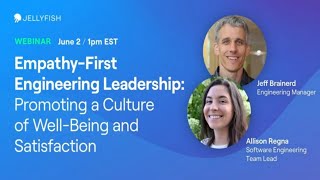
Allison Regna and Jeff Brainard discuss how empathy-first leadership prevents burnout in engineering teams. A 2021 APA survey found 79% of U.S. workers reported recent work-related stress. They cover burnout signs, how to measure it, and leadership practices that build healthier teams.
Chapters
I'm, I'm really excited. Uh, welcome everybody. Um, I'm really excited about our topic here today. And, um, I want to just hand it over to Allison first to introduce, to introduce our topic in more detail and also introduce yourself.
Yeah, sure, happy to. Um, so my full name is Allison Regna, and I am a team lead here at Jellyfish on one of our engineering teams. Um, Jellyfish was actually my introduction into the industry nearly 3 years ago, um, so it's been a super exciting and enjoyable ride thus far and continues to be. Um, but so our topic today is something that Jeff and I actually talk about a lot We're going to be talking about wellness and satisfaction in the workplace and how, you know, in leadership you can promote that type of culture. So we'll dive a little bit into burnout and what that is, what the signs are of it. We'll talk a little bit about burnout in a quantitative way. How might you measure or detect something like that and what the impact of it is? And yeah, just more broadly, Jeff and I will be having a chat in a little bit more depth than we usually do, but I'm, I'm also excited to be talking about this. This. So before we dive in, Jeff, you want to introduce yourself?
Sure. Thank you. Um, Jeff Brainard. Um, I've been at Jellyfish now for about 2 and a half years. I'm an engineering manager here. I've been in the software industry now for 20+ years, um, at some small companies, some big companies, primarily as an engineer, but I've had a number of roles and I really love to build distributed systems, and I love to build teams, which are really just another type of distributed systems, right? The hard, the hard kind. So I'm really excited to be here. And so let's just jump in. Let's, let's talk about burnout. First of all, maybe just, let's just kick it off with like, what is burnout? And sort of why is this such an important and timely topic?
Yeah, I mean, I think burnout is a term we've all heard, especially a lot in the last few years, but it's something that's always existed. I'll rattle off the textbook definition because I think that means something too. But so the APA, the American Psychological Association, has this definition that I'll read here real quick. So burnout is defined as physical, emotional, or mental exhaustion accompanied by decreased motivation, lowered performance, and negative attitudes towards oneself and others. So I think when I think of burnout, those things are definitely included. I think there's a lot of other signals that might point to burnout. One thing worth mentioning that's interesting from the same association, the APA. In 2021, just last year, they did a work and wellness study where they sampled— they did a survey of, I think it was around 1,500 US adult workers, and they found that 79% of people in that survey reported work-related stress within the past month. It's like a lot. That's— yeah, that's pretty bad, right?
A lot.
Um, Further in the survey, they dug into it a little bit more. And they said people were reporting lack of interest and decreased motivation and not wanting to show up to work and things like that. So it's clearly a big topic. It's been around for a while. But the last few years, as the global pandemic has taken over and teams have gone remote or distributed and people are working through hard times, I think it's just very much on everyone's mind. So I'm excited to talk about some of the ways that you might prevent or support, you know, individuals in an organization that might be going through some of this stuff.