
Making Beautiful Music With Colette Alexander
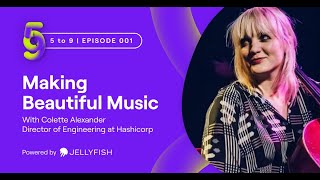
In this episode of the Five to Nine podcast, host Andrew Lau interviews Colette Alexander, a professional cellist, Director of Engineering for SRE at HashiCorp, and a Master of Science student in human factors and system safety. Colette recounts her unconventional journey from high‑school concerto competitions, through a brief stint aiming for law school, to a graduate program at CalArts that launched a decade‑long touring career with artists like Rachel Yamagata and Josh Groban. She describes the emotional high of playing sold‑out A‑market venues such as Madison Square Garden and the personal turning point that led her to prioritize family, graduate studies, and a more sustainable music practice. The conversation then shifts to her technical workflow: a custom cello pickup, a guitar‑style pedalboard (including a Ditto looper, POG2, Electro‑Harmonix reverb/distortion), DI preamp, multitrack recording in Ableton Live, and the post‑production pipeline involving stems, Dropbox sharing, mastering, and distribution via DistroKid and Bandcamp. Colette draws parallels between band dynamics and engineering leadership, emphasizing psychological safety and the "disagree‑and‑commit" principle, using Fleetwood Mac as an illustrative example. The episode closes with a personal recommendation of a Bluey episode soundtrack featuring Stravinsky’s Firebird.
Chapters
I had this moment, I actually had like a series of dreams that like Peter Gabriel told me I should be a musician. Like it was very strange. It was a very strange time.
This is Five to Nine, a podcast where we discover the hidden passions and hobbies that engineering, product, and technology leaders obsess over when the workday ends. Hey, thank you for coming here today. This is super exciting for me. Like we were kind of talking about your background and I was like, this is exciting. Because, uh, you know, well, I'm gonna let you introduce yourself for a second first, and then I'm gonna come back to why it's exciting. So, um, I'm Andrew Lau. I'm one of the co-founders and CEO here of Jellyfish, uh, but really here to talk about Colette. So please tell me why you're here, and then like, let's— and, and what you do, and then I'll tell you why it's extra exciting on two levels.
I'm Colette Alexander. I, uh, I'm a mom of two kids 3-in-1, so insanity. And I'm a Master of Science student at Lund University in Sweden, studying human factors and system safety, which is very exciting. I'm a cellist. I played the cello in rock bands. I think that's why I'm here. And also, I work at a company called HashiCorp. I'm a director of engineering for their SRE team.
Do you mind sharing your journey? Because I don't get to meet many folks that are like, oh yeah, and I play professional cello on the side, kind of. Like, how do those things like meet up and like, like how does that all happen? Because, you know, I want to be that all the things too. So how does one get there? Or how did you get there?
By the time I was in high school, I was like competing in concerto competitions and doing a bunch of other stuff and practicing like 3 hours a day. And after school, I would basically come home and practice until Dinner time.
Oh, you were like a good— like most kids have to wrestle with their parents for practice time and you actually do it.
I mean, it was kind of like my best friend, you know, like I— not that I did— I had friends too, like I had real friends too, but I hung out with my cello probably more than I hung out with my friends. And yeah, I just, I was really interested in it. You know, I, when I was 16 or 17, I sort of had— I like overplayed, and so I had problems with like numbness in my hands. I had to like kind of relearn how to play. And that was around the time that you would normally prepare for conservatory, right? Like if you're like super classical instrument nerd, you're like prepping for your conservatory audition when you're like 14, 15, 16.
Oh, so you knew it early on. This wasn't just for kicks. Like you were feeling that.
I like kind of knew I wanted to do I want to do something with cello. But then this thing happened and I couldn't really prep as much. And I sort of was like, you know, I don't think I want to go to music school. And so I went to Sarah Lawrence and I— and when I was also in high school, I hung out on Freenets. The first Freenets in the world were happening. So I was on M-Net back in the day. In college at Sarah Lawrence, I ran the student-run web server. I was like a systems administrator for the student-run web server on campus.
You were working both sides the whole time.
Yeah. So that was like how I got into computers. Nerd things. I had studied academics as well as cello the whole time, and I thought I was going to go to law school. And then September 11th happened, like my first week at, um, at my senior year in college. And I had to take my LSATs like 5 blocks from Ground Zero, like 3 weeks after it happened. So that was really wild. And I really felt like the world had gone insane. We had this, I had this moment, I actually had like a series of dreams that like Peter Gabriel told me I should be a musician. Like it was very strange. It was a very strange time. And I was like, you know what, I think I need to try to go to music school. But I felt so unprepared because I had not been at conservatory for like a master's degree. But I found this program at California Institute of the Arts. They do like world music there. They have like a lot of different like avant-garde contemporary classical program, like folks composition. So I decided to go to CalArts for graduate school. I played like 7 hours a day at CalArts and I still was like, oh, I don't know what I'm going to do. I'm not really a classical musician. I don't feel like a classical musician. I'm learning all this world music. I'm learning all this contemporary music. I'm learning composition. And I was like looking at like Foreign Service exams and like, I don't know, maybe I'll like go do entry level. I had no idea what I was doing. And 4 days after I graduated, I had an audition with Rachel Yamagata, who's a singer-songwriter. And she wanted a cellist to tour with her. You know, I was one of the only cellists who showed up who could improvise with her, who was willing to just sort of sit and improvise while she played. A lot of other cellists needed like sheet music and stuff, right? And so I fell into like touring with rock bands and working with rock bands for about 10 years. 10 years. So that was like, wow, like all over the place. Yeah.
All right, so that tells me how you got there.
Yeah.
How did you come back?
Well, you know, I think like I worked with a lot of really awesome singer-songwriters. The relationships that you develop with people that you tour with are super tight-knit. It feels like you're at summer, like you're at summer camp. And so I loved, I loved it, but coming home from tour is really hard, um, because it's sort of like coming down from that like you know, high. And I found relationships very hard to keep, like romantic relationships were really hard to keep because I would be out for, you know, sometimes if I had a good year, I would be out for 9, 10 months of the year. I would just be on the road.
Oh my God. All right. And that's a lot of traveling.
And in 2007, I got a really amazing gig. I was able to tour with Josh Groban as his solo cellist. And I was sort of subbing for a cellist that had worked with him already, but she was out on tour with Niles Barkley. She couldn't do the A markets, which is what they call the big city parts of a tour.
A markets, I'm gonna learn that word. Am I an A market? Is Boston an A market?
Boston is an A market. I did Boston on this tour with Josh. Yes, word, word. So I did the A markets with Josh as his solo cellist, and I was really like, This was like the highest low. I mean, we played sold-out show at Madison Square Garden, right? And the Staples Center and all these huge places.
And you got— you got— you can't just drop these A-market names like, well, what is this Madison Square Garden moment? Like, what to talk about this thing?
Well, I mean, with Madison Square Garden, it was like, so sold out when you're met— when you're playing a show at Madison Square Garden is different than sold out when you're doing a sports thing, just so you know. So because they have to like block off part of the back of the arena, because unless you're doing a show in the round. So Josh had like a proscenium show, right? So like he had like parts of the thing blocked off, but I want to say it was like 18,000 people still. Still a lot of people.
Yeah, a lot of energy. No pressure, no pressure. Yeah.
So we're playing these shows, we played Madison Square Garden, and I remember like walking off stage, I would have a break for about one song length during the set, and I would walk off stage and like have a glass of water or do what I needed to do backstage and come back on. And I went backstage and I looked in the mirror and I was like, "Is this it? This is it. This is it? I'm 27. Like, this is it? This is just a show. It is an amazing show, but it is still just a show and it's ephemeral." And I was sort of like, "If this is like the coolest thing I can say I've done when I die, is this like, am I cool with that?" And I was not cool with that. I was very like, this is cool. I'm really grateful for it, but I want, I need something more. Like there needs to be something more. And I realized in that moment I wanted to have kids. I realized in that moment I wanted to have a relationship. I realized in that moment I wanted to like make my own music and like kind of own what I was doing more, right? Like there were a lot of other things I wanted. So I started kind of moving away from touring.
Post that, like, you know, what's the synergy? Like how do you, What's the, what's the, hey, making your own music, but not touring, but yet have like, and some of this engineering stuff, like in life, like how did you, what is the new mix?
Well, right now the mix is like, I have two kids and I try to do work. Yeah, yeah. Up until I had my first, my daughter, who's my oldest, I played a lot. I actually like worked on the last big record that like came out. Like is on Spotify and all the things, uh, that I worked on, I worked up right up until she was born, um, August of 2020. So I like, I, I have like probably pictures of me like super pregnant, like in this studio trying to like, you know, play while I'm, you know.
Oh yeah, cello is hard to hold.
Yeah, right. This is, uh, you like, my teacher actually had like a permanent mark on the back of her cello from when she was pregnant with her daughter because it just sort of like rubbed up against the back of her cello over and over again for 10 months. Since then, I've just been sort of like making do. I think you make do, right, as a parent, because your kids just are—
That is absolutely what you do, right? Like, I'll give you a preview. Like, for us, I mean, it's like this morning, it's a scramble of like one kid won't eat this, the other person like wants to eat school lunch or not. And like, you're like, okay, haven't eaten vegetables in several days. Is that okay? Like, I gotta get out the door, I gotta get here by, you know, this slot. Like, we're just gonna cram some stuff in a lunchbox and cross fingers, right? Like, it's just, you make do. Well, hey, you were talking about your, your, your touring experience, and how do you think about it? Because, you know, Peter Gabriel has come up once already. When we first connected, you told me you just came off a concert, and the feelings, can you express, like, you know, like, hey, are you getting, you know, like look, you don't have as much music in your life now. How does that feel? Like, what does it mean? Right? Um, how do you think about it?
Kind of sucks. I mean, like, my goal is to go back to playing, to having more time to play, but I know that something has to give in that balance of my life. Like, my kids will get older. I think that will help. I will finish my thesis for school. That will help. I think I have to go to some kind of like part-time, like consulting tech thing at some point, because I don't— you still only have so many hours in the day. So that's my goal.
We've talked about the things and how you got here. Can we hear some of your music?
Okay, I will do a shout out to Greg Laswell. Here's about 12 of my cellos right up top.
I mean, I like this Greg person, but come on, the cellos, that's what it's about, right? Hey, so that is dope. Uh, so that was worth all the AV work here. Uh, it was totally worth all the— so, all right, now you gotta teach and we're gonna nerd for a second because I wanna— yeah, you just said there's 12 cellos. I see one of you. Yes. Um, so how the hell do you do this? Like, what's the tech? Like, how would that How do we do it? Right? Like, what happens here?
That's Magic Studio tech.
Talk to me like I'm a 5-year-old or maybe a 3-year-old. Like, what happens here? Like, how do you do your tech vibe on this thing?
Well, that's Magic Studio tech. So that's just like keep rolling and retrack, which is, you know, the studio. But when I'm doing live stuff, there are a lot of different options. I actually have my pedalboard here if you want to see it.
Yeah, hit me. Like, show me, show me, show me. What is this? And like, again, I confront like I know what you're talking about, but like, what is— oh my God. Look at that.
I really like to play with guitar effects pedals, which are, yes, made for guitars. There really aren't any effects pedals made for cello, as far as I know. But they sound kind of cool. But anyways, the one far on the left, the tiny little one, that's called a Ditto. And that does live looping. It's like a very basic looping. Like, you can get other looping pedals that are much more advanced. But the Ditto gets the job done.
So, okay, so I, I know what a pedal is for a guitarist. I never see them for cellists. And so like, both, like, how does that work? Like, how do you, how do you hit them? Like, like last I checked, cello doesn't have a, have like, it's not an electric cello, right?
Because I, you know, like, no, I have like a pickup on my cello, like in between the foot of the bridge and the cello itself.
Oh, you just gotta like just attach it. You can just attach a pickup to it.
Yeah. Yeah. They make them. There's like a guy in New York who makes them for instrumentally. Like, it's, it's a very— it's a niche. Like, rock violin and cello is pretty niche, but he makes these tiny little— like, it's just a copper transducer and it picks up between the bridge and the, the wood.
And then that thing feeds to an amp or something like that, and then you—
well, so I go into a tuning pedal just like a guitarist does. This is like a, a, an acoustic DI, so that like boosts signal and I can like normalize a little bit there. And then I have like, so my, this is like what I would call my standard pedal chain plus one, which is the POG right here. But like, this is my distortion pedal. This is like a Cathedral Electro-Harmonix pedal. It has like a lot of reverb and delay and stuff. So I can like switch through this on settings. And then again, this is my looping pedal. This is the POG2, which is like, it's supposed to make guitars sound like 12 strings, like very, and this kind of actually makes the cello, like if I'm going through like delay, And then this, it kind of makes my cello sound like an organ. It's pretty cool.
I mean, by the way, just for everybody here who can't see, like, I'm looking at this thing that's like a 2-foot by 5-foot board that—
it's pretty big—
Bella is kind of holding on her lap that, like, I don't know, it's— and how the hell do you do it? Because, like, I'm looking at this thing, and last time when we played cello, you got both your hands tied up.
Yes.
You got your, like, cello straddled between you.
Yeah.
I don't even see how you touch this board thing. Yeah, you're, you're right now holding above your head for me. That's like— yeah, so like, how do you do this?
So this is the— I don't know if you can tell, but these are sort of arranged in a slight semicircle, like, and I sort of put them to the side of my, like, my right side. So this front line I can control with my feet while I'm playing, but you kind of can't see anything like while you're doing— so I'm very jealous of guitarists a lot actually who who can see the pedals when they hit them, because you kind of have to learn by feel how to, what to do. So you kind of have to have presets and sort of figure it out. But with the POG, I just, that's why I just, you know, it's sort of up on the second layer and that's usually, I would have to manually intervene and reach over, like turn it on and whatever. I wish I could play standing up. It's never like, it doesn't feel right to me.
So, I mean, gee, you've already accomplished having won a 3-year-old, like a Masters while doing a a structural engineering job and playing professional cello on Spotify. I mean, why not just add stand-up cello to that? Like, you just add that.
I could probably figure it out, but also I'm 42 and I'm tired.
Okay, well, since we're in the nerd stack, that is super cool, by the way, and thank you for sharing some music. And, uh, like, I'm gonna close out with another one in a second, but like, but, um, can we go up stack, right? Because we're, we're a group of nerds here. So like, okay, we already said we're kind of going through the pedals off this thing, and I'm guessing then those things feed into a computer, or like, what do you— like, how do you go from the last of the pedals, like, where does it go?
Yeah.
And, and then, and then like, where do you go from there? I'm gonna keep pushing up stack till we get there. So there's your pipeline.
There's an XLR and it goes into, um, an 8-channel or maybe a 12-channel Claret, um, uh, like preamp, like rack unit on my— I'm, I'm currently sitting at my recording studio desk, which is also my office, home office. Um, and, uh, and so that Claret holds all of— so I will often, when I'm recording, I have my line in from my pedalboard, but I also will have a few different lines from different mics placed throughout the, the room, some closer to my cello. I have like an omni back there that's like further away that's sort of getting room sound. And so I mix all of those into, um, Ableton live, and those are like the full set. So I usually have like— my standard would be like 4 to 5 tracks of cello, like recording at the same time all the time.
And that way you can kind of— when you go to edit, you can, you can pick which, which sound you want.
Yeah. And you can almost like— you can also— I'm not as, as adept at this, uh, yet, but it's something I'm interested in. You can make— you can almost make this the song about where the mic placement is. Colin Stetson does this really well with saxophone. I don't know if you've heard of Colin Stetson, but he, he plays saxophone. He's an instrumentalist saxophonist. He also plays with like Bon Iver and like he tours with a lot of different people, but, um, he has these instrumental saxophone records and like he has like mics placed on the saxophone. And so it sounds like there's like percussion happening, but it's really just like the heavily mic'd keys that are hitting. It's really cool sounding. So I like to think about things like that, right?
You record it, you're going to go and edit, right? But then when you edit it, like, you know, like I'm dated. What does it spit out in a WAV file, an MP3? Like, where does it go from there? And then where do you put it? Like, does it sit in a big hard drive? Like, again, I'm in the nerd corner here for a second.
Yeah. So if I'm working with a producer on a cello arrangement, I usually take all the stems, so every single individual cello track. So he'll have to do the like clap. Sync with them, right? But they should be easy to do because they're just like— everything starts at the same point, so it should be automatically for him. Um, but I send all of those stems in a Dropbox. I put them in a Dropbox folder. The, the, the engineers of the world, the sound engineers of the world prefer Dropbox in my experience.
Um, I wonder if the Dropbox guys knows it, if there's like a vertical.
They're like— I mean, it's so funny, right? Like the Postal Service is like a band that like used send their files to each other. Like, that was— they got their name because they would like mail each other things. But this was like pre-Dropbox. So like now everybody uses Dropbox.
Is there going to be like a band that's a terrible name called like The Dropbox or something like that?
Maybe.
It's going to be like, yeah, it's coming. Okay. So it goes there, they do their thing, and then where does it go?
Well, and they'll like tell me to fix some things or like we'll have back and forth, right? So that's part of the deal is like, they're like, oh, can you play this there? I liked this, but I want it earlier. Or, you know, other stuff. So we go back and forth, we finalize everything, and then they get the stems, and then they can send it off to mixing and mastering with their people. In my case, if I'm making music for myself, I will send it to, uh, like, my good friend Charlie is someone I work with a lot who— he's like Steely Dan's front of house guy, so he's pretty good at sound. Um, and he has a studio, he does mastering and mixing. So I've worked with him a little bit. And then, you know, you mix it down into like one terribly condensed, hopefully not too terribly mastered MP3. And then you send it to the distribution places.
And what are those distribution places? Like, because, all right. You know, what do you do?
If you're an artist and you're on a label, then you have like official distribution through the label. But if you are doing your own labels, stuff.
Yeah, if you're a Colette, like, what do you do?
You sign up for like DistroKid or— well, oh well, I have myself on Bandcamp. Um, colettecello.bandcamp.com. You can hear something.
See, boom, hit it.
Um, sorry, I didn't realize you were trying to get me to drop my Bandcamp or SoundCloud. I don't have a SoundCloud.
Yeah, I'll see. I was gonna give you props because people want to— I want to find you. I want to find the stuff.
Yeah. And then obviously you heard stuff from my reel, which is stuff I've worked on with other artists. Um, that's on Spotify. You can just look up Colette Reel. I think it's a public playlist. Yeah.
This is awesome. Cause you've now kind of given how you got here and how, how this all fits together from like the nerd plumbing, the SDLC of, of cello production. Right. Uh, we can optimize that pipeline. Right. Uh, but, but like, how do you kind of fuse it together? So like you clearly, you know, we are all products of all the things we've done and how we think about things. Like, so how do, how does this, how does this world of music project back to the way that you think about engineering stuff and like, or vice versa? I don't know. Like how do they influence each other?
I mean, I do definitely like to say like everything I needed to learn about being in engineering management, I learned from being in bands. And I think that, that it starts with psychological safety, which is obviously very used and in some cases overused and misused now in the industry, but like. The example I love to give people when I talk about psychological safety is Fleetwood Mac and like about how they made one of the best records ever while they were all still fighting with each other. So it's not like, you know, it's not like you have to like totally be in perfect harmony, right? It's like, but you do have to feel safe enough to like talk about these really important things in order to—
Can I riff for a quick second? Yeah. So I, so, you know, We started this company, there's 3 co-founders, and Dave and Phil actually hired me, gee, 24 years ago. So I've known these guys for a long time. And sometimes you meet people and be like, oh, you guys all, you guys almost get along, right? And I'm like, no, we fight like 25 years of spouses together kind of stuff, right? Like, but I just, so I completely agree with you. I'm riffing with your comment around Fleetwood Mac. It's not that like, you actually always get along and you're all kumbaya. In fact, you actually need some diversity and some argument sometimes on stuff. But I've learned, what does it actually mean to know and respect someone for a long time? And this goes back to team, is you're willing to finish the argument.
Yeah.
So like, if you don't respect each other, you're like, hey, they don't agree with me, I'm out, right? And you're done. Like, there's no room for it. And I think what, um, or it's a version of trust or respect or whatever word you want to introduce in here, but I think it's in the same vein you're talking about. You see the argument through, you, you finish the production.
Totally. There's nothing more indicative of disagree and commit than having a fight with your bandmates and then walking out on stage and playing a show together. Because like, you can, you like can fight all you want. You can like disagree all you want. You can annoy each other all you want because you will, because you will be stuck together for 24 hours a day, and like, that's just life. Um, but when you go out on stage together and you look at each other and you work and you, you play these songs together in front of people, it's like, it's your higher purpose. It's like why you do what you do. And, and it is like, I may disagree with you in these situations, but like, we're here to do work. Like, we're here to make a show happen, and it's, and it's where we connect, and it's where we like It's what we love to do. And that is like the ultimate disagree and commit moment.
What's a little something cool you watched, you learned recently, or you bought? Could be like, hey, like what's, you know, piece of media, something you bought that's cool that you want to share that may have nothing to do with cello or engineering stuff, but you just think is cool. Cause we're all, you know, you're an amazing person. What you think is cool is probably really neat. So like, what's something you discovered? You're like that. Is it?
One thing. Okay. So there's an episode of Bluey. It's where Bingo has a dream. And I just want everybody to know that this— the— I really hope that they release. So the Bluey soundtrack, this Bluey Season 2 soundtrack called Dance Mode is also— is really cool. But I— for some reason, they haven't released the This is like Dvořák, or I think it might be Stravinsky's Firebird, actually. That is almost the entire soundtrack for this one Bluey episode. And it just blew my mind because it was so perfect. And that's, that's where my brain is right now. Bluey episodes and Stravinsky.
Hey, Bluey producers, you hear that? We want that on Spotify, like, now. All right. Well, hey, Colette, thank you so much for spending time here today. This is like so much fun. And I know we all had to make room given kitten mornings and breakfasts and balloons and all that jazz. But it's wonderful to see you here on this, and it's been a lot of fun. So thanks for being here.
Thanks for chatting. It was super fun.
Andrew Lau here. I hope you enjoy this episode of Five to Nine. Don't forget to subscribe so you don't miss out on our next episode. Who knows what hidden talents or hobbies we'll discover on the next episode of Five to Nine.
More from Pamela





68% say AI enhances efficiency. But only 10% report strong AI enablement. More trends on May 7.

68% say AI enhances efficiency. But only 10% report strong AI enablement. More trends on May 7.




