Agentic Commerce 3.0: How Businesses Operate When AI Runs the Market
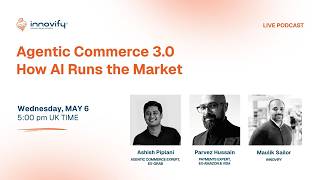
Parvez Hussain and Ashish discuss how AI agents will reshape commerce and payments. The panel maps three agent models, warns that Europe's regulatory path diverges sharply from the US, and identifies data readiness as the critical blocker for retailers preparing for 2026.
Chapters
And, uh, all right, cool. I think we are good on time. Let's, uh, kick off our podcast. And, uh, you know, we have plenty of RSVPs today. So I'm hoping that this session will— it is actually one of our most popular, most RSVP ever that we have received on this series of podcasts as well as compared to the previous one. So really excited about today. Anyways, for folks who are joining us online today, welcome back to Get Future Ready podcast. Where we cut through the noise and get into the real hands-on decisions that senior leaders at retail and e-commerce businesses need to make now, not in 5 years' time. I'm your host, Maulik Sellar, and I'm founder of Innovify, a specialist venture studio focusing on the intersection of fintech, e-commerce, and AI to build the commercial infrastructure for tomorrow for companies across the UK and US. If you're joining us today for the first time, That's great. But I just want to iterate that this is part 3 of 2 previous podcasts we did on the same topic about agent e-commerce and agent e-payments. And if you haven't listened to those parts, then just go to our online channels like YouTube or Spotify or even on LinkedIn Live and just search for Future Ready Podcast with Denoify and you'll be able to find those. And we had plenty of insights on those two podcasts, and we're going to continue with our conversation today with slightly different take and slightly different, you know, panel as well today. So we'll cover quite a few points where we left the previous one, and this is going to be the last one in the series. So we will leave with a few insights or tips on where the leaders need to focus if they are tackling the agent e-commerce phase. Right. But before I go into more details, let me first introduce our panelists today. Let's start with the familiar face. You know, Parvez Hussain, again, would be great if you can introduce yourself. You know, our audience have listened to you before, so why don't you start with your familiar intro?
Of course. So let me set the frame for this episode. I spent nearly 2 decades at Visa watching every big shift in payments. So from cash to card, from click to tap, and every time the goal was the same, to remove friction from human in the loop. And now the human is leaving the loop and that's changing everything. So the shift impacts the customer, the merchant, the bank. And that's what's fascinating me in terms of the intersection at the moment.
That's great, Parvez Hussain. You know, you are new today. You know, welcome to this podcast series. You know, you had amazing career at some of the leading e-commerce platforms and now you are running your own startup within an agent e-commerce space. Why don't you introduce yourself, talk about your background and what you are focusing on now?
So I'll also set up a frame. So, uh, I started my career with Walmart, like the biggest retailer on earth, right? And my journey has been in commerce, uh, from commerce in retail shelves in Walmart to Flipkart, which is e-commerce, like a biggest e-commerce giant out of India. Then I moved to Lazada, this pre-Alibaba days. It eventually got bought by Alibaba, so I was a bit in Honjo as well. And then I moved to Grab, which is like instant commerce. So only made sense to move from commerce to e-commerce, instant commerce, to do something in agent e-commerce. So now I'm building Airshelf, where we help enterprises become agent e-commerce ready. And along with that, we do a lot of like orchestration as well within the commerce space using the agents that Okay, great.
You know, wonderful to have you both again today. Like, again, Parvez Hussain, and, you know, first time with Nasees. Let me just quickly recap on what we discussed in our previous two episodes. We spoke mainly about different kinds of agent e-commerce, you know, where agent could be acting on behalf of the user, doing exactly what a user would do. Or an agent acting, completely replacing the user and directly interacting with the e-commerce platform, maybe directly with the databases as well. And then a third version where the agents are buying and selling directly with each other, bypassing the traditional e-commerce platforms. We also spoke about the problem with fraud. How do you really differentiate between a genuine agent session versus a fraud fraudulent session attacks, trust identity issues in this space. We spoke at length about that. We also spoke about payments, how payments come into play. Ultimately, the money has to flow. What are different, like what is happening in the current ecosystem? What are the big players trying to do? Visas and Mastercards of the world, the new protocols emerging out within this space. We spoke about friction versus frictionless payments. We also spoke about micropayments and nanopayments that could be made between two AgentX sessions or two AgentX buyers and sellers. And, you know, the use of stablecoins and so forth, right? And then we also spoke about the possibilities in the near future that could happen within this whole agent space, right? So building on that, let's start with our current state. This is kind of a retreading from previous podcast, but you know what would be good for us to recap on in our understanding, what part of agent e-commerce is already defined or solved for, and what is still to be done? Right? So why don't we start with that? And as you know, you're new, you are pretty much in this space, you know, hands in, day in, day out. Let's build on what you are seeing every day.
Okay, cool. So I like the way you said that about authenticity and, you know, whether agents are good or not. Actually, let me like tell you two stories on this, right? So the first one is traditionally bots were seen as bad, right? There's DDoS attacks. We used to face that a lot in marketplaces that we built. And recently now bots are good. Somehow they have agency, somehow they want to pay, somehow they want to discover your catalog. And what we see in the market is there's still a lag when we work with these enterprises. Some of them outright block the bots. And some of these bots are like OpenAI bot represents 1 billion weekly active users on the other side. It's like leaving money on the table. Doesn't make sense, right? So we have like this kind of a lag between where the infrastructure is, where the enterprises are, and the willingness to pay which now bots have. So that's one interesting trend I see. The second is like in general the way e-commerce, the agentic commerce is going, I think there's two bubbles kind of emerging. So on one side you have like completely autonomous payments, you'll see like Reddit, even Salesforce recently became headless so that you can do micro and nano payments and start accessing real-time data, or in case of like drones, real-time access to telecom networks. So that's one that's happening, but it's not yet real end-to-end for the normal, like, you know, things that we buy, the soap and the shampoo and, you know, like other things. There, agent e-commerce is there, but it's not like end-to-end agent e-commerce. It's basically agent-assisted commerce. So the other side of Barbell is B2B buying, or like you have a high-spec retailer, let's say printers, where there's no joy of buying printer and the amount of specs inside there is so high that you probably will ask your agent, hey, can you compare among these 3 printers? And then the final step still remains with the human. So those are the 2 like bifurcations happening, and in the middle it is still yet to arrive, sort of based on our understanding of the market. But the two bubbles are emerging now.
That's great. Parvez Hussain, do you want to add something to what Ashish said?
So the thing— so if I bring it up a level, we need to acknowledge the difference in approach between the US and Europe. So in the US, agentic commerce is being driven by technology. In Europe, it's, it's being shaped by regulation. And that's why the Europe versus US distinction matters, because the US has pushed forward with products into the market. However, the UK and EU are putting up the guardrails in place. So it matters if you do the business here. Regulation is going to be something that detects, you know, it really dictates the adoption speed. That's the thing I would add.
Okay, cool, wonderful. Um, I want to address the, the big elephant in the room, you know, when we talk about agent payments and agent e-commerce, right? The liability, the fraud and reliability. Now, agents by definition are going to be probabilistic and not deterministic, right? There's always room for error, and there is a chance that a transaction may go wrong, and there is a liability coming out of that, right? Now, of course, this is not currently defined. You know, there's still a lot of moving targets in the industry or evolving discussions in the industry going on. And this podcast today is about the future state, you know, what the future holds like, right? So in an ideal world, projecting forward, what do you guys think? How can you, what would be an ideal state here, you know, in terms of the liabilities? Right. Anyone? Parvez Hussain, let's start with you. This is your ballgame.
So, so in terms of liabilities, In a word, right now the systems are being worked out. So firstly, a reality check in Europe. AgenTic AI, it's not, it's not properly live across UK and the European retail yet. However, it's, it's already kind of starting to streamline the retail processes elsewhere, as, as Ashish was mentioning before. Um, so that's kind of our baseline in Europe. Europe's probably, I'd say, almost 12 months behind the US. And it's not that Europe is asleep. It's, it's a structural thing. So we've got 3 things that's slowing it down. If I think number 1 is GDPR and the way data is handled and stored. And the second thing is that we're in this big payments transition with PSD3, which is coming more in 2028. And the third thing is, and this is the vital piece, it's the consumer trust gap. And when I, uh, one of the things I was reading, a BNP Paribas survey of shoppers, it basically said plenty of people are already using AI in the purchase journey in terms of discovery. However, confidence in kind of actually allowing it to pay you know, especially when people can't tell if it's a genuine recommendation versus a paid placement. So I believe that's the key point in, in the window. Europe has it— it's got a huge potential in terms of global consumption. But so small moderate adoption would really create a sort of a big movement in retail and consumer sectors. But that trust element, building that trust is key.
Parvez, what do you think?
I mean, so we also operate globally. We have like clients in like Europe as well, Australia as well, US. Clearly US is ahead in this, right? The last holiday season, agentic shopping was like 10x more. That one year that grew like almost 10x if I'm not wrong. So I think what we see is that the categories which are problem first, uh, I'm talking about retail right now, uh, that is where you see traffic, uh, over-indexed. I'll explain what that means. It's like if you are looking for a product, then probably you're going to Google and search that or go to Amazon and buy it. But if you have a problem, uh, and it could be like DIY category, right? So we are working with one of the biggest DIY retailers in Europe. So in those categories you generally come with a problem that hey, I have my kid's birthday, I want to buy something for her or for him and then takes you from the journey from problem to like a set of product and services. That's where it is coming early so that's one layer and that's where the consumer trust is slowly building and then generally those categories you don't really care. For example your charger is broken for your laptop. You don't really care if it's black or blue, as long as it works, has good reviews, you're good, right? So those are the categories where we see a bit of like over-indexing. Obviously these are lower single digits, so it is still a smaller niche portion of any of our customers' business. But you know, you never know the way world is moving now, what becomes mass quickly, we don't know.
I have a question for you, Ashish. So is there a different kind of attitude from between buying something on a regular basis versus one-off type of purchase?
Yeah, I want to build— sorry, sorry, Ashish, before you answer that, I want to build on what Parvez says. And I was thinking the same, you know, as you were talking that You know, when you talk of e-commerce, at least in the current day and age, e-commerce is everywhere. You can buy low-value mass market product, you know, where you don't really care about the utility as much, as well as, you know, high-value, high price point products where the utility is really high and you wanna make sure that you're getting the right product. Plus there might be a lot of customization required as well to make the product work. Product or service, you know, in that sense. Where are we seeing this adoption and the trend in terms of like, you know, the agent e-commerce and payments? You know, where do you think the industry has had it first, right? You know, of course it's going to spread over all everywhere, but you know, where is it right now and where could it be next?
So I can— so one on the agent payments, right? So that's where Parvez Hussain, you are the expert. But what we see is that these low stakes purchases. And again, these are like where we see traction. It's not— that's not traction from businesses, does not mean traction from users, right? So what we see is that, okay, yeah, it makes sense. I'm a retailer, uh, there's like— now you're aware of Stripe and, you know, like all these like payment providers have now agent-take-token payments where you can say, here's my $100, take it and buy, uh, 3 things that I need. And Those 3 things could be I'm traveling and I need a world adapter and I need a power bank, right. Just build that basket and do it for me. So that's where you are objectively providing better user experience for your end customers, right, and then that shows up in better conversion. So those are the categories or the use cases where there is traction, right. Low ticket purchases, the ones that you mentioned, I think you were hinting towards groceries for example, right. There it's like subscription is good enough. You can subscribe for, I don't know, like utilities and that's good enough. It's not there yet, we hear conversations with some of these like big brands like hey, telemetry data could work there. For example, you put like a sensor on your refrigerator and then it automatically detects that the egg tray is empty and triggers the purchase. But right now subscription as a business model in those like regular purchases is so good I don't think— I think it's very hard to like, uh, kind of, uh, unseat it so easy. It makes business and it has better retention and all those things, right? Uh, and I tend to kind of like that subscription model because I created one of the, like, the leading subscriptions in Southeast Asia. So I have like a personal affinity to it as well. But really it is coming in those like low ticket items. And then as I mentioned, uh, we label it as agent e-commerce, but that agent assisted commerce in B2B, and it's a very interesting thing. So we are doing a bit of research, and Walmart had 40% of their procurement anyway happening in what we now call agent e-commerce, but it was then ML, which is, hey, I'm going out of stock tomorrow, programmatically buy this from P&G, right? So we just changed the name, but looks like in B2B it was already there, 40% of Walmart's procurement was happening that way. We see that already now in like some complex categories, but the end decision where you have like, hey, two options are created, choose one versus B, that human in the loop is still there in these high-ticket purchases, right? So they're like two, as I said, there are two sides of it. The middle layer is kind of empty, or maybe it's lagging behind. It's either like you don't care about that SKU and you just want the problem to be solved and you're okay if this goes wrong, right? Okay, agent orders something weird, so what? You can return it. And on the other hand, all this like agent-assisted buying is happening.
That's good, that's good. Right now, let's build on that, right? Now clearly, as you are working in this space, you know, you would certainly have a forward-looking view of what the world looks like, right? And as I understand about your focus area, it's really the top of the funnel where the discovery, the merchant discovery, the product discovery, and all those things comes into play, right? So again, you know, just to remind our focus of talk today, you know, what does this forward-looking world look like? And in your mind, What's the state of discovery, right? You know, is SEO dead going forward? You know, is AGO the new commerce platform? You know, do we need storefronts or not? You know, do we need to do Google Merchant Feeds? You know, there's so many questions around here. What's your take over there?
You mentioned storefronts. I think storefronts are still there. It has been there pre-e-commerce, you know, like as a young kid in India, I would go to a storefront, right? Just that the storefront shape changed. When internet came, website became the storefront. When the mobile came, app became the storefront. When the social came, your feed became the storefront, right? In the agentic era, your storefront would be a data layer. Think of it this way, like no one goes to Porsche.com to buy a Porsche. They go there to just look at it, right? And then they go to their dealer and say, I want this color, this financing, etc. So similarly here, I think where it is going is that eventually brand.coms will become purely UX-based meaning you go there just for the branding. Right now, if you think about it, they're half-assing. You have like some brand content, beautiful pictures, and then you have like a category and like complex looking dropdowns to kind of navigate. I think that will go away. What we'll have— what we'll have is like you have the front end which is brand heavy, and then you have a backdoor entry which would be the data layer which we are basically building here at Airshelf., and that's where you go for your purchase. And that purchase did not happen on the website. It could happen via your Siri, could be your WhatsApp or whatever, iMessages, whatever you use. And you say, hey, I looked at it, it looks great, I want. And this particular AI assistant you have would have all the information about you. So one thing that we believe is that ChatGPT won't replace Google. I think it will be millions or like swarms of agents and, uh, like, Smallik will have your own agent and it will know everything about you, which you may or may not want to share to ChatGPT, right? So that memory layer is yours, and then you have your agent who is doing this, like, you're delegating stuff to it, right? And one of the tasks would be commerce, and that agent has to go somewhere, and that somewhere would be that data layer, which would be the unsexy sort of storefront, which is backend. So that's how we are thinking it's happening.
Cool. So just to summarize that thought is effectively your data layer or product catalog is not only your backend, but this also is your potential new storefront that you need to manage as you would manage your websites and, you know, your physical storefronts and whatever, right? It's fair to say?
Yeah, I mean, you can add commercial logic also on top of it. So it's not just the catalog. Because the way agents want to discover, like in the human world, you have cognitive bandwidth, which is limited. So what you put on the label of anything is that, hey, these are the two, like let's talk supplements. Magnesium is better for sleep, right? So you write that, but magnesium may be better for 10 other things, just that there's no space on the, uh, like you don't have cognitive bandwidth to like look at other 9 benefits of magnesium. For an AI agent, they don't have a context window. Like, they can just— like, you can throw in all the information. So the catalog needs to be optimized for this agentic discovery, which is part of what I think this whole discovery layer and the orchestration layer is made of. Uh, so yeah, so you have to do a bit of that as well, but I think more or less you got it right. Yeah, okay, cool.
You know, one thing which always kind of puzzled me, uh, or, or maybe I'm not aware of a solution, maybe it's already out there, But you know what, generally, you know, let's say you want to buy a product. So the user has a need, they go on Google or Amazon or Walmart or in the store, look for the product, you know, maybe compare with 10 other merchants and then make a decision to buy, right? But the user always has a thought process in their head, as in, I want to buy this product by this particular date. Right, or a day at this particular price, right? That I'm not going to pay more than this, or I really need this product now and I'm willing to pay any price for that, or whatever the price of the market is, right? Sometimes you're like, okay, yeah, I want this product, but you know what, I'm not going to pay this price and I'm happy to wait for sale or discounts or negotiate it down to a level that is comfortable, right? That is how a typical, like, you know, the commerce happens, right? And this is all always has been a user-led. But there could be a possibility where me as a user, you know, I kind of do a pull, like a demand pull that, hey, you know what, this is what my things that I want to buy. You know, maybe I want to buy, you know, some kind of jacket, maybe a car, or maybe, you know, whatever, right? You know, holiday, you know, create my wishlist that, okay, this is what I'm looking for. Now, some of this product might be like commodities, like I don't really care about the brand or whatever, I just need this product at this price. Some of the product might be, okay, I want a specific branded product goods for a specific use case. And some products might have a lot of variability in it. So I'm okay to receive some options on it. And if you think of this as a large scale, where millions of users are defining their own purchase list. Can it be in this new agent-equal, can it be more of a brand push, like a brand discovering the demand on the user? Because let's say I don't really care, like if I create, let's say, some smart wallet, defining that wallet, okay, of my wishlist and then define this is all I want, then I don't really care who fulfills that as long as I'm getting the product I want. At the price point I'm comfortable paying and when I need it by, right? And if brands want to compete and, you know, give me the best price or the best service, uh, you know, in a more comfortable manner, I'm happy with it, right? So this is an aspirational use case that I've been thinking about for a while, that, you know, why do I have to go and buy for this product? You know, just sell me, you know, I want this, just sell me, you know, the other way. Push me, sell to me, you know, find me and sell it to me.
This is very interesting. I think we thought about it as well. And it's really very— I'll tell you a small story on this, right? So commerce has always been contextual. You know, if you think about it, in the neighborhood store, the uncle or the aunt or the mom-and-pop store knows that if your birthday is coming or, you know, it's Christmas, so they know about your, uh, you know, like, oh, you may have this thing in your wishlist, and they sometimes say, hey, it's already here. You— I know last time you mentioned you wanted this particular brand and this particular product. I got it from the supplier just for you, right? So that level of personalized context was there, which almost got stripped away when e-commerce and supermarkets came, right? Now, what you just mentioned about all your wishlist, you want a certain brand, certain price, all that is context. That is personal to Maulik, personal to Parvez Hussain, you know, that context is not digitized or can be digitized. And that's where I think a lot of use cases will come. Uh, we, uh, we have like some examples of that. For example, asynchronous movie ticket booking, right? You know that you want to watch this movie, and, uh, whenever it's like live or whenever it's released, there's a prompt that, hey, this is now live, and then you can watch it. So it's already happening to some extent. If not, I'm not sure if you have seen ChatGPT has a new feature called Pulse. It kind of preempts based on your browsing history what you may want to read. And what you mentioned is the commerce extension of that. I think eventually that's where the world will go for these, uh, low-ticket purchases, right? Or the wishlist, uh, items. And, uh, you can sort of come with your wishlist and someone will fulfill that demand. Still a bit of a long way to go. I mean, companies like ours or Parvez Hussain, we have to like accelerate that shift, to be honest.
And so Ashish, on that layering on top, say loyalty, how does that, you know, at the beginning of say provisioning an agent for you, you know, say for Malek Hussain's agent, would the brands be able to implement their loyalty offerings in there as a, you know, as an initial offering to bring, bring Molek under their kind of wing, let's say, and say, actually, we don't want you to be whatever price, whatever, wherever. We want you to come with us. So we're going to give you 20% off here of your first 5 purchases and so on and so forth.
It's a very interesting topic, also because I used to lead loyalty for Grab, and that's a topic close to my heart. But, uh, we actually— we have a partnership with a UK-based company, White Label Loyalty. The chap, uh, Akhil— Ashil, he sits out of UK. So we are having a long chat about this when he was in Singapore, and looks like loyalty is a very tough nut to crack in agent world. Because, you know, like, think about all the marketplaces you go to. How are they making money? They have a loss leader tactic. So you enter IKEA to buy something and you end up buying 10 other things, or you enter Walmart for that milk which is at a loss leader. But the whole margin driver there is you being influenced as a user either by ads, which is a big— I mean, Parvez Hussain, Amazon ads was a big bottom line. I'm not talking about GMV or revenue, I'm talking about pure EBITDA. That's ads or cross-sell or loyalty. All three are human emotional things where you are influenced. You went there to buy A, you ended up buying B, and it's about user behavior change. Agents are rational, so I don't have a good answer for you. Looks like it's a tough nut to crack, uh, loyalty in the agent e-commerce. Well, because these agents are cold machines, you know, like wherever you get better value, just switch. It's like a data— the storefront is data. What would you— there's no differentiation, you know, like you say this one is better, you go there. So the switching cost is low.
Yeah. See, I think with the loyalty, there was a phase where a lot of people were brand loyal, as in, you know, they will wear a brand because they want to associate themselves with, you know, the whole brand positioning and the cause or imagery they used to project. But nowadays, like, I think pretty much across all the segments or all the goods, maybe there might be a few where you really want to follow a brand. But apart from that, most of the, like, you know, you take mass market, you know, mid-market, premium market, luxury market, you know, fashion, automobile, wherever, you know, you got enough of the brands in pretty much all the segments, right? And most of the brands are, I would say, functionally very similar, right? So I think the brand loyalty, maybe I could be wrong, but at least I think that is was on a dying way out anyways from consumer point of view, right? But I have a theory, right? The theory is that a consumer is only loyal to his or her own convenience, right? And I'm talking that from my own experience because let's say I wanna buy something, right? And I can go to Google, I can try to find a merchant's website, you know, maybe try to place an order and get delivered, or, but then the merchant will ask me to fill in my contact details, create an account or whatever, right? Maybe I can find it at some other retailer, again, similar experience, maybe slightly better price, but again, similar pain point or whatever. And then I just go, I end up going to Amazon and buying it, right? I mean, same retailer, if it's like some products they're selling on Amazon, then I'll just buy from Amazon, right? Not because I'm overly loyal to Amazon, it's just because I just want that convenience. I don't wanna fill up all that forms. I don't want to be like, if things go wrong, go back and figure out where to return and all, you know, with Amazon you can just do that. So personally, you know, I don't think I'm loyal to Amazon particularly, but I think I'm very loyal to my own convenience. And for that reason, I end up using Amazon most of the time, right? So projecting that out in the agent world, I think an agent that makes like, you know, that convenience, like, as a prime focus, right, may win. It may not win a lot of customers, but at least it will win customers like me.
I feel that's— so if I add a point, an angle, that's you contextualizing your agent to be very specific to your kind of wants and needs. Now, if I extrapolate out like a different generation, the new generation coming through, where things are gamified to the point where they're collecting points on, you know, when I think of my 12-year-old daughter, there's a particular way that she interacts with commerce in terms of things that she sees dropping and how she wants to get this and that because you're going to get this level of points. Or it's a whole other mindset. So there will be your way of doing it. But I also feel there'll be other kind of routes and paths in this.
Yeah, I mean, uh, maybe I'll add, Parvez Hussain. So it's like, it's n 1, right? We had these user segmentation. Someone, I think Malik, you mentioned convenience seeker, right? So, uh, how, how we define segments in consumers is like value, service, and selection. Some are value seekers, some are service seekers. Uh, so like, you know, like money poor, time rich people, like students, would queue up for like 1 hour to get that 10% off, you know. So yeah, there are different segments, just that with this Agentik kind of like journey, what happens is that every single one of us will have a graph of what percentage of your, you know, preferences on value versus selection versus service, and that kind of like becomes very hyper-personalized, so to speak. And that's where it will go. It's just that earlier we were not able to do it because it was not like practical. So we had like these consumer segments and we had the premium ones and the value seeker ones. It will just go like that. But actually, that's the way you put it, it's like it's the underlying user behavior which is, uh, which I mean which draws you to Amazon. But, uh, some people go to, you know, uh, Taobao now and wait for 7 days so that in Singapore the stuff that arrives is cheap. So there are always two types of like many segments.
Yeah, like my daughter Sheen is the way that operates. It's very— I see the addiction to that platform even though she doesn't care that it's going to take 7 days, 10 days for it to arrive. She wants from there, that particular thing.
And it's like, I can, uh, maybe add one more thing on this. You mentioned gamification, right? So I'm personally not a fan of it. In fact, if you enter any, uh, marketplace in Southeast Asia, uh, or even like, uh, these, like the— you mentioned Shein, or, you know, there's Temu. There's like— it's like entering a casino. You are collecting points, you are like spinning a wheel. It's like, okay, hey, I came here just to to get diapers for my daughter, you know, like what the hell? And they are trying to like, you know, they're optimizing for everything except my user experience, like cross-sell, engagement.
Exactly. I find it very frustrating. I'm like, I just want to get to the bit and things keep flashing up.
Exactly. So apparently there is a market out for it. We are not in that segment, you know, and that's the reason why we would be the first ones to go for agent e-commerce. I would be happy to just ask my agent, diapers for my daughter are running out, she's 1 year old, go get the next batch. But that's bad news for marketplaces. As I mentioned, they make money from ads and gross, and the influence would be lower because our agents have zero agency beyond what they are doing, right? So this whole marketplace model kind of crashes if there are— for our segment who are like, I would say, convenience seeker who just want to get the job done.. But if you're into those like fashion and scrolling and browsing all the like the latest trends and the whatever, you know, Temu and Shein, then that's a different audience. So yeah, it's coming. I think it's there, just that different segments coming at different times for different segments, different categories. Who used to say that? I think Paul Graham, right? Future is already here, it's just like unevenly distributed. So that's what is happening.
Yeah, good. You know, you guys mentioned about like, you know, pricing. Right over there, right? Now again, pricing is an important part of any, any commerce platform and commerce transactions, right? Uh, you got to exchange, right? I mean, not the payment, you know, you got to pay, but you know, there's a price before that. And, um, like you always have price of the product and then price of the convenience and then price of the brand loyalty and the price of everything else, right? I think there might be a carbon tax coming up in the pricing as well. So, and some product, right? Again, you have a market pricing, particularly for commodities, you have market pricing that, okay, this is what the current wholesale or whatever the market price is, and that's what you're gonna get. But some product have completely random price. Today you might buy at one price, tomorrow it might be completely different. Price and so forth. Um, what's your take on it? Now again, I'm just talking more aspirational here, that, you know, what in a perfect world or an agent world this pricing function look like?
Like, Parvez Hussain, you want to go first?
I, I would say we're heading towards— so the, the way I would deem it to be is a dynamic pricing. So depending on supply and demand, if there is a demand drop on something what's gone viral, obviously it will adjust as soon as the API hits are hitting on a particular product, particular SKU. The, the retailer would be able to adjust that knowing that, okay, that there's a huge demand now, we can, we can up the price or whatever. And conversely, if that changes down, then they're trying to get rid of stock, then switch it the other way.
I mean, I completely agree with Parvez Hussain. I mean, actually, uh, like, so I, I, I have like, by academy, like, I have an economist by, uh, training, and, uh, it's economically objectively better for every, every party involved for the price to be dynamic. But somehow, like, especially for retail, there's this like taboo that, hey, price discrimination and Actually, it's illegal in most jurisdictions, and you have to like discriminate, and then for that you need to have a reason like, hey, you are a Prime member, or you know, you are a student, prove it with the KYC that you have a student ID. And that's the only way you can discriminate price. And there was time like early days of e-commerce where you might have done like Android pricing is different from iOS just to try some experiments, and we got in trouble. But the point is this, If you like what Parvez Hussain mentioned, that's true for, let's say, if you take an Uber, you're okay to pay this $20 or like €20, but then suddenly you're paying €30 because it's peak hours. So you're trained now for that. Like, I'll be taking a flight to SF like shortly, and the person sitting to me might be paying $1,000 more, but I planned it before, right? And we are used to kind of like, uh, as a society, okay with that, right? Okay, uh, you can sit on the same flight, same plane, uh, besides and pay a different price. But somehow when it comes to retail items, if you're doing the same thing for soap, that's illegal somehow, right? And I think it's very weird, like, you know, so somehow we have cracked it in service economy. Even there, I don't think it is cracked fully because if you are in a barber shop, you are— someone is paying $20 and another is— another guy is paying $30, there might be a fight between them, like, how the hell that's happening, right? So I think that And like objectively speaking, that's the end state. That's the reason why that never happened is because in e-commerce you had this one-to-many, right, you know, flash sale $4.99, everyone buys that, take it or leave it. That's not good, that's not objectively good for anyone involved in there, right. But let's see how regulations kind of catch up to this.
You gave a great example, Asish, you know, next time I go to my barber shop I need to check the demand first before I step in. Yeah. And negotiate the price down. Hey, you don't really have a lot of effort to spend on me.
Yeah. And then you can do surge pricing, you know, like here's my extra $10, I cut the queue. Yeah.
Yeah.
Yeah.
Cool. All right. Now we've been talking for a while, right? And before we wrap up, you know, I just want to check on any audience questions. That might be coming in. So just give me a second, I just want to go to the live stream and see if there are any, any comments. Right, okay, cool. All right, um, let's— there are a few questions that has come up, right? Uh, let's start with the first one. Will product differentiation still matter in agentic discovery, or are we moving towards a low-risk highest confidence commodity market decided by agents. A little bit complex. What do you guys think?
I think, um, okay, I will take— I mean, I'll take a stab, uh, which is unlike stock market, which is fungible, right? Agents are still working on behest of someone on the other side, right? So I don't think it will be as simplistic as it just moves to the lowest risk, highest confidence commodity might happen for certain things which are like more fungible items, you know, like, but that's already happening for stock, the quant trading. So yeah, I mean, I'm not really like sure about this happening, but yeah, there will be some level of commoditization just because, you know, we were talking about loyalty, very hard to keep agents loyal because switching cost is so low.
Parvez Hussain, anything to add?
I'd say it's not just about how do we convert the customers. It becomes how do we, you know, how do you stay visible and persuasive when the first customer isn't a human being and it's an AI agent? I think that's the key in here.
Yeah. Okay, cool. Another question. Do you realistically see a world where agents are allowed to transact? Without step-up authentication in B2C, or will human in the loop always remain?
It's already happening. Like, I can go, just a quick one. I had like an OpenClaw agent set up, like an AI employee, and it just bought like a subscription service because I had given it this, like, given the agency that, hey, up to $50, you have a card to make that purchase. And it did. So it's happening already for these SaaS purchases. You know, this was for like, I think signing a contract and it required like a premium version of DocuSign and it did it. So it's already kind of happening. Obviously I had given that permission async before that, hey, you can go ahead and do that. Uh, yeah. So it's there.
Yeah, I feel so. I think as long as the permission is bounded within particular guardrails, you know, particular to you, Ashish, particularly to you, Malik, or myself, however we want, you know, the strict limits, we will allow it to play within those limits. And I think as long as you have that control, yes.
Yeah, my take on that is Like, you know, right now, you are basically approving an agent to transact on your behalf. So you are still the party liable for any losses or any errors, right? And I think there is still an unknown piece. It's like, okay, when two agents are transacting, you know, completely autonomously, who would be liable for that transaction when things go wrong, right? Is it the agent itself or the models or the retailers or the buyers or the seller or the payment network? I think there's a lot of unknown over there. So I think, yes, I can see a world where there is human in the loop is not required for a lot of transactions. There will be like, you know, certain scenarios where you do need human in the loop. There will be like, you know, situation where completely frictionless payments happening between agents. There will be a situation where for certain kind of goods and payment mechanism, there would be a friction introduced to make sure that the agents are acting on behalf of the user and are authorized to make that particular transaction, right? So I think I see more of a mixed world. I don't think there's one end state. I think the world is going to be more mixed.
We can think of it this way, in my— like the way I'm thinking about this is that it's not human in the loop, it's like eventually the loop will end and there'll be a liable human in the loop because you can't send agents to jail, right? So eventually, like when I'm pre-authorizing $50 to my agent, it's me, right? So that's possible with a corporate card, So there's always like some human eventually who is not in the loop but will be there for liability. Yeah. Yeah.
Cool. I think just given the time, I'll take one more. For a mid-sized retailer with limited resources, what is the single non-negotiable system change required to be agent ready in 2026?
Right up my alley. So I mean, we have— okay, shameless plug— so we have, uh, Agent Experience Score where any retailer on brand.com can go and check their score. AX is basically user experience but for agents. So it's like ax.airshelf.ai. You'll see the whole audit, what's wrong, what needs to be done. And one of the things there would be all these protocols are coming, like the big model companies are saying, hey, this is the way you should organize your data. So you have to go ahead and do that at some point, right? So I think that's the— that's one which I would recommend. Yeah, cool.
I think that's a great question to basically start wrapping up on our discussion today. And I think I wanted to wrap up like, you know, all the 3-part series that we did on like, you know, top 3 tips or takeaway I would recommend businesses to do now, pretty much now in 2026, so that they are at least getting ready towards this whole agent e-commerce world. And I think one very important one, which we all touched upon today as well as in the first two parts, is like, you know, getting your data ready, right? I think in all the discussions we had, we very rightly identified that the data, your product catalog and the meta information about the product as well as your platform and your brand is gonna be super important for any agent to discover you as a platform, you as a retailer, you, the products you are selling and so forth, right? The context of what you are selling, the context of users, the context of your service levels and everything else is gonna matter more. So I think getting that data foundation in place is probably the most important thing you can do right now, right? So everything you do, or the better data structures you have, the better data formats you have, that's going to power every single thing downstream in this agent-equal, right? Am I right to say, guys?
Absolutely. That was one of the 5 I have, I had in terms of practical actions. I've got them kind of ranked by the regulatory urgency, because regulation's coming and it's not hype. So my, my first one I had was get ready for the EU AI Act, which is coming in August. So when you're working out what your use cases are and where they sit in the risk tiers, and be ready for those obligations, you know, transparency, monitoring, and accountability. And the second thing was around the GDPR compliance and, you know, how you store your data. So, and how your agents access that data. So there's a preference for retrieval over, you know, retention of data. Let the agent pull the data from the source systems when it needs rather than just having it in its memory. And the third thing is around the consumer law audit, you know, where you go through every Agentic touchpoint— pricing, comparisons, refunds, customer service— and test it against existing consumer protection law. Because the competition markets authorities are not waiting for the new legislation. They've given that as a guidance already. And the fourth thing was around the data foundations, as you mentioned, Malik, so I won't go into that again. The final thing I'd say is building the mandate for, you know, your payments architecture, putting in spending limits, delegation token frameworks, start aligning to where PSD3 is already heading. Because ultimately where merchants build early, there won't be forced to have to retrofit into PSD3 when it comes in 2028.
Yeah, great one, Parvez. You know, you had quite more action points than me. How about you, Hussain?
I think Parvez gave a very comprehensive list anyway. I think I would just reiterate the data point. Actually, if you think about it, there's this now new meme that, hey, oil is the new oil, right? Not data. Oil is the new oil. I think that data is the new storefront, and, uh, it's all the game of data. So I think what Malik, you said, I just concur. Get the data right, put more attributes there, uh, policy, clarity, everything. Because earlier you had this assumption that users have limited bandwidth. Agents can read dreams and dreams of whatever you put out there. So you can be rigorous in the benefits you shout out and the policies you mentioned and basically get ready for it because it's coming.
Cool. So that's it for, for today, folks. You know, as you heard from, you know, this 3-part series, e-commerce isn't the future anymore. It is actually happening all around us and the markets, the platforms are changing very fast to adopt that. And it's just a matter of time before it's more mainstream and pretty much everything you are doing is agenting. Maybe in the surface you might see some UI layer, maybe you are still interacting with your website the way you would, but there would be an agent behind the scenes doing everything for you, including transactions and the checking out and the inventory and everything else, right? So it's happening right now and the urgency needs to be there. For most of the players in this space to be part of that. So in today's conversation, I think it was useful to hear from two veterans, Arsis and Parvez Hussain, who are hands-on in this particular space. You know, so thanks a lot to both of you for making an effort to join me today and sharing your insights. Thanks a lot, Arsis, and thanks a lot, Parvez. Parvez Hussain for joining. And I also want to thank all the people who are listening live today and who sent in the questions for our panelists to answer. You know, it was pretty good. And if you find this session useful, then do subscribe, subscribe to our online calendar where we do publish out all these events that are happening, uh, you know, in near future. We are hoping to do at least one event every month and, you know, build up a whole series for the entire of 2026. And that's it, folks. Until next time, stay curious, stay informed, and get feature ready. Thanks a lot.
Thank you. Thanks, Mohnish.
More from Parvez
Agentic Commerce 2.0: When AI Becomes the Negotiator, the Buyer, and the Marketplace