4 Strategies for Story Sourcing - Significant Impact Monthly with Patrick Mosher - Wisdom 4 Humanity
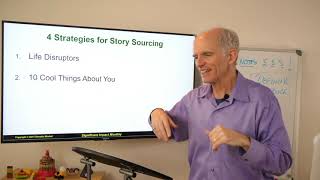
Patrick Mosher teaches four ways to find stories worth telling: life disruptors like moves or health events, ten cool things about yourself, the extraordinary hiding in ordinary moments, and the relatable side of extraordinary ones. He walks through journaling exercises and sensory drills to help you build a personal story inventory.
Chapters
And now we're going to go through some strategies, 4 strategies for story sourcing, 4 strategies for story sourcing. And we're going to— my challenge for you today is to add 10 new stories here. We're going to say, okay, today we're going to add 10 new stories to your story inventory. That's my challenge for you. That's my challenge for me to say, oh, did you come up with 10 new stories? Okay, so here we go. The first strategy for story sourcing is life disruptors. Now, life disruptors— I read a book called Life Transitions by Bruce Feiler, or Feiler, I think. Bruce Feiler, F-E-I-L-E-R. Bruce Feiler. And there's a source— every life disruptor you've had is a possible extraordinary story. It's a possible extraordinary story. So what's the definition of a life disruptor? It's a simple deviation from daily life. Marriage, divorce, having children, health issues, moves that you make, accidents that you had along the way. All of these are life disruptors. Each one of those is a possible story. So, uh, Bruce in his book talks about the average adult faces 35 to 40 life disruptors in a lifetime. In fact, they go through a life disruptor every 12 to 18 months. So in the last 5 years, by definition, you've had at least 4 or 5 life disruptors. If you've had any children, each one gets to be a life disruptor, right? Because each one's this new personality that came into your life that you couldn't plan for. You could plan for their physical needs, but you didn't plan for this new personality that came into your life. If you got married, oh, marriage creates that whole new life disruptor. If you moved, life disruptor. If a parent passed away, life disruptor. So right now, journal what have been, I don't know, 5, 6, 7 life disruptors that you've had in the last maybe 5 years or 10 years, whatever they are. But write down, journal right now, some of your life disruptors. Write down 10 of them. What are 10 life disruptors that you've had? 10 life disruptors. Mm, 10 life disruptors. I just looked at the chat. Patriotism. Thank you, Linda. Yes, patriotism. Huge takeaway from that story too, from my dad. But what are your 10 life disruptors? 10 life disruptors. Okay, jot those down really fast. Don't do the whole story inventory, save that for later as homework. But if you came up with 3 or 4 of these, that's great. And hopefully you came up with like, oh, you know what, that could be a good story. Maybe if that's the case, go like, you know what, I never thought of that before, but that's a great story. People like to hear about life disruptors because it makes you vulnerable. And when you're vulnerable, you're accessible to people. And when you're accessible and vulnerable, that creates credibility with people because you're one of them. You make them feel like, "Oh, that happened to me too." So Life Disruptors, great place to look at stories, sourcing stories. Okay, so that's the first one. The next one, this is one that I did some work with, with Bo Eason. I was in his mastermind, and Bo Eason is the master of personal story power. I like this one, this exercise that he had us do at one of his events, and maybe you were there too. Here's the one. List 10 cool things about you. Go! Write 10 cool things about you. You go like, "Well, there's nothing cool about me." Oh, come on now. You're all really cool people. Because you're here. You're deviant somehow. So, what are those cool things about you? Write those down. Oh, it's so good. And something that you think may not be that cool may be really cool to other people. I'll give you an example of one. I was an Eagle Scout. I think that's a cool thing about me. There's a lot of other Eagle Scouts out there. I was a Boy Scout when I was a kid. Cool thing about me, I was painfully shy as a kid and then I went to college and I got out of that. I think that's a cool thing. I think a cool thing about me is I have really— I'd say on a scale of 1 to 10, I'm a 6 or 7 skill on working a chainsaw. Did you think this kid was good at chainsaws? I'm pretty good with a chainsaw. I can take down a tree. With a chainsaw. So these are 10 cool things about me. I know some Lakota words. Mitákuye Oyasin, for example. We're all related. What are some cool things about you? Write those 10 things down. Ah, so good, so good. Okay, moving on. Strategy number 3 for story sourcing. Okay, I'm going to tell you this story first, and then I'll show you what number 3 is. So here's my story. I was playing with my grandson, and he was 6 years old at the time, and he was in a sandbox. And in the corner of the sandbox, there was one of those diggers with the sand, you know, that you can work and it pulls up sand and you can move it around and do all that kind of stuff. And he was sitting in the corner He was having the time of his life and he was in the sandbox and then there was this other sand digger across catty-corner to him in the sandbox and it was bigger than his. But this other kid was playing with it so he knew that, you know, he shouldn't go over there and bother him and all that kind of stuff. So he was digging and then that kid's parents came and he went away and I saw him look over there at that piece and he has eye on that other toy across the way. And he got up, and then the sandbox was an above-the-ground sandbox, and it had like two 2x6s together, nailed together, and in a long line. That was how all the sand got held in. So there's these two boards nailed together. So he stands up and he starts walking on the boards like this, going like this, and he goes— instead of going across the sandbox, He walks on the corners and he's like balancing beam walking across this thing. And he walks in front of me. And I said, "You know, Eli. It would have been faster if you'd gone across straight from your toy to the other toy." And he looked up at me and said, "Papa, I didn't want to do it fast. I wanted to make it worth it." I just sat back and said, "I just got a wisdom from my 6-year-old grandson." What an amazing story. He said, "I didn't want to make it do it fast. I wanted to make it worth it." How often do we do things so fast but we didn't really enjoy the journey from point A to point B? And from this 6-year-old, I got this wisdom back from him to remind me of that. Oh, that we are in the presence always, always. And so I wanted to tell you this story because finding the extraordinary in the ordinary, that's the third way to look at this. You've got to find the extraordinary in the ordinary. Where's that extra piece? I could have just done that. I could have not said anything. I could have gone, "Oh, that was interesting." But I grabbed that and I made— as a story source, I was like, "I'm going to remember this." And because this happened years ago, but I really wanted to remember this because it was such an important story. So that's how you source stories. How do you find the extra in the ordinary? Finding the extra in the ordinary. And it's just— again, it's just beyond the veil of your tunnel vision of what you're getting there. It's there all the time. This is the most important thing I want you to take away from today is finding the extra in the ordinary because it's always there. You can always make a story out of something that's ordinary, just if you breathe into it and let it, let it really fill your soul. So I did this, I was explaining this one to my wife a couple days ago and we're walking outside and And she said, "Well, I don't get it." And I said, "Okay, just stop and close your eyes. And what do you notice?" She said, "It's the breeze." Because there's a breeze to the trees. There's a nice breeze that day. And I said, "What does that remind you of?" She said, "Oh." And she just— her face lit up and she said, "I'm on a boat on a lake on Lake Minnewaska." and I can feel the breeze across my face, I can feel the mist. And that transported her, that breeze transported her to a place where she told a story, an association of just that breeze in the trees, but it moved her to a different place. So it wasn't just like, oh, nice breeze, but it was like there was this whole story that unfolded from her. And I was like, when was the last time you remember of like cruising on Lake Minnewaska on the boat? And she's like, oh, and then she went. That extra in the ordinary is always there because we can associate other events that happen in our life with what's happening in the ordinary. I hope that helps you identify some of these things. So what are some of the ordinary things that happen to you? So we're going to do something really quick here. We're going to do it more a little later, but I do want you to just close your eyes Just close your eyes, put your pen down, put your hands off your desktop, your laptop. Close your eyes and take a deep breath. Breathe out so you can hear it. Okay, now what do you notice? Do you hear something? Do you smell something? Something right beyond the veil of your tunnel vision is trying to get your attention. Now open your eyes and write that down. What's that one thing that was, that was grabbing your attention? I can tell you from where I'm standing right here, right when I did that, it was amazing. Right when I did that, our dog started barking. Not loud, just a little bit. And I was like, "Oh." And you know, that's a story. That's something that's there. It's like, "Oh, you know, she wants something." And what story reminds me of, you know, her wanting to go? There's a story there, right there. If you just close your eyes, open your senses, and then something is trying to catch your attention. And what's that story? I hope that helps. Okay, wisdom is everywhere. It's everywhere. Okay, strategy number 4, here we go. Finding the ordinary in the extraordinary. Now that sounds kind of weird. Oh, I've got this story, this extraordinary story, and you tell the story, people go like, that was awesome! But it's not accessible because it's so extraordinary. It's like, you know, when I was in Cabo and I was around, you know, all these amazing people and we shared all these $100,000 ideas and then we helped each other make those $100,000 ideas happen in the world. And now I have a million bucks. And you go like, that's fascinating, but it doesn't connect with me at all. So how do I create the ordinary in the extraordinary to make that story accessible? And here's my story with this. It's, it's so good. So here's my story. So I was at a large event with Brendon Burchard. And Brendon, on the third day, was going to talk about productivity. And so he got up on stage and he said, "You know, I'm going to talk about productivity, but there's 3 people out in the audience," and there was 2,000 people and I was in the audience. "There's 2,000 people out there," and he said, "There's 3 people in the audience that could tell you a lot more about productivity than I can in this moment, so I'm going to invite them up here." And so he invited an astrophysicist who had actually sent a satellite to Pluto. How do you do productivity of sending a satellite to Pluto? Awesome. And so this person stands up and starts walking forward. Come on back, we're gonna get you mic'd up and we'll talk, you know, about productivity. The second person is Paula, and I'm gonna bring her up here, and she's done 7-figure launches in Brazil. And so she's going to come up and she's going to tell you how she just made that happen. And so she got up and started walking forward and I'm sitting there getting nervous and he goes like, "And right here in front, Patrick Mosher used to be my boss. You know, he was a partner at Accenture. Stand up, come back, we'll get you all mic'd up." And so I stand up, go into the back, and now I'm really nervous. I'm thinking, "Okay, I've got these 5 minutes that I'm going to be on stage to talk about productivity. What am I going to say?" So we go backstage and the other two, Michael and Paula, they're paging through their journal, they're making notes and everything, and Brendon pulls me aside backstage and he says, "So Patrick, you know, when I'm backstage, you know, I want to show you some of the things here. I really want to show this to you. It's like, this is a big bowl of spinach. I really find spinach is really important in between sessions." And so he's describing his spinach and his blueberries. And in my head I'm going like, shut up! I've got to be on stage in front of 2,000 people impromptu, extemporaneous, and I'm looking up at the clock behind the scenes and there's 90 seconds left and I'm going like, oh my gosh, I'm trying to think about what I'm going to say and you're talking about spinach and blueberries. And so he gets finished with this, I look up at the clock, 35 seconds left, and he goes like, What question do you have for me? Okay, here's the highest-paid coach on the planet. Here's a guy that's written best-selling books, and I've got this 30 seconds to ask him a question, and all I could think of is, where'd you get your shoes? And of all the questions I could have asked, where'd you get your shoes And he goes like, "Oh," and he took the question so seriously, he was like, "Oh, I got these shoes, you know, they're really great shoes when you're on stage, you know, I know you'll be on stage going back and forth. They look like, you know, dress shoes, but they're built like athletic shoes. I'll send you, I'll email you, you know, where to get them and that kind of thing. They're not that expensive." And then, "Okay, 20 seconds, you know, line up," and I'm going like, "Okay, I'm not ready to get on stage and I just..." asked him where he got his shoes. And then we went on stage, and that was an extraordinary experience, being on stage. But the story I wanted to share with you is the ordinary in the extraordinary. When you have the opportunity to ask somebody an amazing question, be ready. I wasn't. And when I told the story earlier this week to a friend of mine, He said, "Oh, that happened to me too." And then he told me his story. The whole point of a story is to create a reference point. A common reference point for people to walk away from. What was the opportunity missed? Have you ever missed an opportunity and you go later and go like, "Oh my gosh." That's the point of that story. Finding the ordinary in the extraordinary.
More from Patrick

Frozen by Indecision: The iPad Dilemma #psychologytips #indecision #wisdom4humanity #patrickmosher

Stop Beating Yourself Up for Bad Habits! #psychologytips #lifelessons #psychology #patrickmosher

Hilarious Dance Rehearsal Mishap - iPad Hunt Gone Wild! #lifelessons #wisdom #patrickmosher #purpose

Unexpected Bollywood Dance Rehearsal - My Reaction! #lifelessons #purpose #wisdom4humanity #legacy

I Accidentally Left My iPad… and Walked Into a Dance Rehearsal I Was Never Supposed to See #wisdom

Unlock Your Telepathic Capability: Tap Into Larger Energy #patrickmosher #wisdom4humanity #presence

Overcoming Fear and Uncertainty - Finding Your Ground #psychology #purpose #lifelessons #purpose

Unlock Your Intuition: Embrace Serendipity & Telepathy! #telepathy #telepathiccommunication #purpose

Unlock Your Unique Energy: The Ripple Effect Explained! #telepathy #telepathicconnection #purpose

How Telepathy Works: Tapping Into Energy Bigger Than Yourself with Patrick Mosher (Wisdom4Humanity)

Telepathy: Unlocking Mind to Mind Communication Explained #telepathy #telepathiccommunication #love