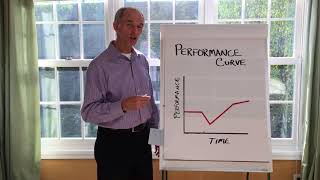
In this A2B Academy video, Patrick Mosher shares a practical framework for preparing any kind of launch—whether a product, campaign, or personal goal—by focusing on pre‑launch readiness. He introduces the performance‑curve model that shows how an unprepared launch creates a deep performance drop, while adequate readiness creates only a shallow dip. Mosher then outlines six actionable "E" strategies: (1) Enlist the people who will be impacted, (2) Educate them on new target behaviors, (3) Enlist expertise from those who have done it before, (4) Engage their energy and enthusiasm, (5) Eliminate distractions and friction, and (6) Set the expectation of an inevitable dip. He illustrates the approach with a $45 million software‑implementation case study where 23 % of the budget was devoted to business readiness, resulting in a smooth launch, minimal support calls, and a CEO commendation. The video concludes with a call to apply these strategies to the viewer’s own upcoming launch to achieve momentum, reduce wasted time, money, and energy, and reach the desired point B efficiently.
Chapters
Hello, welcome to the A2B Academy channel where we explore and discover alternative ways of thinking to drive measurable value in executing our personal and organization strategies. In this channel, we look at getting from point A, where you are right now, to some point B. And your point B might be, you know, a big project that you're trying to do. It might be, you know, a new workout schedule that you're trying to figure out for yourself. Any point B that you're trying to get to, and the fastest way to get from A to B is of course a straight line. But we all know it takes twists and turns, especially the big, complex, most difficult things. Well, you know, those are harder to get to. And today we're going to talk about launches and actually pre-launch activities that you can do to help make your launches easier. So the big complex things that you have to do out there, usually you have a launch day, a day one. That you're ready for. On some of those things, on some of the post-merger integrations that I worked on, that pre-launch time might be as much as 1.5 or 2 years. And other things, it might be in a month or so. But any way you look at it, there's things that you can do to get ready for that launch, and that's what we're going to talk about today. Getting ready for that new product launch, that new marketing campaign, that new workout schedule, whatever it is. And so, one of the things that I want to share with you is, for 17 years, I was the global lead for our sales talent solutions, and that's a big title for basically anywhere in the world where a client had a problem with helping their sellers sell better, I was the guy that got called on. So, in working with sellers, you know, I put in new tools, new processes, new incentive schemes, all sorts of things to help them sell better. Help them engage with their customers better. And one of the things that I found out through all those travels all over the world is that basically sellers valued one resource, and here's what it was. The most valued resource that they had was what I'll call time. Now, time isn't just time. You know, you've got time in there, and they did, they valued their time. I mean, where they spent their time, how many calls they would make in a week, how they pull together their proposals and stuff, all of that was where they spent their time. But that's just the first part of this. They also valued money, right? So the second part of that is they valued money, not only the money that they gained from incentives, but also the money they spent on promotions and proposals. So there was time and money, and then the last one is, they really valued their energy. You know, where they spent their energy. And when they spent their energy on a customer that just didn't buy from them after they spent so much energy on it and time, you know, they felt so deflated. So the most valuable resource that I want to look at in launching is your time. Your time, your money, and your energy. So if you do launch readiness better, your launch, your post-launch activity, you're going to spend a lot less time. Alright, so let's go through the performance curve. Now, whenever we go through some sort of new change, you know, we're rolling along in a certain place and then this is day 1 and we launch something. Then the performance results aren't exactly where we want them to be. We kind of figure that out, solve some problems, pick it up and come up the other side until we actually land at a performance place that's higher than the first. Alright, so that's just the basic performance curve, and that's generally, you know, what happens in any, you know, big launch. But I want to talk about the difference between a drop and a dip in performance. So let's talk about a drop. So I've got, you know, a steely here, a steel ball, and let's say we're rolling it along here, we're going around here, and then I just stop before we're ready to launch. And then I just dropped this ball on this curve. Well, it would roll down here, and then if there's zero friction in this, it would roll down and come up the other side, and at best it would come up to the same level it was before. But we all know when we launch something new, there's all sorts of friction. There might actually be some friction ahead of time as well. So when you go down, you feel this friction, so that as high as this ball could get is, is, you know, somewhere in here. So in some sense, you know, that creates a drop. And when you don't prepare, you don't have enough readiness before you go live, then you experience that drop. And the breadth and the depth of this curve goes longer. Hope that makes sense. So part of what we're looking at is let's go for a dip. A dip would be, well, let's put some energy in this ball. Now if I have some momentum in this ball and I get it rolling, it starts rolling, it gets faster and faster. And I get to this point and this ball is rolling pretty fast. Where's that ball going to go? Well, it's not going to drop down. It's going to actually come across. And then you've got less of a dip and you come up faster. And then so the breadth and the depth of this performance dip is a lot less. So what does that mean? It means that if we create readiness activity, readiness momentum before we go live, before we launch, then we have a better chance of creating a dip instead of a performance drop. Alright, so, got it. Alright, that makes sense, the physical reality of that, the mechanics of that makes sense. So then you probably are asking, alright, got it, what are my readiness strategies? Alright, so we're gonna go there next. I'm gonna provide you 6 easy strategies for pre-launch readiness. And I put some quotes on E, you'll see why in a second. So the first strategy that we look at is to enlist the people, the target people that you have involved in this. There's a saying that says, "People own what they create." So pre-launch, if you get the people who you're going to impact by this and you get them involved ahead of time, They're going to own that and when you get into that timeframe of that launch, they're going to pick that up and run with it more. So that's creating some of that energy and the momentum ahead of time. So that's the first way to look at it is enlist the people who are going to own this. The second one, the second E, is to educate those folks. Educate them on the target behaviors that will really make a difference when you go live. So a lot of times what happens is, if you know how to do something ahead of time, then when you go do the thing, it actually is a lot easier, right? So that's what training and education is. Part of the challenge in this is identifying what are those big things that are going to be different in your new world and try to simulate those ahead of that launch date. So they go, "Oh, I know how to do this," and it becomes familiar with them. So it's not as big of a leap across that performance chasm that you created. And now they're educated and they can do those things ahead of time. The third E of our easy strategies is to enlist two. Enlist the expertise. So many times we go through these things, but we should ask for help. Who's done this before? And ask for them to say, what are the big pitfalls? Where are we gonna, you know, hit some major barriers. And so ask and enlist those people who have the expertise that have done this before. The third E strategy, or the fourth E strategy, is to engage these people. Not only, you know, are we going to train them up, they need to do all these things, but engage their energy, engage their enthusiasm. And so that might be some engagement generation-like activities that you have. It could be celebrations, pre-launch celebration. It could be anticipation, but you want people to hit that point in that curve where they're going like, "Ah, I'm so ready to go. Let's get on with it." And that's what you want to do is really engage people, and that creates that momentum as well. The 5th E of our engagement, of our easy strategies, is to eliminate the distractions and eliminate the friction. So, a lot of times we get into that and we go, "Oh, at the last minute, let's think about this and this and all these other sorts of things." All of a sudden, that ball starts rolling really slow towards that launch date. What you want to do is have that ball rolling faster when you get to the launch date, which means you're taking away all the friction. It takes away the resistance to what we're doing as well as giving people, again, that energy and the less distraction to focus Exactly on what we're trying to do. And the 6th E of our strategies is to expect. Give people the expectation that there's going to be a performance dip. So many times in the corporate world, you know, I would present that performance curve to executives and they go, "That's not going to happen to us because we're just going to go right past that." I'm like, No, that's not true. It's just not true. That's not how that works. You'll always see some sort of performance drop and you know that. You feel it in your body when you start a new habit of some sort, going to the gym. For me, doing push-ups. If I do push-ups and I haven't done them for a year and start doing them, well, the second, third day, it's kind of hard and my muscles are sore. So part of that is set the expectation that that performance gap is going to happen. Very key. So these are the 6 easy strategies pre-launch to create that momentum and create those— that expectation, and so that you can roll that ball really fast so that you jump across that chasm with just a mere dip instead of a drop. Alright, so let me give you a story of how this worked for me in one place. So I was at a company and we had a $45 million project. To implement a software system. And I was in charge of business readiness. Well, in that $45 million project, I got like, I think about 23% of the budget to create that business readiness, which was fabulous. And we did all sorts of great things to make that happen. We trained the people, we had energy generating events, we sent gift boxes to everybody the day of, day one of launch, just to say, Hey, welcome to this new world. And there was a poem in there and some candy in there and stuff like that, just to lightheartedly say, hey, here we enter a new world. And you know, we did such a great job with that business readiness that we launched what they call hypercare. We launched hypercare for 12 hours every day. It was North America-based. And we had people on standby to answer calls on, all the difficult things people would face. And after 3 days, we only got 6 calls because everybody knew exactly what they needed to do. So what happened is, is that drop wasn't a drop at all, it was just a dip. And everybody knew exactly what to do and they knew where to ask the questions when they didn't. And things went really well. Actually, we got an email from the CEO of the company. This is a multi-billion dollar company. And he said, "Great job to the business readiness team." And so that was awesome because the people knew what they wanted to do and what they needed to do. And so that's when readiness goes right. So I want you to think about your own point B, your own launch that you have coming up. And what are some of the 6 strategies that you can put in place now before you go launch to create that performance dip instead of that performance drop? Alright, I really would like you to create that momentum and to really make things happen for yourself. So that's it for today. I hope you took away something about the 6 easy strategies, and I hope the next launch that you have is absolutely successful so that you can get to your point B with momentum and energy and with success. So with that, I'll leave you with this. I hope you learn continuously, live your life 100% empowered, and interact authentically with each other. Until next time.