A former chemical engineer breaks down how to tackle massive projects by splitting them into phases, tasks, and activities. The 4/40 rule keeps tasks between 4 and 40 hours. Writing milestone tasks in past tense like "Report submitted" gives teams clear wins to celebrate.
Chapters
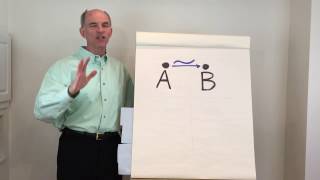
Hello and welcome to the Change Science Academy channel where we explore and discover alternative ways of thinking to drive measurable value in executing our personal and organization strategies. In this channel, we look at science and art and theory and practice, but basically we're trying to get the best tips and tricks to get from point A to point B fast, efficient, but also with joy and energy as well. Sometimes they don't always go straight, so that's why we have this little curvy line here. Today's episode, we're going to talk about distance. When I think about distance on this Change Science Academy channel, I think about completing a task. We got this big boulder here and we're trying to get that budge, that big boulder, and get it moving over here to B. Task completion has something to do around defining what B looks like. We talked about in the last— marbles are over here. How do you take a million marbles and move them from point A to point B? Budging big boulders and moving millions of marbles, that's the theme for today. Right now, I'd like you to write down, do you have a project that you're working on that looks like this big boulder or billions of marbles? To make that path look a little bit easier and make it go a little straighter and faster. Some of the projects that I've worked on in the past, completing day 1 of a post-merger integration, that's a big day 1 kind of activity. That's a big project. Another project could be launching your company website, or conducting a seminar, completing your go-live of a new system, or releasing the first email of a marketing campaign of some sort. These are all the different types of projects that you could be looking at. So write that down, and then what I'd like to do is start looking at how do you take that project and move it into its pieces and parts. So the first thing I'd like to look at is taking this project and saying, Breaking it down into phases, tasks, and activities. When I think about a phase of a project, I think about different phases. I was a chemical engineer, so a phase is a non-overlap piece from one part to another. You think about that as like water. There's steam, which is one phase, and then there's water, which is like we have a pond in our backyard here. And that's the liquid water. And then sometimes here in Minnesota, it freezes over. So then you've got that ice part of a phase. So phases are those distinct parts of a project. And I wanted to give you— these are my go-to different phases of a project. I think about ideating that project and then maybe planning out that project. Then you design it. You build that project. And then this blue line here indicates, oh, then you have a go-live date. And then you might go through an adoption phase of, how do I adopt this and make it better? How do you operate in that new environment? And then how do you evaluate? How do you look at the value of what you ideated up front? Did you get value out of it as you thought you would? So these are kind of my go-to phases. So if you don't have your own idea of what those phases are, try to use these as, I've got this big idea, I want to ideate, plan it, design it, build it. Go live, then adopt it, operate it, and evaluate it. So, we'll go back to looking at— we talked about phases, and let me give you another example of phases. Think about a golf game. So if you get up there and you tee up that ball and you're getting ready to hit that ball and you have a putter in your hand, well, you're not going to hit that ball very far. Part of looking at a phase is it has its own distinct equipment. So you want to have a driver in your hand, has a certain expertise. You want to use your driving swing to get there. And that effort's going to be a lot more efficient if you look at the equipment and the expertise required for that phase. Different phase of a golf game would be when you're on the putting green or on the putter, you know, on the green and you're trying to putt in. Well, you don't want to use a driver then either. So I think about phases having specific equipment and effort and expertise. And if you break that phase down into tasks in that, in that phase. And if tasks go a little bit further, you break tasks down into activities. So I'm going to give you some guidelines now around how to look at tasks. And what I'm going to do is if you have a major task that you're looking at, You might have a report that you need to write, and that report might take 80 hours to do. And I'm going to use the 4/40 rule. No task should be smaller than 4 hours or greater than 40 hours, the 4/40 rule of doing tasks. So if it's smaller than 4 hours, maybe it's just an activity, you should put it on your to-do list instead of having a task planned for that. But if we have this 80-hour task, let's break that down into developing the outline. Maybe just drafting that outline will take us 8 hours. And then after that, we're gonna run it by the team. And so we've got a team meeting, and then after we do that team meeting, we're gonna think, we have to do a little bit of research, we have to figure out how to build out that outline a little bit better, so that might take us 24 or more hours. And then we draft the report, and we take 32 hours to do that, and then we revise the report. And we revise the report, maybe we run it by Bob, and Bob says, oh, You need to make these revisions. So, we take 16 hours to do those revisions. And then the last task here is report submitted. And what I mean by that, you can see this is different than the other tasks here because it doesn't have an action verb on the front end. And it's defined in terms of it's in past tense, report submitted. And I call this a mission milestone task. This is the kind of task where you guide your team and say, At the end here, we can now celebrate. So it provides a rally point for your team, and it also provides a celebration point for you to say, "This task is now complete." That's how you apply the 4/40. I suggest that you take your, your project that you have in front of you and think about how do you estimate how much effort there was in there, and then break that down, budge that big boulder by breaking that boulder down into 4 hours or 40-hour task, between 4 and 40 hours task. That's budging those, those big boulders or breaking those big boulders down. Or if you have lots of millions of marbles of tasks out there, then start grouping them into pieces so that they build up to at least 4 hours. So that's using the 4-40 rule. I hope that helped you there. So at the very end here, we talked today about breaking big boulders, Moving millions of marbles and celebrating milestones. And the 3 tips that we used here, the first one was looking at breaking those big boulders down into project phases, tasks, and activities. And then we looked at how do you look at breaking those big boulders down or moving those millions of marbles? Use the 440 rule. And the last task that you put into a task plan is now a milestone task. Where you define it in past tense and then you celebrate. And that really helps bring up the energy for your team and you that you can actually celebrate. You have something in your work plan that actually says, we're going to celebrate this with this milestone task. That's our episode for today. I hope you enjoyed it and I hope that really helped you break down that big boulder or move those millions of marbles. If you have questions or comments, please put them in the comments down below. Also, if you could, like this channel, subscribe to this channel, and find 4 or 5 other people that might enjoy this channel as well and get some value out of this. Until next time, learn continuously and live your life 100% empowered.