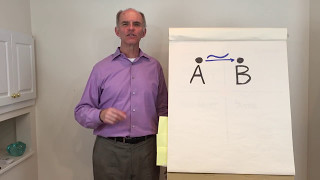
Patrick Mosher uses physics to explain organizational momentum: mass (effort) times velocity (completion rate) equals capacity utilization. A 5-hour task spread over 40 hours uses 12% capacity; compress it and hit 100%. Three levers increase momentum: reduce the work, shorten the deadline, or split it across more people.
Chapters
Welcome to the Change Science Academy channel, where we explore and discover alternative ways of thinking to drive measurable value in executing our personal and organization strategies. On this channel, we look at getting from point A to point B in as straight a line as possible, but we also know that there's curves and twists along the way. I've been doing organization change work for 30 years, doing post-merger integrations, new company launches, big system implementations, and all along the way I've heard and we've talked about how do you build momentum and sustain it. Do you ever wonder why your team doesn't just get going and they're not rolling the way you want them to? Well, I've wondered the same thing. And then actually it came to me at one point where momentum actually is a scientific term. So we talk about, oh, let's get some momentum on this project. But I actually started turning to science. What is momentum? And so momentum, the scientific term for it, is actually mass times velocity. This is a rho. This is rho equals mass times velocity with a little vector over it. That's the scientific term for momentum. And in this Change Science Academy channel, when we look at mass, mass is the estimated effort to get something done. If it's a big mass, like a big boulder, well, we gotta roll that thing forward, you know, and it goes kind of slow, doesn't it? If it's a little thing, it may actually go faster. Where velocity is now the task completion of that task over the duration to complete it. This is the distance it needs to travel and this is, you know, how fast we complete it. So if the estimated effort is there divided by the task, the duration to complete it, That's actually what momentum is. And don't ever forget that little vector on top because if you're off on your vector, you're actually not going towards B, you're going a little off of B. We'll talk about that in a future channel at some point. So if we look at momentum as that— as those components, I want to use the Change Science Academy lab bench down below to talk about, you know, breaking this down into what are the basic fundamental components of momentum. If you look down here, you can see A to B. This is where we are today and where we want to be at B. The distance here is the task complete, and the time it takes to get from A to B would be the duration. The distance over duration is the velocity, how fast we go from point A to point B. Then we're also looking at all these beautiful little tiles here. These are little Legos, you look at, we have 8 hours each day, Monday, Tuesday, Wednesday, Thursday, Friday. This is our little person here. They've got 8 hours each day, so they have 40 hours of capacity in a given week. And then you look at, let's just say each marble is an hour of time, and there's 40 marbles in here. And so if you look at, let's just say they have a 5-hour task, well, they could do 1 hour on each day. And that would be, the velocity of that would be 5 hours over 40 hours of available time. So this is a 12% momentum, a 0.12 momentum. And if you think about that, then momentum is the same thing in our Change Science Academy as capacity. So this person is working at 12% capacity. And when you take an 8-hour or 5-hour task like this and split it across multiple days, Think about all the other distractions that can happen with this other time, or how much time it takes to drop a task, pick it up, drop it, pick it up, drop it, pick it up, drop it, and pick it up. We can change the momentum of this if we actually start compacting this a little bit into a shorter period of time, now making B, the end date of B being on Tuesday, or even better, making the end date of B being on Monday. Now, the momentum of this is 5 hours over, you know, if we say 2 o'clock on Monday, now they're at a 1.0 capacity or a 1.0 momentum, 100% capacity. So if we spread these 40 marbles across all of these, well, that would be a 1.0 momentum or 100% capacity. That's how we look at the basics of what momentum is. Now, coming back to, you know, our definition of mass times velocity, we know what momentum is now in the Change Science Academy of mass, you know, being effort and time to complete. But the real question here now is how do you increase momentum? Well, we want to increase momentum and we have 3 ways of increasing momentum and I have a surprise down below. If you look at 3 ways to increase momentum, The first way to increase momentum is to decrease the mass, decrease the effort of a particular task or project. There's two ways to do that. One way to do that is to bring on the right expertise for the right task. I could probably do rocket science if you gave me a few years, but there's rocket scientists out there that can do the calculations a lot faster than I can, for sure. So if you start looking at that, if you get the right expertise doing the right task, the amount of effort actually goes down. And then the second way to increase momentum through decreasing mass is by increasing the energy on it. And what I mean by that is if your team is excited about getting to point B, the effort actually will go down. I used to drive my HR folks crazy in consulting because when they'd say, "Hey Patrick, you know, when you need to scale up this project, What are you looking for in terms of the people? They expected me to come back with, oh, these technical skills or these functional skills or technology aptitude or something like that. I'd say, you know what I really want is scrappy, probie, pushy people. They'd scratch their heads and go, what do you mean by scrappy, probie, pushy people? For me, what was really important, more important sometimes than the expertise that I had on a project, It was a mindset for the project of scrappy people could get things done fast with very little direction, and they were probey. They would just ask questions and keep asking the questions until they got an answer that was acceptable. Or they'd be pushy. They'd actually push, you know, keep pushing, pushing, pushing to get a deadline complete. So I'd rather have that kind of mindset, and that would actually reduce the efforts on a project. So one way to increase momentum is to decrease mass. The second way to increase momentum, which I kind of mentioned before, is you change the end date. You make the end date sooner. Basically what that's doing for your team is just increasing the pressure. So if you look at this, if I take a 40-hour task and say, well, you got a 40-hour task and it takes you 40 hours to do it, but the end date is like 3 days away, well, I'm just actually increasing the pressure on the project. I'm just decreasing that end-to-end date. And that actually increases the momentum. It may actually decrease energy though, because your people might get burned out, especially if you do this a lot. You know, you might think about this as sprints, but not in terms of a marathon. Then the third way to increase momentum is actually to do both of these things. Reduce the mass and decrease the end date. Meaning, what you can do is spread the mass across multiple people. So if you take a 40-hour task and you split it across 5 people, well, instead of having 1 person getting that done in 1 week, now you might be able to get that task done in 1 day if you spread that mass. And now you can change the end date as well, so that now you've changed, you spread the mass across people, and then you have the end date. Now, this looks really simple, but on large, large projects, actually trying to figure out the expertise you need, What your end dates are and how you spread that across people can be quite an algorithm to get that right. But to get it right means that you don't have people waiting around for others to get their work done, and it has people helping each other out in a collaborative environment that has the right energy around it. Now, I told you about this fourth thing down here in terms of changing the momentum, and I'm going to talk about capacity. Now, this whole episode we've talked about capacity being at 40 hours. And, you know, that's one way to look at it. Now, I've worked in an industry where people don't think of 40 hours as a normal work week, and probably you may not either. But if you start thinking about, well, if I adjust my standard of what my work week is, then I can actually increase the amount of work I get done. So if I think about 45-hour work week as my standard work week, I'm actually decreasing my momentum by increasing my capacity, but if I define it as 45 hours, well now I can put 45 hours of work in and get more of the work done. Now you have to be really careful with that because so many people start inching that up. 45 hours becomes a standard work week and then it's 45, 47, 50, 55. All of a sudden people think that if you're only working 53 hours a week, yeah, you're slacking. So you want to be careful about defining the standard work week, especially on projects that are long, like 2 years long or something like that. You have to really look at what your standard work week is and plan for that accordingly. And then the other way to increase capacity, of course, is to add more people to the project. And that actually helps spread the effort out a little bit more. Those are 3 strategies for increasing the momentum. And then also looking at ways of playing with your capacity so that you can get your work done. Hopefully that worked for you. I want you to come back to your own project and think about these 4 questions. What are these momentum builders? Now, if you establish your team right, like we did with the international project, on the international project we actually took some of the work and we spread that effort across people so that one team could get their work done and people weren't waiting for them to get their work done. So now we spread that effort across and we changed our end dates, which was great. Everybody could now make their end dates. I want you to think about the same strategy with your project. And here's the 4 questions that I want you to ask about building the momentum that you need for your project. First of all, do you have the right team members with the right expertise doing the right tasks? You might be thinking about that for yourself. Do I have the skills and expertise to do this, or does somebody else have the better skills to do this, to do it faster? The second thing to ask is, is your team operating with maximum energy? They're looking for energy from their leader, probably from you, to come in and create that energetic endpoint and give them that energy so that they know what they're going for in the end. That can actually reduce the effort as well and increase momentum. And then, is the effort equally distributed across your teams? So, it's not just the expertise, but do you have the effort spread across your team so that people aren't waiting for other people to get stuff done and some teams aren't working at 200% capacity and some are working at 70% capacity? And then finally, looking at the end dates being strategically placed. Are the end dates in your plan strategically placed? So that you're not cranking at the end of something to get something done and then wasting time for other periods of time. Part of this is strategically placing those end dates for your tasks so that there's a more even flow of the work and your momentum becomes more evenly distributed rather than big pushes and heroic acts. I hope you got something out of today. I hope you can apply one of these principles to your project so that you can start building that momentum momentum. If you did find some of those, some things interesting here, please put some comments down below. I'd love to hear your thoughts about today's episode. Then also, as always, if you like this channel, like the channel, subscribe to it, invite a couple of friends to join us too. On a week-to-week basis, I love talking about momentum. I love to hear your comments. That's it for today's episode on momentum building. I'll leave you with this, as I always do: please learn continuously and live your life 100% empowered. Until next time.
More from Patrick

Unlock Your Unique Energy: The Ripple Effect Explained! #telepathy #telepathicconnection #purpose

How Telepathy Works: Tapping Into Energy Bigger Than Yourself with Patrick Mosher (Wisdom4Humanity)

Telepathy: Unlocking Mind to Mind Communication Explained #telepathy #telepathiccommunication #love

Unlock Your True Self: Connect to Infinity #telepathy #telepathicconnection #purpose #love #mission

True Self, Soul, and the Sense of Infinity - Patrick Mosher - Wisdom4Humanity #soul #trueself #love

Unlock Telepathic Powers: Your Guide to Intentions #telepathy #telepathiccommunication #purpose

Unlock Telepathy: Release Distractions, Embrace Love #telepathy #telepathychallenge #wisdom4humanity

Serendipity & Goldfinches: A Spiritual Moment Shared #telepathicconnection #spiritualjourney #love

Unlock Your Telepathic Power: Tap Into Larger Energy #patrickmosher #wisdom4humanity #presence #love

Build Telepathic Capability in 6 Simple Steps - Patrick Mosher, Wisdom4Humanity #leadership #love

3 Words Defining Today's World & Personal Rhythm #worldpulse #today #humanity #purpose #vision #love