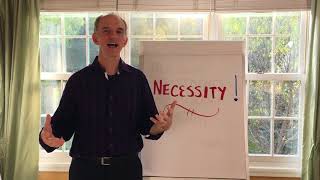
Patrick Mosher explains how to motivate organizational change using a "burning platform" necessity statement. He shares the story of an oil-rig worker who jumped from a burning platform, then breaks down three qualities of effective necessity statements: significant to your audience, simple and precise, and a clear signal to act. Quantifying loss and visualizing benefits drives rapid decisions.
Chapters
Hello, I'm Patrick Mosher, and welcome to the A2B Academy channel where we explore and discover alternative ways of thinking to drive measurable value in executing our personal and our organization strategies. In this channel, we look at where you are right now, point A, and then where you want to be, point B. And I'm sure you all have a point B of some sort. Is it a dream or an aspiration? Is it a a project that you just can't get done? Is it, you know, a marketing program that you need to get going? Or is it a sales quota you need to meet? Whatever your B is, we want to get there as straight as possible. But we all know the more complex B is, the harder B is, the more difficult B is, well, then the more twists and turns we take along the way. So the point, the purpose of this channel is to provide tips and tricks and strategies to iron those things out. You know, I've spent 30 years in industry working with executives to get executive alignment on major initiatives in Global 1000 companies all over the world. And I'm trying to capture those things and give you a few of those tips so that you can get to your point B as fast as possible with a little bit of risk, with as little bit of risk as possible, and with the highest point of success that you can. Well, that's our purpose of the A2B Academy channel. So today, I wanna talk about, you know, you go from point A to point B, and you know, right about, I don't know, right here, somewhere in here, you get stuck. You know, so you sent out a communication to ask people to do something, and you go, okay, that was really clear. And then you go back later on, it's like nothing's happened, nobody did anything. Wow, okay, what's that about? And then you adjust and you do something else and you go, okay, here's another thing, here's the thing that we asked you to do. And everybody goes, yep, yep, yep, and nothing happens. Ever have that happen to you? Or another scenario, you send your people to training or you go to training and training is awesome. You know, you get all energized, people are jumping up and down, this is like, this is great. So part of the point of training is to get energized about something, which is awesome. Awesome, that's great and fabulous. But then when people go back to their environments, well, the training doesn't stick. They don't do things that they were trained to do. Another scenario, this is going to age me a little bit, but in the 1980s and 1990s, there was this big thing about taking people on team building exercises. And so you'd go out and you take executives out of the work world, and then you'd say, well, hang your hierarchy at the door. There's no status here, no positions of power here. And everybody goes in there and they paddle down whitewater rafting, or they do trust walks and stuff like that, which again, those are great. But then you put them back in their environment and nothing changed. So what is that about? In my view of that, and having been involved with a lot of those kinds of initiatives, is that when you take people out of the environment and you put them back in, the status quo status quo is more comfortable than changing. So they go back to the way they were doing things before. And so the bigger the B is, the bigger the change, and the more growth it requires, the more resistance you're going to get to move out of the comfort of status quo. So in the early '90s, Daryl Conner wrote a book called Managing at the Speed of Change: How Resilient Managers Succeed and Prosper Where Others Fail. Don't we want to be those resilient managers, and don't we want to succeed? Well, in Darryl Conner's book—great book, by the way—in Darryl Conner's book, he talks about the burning platform. Now, I'm going to describe the burning platform in my words here, but definitely read the book. Now, Darryl Conner wanted to learn why people were resilient. How did people gain their resilience along the way? And so he interviewed tons of people. And one of them that he interviewed was a man who was recovering from a very severe accident. He was on an oil rig in the North Sea in the wintertime. And he was laying in bed sleeping. And all of a sudden, the alarm bells go off. You can just hear bing, bing, bing, bing, bing, bing, bing. And the alarms go off. And when you're trained like that on an oil rig, in the North Sea and the fire alarm bells go off, man, you pay attention. So he jumped out of bed and went to the edge of the platform just to see if, is this an alarm or is this real? And he looked up to see that part of the platform was lit. It was on fire. Now if you think about being on fire where oil is spewing all over the place, it's not the place you want to be. So he stopped and he jumped. And Daryl Conner asked him, "Why did you jump?" And the man said, "Well, I looked at my impending death and I looked at my probable death and I jumped to my probable death." Now, as it goes with this story, everybody who stayed on the platform, you know, you could have stayed another minute, another 5 minutes, another 10 minutes just to see what would happen, but everybody who stayed on the platform perished. And in fact, not everybody who jumped in the water survived. I mean, if you're in the North Sea in the wintertime, you could perish due to hypothermia. You could jump into an oil slick that's on fire. Critters can come and get you. I don't know, all sorts of bad things can happen to you. And you might only survive for minutes. But the man jumped to his probable death. And that's called the burning platform story. And maybe you've heard of the burning platform. Now you know the story. But burning platform means whatever the status quo is, it's not a great place to be. And so you jump to the future, you jump to your point B. Now, having said that, I think of two strategies of what that burning platform or going to that point B could look like. I think part of it is creating a beautiful B. You know, what does the beautiful thing look like? What are the benefits of that? But also, what makes sitting in point A a terrible place to be. So I think about that as what the Burning Platform message is about. And I think it really boils down to what the Burning Platform gives us is necessity. Why is it necessary to move? When the status quo is okay to be in, we're not creating a necessary movement for ourselves. And I see a lot of companies, and I worked with a lot of companies, that tried to create benefit statements. And they would go create benefit statements and the benefit statements typically would read like, "Well, you know, our company's going to make $100 million off of this. It's good for the business and it's good for our people." But the guys in the trenches, the people in the trenches that this change would affect, that they have to get out of their status quo and do something radically different, you know, $100 million doesn't mean I'm going to get that $100 million. These benefit statements never touch them. I've heard statements, "What's in it for me?" But a lot of times when businesses and people create those "what's in it for me," it's what's in it for me but not what's in it for you. So part of creating these statements, you have to really get into who's your target and what do they want. So that's an important part of these benefit statements, these necessity statements that we're going to talk about. Oftentimes with companies, they overlook these, they underdevelop them, and they're just not impactful. I spent days and weeks working with companies crafting these necessity statements and refining them so that they help people to move. Now I think about 3 necessary requirements for necessity statements. Those 3 things are: they should be significant, simple, and it signals action. And let me walk through each of those. So significant to your target. A necessity statement should be really significant. If it's for you, what is, what is really important for you? What's, what is the significant thing that you care about? For a business, it might be what are the results of the business, or it might be growth of your people, or Or it might be certainty in the journey. Whatever is significant for your target group, that necessity statement should have that kind of significance, just palpable, just so important to them. The second one is it should be simple, really simple. And I think of that as being really precise. Is it precise data? Is it precise analytics? Is it a picture that you look at and you go, Totally get it. Awesome. Is it a graph? Or is it some sort of soundbite even? So these things are really simple as necessity statements. And so a story of that, I worked with a statistician when I was a chemical engineer a gazillion years ago. And his name was Neil. And whenever Neil created a graph, he was a PhD statistician, just this incredibly brilliant man. And whenever he created a graph and somebody put in, he put up the graph, everybody goes, yep, let's do that. I mean, I would watch plant managers go, yep, let's spend the $100,000, let's get that done. Let's trade out that thermocouple, take the vat down for a day and a half. And that, you know, those things would cost, you know, hundreds of thousands of dollars. And he'd throw up a graph, wouldn't even have to talk to it, and people go, got it, boom, let's make a decision. It was amazing. So one time I pulled Neil aside and I said, Neil, You have magical graphs. What's the deal with those magical graphs? And he goes, oh, Patrick, you know, what you don't see is that I do 120, literally 120 graphs for every graph that you see. He would look at time versus pressure and log time, log pressure. He would look at all sorts of ways until that graph showed exactly what the right decision would need to be. And so I took that away from that, and that was really helpful for me to look at These are ways that are simple, but sometimes those simple statements, those simple graphs, those simple analytics are really tough to get to, and you need to spend the time to get there with those necessity statements. And then finally, it signals action. And when I think about signaling action, you know, this statement should be— it's like you're a drag car racer, you know, and they have those lights, you know, it's red, yellow, yellow, yellow, green. And when it's green, the drag car racer doesn't go, "Well, let me do one last check of all the systems here to see if we're ready." I mean, he's lost by then, right? So the point is, when it gets down to green, he's revved up, he's ready to go, and then when that green light hits, he goes. These necessity statements should signal action, that where you are isn't where you want to be, and where you want to go is exactly where you want to be. So that's the importance of these necessity statements. And how you craft them, make them significant, simple, and it signals action. What are the results you're gonna see out of this if you do this really well? What I've seen in my 30 years of consulting experience is when these get put up there, sometimes it just takes the air right out of the room. It's just like, ah. And you could hear a pin drop. It's just amazing, right? Because people go, yeah, that's it. You get decisions, I mentioned that before, you get decisions made in an instant. So people go, yep, let's do that, let's go. And executives that I saw for weeks would not make a decision. It's like, well, we need more data, we need this, we need this. There's a lot of friction to make this go. But when a great necessity statement gets put up there, boom, decisions get made. And then the other thing about great necessity statements, either as graphs or analytics or data, is that people talk about it for not only for days, but sometimes weeks, sometimes even for months where you hear that soundbite over and over again. Or that graph, it's like, whoa, got to take down VAT3. Whatever that was, it was like, why? Well, didn't you see Neil's graph? It's that kind of thing where you really have that— it takes on that viral messaging all around the organization. So those are results that you get when you do a necessity statement really well. And sometimes when I think about the point A not being where you need to be, the term I use a lot in crafting my necessity statements is leakage. And I think about what's leaking, what's leaking through the floorboards, what money, time, or, you know, relationship or health is getting leaking through the floorboards. In one company I was with, they were not rehiring people that had the right skills in the IT department. I tried to get them to set up this system where a process where they could bring people in, and the CIO of this organization in Chicago was just saying, "Nope, nope, nope, can't do that. We got to wait for this." There's all these things until the point I brought up and I said, 'Corey left 2 weeks ago. Do you know how much money you've lost in your warehouse because Corey was the only guy that knew the systems in the warehouse? You know how much money you've lost? You've lost $200,000. You're losing $100,000 a week because you can't replace Corey.' Boom. There's the burning platform message about leakage that he needed to plug and fix right away. So that's one way I look at looking at some of those simple messages and its signal to action. And it was significant to him. So that's an example of one of those kind of things, to look at those leakages and then try to quantify it. So if you think about your point B, whatever that is, what makes that a great place to be? Paint the beautiful B picture first of all, and then start thinking about what makes the journey difficult. You know, what are some of the barriers and friction that you're going to see along the way? But then the third most important part of this necessity statement, that burning platform message, what's the leakage if you don't jump? How are you going to jump to avoid this continued leakage that you have? And that's an important part of creating this necessity statement for yourself. So I suggest that you draft that necessity statement for your point B. And I would love to see a couple of those necessity statements in the comment section down below. Well, that's it for today. I hope you enjoyed it. I hope you create your necessity statement as I do for my major initiatives. And if you did like it, like this episode, subscribe to this channel, get a few more people to join us, you know, in these episodes. And I'll leave you with this as I always do: learn continuously, live your life 100% empowered, and interact authentically. Until next time.
More from Patrick

Unlock Your Unique Energy: The Ripple Effect Explained! #telepathy #telepathicconnection #purpose

How Telepathy Works: Tapping Into Energy Bigger Than Yourself with Patrick Mosher (Wisdom4Humanity)

Telepathy: Unlocking Mind to Mind Communication Explained #telepathy #telepathiccommunication #love

Unlock Your True Self: Connect to Infinity #telepathy #telepathicconnection #purpose #love #mission

True Self, Soul, and the Sense of Infinity - Patrick Mosher - Wisdom4Humanity #soul #trueself #love

Unlock Telepathic Powers: Your Guide to Intentions #telepathy #telepathiccommunication #purpose

Unlock Telepathy: Release Distractions, Embrace Love #telepathy #telepathychallenge #wisdom4humanity

Serendipity & Goldfinches: A Spiritual Moment Shared #telepathicconnection #spiritualjourney #love

Unlock Your Telepathic Power: Tap Into Larger Energy #patrickmosher #wisdom4humanity #presence #love

Build Telepathic Capability in 6 Simple Steps - Patrick Mosher, Wisdom4Humanity #leadership #love

3 Words Defining Today's World & Personal Rhythm #worldpulse #today #humanity #purpose #vision #love