A project-management framework using vectors and velocity to keep teams on course. Small directional deviations compound across team members, so regular progress checks help: define the target, assess whether you're on track, and time-block next steps. Daily stand-ups to annual reviews, depending on what you need.
Chapters
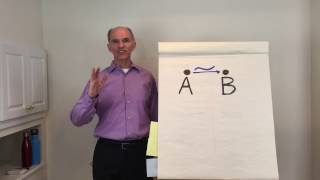
Hello and welcome to the Change Science Academy where we explore and discover alternative ways of thinking to drive measurable value in executing our personal and organization strategies. On this channel, we look at how to get from point A to point B with our projects, with our tasks or activities, and to take the straight line to be as efficient as possible to do that. But you see this little curvy line there? Yeah, sometimes it doesn't go as straight as we want it to and we take some detours deviations and distractions. But on this channel, we'll look at taking science and a little bit of art, a little bit of practice and theory to figure out how to do this better, faster, cheaper. But today, we're going to talk exactly about this line here. And this is all about being directionally correct. I'm going to call this episode Directionally Correct or Fun with Vectors. So we're going to take, you know, this path here and say, how do we make that as straight as possible for ourselves and maybe even for our teams? And so I'm going to use the term velocity for that. So the first concept that I want to talk about is velocity. And the definition of velocity is distance over time. And on this channel, when we talk about distance, we're talking about getting a task complete. That means that we've covered the distance for that task. And we do that over a certain amount of time. So when we say task complete in 10 hours, we're actually talking about the velocity of completing that task. That's the beauty of this. Now, I've mentioned before, sometimes you take some deviations here, and your team may take some deviations here. And I want to show, using a little bit of math from high school, and say, wow, how, how hard, what's the impact when you, people deviate just a little bit? So I'm going to show you, and don't get scared here folks, I'm going to show you a triangle that says if we're trying to get from point A to point B, and And that's 10 miles. And we travel that 10 miles. Now, when we start this thing, we got a team member that says, hey boss, I got it. And they head off 45 degrees off, and then they give you a call and they're 10 miles out and they say, hey, I'm not near point B. What the heck happened? And so you're getting a call and you're sitting at point B going like, okay, you know, team member, you gotta get to B. If I've done my math right, if this is 10 miles and they've traveled 10 miles, well then, you know, the distance they have to travel at that point is 7.7 miles. Now that's using Pythagorean theory. You can look it up and check my math actually. Or if they need to go back to this point to get a reference point, then C is going to look like 7.1 miles and then another 3 miles to get to B. So we're looking at this as being either they're going to travel 10 miles and another 7, 17 miles to take the 10 miles. or they're going to take almost 20 miles to get from point A to point B if they come back this way. Now, most times team members may not be 45 degrees off, but if you have a team of 10 people and each one is off by 4.5 degrees, now you're talking about 45 degrees in total as a sum. And now people are all over the place and starting to really head out, and you've got to spend all that energy to pull them together. And that's what we're going to talk about today, is how do you Start a project, get out there, and people start going all over the place. Pull them together and then check it again and then check it again so that the deviation, the vector that goes off of this, stays as consistent as possible along this vector B. We're going to talk about that by using progress checks. Progress checks are a great mechanism to go from point A to point B. What I mean by a progress check is periodically you take a point and you get your team together and you talk about what progress have you made. Now, you might have heard these as status reports or status checks or status meetings. I don't really like the term because status kind of gives you the impression that we're going to look backwards. So what did you get done this week? What did you do last week? All that kind of stuff. It's like, no, don't look backwards, look forwards. So, you can check to see where you are and then what you need to do going forward. So, after 30 years of doing consulting with large-scale change, post-merger integrations, new company launches, big system implementations in Global 500 companies, I talk— I look at a progress check as having basically 3 big components. The first component is really establish what is point B. And as you go from point A to point B, as you get closer to point B, it's going to look a lot more concrete and you'll be able to celebrate that a a little bit more at the end. In the beginning, you may not know exactly what point B looks like, and that's where that term directionally correct comes in, is how do you keep going and then pull people in on one of these vector checks and say, where is point B? Let's define that. The second piece of a good progress check is to say, are we all at the point B, this sub-point B, the interim place? Did we make the progress we thought we were going to make? And if not, what are we going to do forward-looking to pull people in to get them to that central place where they've deviated and coming back? And then the third most important part of a progress check or a vector check is to time block. Ask people, how are you going to spend your activity to time block your activities to get from, from where we are today to the next progress check? That's really important so that you know what they're going to be working on. That's a great progress check or vector check is identify point B, define it for folks, what's the rally point, are we at the progress point that we need to be, and then what's the time block, how you're going to spend your activities going forward. Now I'm going to use our Change Science Academy lab table to demonstrate this another way. And if you look down here, you see point A to point B. We've got people saying, "Yeah, boss, I know exactly where we need to go," and they set out. In the beginning, it might look okay, but then they start looking like they're going to go all over the place. Instead of letting them travel those 10 miles, here's what a good vector check looks like. In 1 week, we're going to pull people together and say, "Hey, what does point B look like for you? Are we at this point in the process where we should be, and what are your activities going forward?" Well, if we do that again in another week, look what happens. We bundle people all together again, and all of a sudden these vectors that look like they were going all over the place, they're looking like they're starting to pull together a little bit, which is great. Now imagine if we had a third one right close to that final point. Well, now that third vector check, now people are going from point A to point B, and we've got people pulled in, and we're going to get from point A to point B a lot more efficiently. I want to use another metaphor as a trail guide. I've used this metaphor a lot with teams, so feel free to use it for your teams as well. If you're a leader of a team and you've got people going out, let's just say the project is this walk through a beautiful forest or a beautiful natural area, and you're looking at mountains and beautiful flowers and meadows. All of our projects should be like that, right? And so you're walking along, but as a leader, what you're doing is right foot, step here, left foot, step here, right foot, step there, left foot, step there. And imagine doing that for 20 miles for each person that's in your team. Oh my gosh, people are going to be ready to kill you. And what also happens is that it just drains all the joy out of the task. What you're looking for is for people to learn from the experience, so you've got to give a little bit of discovery and experience. To this whole process. You don't want to micromanage folks, so you don't want to put these progress checks so tight and so deep that people feel micromanaged. On the other end of the continuum, you're walking out into the wilderness and you have a 20-mile trail marker. You have one at the beginning and 20 miles out there you got another one somewhere out there. Well, now people are terrified of getting eaten up by the wilderness. They're out there, they don't know if they're on track, they don't know where they are, they don't know what to do next. And it's an awful experience for them as well. And they don't learn much. And all they're focused on is the fear. So the art of good leadership in this, taking the science of this, is saying, how often should I do those progress checks? And how deep should I go? I've done those progress checks as daily 10-minute stand-up meetings. I've done them as a weekly meeting with my team, usually on Thursdays or Fridays, so that they can walk in, think about it over the weekend, and hit the next week really crashing through everything, it's awesome. For me personally, I always do a Sunday check for my personal goals. And then if you have big projects, you should probably have a monthly check, progress check, as well as a quarterly check, and maybe even an annual check if you have a project that's that big. But put the right number in with the right depth so you don't totally micromanage and strangle your people and pull all the joy out of it. Hopefully that helps. A project that you're working on today, put in a few progress checks and think about the point B, the rally point, am I making the progress where I need to be, and how am I going to time block my activities going forward, and then schedule the next progress check. Hope that's helpful for you, and that's our episode for today. I hope you will join us again next week. If you like this particular episode, put a comment down below. If there's other things that you do in your progress checks, I'd love to hear about those. If you have other ways of defining a progress check, that's awesome. I'd love to hear that, or a vector check. If you really like it, please like this channel, subscribe, and bring 4 or 5 other friends to next week's episode. I'll leave you with this, as I always do. I'd like you to learn continuously because that's what keeps us vibrant in the world. Then also, live your life 100% empowered. Until next time.