A marble-drop experiment showed only 6% success when the destination was undefined. The SMART framework turns vague goals into concrete ones: instead of "build a website," say "launch a customer-facing website showing product benefits by June 1st." Use action verbs like design or draft, not abstract ones like understand.
Chapters
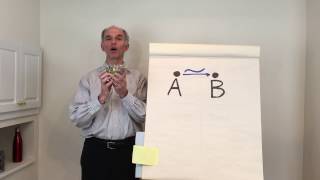
Hello and welcome to the Change Science Academy, where we explore and discover alternative ways of thinking to drive measurable value in executing our personal and organization strategies. In this channel, we look at the art and science of things. We look at the theory, but also most importantly, we look at the practice of getting from point A to point B in the fastest way possible. I know sometimes it takes a curvy route and it's never really quite straight. We're looking for tips and tricks and strategies to get us from point A to point B in the best way possible. Today's topic, I like to think of this as how to manage the never-ending task. Have you ever had a task that you thought you got it done but it keeps popping up, you kind of never get it done, and then it just keeps rolling around and everything like that? What we're looking at today is how do you create something that will actually stop, that never-ending task will actually get completed. In our Change Science Academy, what we look at, that's really defining a task being completed. I think of that as distance. If a task being completed is distance, one of the things that we're going to look at here is let's clearly define B. Now, there's an old saying that says, If you don't know where you're going, any road will do. I think of that as the Alice in Wonderland strategy. So you just kind of hope that things land in the right place. And so the Alice in Wonderland strategy means like, well, you know, we've got all this stuff, but we're not defining where B is. So if you don't know where B is, well, you know, people are going to go their own way. So I'm going to demonstrate that. So if you've been with us on the Change Science Academy, you know that I have a lab bench in front of me, and we go from point A to point B on this lab bench. And so what I'm going to do is I'm going to take this bowl of marbles, and think of this as 100 tasks. There's 100 tasks in this, but I'm not going to give these marbles any guidance. I'm not going to tell them where to go. And so I'm just going to say, hey, take your own road, and let's see what ends up B. So what I want to do is ask you, I want to give you this little test. What percent— there's 100 marbles in here— how many of these marbles will go into, go from point A to point B on our lab bench? So give it a shot, think about that, and then here we go. Here's the test. Ready? Okay, I hope you found that amusing. If I look down there, there's 1, 2, 3, 4, 5, 6, 6 marbles that landed of the 100 using the Alice in Wonderland strategy that got there. So we have a 6% success strategy using the Alice in Wonderland strategy to get from point A to point B. Yeah, we want to be a little bit better with our predictable results than that, don't we? So what we're going to do today is we're going to look at defining B a little bit better so these marbles know where to go from point A to point B. And we're going to do that— the first strategy I'm going to use is called SMART. Now you might have heard of SMART goals, and you can go out and search SMART goals, and there's tons of great tools out there, so I really suggest you do that. I'm going to walk through those today just to go through SMART. If you look at B, how do we go from point A to point B in a SMART way? SMART stands for being specific, measurable, attainment, relevant, and time-based. SMART. I want you to right now write down an activity that you've got, and I want you to use these criteria. I'll walk through an example. Of revising your goal, your point B, so that it becomes more attainable. I'm going to put out there, my boss came to me and said, "I need to build a website." Build a website is our goal. Let's be more specific. A website could be for customers, it can be for internal employees, it could be for the public domain. Let's be more specific. Let's make it a customer website. So now I'm going to build a customer website. But what will that website do? There's a lot of things it could do if it's customer-facing. So let's be more specific. Let's say it's a customer website where people can, the customers can see our products. Okay, so now it's S and M, you know, it's specific. Now let's look at measurable and attainable. Well, building a website, we could build and build and build a website and a customer may never see it. So let's change the verb. Instead of build a website, let's talk about launching a customer-facing website where customers can see our products. Now I've got these 3. And now we look at and say, well, what could make that more relevant of a point B to get to? So let's launch a customer-facing website where customers can see the benefits of our products. Now it becomes more relevant. And finally, to make it SMART, to get the T part here, let's do that by June 1st. So if we go through build a website and converting it to a SMART goal, we look at it as build, launch a customer-facing website which shows the product benefits by June 1st. So that's now a SMART goal, and now all those marbles know a little bit better about what point B looks like instead of build a website. Anytime you find yourself wandering around, meandering, and not sure, go back to the SMART objectives and ask yourself, is it specific, measurable, is it attainable, relevant, and is it time-based? All right, so now we're looking at that. One great place to look at goal setting is goal setting theory. Ed Locke and Gary Latham, you can look up their names again and search those. They've done tons of great academic studies, really deep, good stuff. On goal setting theory. So if you want to learn more, go there. But I want to come back to attainable and relevant and measurable. In my 30 years of consulting, this is where people get stuck on really drafting good SMART goals or Point Bs. And so I want to give you a little bit of background on that. I'll let you know, I did my PhD work in organization behavior. I'm a very behavior-based guy. It's not so much what's in your head, it's what you do. I'm going to go to how do you write objectives, defining point B, and I'm going to use action verbs. I'm going to share with you some of my go-to action verbs that I've used in the past for drafting these goals. If I look at my action verbs, things like design, draft, select, revise, conduct. All of those things, when you draft an action item like that or define Point B like that, you're defining a behavioral outcome. So it's a lot easier to say, "Oh, that's attainable or measurable or observable." Some of the verbs that I don't like to use when I'm doing work planning this way are things like know and understand. When I talk about knowing something, well, I want to know how all there is about calculus. Well, I mean, that's a bottomless pit. So I might want to change know into I want to draft a research paper on topic A. Or if I need to understand something, I need to understand car mechanics. Well, that's a big ask. I mean, that's a bottomless pit too. But if you say, well, I want to know I want to be able to change a tire. I want to be able to diagnose the knocking in my engine. Those are very specific things that you can learn, and you can learn all about those things. Or state the benefits of a product versus I want to know or understand the benefits of a product. Change these action verbs into behavioral or action verbs. Those are my 2 tips for today. If you have a hard time defining what your point B looks like, try these 2 tips. Make them SMART goals and use action verbs to look at them in a behavioral way. That's our episode for today to define point B. As we see over here, point B, if we define that really well, then we're not going to take the Alice in Wonderland strategy of hoping all the marbles get into point B, which we saw was a 6% success rate. We want a higher success rate. So if you define what B looks like, you have a much better chance of getting from point A to point B. If you like this episode, that's great. And if you could, make some comments below. Like this channel, and then subscribe to this channel. Even better, find 4 or 5 people to come over and visit this channel so that we can take a look and, and have a place of great collaboration here. Well, I'll leave you with this: learn continuously and live your life 100% empowered. Until next time.