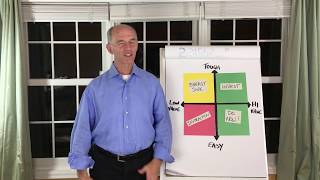
A2B Academy presents the Ease and Value Matrix, a 2x2 grid that sorts tasks by how hard they are and how much they matter. Do the easy, high-value stuff first. Skip the distractions. The real payoff comes from the hard, high-value work that needs planning and help, like when a broken axle in South Dakota forced a better decision.
Chapters
Hello and welcome to the A2B Academy channel, where we explore and discover alternative ways of thinking to drive measurable value in our personal and organization strategies. In this channel, we go from point A, where you are right now, to point B. And, you know, in a conceptual model, that's a straight line, and that sounds good in concept, but actually what happens is we get distracted, other priorities come in, so So we take kind of a wavy line, so we don't get to point B directly. But the whole point of this channel is to try to iron out how wavy that is, to make it as straight as possible. We talk about tips and strategies, we talk about science and art and theories and practice and habits, but all those things are trying to get us from point A to point B as fast as possible, less risk, high benefit, high probability of success. Today, we're going to talk a little bit about Point B. There's a lot of different ways to look at what is Point B. Point B could be an aspiration that you have, it could be a dream, it could be a project that you need to get done, or it could be a problem, just a problem that's in front of you that you have to solve. You could have all sorts of Point Bs, and so you could be chasing all different kinds of things and it'll get you really distracted. So today we're going to talk about how to categorize those Point Bs into 4 different types. And when you do that, you'll be able to prioritize, you'll be able to succeed with a higher probability. Now, before I jump to the framework itself, I want you to think of maybe 2 or 3 Point Bs that you have in front of you right now. Maybe that you have to do over the weekend or next week, But think about 2 or 3 Point Bs that you have, and then when we bring up the framework, I want you to put those on the framework where you think they land. Alright, so here we go, into the framework. Now, if you think about a Point B, I'm going to start with the y-axis. Those Point Bs, some of them are really easy, some of them are really tough, and in some ways this could be almost a measure of complexity or ease of implementation. But sometimes if it's really simple, then those are easy things to do. If they're really complex, lots of moving parts, maybe it's 2 years out of a goal, maybe it's skills you don't have, maybe you have a team of 20 people working on something, but maybe those are the tougher ones. And then the x-axis is here's the low-value things and then there's a high-value things. Those are the axes that we're going to talk about in putting your point B's on a grid. The first part of the grid that I want to talk about are the things that are of low value and easy to do. I'm going to call those distractions. Those are just purely things that distract you from the high value things that you need to do. Distractions could be other priorities, stuff that's fun to do but not necessarily strategic for you to do. And I can tell you, one of the things that happens for me all the time is when I have a really hard thing to do, my room gets really clean. Why is that? Well, because it's an easy distraction. I have to pick up all the things, I have to get everything in order before I do the hard thing. And that's okay to a certain extent, but if that's the thing that just consumes me, and keeps me away from doing the high priority things, well then it's just a pure distraction. So these are the easy, low value things that distract you from getting the things done that you need to. I'm going to stay on the easy side of our continuum here and just go, there's some things that are really easy and high value. And I'm going to call those "do now." If they're easy, what are you waiting for? Just put it on your to-do list Pick it up, just do that. As you might think, you know, big pile of rocks you have to move, but these are the high-value, easy rocks to move. Pick up a rock and move it and put it to the new pile. So this is just the easy stuff to do, do now. The third quadrant I want to talk about are the things that are of low value that are really tough. And these, I'm going to call those energy sinks. Black holes. They're things that suck up the energy and resources. Sometimes you might get stuck in something that it's a low value, but it's really hard to do. Sometimes our aspirations are bigger than what we can complete. Maybe the expectations are too high that we'll never make it. These things just end up becoming that energy sink. I think of that as like this rock that you just keep throwing yourself against. It's just hard to do and and just can't get it over the hump. And so some of these things might be an energy sink, but it might be wise to think about how can I get more value out of that to move that into the upper right-hand quadrant so that it's not just low-value, really hard stuff, but how do you get more value out of those things? Which moves us to the last quadrant here. The last quadrant are the things that you should, that are really tough, but you have a high value. And what I would say is invest in those. And what I mean by invest, invest your resources, invest your precious time, invest in terms of planning those out, creating a plan, a project plan for that. How are you going to get the effort for that? How are you going to get the support you need to get those things done? Usually, if they're in the upper right-hand quadrant, you can't get those things done yourself. So you probably have to ask for help, which I know for me is a really hard thing to do. So in the upper right-hand quadrant, how do you invest in resources, invest time, invest in support, invest in the right experience to get those things done? So now I'm going to come back to the 2 or 3 things that you wrote down, your point B's that you wrote down. Where do they fall on the grid? Was it a distraction? Is it an energy sink? Is it a do now? Or is it one of those things that you need to invest? And in this channel, for the A2B Academy channel, we actually focus almost exclusively on the upper right-hand quadrant. Those are the things that may be getting a few tips, a few tricks, a few strategies. That's the hard stuff to get done, but that's also the things that are most transformative. Things that you build and quantum leap your world in because you get that much more value out of those things that you invest in. So that's what we're going to focus on in this channel, in that, in that upper right-hand quadrant. Now, I'm going to tell you a little story about this, about a journey that I took to get from A to B. And it was a long time ago, almost more than 20 years ago, or about 20 years ago, and I was in South Dakota, and I was traveling in South Dakota on Pine Ridge Indian Reservation, and I was on a dirt road dirt road in the back hills. It was about 101 degrees. It was really hot. And all of a sudden, you know, we hit a pothole and, you know, the car just came to a screeching halt. I mean, it literally just came to a screeching halt. And I was like, "Wow, what's going on?" And I looked underneath and, you know, I didn't blow a tire or anything. And I looked underneath, but actually what I'd done is broke the axle. So I broke the axle on a back road. And now this was a 19— like a 1988 Plymouth Voyager, a minivan, and the window was just leaking when it rained and it was rusty and all this kind of stuff. But here I was on a back road in Pine Ridge Reservation with a broken car. So we had to go find a phone and we phoned up AAA. So I used my AAA and AAA luckily came way out there and then towed me to the nearest town, which was Kadoka, Kadoka, South Dakota, if you've ever been there. And so we were in Kadoka, South Dakota, and I called my wife because she wasn't there with me, and I said, you know, hey, the car broke down. I found out it's gonna cost $1,800 after I tow it to Rapid City. And she said no. I'm like, uh, what do you mean no? And she goes, no, we're not getting it repaired. I'm like, uh, but I'm out here with 3 weeks of camping gear. I got all the food. I got all this stuff out here. "Am I gonna get home?" And she said, "I don't know, but don't bring the car home." And I was like, "Okay." Now, my wife's not unreasonable. This car was horrible. But you know, as a guy, you know, have you ever had that favorite pair of sneakers that you just don't know how to get rid of? This was one of those things. This was like the favorite car that I just couldn't get rid of. And it was time to go, but I just didn't know that at the time. So, you know, I'm like, "Okay." I don't know how I'm going to figure this out. So this is a story of literally, I have to get from point A to home, point B. And so, you know, and when I look at this grid, at that moment in time, I thought that this was really hard, really tough, and the value of getting home, I don't know, really high because I wanted to get home. So I had to figure that out. Now, you know, I had a minivan. Now, if you think about a minivan full of stuff, I had to go back to camp and I have all my stuff and I have to ask for help, which again, I mentioned, really hard for me to do because I don't like to be that vulnerable. I was like, "Okay, folks, I have to get home." So I asked around and somebody said, "Oh, I'll help you." So this person that said they'd help me had a Toyota Celica. Now, if you know brands of cars, a Toyota Celica is really tiny. It was a little sports car. And she had all her stuff, and so I had all my stuff. And so then I had all this stuff and I was like, "Wow, what am I gonna do now?" And so part of my strategy to look at this is I had to figure out what was the important stuff to bring home, because I needed to get home, she needed to get home with all her stuff, and then I had to fit all the rest of my stuff in a little space in the car. So what actually happened is I had to give away a lot of stuff, but I had to figure out what was most important for me to save. And so that was an experience indeed of getting from point A to point B. And I got home and the reward for that was I got to go out and buy a brand new 1999 Ford Explorer, red, it was awesome. And so I bought this car, but think about it now, instead of having an old beat-up car, now I had a Ford Explorer which actually could ride on the prairie, it could be on dirt roads and stuff. So I actually upgraded in the whole experience. I had to get from point A to point B and I had to invest in an A to B strategy that I could win in and I did in the end. So I encourage you to think about going back to your point B's, where did you land in this and these in the upper right-hand quadrant just take more intention, it's more complexity to get from point A to point B and in this channel, the A to B Academy channel, we talk about those tips and those tricks, those strategies to help you get from point A to point B or get home. Yeah, that's sometimes what you have to do. So, um, that's where we are. I hope this was helpful for you today. If you like this channel, if you like this episode, like the episode, subscribe to the channel, invite a few more people over to view this and subscribe to the channel. And until next time, Learn continuously and engage authentically with everyone around you. Until next time.
More from Patrick

Unlock Your Unique Energy: The Ripple Effect Explained! #telepathy #telepathicconnection #purpose

How Telepathy Works: Tapping Into Energy Bigger Than Yourself with Patrick Mosher (Wisdom4Humanity)

Telepathy: Unlocking Mind to Mind Communication Explained #telepathy #telepathiccommunication #love

Unlock Your True Self: Connect to Infinity #telepathy #telepathicconnection #purpose #love #mission

True Self, Soul, and the Sense of Infinity - Patrick Mosher - Wisdom4Humanity #soul #trueself #love

Unlock Telepathic Powers: Your Guide to Intentions #telepathy #telepathiccommunication #purpose

Unlock Telepathy: Release Distractions, Embrace Love #telepathy #telepathychallenge #wisdom4humanity

Serendipity & Goldfinches: A Spiritual Moment Shared #telepathicconnection #spiritualjourney #love

Unlock Your Telepathic Power: Tap Into Larger Energy #patrickmosher #wisdom4humanity #presence #love

Build Telepathic Capability in 6 Simple Steps - Patrick Mosher, Wisdom4Humanity #leadership #love

3 Words Defining Today's World & Personal Rhythm #worldpulse #today #humanity #purpose #vision #love