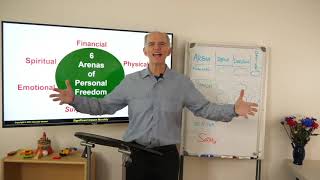
Patrick Mosher argues that technology deepens loneliness and depression by constraining how we express emotion. He introduced a "feelings check" at the end of a hospital team meeting where people shared overwhelm and fear, which deepened trust. Journaling and setting emotional objectives for meetings are practical ways to build what he calls emotional freedom.
Chapters
this one. We're going to do emotional freedom. So, let's talk about emotional personal freedom. And what's amazing to me in our world today, there's more depression and feelings of loneliness than ever before. Which is kind of weird because Technologically speaking, we're more connected than ever before. My view is that we're just using the technologies incorrectly. Here's— we're using a technology right here, right now. You know, 15 years ago, this was not possible for us to do this today together this way, this easily. And so this is a way to stay connected in this technology. So, but yet connectedness and loneliness and depression are you know, the connectedness is going away and people are feeling lonely. And so when I think about that, people are feeling emotionally constrained. So what does emotional freedom mean? Emotional freedom. And I have to say, emotional freedom of all of these is the toughest one for me. Here I'm being vulnerable and present with you. Emotional freedom is tough for me and just a little bit, it started— well, it didn't start, but when I was a kid, I was a really sensitive child, really, really sensitive to people's feelings and emotions. And so very early on, I opened up my heart and I got hurt a lot. And so what happens with that is I got hurt a lot and then I built up these barriers. And so emotional freedom is tough for me, not just because people think that I'm a very emotional guy, it's great, I'm very compassionate, which is great, but to really let go of my vulnerable self and is really tough for me. So this is one for me that I'm working on, particularly to get that emotional freedom. So what is— what does emotional freedom mean? What does emotional freedom mean? And so go ahead and journal. What does emotional freedom mean? How would you define it? How would you define emotional freedom? Yeah, how do you define emotional freedom? What are the minimum requirements for that? What are your minimum requirements for emotional freedom? Hmm, so good. I kind of think of it this way: is there a group of people— you know, when I talked about psychological freedom, I talked about a place of people where I can express my thoughts and When I think about emotional freedom, I think about a place where I can express my emotions freely, my genuine emotions, how I'm feeling. Maybe it's a place that— maybe that's your definition, is people that I can share myself emotionally, what I really feel. Maybe it's journaling, you know, maybe that's a place where you feel that emotional freedom. I'll share with you a little story. I was working at a hospital here in town actually on a project, and it was a patient-focused care project, and things were hard. We had 2 nurses and a lab technician and a transporter. We had, you know, all these people on the project team, and it was just hard. I mean, you know, we're doing a major project and There's a lot of moving parts. I remember we were having a status meeting and the lead— I wasn't leading this project, I was a manager at the time, but an associate partner came in and he came in and said, "Okay, let's talk about progress today. How are you doing? How are we doing here? How are we doing here? How are we doing here?" We got through all that, we raised the issues and everything, and he said, "Anything else?" And I looked over at— her name was Diane. I looked over at Diane and I said, "Diane, how are you feeling?" You could hear a pin drop in the room. And she said, "I'm actually feeling really overwhelmed with everything we're trying to do. I feel like I'm failing." And then she started crying. And then, you know, we were in a hospital, so, you know, this is, you know, these people in this place is very nurturing. So it was like, oh, you know, and they were just like, you know, I feel the same way. And then I said, well, Joanne, how are you feeling? She's like, well, I'm feeling okay, but I just feel like we're behind on this thing and I just feel like I can't catch up. Well, then Mike, how are you feeling? And Mary Beth, how are you feeling? And Emily, how are you feeling? We went around and everybody like expressed their feelings, and it was just a beautiful end to this corporate status meeting that we had. And then, you know, there were tears, there was happiness, there was joy, but we bonded so much. And at the end of the meeting, uh, somebody said, you know, let's do this at every one of our meetings every week. So at the end of every meeting every week, we had a feeling section And everybody expressed themselves. Oh, it's bringing tears to my eyes because this was one of the moments in my career where I felt the most genuine self, that I introduced something courageous, something deviant, and it worked. And people felt like this was an oasis, an emotional oasis. They felt an emotional freedom. At the end of the project— oh, I should have had this here because I saved it— but at the end of the project, they gave me a feelings book. A journal of feelings. That was so good. And so that's, that's how I would describe— that's a mini story about where I could feel an emotional freedom. So what's a discipline to create for developing that emotional freedom? What's a discipline that you can create? People to interact with, journaling, But how do you create that place that you express that emotional freedom? Maybe it's a talk with your significant other. Whatever it is, where do you feel that emotional freedom? And how do you create a discipline around that so that you can have that every week or every month? Oh, that's so important. For me, one of the things that I do Oh, and you should be writing right now, so journal these things down. What's your discipline for emotional freedom? I'm gonna share with you one of mine. For every one of these, this curriculum that I develop, I have learning objectives and I also have emotional objectives. I proactively think about at the end or during this session and at the end of the session, How do I— what's my objective for how you feel during this? And I want you to feel happier. I want you to feel energized. I want you to feel fulfilled. I want you to feel stretched. These are feelings of— but I want you to feel lighter too. It's like, yeah, let's go, let's do this. Let me make my significant impact. These are my emotional objectives. And so part of my emotional freedom is I draft emotional objectives for all my major teachings and even interactions with significant people. How do I want them to feel at the end of this? This is a level up, folks. This is a level of mastery. If you're in corporate America and you're actually thinking about, "How do I want people to feel at the end of this meeting?" Oh man, the impact you have just goes exponential on you. Okay, so that's emotional freedom of discipline. So good, so good, so good. Okay, so one of the things that is my goal is to turn up the emotional heat when I do my blog stories. I videotape, videotape, wow, that's an old term. I shoot all my blog posts, and I'm really trying to level up my emotion in those. Okay, so then, what is one, put those in the chat, one emotional discipline or a practice that you have that you can share with the rest of the group? And then what does emotional freedom deliver to you? What's it deliver to you? It probably delivers less stress. It probably— you get to let go of steam. It provides some relief. You feel more vulnerable, safe. You feel present, you feel connected. Man, if we had this emotional freedom, depression wouldn't be so big. People wouldn't feel so anxious. Anxiety is through the roof these days, and yet we have more freedom than any ever before, for any generation before us. But maybe that freedom is creating an angst, an anxiety And part of that is to be present and have this emotional— find these emotional oases of freedom that we have with each other. So powerful. And in the end, the most important part for me of what this delivers, emotional freedom, is unity. We feel a collective consciousness. We feel our humanity with each other. We feel connected. Oh, that's so important with that emotional freedom.