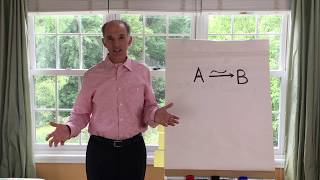
When someone actively blocks your progress, six strategies help: adopt a constructive mindset, build trust, read their real concern (time, ego, money, or disagreement), assess how serious it is, create psychological safety, and use curiosity to find overlapping interests instead of fighting over who wins.
Chapters
Hello and welcome to the A2B Academy channel, where we explore and discover alternative ways of thinking to drive measurable value in executing our personal and/or our organization strategies. In this channel, we look at where you are at point A, and we look at how do you get to point B in as straight a line as possible. Point B could be getting a project completed, could be aspirations that you have, But as we know, it's never really a straight line like this. It usually takes these twists and turns. So the whole point of this channel is to provide strategies to iron out the point A to point B line and make that as straight as possible. Today's topic is about resistance, and we're going to talk about active resistance today. This is kind of like the in-your-face active resistance. You might even call it conflict. We're not going to talk about your internal resistance that you have for something, or your passive resistance where you can't quite see it. This is like resistance that pops up and it's in your face. We're going to talk about that today and hopefully give you 6 strategies that will help you face the next active resistance that you see. I'm going to start with a story. For 30 years, I was a consultant in big consulting and we consulted large corporations, Fortune 500, Global 1000. And in this particular story, I was working on a project in Chicago with the office of the CIO. And the CIO, they were going from one platform to another. And as we were helping them migrate that, we had a technology team, we had a process team, And then we had my change management team. And it seemed like, you know, I offered up this suggestion and it was ignored, and I offered up this suggestion and it was ignored. And, you know, all the people were like, "Yeah, that's good, good idea, Patrick," but then nothing got implemented. And I found out that the CIO, Dave, was just rejecting all the ideas. And so I was there for about a month, and I told the partner I was working with, "Look, I'm actually adding no value here as long as they don't take any of our suggestions." Maybe I should just go home, but before I do that, you know, let's talk to the CIO. Can you score a meeting with him? And he said yes. So the three of us sat down in a meeting and as we sat there, you know, Dave walked in and he was late and he said, you know, gee, why are we having this meeting? I don't understand why we're having this meeting with the change management team. And so I said, look, we're not adding any value for you because you're not taking any suggestions, you know, and so we could go home, and, you know, so I wanted to have this meeting to have one last-ditch effort to find out what your concerns are. And he looked at me, and he got really angry. He said, "Look, if you had suggested anything, anything that would work in our culture that would help our people get here from there, then I would be all for it." And then I responded back, and I said, "Well, Dave, what do you think would work?" What are your great ideas? And then he said, well, it would be this and this and this and this and this. So he listed out 5 things. By the way, 4 of those were things that I already put on the table to him. The 5th one was kind of innovative and different. But 4 out of the 5 ideas, 80% of what he talked about, were things that our team had already suggested. And then I took a different mindset and I turned the conversation by Coming back to him calmly and saying, "You know, Dave, whatever you do, for the sake of your people, please do those things. Our team can help you with that, our team can go away, but whatever you do, for the sake of your people, please do those things." And he looked at me stunned and he was like, "Wow, what a difference that made." And, you know, so we engaged in conversation, our team stayed on, we helped him with these initiatives. But it really shifted the relationship in a good way. Today, I want to talk about this resistance. The definition of resistance, as we just heard in the story, is refusing to accept or comply with something or attempting to prevent something by action or argument. Dave certainly was arguing against all the solutions that we put on the table. It had to be his idea, which is great. What I really love about the term resistance, it actually is a scientific term. And it's the degree to which a substance or device opposes the passage of an electric current. So we're talking about electric current here. And then the next part of the definition is great, which causes energy dissipation. So when you have resistance in a wire, it creates an energy dissipation, meaning it heats up. You know, we've kind of seen that sometimes with some of our wires that get hot. And so, you know, that energy dissipation also works for our thing because when we look at our channel, if you see resistance getting from point A to point B, doesn't that dissipate your energy? It makes you put energy in places that you maybe didn't want to. It makes things heat up and people get emotional about things. So part of this is, how do we deal with that act of resistance, that conflict, so we dissipate as little energy as possible and get us focused? So that's what we're going to talk about today. I have 6 strategies that I'm going to present to you today that talk about how do you deal with that, or how have I done that in the past successfully. So let's just jump to those 6 things right now. I'm going to bring those up one at a time. One thing I love about resistance, this is the electrical term for resistance and it's really good for our A to B strategy, so I like the little graphic here. 6 resistance strategies. The very first one that I'm going to bring up right here is all about mindset. What is your mindset around resistance? I'm going to jump to another page here too to talk about what are the 3 different mindsets that you can have around resistance. The first one is, especially in active resistance, active resistance and conflict is normal. Don't treat it as something abnormal. Treat it as like, "Hey, it's going to come up." If you anticipate or you expect it's going to happen at some point in the process, when it comes up, you won't be as surprised. It's a normal part of the process. The second mindset is that there's always Solution Z. Oftentimes with conflict, there's A versus B, and then you're fighting how to get somewhere in between, and there's no common ground. I don't believe that's true. If you break a couple of assumptions on either side, you start seeing how they can merge. And there's always, I believe that there's always, always, always a Solution Z because the number of possibilities in a situation is as infinite as the stars. So always believe that there's a Solution Z. And the last part of a great mindset is to have true curiosity. And what I mean by true curiosity, curiosity is a good thing, but true curiosity has no expectations. So you walk into the conversation, you have no expectation about what you're going to say next, what they're going to say next, if they're going to resist here. Here's the 16 things that I'm going to say in the next 5 minutes to overcome the conflict that's here. Part of true curiosity is really listening, actively listening to what the person's saying and listening for their concerns, listening for what are they really trying to say. So this is a positive mindset to create. When you get into that active resistance point of view. Alright, so now going back to the original 6 strategies, first thing is mindset and then the second thing is trust. Let me give you what I do when I see trust, when I see active resistance coming at me or conflict. It's almost like in martial arts, they might call it a martial situation. Where there's somebody coming at you that has a violent intent. So part of this is to say, what I do is I go, I take a deep breath, and then I ask for help from the universe. I just go, "Hey, universe, help me out here." And then I tell myself, "I got this." Give myself a little bit of a confidence boost. And the last, the fourth piece of this is to trust that the very next thing that happens is perfect. It may not be perfect for you, it may not be perfect for the other person, but whatever comes next is going to be perfect for the situation because you put yourself to serve the moment. In that, the second part of this is to really trust that you're in a situation and it's going to be okay. The third strategy of resistance is intent. And what I mean by that is read the person's intent. Is their intent that, you know, when they come at you with that conflict, is it that they disagree with that point of view? Do they have another point of view that they're trying to push? Do they see conflict with what you're trying to put out there? And I kind of put conflict in time, ego, money. Have you put something that's going to take away their time or add more time to them? Or is it something that fights their ego, their status, their position of power? Or is it something that they're going to have to actually spend more money on, so it's going to take more resources for them? So what's their intent? Or are they just a disagreeable person? And I've faced a couple of those too. Sometimes people are just disagreeable just to get a rise out of people because they like to see people get emotional. So part of this is read the intent because Honestly, if you don't read this intent right, what you're going to do is you're going to go down the wrong branch, the wrong path of navigating that conflict situation, that act of resistance. So reading the intent correctly, if they're just resisting because they want to make the solution better and you see it as conflict, you're going to act as if it's conflict and then you're going to get into a conflict versus, "Hey, they were just using strong words to say and say, "I don't see it this way. I see it— couldn't that be better if we did this?" So that's the third strategy. The fourth strategy for looking at active resistance is severity. Just because somebody's highly emotional doesn't mean that it's a highly severe moment. And I look at severity, you know, as almost on a scale. Can this person actually stop this initiative? Or is this just a minor annoyance that has a loud bark and maybe not a big bite? So part of this is assessing the severity of the situation. And I honestly, if I'm in that mode, in the situation, and I'm assessing severity, I'm actually a little detached from it so that I don't get caught in the emotion of it. So sometimes pulling yourself away from the emotion of the situation will help you look at how severe is this? On a 1 to 10 scale. And then the fifth strategy for resistance is about creating a container. And what I mean by that is create a safe haven for that resistance to happen. And so, you know, what I like to do with that is when somebody, when they brought in, you know, heavy conflict or active resistance, Sometimes a great first response is, "Wow, thank you. Thank you for the courage to bring up that point of view. Sometimes it's not always easy to do that, so I'm glad that you feel safe enough to do that here." That oftentimes is a great reminder for people that this is an environment where you can bring up different points of views. Because again, you know, in some ways, different points of view will make your solution better. Maybe that's the way to get to Z. Better. What is the container and how do you create that? That's all about creating that safe environment where you say, "Hey, thank you for putting your point of view on the table." The sixth strategy for active resistance is to understand, seek to understand. That goes back to that true curiosity. When you seek to understand, you're actually looking for what are the underlying interests that this person is looking for? What are they trying to protect? And I think about that in that seeking to understand, there's two negotiation methods that people talk about. One is a distributive bargaining model and the other one is an integrative bargaining model. And in those two models, you have different points of view and let me talk about those for a second. In a distributive model, you have A and they have B and in this Venn diagram, there's no point of intersection. So in that mode, somebody's got to compromise, or both have to compromise to get to the middle. And that creates a conflict that's unresolvable unless somebody gives in. My view that there's always a Z is that in integrative bargaining, there's always an overlap. But what that requires is not to take a position point of view, A versus B, but it makes you seek to understand. How do you understand What are you trying to protect? What's your time, money, or ego, things that you're trying to protect as well or to hoard or to save? Part of that is that when you understand that way, you're creating that safe environment for a dialogue to happen. In that authentic exchange, something good is going to happen. I believe that will happen and that's how most of my career went, is having those authentic exchanges where Z was found. Here's the challenge that I have for you. I want you to think about a time of conflict that you had, any time over the last 6 months or a year, and I want you to sit back and think, "Well, did I have a positive mindset in that situation? Did I trust that the universe was perfect and what was going to happen was good?" Did I take that situation and role model good constructive behaviors? Did I show good intent in terms of what I was doing, but also did I accurately read the intent of the other person? Did I put it in the right category? Did I assess the severity, or did I get caught up in the emotion of it and then responded emotionally as well? Did I offer some gratitude and thanks for the container that the person, you know, or create a container for that person to say, "Yeah, this is a different point of view." Did you create that container? Did you seek to understand? I'd really ask that you think about what was my response? Actually rate yourself on a 1 to 10 scale. How did I do? 1 versus I was awful, man. I just engaged the emotion. I engaged the conflict, I fought for A to B, I might have won, but it didn't end up in a very good place. Or 10, I went through that and it was beautifully navigated. Rate yourself and then start thinking about what could I have done differently, maybe, to navigate that resistance differently or that conflict differently. I hope today was successful for you. I hope today you got a couple of great ideas. Around the 6 active resistance strategies, and I really hope that you put some of those things in play over the next week or two, whenever that active resistance comes up for you again. If you do have that happen for you, please write down in the comments section below what you thought about today's session, but also some situations where maybe you did have something happen and you did something better, or over the next few weeks, go ahead and put it in the comments section. Now, if you like today's episode, please like this episode, subscribe to the channel, find 5 or 6 other people to join us here, and collaborate in the comments section down below. I'd really like to have lots more collaboration in the comments section down below. And I'll leave you with this, as I always do: learn continuously and live your life 100% empowered. Until next time.
More from Patrick

Unlock Your Unique Energy: The Ripple Effect Explained! #telepathy #telepathicconnection #purpose

How Telepathy Works: Tapping Into Energy Bigger Than Yourself with Patrick Mosher (Wisdom4Humanity)

Telepathy: Unlocking Mind to Mind Communication Explained #telepathy #telepathiccommunication #love

Unlock Your True Self: Connect to Infinity #telepathy #telepathicconnection #purpose #love #mission

True Self, Soul, and the Sense of Infinity - Patrick Mosher - Wisdom4Humanity #soul #trueself #love

Unlock Telepathic Powers: Your Guide to Intentions #telepathy #telepathiccommunication #purpose

Unlock Telepathy: Release Distractions, Embrace Love #telepathy #telepathychallenge #wisdom4humanity

Serendipity & Goldfinches: A Spiritual Moment Shared #telepathicconnection #spiritualjourney #love

Unlock Your Telepathic Power: Tap Into Larger Energy #patrickmosher #wisdom4humanity #presence #love

Build Telepathic Capability in 6 Simple Steps - Patrick Mosher, Wisdom4Humanity #leadership #love

3 Words Defining Today's World & Personal Rhythm #worldpulse #today #humanity #purpose #vision #love